
BuddhistCatholicContemplativeEvangelicalGeneral ChristianHinduJewishLatter-day SaintMuslimNew VisionsProgressive Christian
Beliefs
- Buddhist
- Catholic
- Contemplative
- Evangelical
- General Christian
- Hindu
- Jewish
- Latter-day Saint
- More Voices
- Muslim
- New Visions
- Pagan
- Progressive Christian
Topics
- Religion News
- Food and Religion
- Sports and Religion
- Religious Art
- Religious Music and Entertainment
- Religious Events
- History and Religion
- Style and Religion
- Politics and Religion
- Women in Religion
- Recreation Outdoors and Religion
- Business Finance and Religion
- Careers Workplace and Religion
- Education and Religion
- Family Parenting and Religion
- Health Fitness and Religion
- Home and Religion
- Relationships and Religion
- Technology and Religion
- Travel and Religion
Columnists
- Buddhist Columnists
- Business Finance and Religion Columnists
- Careers Workplace and Religion Columnists
- Catholic Columnists
- Contemplative Columnists
- Education and Religion Columnists
- Evangelists Columnists
- Family Parenting and Religion Columnists
- General Christian Columnists
- Health Fitness and Religion Columnists
- Hindu Columnists
- History and Religion Columnists
- Home and Religion Columnists
- Jewish Columnists
- More Voices Columnists
- Latter Day Columnists
- Muslim Columnists
- New Visions Columnists
- Nonreligious Columnists
- Pagan Columnists
- Politics and Religion Columnists
- Progressive Columnists
- Recreation Outdoors and Religion Columnists
- Relationships and Religion Columnists
- Religion News Columnists
- Religious Art Columnists
- Religious Events Columnists
- Religious Music and Entertainment Columnists
- Sports and Religion Columnists
- Style and Religion Columnists
- Technology and Religion Columnists
- Travel and Religion Columnists
- Women in Religion Columnists
Resource Library
- 2026 Calendar
- Library of World Religions
- The 100 Most Holy Places on Earth
- Patheos Answers
- Podcasts
- Videos
- Faith Leaders Database
- Anglican Episcopalian
- Bahai
- Baptist
- Buddhism
- Christianity
- Confucianism
- Eastern Orthodoxy
- Hinduism
- Holiness and Pentecostal
- ISKCON
- Islam
- Judaism
- Lutheran
- Methodist
- The Church of Jesus Christ of Latter-day Saints
- New Age
- Paganism
- Presbytarian and Reformed
- Protestantism
- Religion Behind the Scenes
- Roman Catholic
- Scientology
- Shia Islam
- Sikhism
- Sufism
- Sunni Islam
- Taoism
- Zen
- See all religions
Research Tools
 Ad-Free & Subscriber Log-In Subscription Support
Ad-Free & Subscriber Log-In Subscription Support
Follow Patheos 

- Trending:
- Forgiveness
- |
- Marriage
- |
- Consciousness
- |
- Death Penalty
- |
- Election
- |
- Halloween
 Mark D. Roberts
-
Publications
-
Series
- Advent Devotional Guide: Preparing for the Coming of Christ
- Ancient Ephesus and the New Testament
- Ash Wednesday: What Is Ash Wednesday? How Do We Observe It? Why Should We?
- Christmas According to Dickens
- Christmas Pictures
- Christopher Hitchens: My Response to god is not Great
- Christopher Hitchens: Our Three-Hour Debate
- Do Demons Exist?
- God at Work: A Review of the Book by David Miller
- God's Guidance for Christians in Conflict
- Handel's Messiah: An Unexpected Easter Masterpiece
- Harvard Ironies
- How Does God Guide Us?
- How Lent Can Make a Difference in Your Relationship with God
- Illegal Immigration: Seeking a Christian Perspective
- Introduction to Eastertide: The Season of Easter
- Introduction to the Christian Year
- Liturgical Year Chart
- Photos of Jerusalem
- Praying in the Name of Jesus
- Privacy and God
- Redeemer Presbyterian Church: Why Is It Thriving?
- Seeking the Peace of Christ: Christianity and Peacemaking
- Thanksgiving: Not Just a Day, But a Season
- The Birth of Jesus: Hype or History?
- The Colors of the Christian Year – Part of Series: Introduction to the Christian Year
- The End of the Presbyterian Church (U.S.A.)?
- The End of the Presbyterian Church (U.S.A.)? Revisited
- The Mission of God and the Missional Church
- The Piazza del Popolo in Rome and Its Augustan Obelisk
- The Seven Last Words of Christ: Reflections for Holy Week
- The Stations of the Cross: A Devotional Guide for Lent and Holy Week
- Thin Places
- Unmasking the Jesus Seminar
- VBS Fun: Vacation Bible School Skits
- Was Jesus Divine?
- Was Jesus Married? A Careful Look at the Real Evidence
- What is a Church?
- What is a Successful Worship Leader?
- What is Advent? An Introduction to Advent
- What is Pentecost? Why Does It Matter?
- What Language Did Jesus Speak? Why Does It Matter?
- What To Do If Someone Sins Against You: The Teaching of Jesus
- What Was the Message of Jesus?
- Why Did Jesus Have to Die?
- Why Don't We Pray for Business?
- Why Not Just Leave the PC(USA)?
- Home
- Evangelical
- A Week of Thanksgiving: A Brief History of Thanksgiving
A Week of Thanksgiving: A Brief History of Thanksgiving
Last updated on: March 13, 2015 at 3:31 pm by Mark D. Roberts
A Week of Thanksgiving: A Brief History of Thanksgiving 2015-03-13T15:31:19-05:00 Mark D. Roberts
Patheos Explore the world's faith through different perspectives on religion and spirituality! Patheos has the views of the prevalent religions and spiritualities of the world.
For several years, it has been my history to put up a bit of Thanksgiving history a few days prior to the holiday. So, once again, here is a brief history of Thanksgiving.
Several years ago I asked my six-year-old nephew, “On Thanksgiving, to whom do we say thank you?” He quickly responded, “To the Native Americans.” (No, I’m not kidding.) “Do we say thank you to anybody else?” I queried persistently. “To the Pilgrims.” “And to anybody else?” I prodded further. “To God!” he exclaimed.
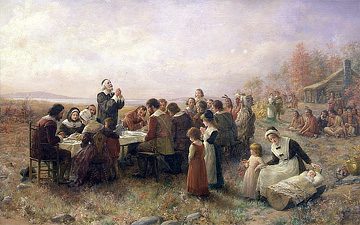
“The First Thanksgiving” by Jennie August Brownscombe, 1914
Well, though his order may be a little curious, that just about nails the historical roots of Thanksgiving. It’s common knowledge that the American celebration has its origin in 1621, as the Pilgrims invited the neighboring Indian tribes to join them in a feast of gratitude for God’s blessings. There’s no evidence, however, that they actually celebrated this on the fourth Thursday in November, or that it lasted only one day, or that they played a mean game of touch football after dinner. (Note: Ed Boyce comments that the first official Thanksgiving in the New World happened, not in New England, but in Virginia. Check out this link for the evidence. More discussion of the issue of the first Thanksgiving here.)
New Englanders remembered the Pilgrims’ effort for many years through regional celebrations of Thanksgiving. Sometimes American Presidents would set aside a day for the nation to be thankful. In 1789, for example, President George Washington proclaimed November 26th as a national day of thanksgiving. Here’s the core of his presidential proclamation:
Whereas it is the duty of all Nations to acknowledge the providence of Almighty God, to obey his will, to be grateful for his benefits, and humbly to implore his protection and favor–and Whereas both Houses of Congress have by their Joint Committee requested me “to recommend to the People of the United States a day of public thanksgiving and prayer to be observed by acknowledging with grateful hearts the many signal favors of Almighty God, especially by affording them an opportunity peaceably to establish a form of government for their safety and happiness.”
Now therefore I do recommend and assign Thursday the 26th day of November next to be devoted by the People of these States to the service of that great and glorious Being, who is the beneficent Author of all the good that was, that is, or that will be–That we may then all unite in rendering unto him our sincere and humble thanks–for his kind care and protection of the People of this country previous to their becoming a Nation–for the signal and manifold mercies, and the favorable interpositions of his providence, which we experienced in the course and conclusion of the late war–for the great degree of tranquility, union, and plenty, which we have since enjoyed–for the peaceable and rational manner in which we have been enabled to establish constitutions of government for our safety and happiness, and particularly the national One now lately instituted, for the civil and religious liberty with which we are blessed, and the means we have of acquiring and diffusing useful knowledge; and in general for all the great and various favors which he hath been pleased to confer upon us.
And also that we may then unite in most humbly offering our prayers and supplications to the great Lord and Ruler of Nations and beseech him to pardon our national and other transgressions–to enable us all, whether in public or private stations, to perform our several and relative duties properly and punctually–to render our national government a blessing to all the People, by constantly being a government of wise, just, and constitutional laws, discreetly and faithfully executed and obeyed–to protect and guide all Sovereigns and Nations (especially such as have shown kindness unto us) and to bless them with good government, peace, and concord–To promote the knowledge and practice of true religion and virtue, and the increase of science among them and Us–and generally to grant unto all mankind such a degree of temporal prosperity as he alone knows to be best.
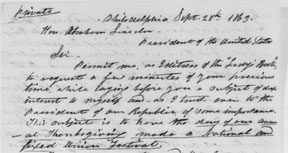
The first part of Hale’s letter to Lincoln. The underlined part reads “have the day of our annual Thanksgiving made a national and fixed Union Festival.”
The idea of a permanent, national celebration each November came 242 years after the first Pilgrim-Indian festival in the early 17th century. During the Civil War, many Americans clamored for some sort of national religious holiday. One of the most vocal was Sarah Josepha Hale (who, by the way, wrote “Mary Had a Little Lamb”). Hale used her clout as editor of the influential Godey’s Lady’s Book magazine to motivate President Lincoln to proclaim a national holiday. On September 28, 1863 she wrote a letter to the President encouraging him to “have the day of our annual Thanksgiving made a national and fixed Union Festival.” Five days later Lincoln issued the “Thanksgiving Proclamation of 1863” (which we’ll examine below).
In his proclamation, Lincoln set apart the “last Thursday of November” as “a day of thanksgiving and praise to our beneficent Father who dwelleth in the heavens.” Throughout the next eight decades, all American Presidents followed Lincoln’s example. But during 1933, as the Great Depression raged, many merchants appealed to President Franklin D. Roosevelt to change the day from the last Thursday in November to the fourth Thursday. The reason for this request? November, 1933 had five Thursdays, which left the minimum number of shopping days between Thanksgiving Day and Christmas Day. Roosevelt denied this request, leaving the holiday on the last Thursday of the month.
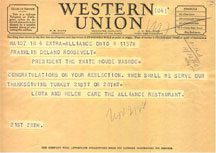
One of many critical communications Roosevelt received in light of his controversial Thanksgiving decision. This telegram, written in November 1940 by two restaurant owners reads: CONGRATULATIONS ON YOUR REELECTION. WHEN SHALL WE SERVE OUR THANKSGIVING TURKEY 21ST? OR 28TH?
But in 1939, the next five-Thursdays-in-November year, President Roosevelt gave in to the requests of business owners and established the fourth Thursday of November as Thanksgiving Day. National chaos ensued, with some states following Roosevelt’s lead and others sticking with the traditional last, and in this year, fifth Thursday. This meant, among other things, that families living in different states were in many cases unable to celebrate Thanksgiving together. The national controversy over the day of the holiday continued, until Congress passed a law on December 26, 1941, making the fourth Thursday of November the one, official, national day.
Recalcitrant Canada, I might add, does not recognize the fourth Thursday in November as Thanksgiving Day. I learned this the hard way while in college. Some friends and I decided to celebrate Thanksgiving by driving from Boston up to Montreal. It didn’t dawn on us that Canadians celebrate their Thanksgiving on the second Monday in October. This wouldn’t have been so bad, except that the restaurant in which we had our Thanksgiving dinner didn’t even have turkey on its menu. I had to settle for quiche, of all things. Now that’s a Thanksgiving travesty, from a narrow-minded American perspective, I might add.
I want to close by printing the text of Lincoln’s original Thanksgiving proclamation. I won’t add my own comments. But I will italicize a few sections that strike me as especially profound. As you read this proclamation, you might ask yourself: What would happen if an American President used this kind of language today in an official proclamation? What in this statement speaks to the heart of our national crisis today?
Thanksgiving Proclamation of 1863
The year that is drawing toward its close has been filled with the blessings of fruitful fields and healthful skies. To these bounties, which are so constantly enjoyed that we are prone to forget the source from which they come, others have been added which are of so extraordinary a nature that they can not fail to penetrate and soften even the heart which is habitually insensible to the ever-watchful providence of Almighty God.
In the midst of a civil war of unequaled magnitude and severity, which has sometimes seemed to foreign states to invite and to provoke their aggression, peace has been preserved with all nations, order has been maintained, the laws have been respected and obeyed, and harmony has prevailed everywhere, except in the theater of military conflict, while that theater has been greatly contracted by the advancing armies and navies of the Union.
Needful diversions of wealth and of strength from the fields of peaceful industry to the national defense have not arrested the plow, the shuttle, or the ship; the ax has enlarged the borders of our settlements, and the mines, as well as the iron and coal as of our precious metals, have yielded even more abundantly than heretofore. Population has steadily increased notwithstanding the waste that has been made in the camp, the siege, and the battlefield, and the country, rejoicing in the consciousness of augmented strength and vigor, is permitted to expect continuance of years with large increase of freedom.
No human counsel hath devised nor hath any mortal hand worked out these great things. They are the gracious gifts of the Most High God, who, while dealing with us in anger for our sins, hath nevertheless remembered mercy.
It has seemed to me fit and proper that they should be solemnly, reverently, and gratefully acknowledged, as with one heart and one voice, by the whole American people. I do therefore invite my fellow-citizens in every part of the United States, and also those who are in foreign lands, to set apart and observe the last Thursday of November next as a day of thanksgiving and praise to our beneficent Father who dwelleth in the heavens. And I recommend to them that while offering up the ascriptions justly due to Him for such singular deliverances and blessings they do also, with humble penitence for our national perverseness and disobedience, commend to His tender care all those who have become widows, orphans, mourners, or sufferers in the lamentable civil strife in which we are unavoidably engaged, and fervently implore the imposition of the Almighty hand to heal the wounds of the nation and to restore it, as soon as may be consistent with the divine purpose, to the full enjoyment of peace, harmony, tranquility [sic], and union.
In testimony whereof I have hereunto set my hand and caused the seal of the United States to be affixed.
Done at the city of Washington, this 3d day of October, A. D. 1863, and of the Independence of the United States the eighty-eighth.
P.S. You can find more of my writings on Thanksgiving in this collection of blog posts: Thanksgiving – Not Just a Day But a Season

Next Post

November 20, 2012 A Week of Thanksgiving: The Cost of Ingratitude
Browse Our Archives
Select a Category Advent Advent Calendar Alissa Wilkinson Archeology Art and Faith Ash Wednesday Bible Books Business Business and Faith Christian Year (Liturgical or Church Year) Christmas Christmas according to Dickens Christmas, Culture, and Christ Christmas: Keeping Christmas Well Church and Culture Church and Ministry Church and Technology Church Life Church: What is a Church? Cities Code of Ethics for Pastors Contentment Creativity Cultural Commentary Culture Daily Reflections Dallas Willard Deliberating on Digital Dignity Easter Education Ephesus and the New Testament Ethics Eugene Peterson Evangelical Existential Questions Faith Faith and Work Family Food Friendship Fun Good Reads Gospel Centered Christianity Grace Handel's Messiah Harvard University Health High Calling History Holidays Holy Spirit Holy Week Hospitality How Does God Guide Us? Hunger Games Insights for Leaders - De Pree Center Inspiration from the High Calling Jesus Jesus: Following Him as a Disciple Jesus: Seven Last Words Jesus: Was Jesus Married? Jesus: What Was His Message? Jesus: Why Did He Have to Die? Laity Lodge Leadership Leadership Conversation Lent Les Miserables Life for Leaders Linda's Advent Doodles Linda's Lenten Doodles Living Well Loving Neighbors Max De Pree Center for Leadership Mental Health Mission of God and Missional Church Money Moral Dilemmas Mormonism Movies Nature New York City Pastors and Churches Pentecost Photos to Share Poetry Police Blotter Politics Prayer Preachers Portal Preaching Presbyterian Church Quotations Reading the Times Recommendations Reflecting on Technology Religion and Culture Ruminations Sabbath Science Seven Last Words Sexual Harassment Social Media Something to Think About Spiritual Warfare Sports Stations of the Cross Stephen Hawking: Heaven and Faith Stories Technology and Culture Technology and Education Technology and Mental Health Technology Bits Texas Thanksgiving The High Calling Thin Places Uncategorized Vocation Women Words Work Worship
Select a Month November 2018 October 2018 June 2018 May 2018 April 2018 January 2018 December 2017 November 2017 March 2017 February 2017 December 2016 March 2016 February 2016 January 2016 December 2015 November 2015 April 2015 March 2015 December 2014 November 2014 October 2014 September 2014 August 2014 July 2014 June 2014 May 2014 April 2014 March 2014 February 2014 January 2014 December 2013 November 2013 October 2013 September 2013 August 2013 July 2013 June 2013 May 2013 April 2013 March 2013 February 2013 January 2013 December 2012 November 2012 October 2012 September 2012 August 2012 July 2012 June 2012 May 2012 April 2012 March 2012 February 2012 January 2012 December 2011 November 2011 October 2011 September 2011 August 2011 July 2011 June 2011 May 2011 April 2011 November 2010
Follow Us!
TAKE THE
Religious Wisdom Quiz
True or False: Paul shook a viper off his hand into the fire on the island of Cyprus.
Select your answer to see how you score.
FALSE TRUE
Related posts from Mark D. Roberts
A Simple "Thank You" That Makes a Big...

Is Gratitude a Leadership Weapon?

Can Gratitude Improve Your Leadership?

Enjoying Your Thanksgiving Dinner Twice
TRENDING AT PATHEOS Evangelical

The REST of Your Life: A Creative Wrestles...
This week I had a conversation with a good friend from church....

How the author of the world's best hymn...
I've been working with John Newton for a while now. This makes...

Long before this Lectio Divina, Psalm 130 - the song - started...

What About the Trees? Another Living Parable
After I finished writing the last article about falling leaves as a...

Why Classical Education Is a Conversation, Not a...
Come and Read: Joy in Classical Education When I was a little...

Cornell University has received a great deal of negative publicity and intense...
view all Evangelical blogs
Ad-Free & Subscriber Log-In Subscription Support
- About Us
- 2026 Calendar
- Videos
- Podcasts
- Library of World Religions
- Faith In Media Tracker
- Advertise With Us
- Write for Us
- Privacy Policy
- Terms of Service
- Do Not Sell My Data
- Contact Us
- Radiant Digital
- Manage Newsletter Subscriptions
- Unsubscribe From Notifications
- Sitemap
Copyright 2008-2026, Patheos. All rights reserved.
Subscription Support Ad-Free & Subscriber Log-In
Follow Patheos