
BuddhistCatholicContemplativeEvangelicalGeneral ChristianHinduJewishLatter-day SaintMuslimNew VisionsProgressive Christian
Beliefs
- Buddhist
- Catholic
- Contemplative
- Evangelical
- General Christian
- Hindu
- Jewish
- Latter-day Saint
- More Voices
- Muslim
- New Visions
- Pagan
- Progressive Christian
Topics
- Religion News
- Food and Religion
- Sports and Religion
- Religious Art
- Religious Music and Entertainment
- Religious Events
- History and Religion
- Style and Religion
- Politics and Religion
- Women in Religion
- Recreation Outdoors and Religion
- Business Finance and Religion
- Careers Workplace and Religion
- Education and Religion
- Family Parenting and Religion
- Health Fitness and Religion
- Home and Religion
- Relationships and Religion
- Technology and Religion
- Travel and Religion
Columnists
- Buddhist Columnists
- Business Finance and Religion Columnists
- Careers Workplace and Religion Columnists
- Catholic Columnists
- Contemplative Columnists
- Education and Religion Columnists
- Evangelists Columnists
- Family Parenting and Religion Columnists
- General Christian Columnists
- Health Fitness and Religion Columnists
- Hindu Columnists
- History and Religion Columnists
- Home and Religion Columnists
- Jewish Columnists
- More Voices Columnists
- Latter Day Columnists
- Muslim Columnists
- New Visions Columnists
- Nonreligious Columnists
- Pagan Columnists
- Politics and Religion Columnists
- Progressive Columnists
- Recreation Outdoors and Religion Columnists
- Relationships and Religion Columnists
- Religion News Columnists
- Religious Art Columnists
- Religious Events Columnists
- Religious Music and Entertainment Columnists
- Sports and Religion Columnists
- Style and Religion Columnists
- Technology and Religion Columnists
- Travel and Religion Columnists
- Women in Religion Columnists
Resource Library
- 2026 Calendar
- Library of World Religions
- The 100 Most Holy Places on Earth
- Patheos Answers
- Podcasts
- Videos
- Faith Leaders Database
- Anglican Episcopalian
- Bahai
- Baptist
- Buddhism
- Christianity
- Confucianism
- Eastern Orthodoxy
- Hinduism
- Holiness and Pentecostal
- ISKCON
- Islam
- Judaism
- Lutheran
- Methodist
- The Church of Jesus Christ of Latter-day Saints
- New Age
- Paganism
- Presbytarian and Reformed
- Protestantism
- Religion Behind the Scenes
- Roman Catholic
- Scientology
- Shia Islam
- Sikhism
- Sufism
- Sunni Islam
- Taoism
- Zen
- See all religions
Research Tools
 Ad-Free & Subscriber Log-In Subscription Support
Ad-Free & Subscriber Log-In Subscription Support
Follow Patheos 

- Trending:
- Forgiveness
- |
- Marriage
- |
- Consciousness
- |
- Death Penalty
- |
- Election
- |
- Halloween

- Home
- History and Religion
- No. 22,542; Or, The Curse Of Amen Ra
No. 22,542; Or, The Curse Of Amen Ra
Last updated on: February 7, 2025 at 12:35 pm by Shawn F. Higgins
No. 22,542; Or, The Curse Of Amen Ra 2025-02-07T12:35:42-05:00 Shawn F. Higgins
Patheos Explore the world's faith through different perspectives on religion and spirituality! Patheos has the views of the prevalent religions and spiritualities of the world.
The mummy case in question in the catalogue of the British Museum was No. 22,542. The mummy that it originally covered, however, was never brought to England. This is what W. T. Stead told Frederick K. Seward at the ship’s saloon table. Though the immediate purpose of the veteran English journalist’s visit to America was to aid in the New York campaign of the Men and Religion Forward Movement, Stead talked much of Spiritualism, thought transference, and the occult.[1] Any person who wrote the story of the mummy case, Stead said, was punished with great calamities. He told of one person after another who “had come to grief after writing the story,” adding that, “although he knew it, he would never write it.” (He did not say whether such ill luck was attached to the mere telling of it.)[2] It was in 1909 when Stead heard the very startling report, which, however, he was not unprepared for. It was said that because of the number of “accidents” that had occurred to visitors of the Egyptian Room where the famous mummy case lid of the royal priestess, Amen Ra, was to be removed from the room where it has been exhibited for several years.
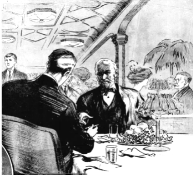
William T. Stead relating the story of Mummy.
“More than thirty years ago this case was brought from Egypt by a party of four young gentlemen who had been enjoying a holiday on the Nile,” said Stead. “One of these is a personal friend of my own. I have a letter from him—written with his left hand. For on him, the wrath of the offended priestess was the first to fall. Before he left Egypt his fowling piece exploded, shattering his right arm. He was about to enter the lifeguards, and the accident blighted his military career. That was more than thirty years ago.”
From that time onward an uninterrupted series of accidents and fatalities had been recorded by all who had offended the ireful shade of the princess priestess who left this earthly plane a thousand years before the Christian era. On the return journey, one of the members of the party was accidentally shot in the arm by his servant, through a gun that discharged without visible cause. The arm had to be amputated. Another died in poverty within a year. A third was shot. The owner of the mummy case found, on reaching Cairo, that he had lost a large part of his fortune and died soon after.
“Possession means disaster,” said Stead. “The case passed to the sister of one of the luckless quartet. From the time it entered her house misfortune after misfortune rained upon its occupants. She sent it to be photographed. When the negative was developed it was discovered that in place of the pictured features on the lid, the photograph showed the face of a living Egyptian woman of malevolent aspect. Within the year the photographer committed suicide.”
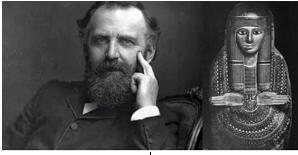
Stead & Amen Ra.
The priestess of Amen-Ra showed her displeasure convincingly. When the case arrived in England, it was given by its owner, Mr. W—, to a married sister living near London. One day the Theosophist, Madame Blavatsky, entered the room in which the case had been placed. She soon declared there was a “most malignant influence in the room.” On finding the cover, she begged her hostess to send it away, declaring it to be “a thing of the utmost danger.” The lady, however, laughed at this idea as a foolish superstition.”[3]
She sent the case to a popular photographer in Baker Street. Within a week he called upon her in great excitement, to say that while he had photographed the face with the greatest care and could guarantee that no one had touched either his negative or the photograph, the photograph showed the face of a living Egyptian woman staring straight before her with an expression of singular malevolence. The photographer died suddenly and mysteriously shortly after.
“Misfortune continuing, the lady decided to send the case to the British Museum,” said Stead. “The man who took it to the Museum died in a week, and the man who helped him to carry the case into the building met with a serious accident. From that day the haunted lid has been a source of innumerable accidents. When it was photographed in the museum, the photographer smashed his camera, cut open his face and one of his children had a narrow escape from drowning. An old acquaintance of mine, B. Fletcher Robinson, a man hale and hearty and in the prime of life, wrote the story of the priestess for The Daily Express, and within a few weeks, he died.[4] An American magazine commissioned a correspondent to write the story of the haunted lid. He died before he completed the copy. All this happened before 1905. Since then the fame of the lid has been well established; many persons avoided the Egyptian room in the Museum, or when they visited it gave No. 22,542 a wide berth. Others more daring mocked the lid, and in many cases suffered for their temerity.”[5]
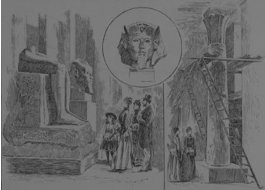
“Egyptian Antiquities In The British Museum.”[6]
Little did anyone know that their ship, the R.M.S. Titanic, was tearing through the April night to her doom. Contrary to the general expectation, there was no jarring impact when the vessel struck the iceberg.[7] Perhaps Stead thought about a piece he wrote for The Pall Mall Gazette nearly three decades earlier. “How The Mail Steamer Went Down,” was a fictional account that warned of the perils that would befall passengers should there be an insufficient number of lifeboats.[8] It was now a prophecy. “For it was in the whirling suction which followed the burial of the Titanic, in the rush and swirl and horror of fear dumbed death at sea that W.T. Stead went into that land from which in life he drew messages.”[9]
SOURCES:
[1] “Stead, Estelle W. My Father, Personal & Spiritual Reminiscences. George H. Doran Company. New York, New York. (1913): 374-378.
[2] “The Ghost Of The Titanic.” St. Louis Post-Dispatch. (St. Louis, Missouri) May 5, 1912.
[3] St. Russell, G.. “The Mysterious Mummy.” Pearson’s Magazine. Vol. XXVII, No. 12 (August 1909): 163-172
[4] Robinson, B. Fletcher. “Priestess Of Death” The Daily Express. (London, England) June 3, 1904.
[5] Stead, William T. “Ghost Of Mummy Haunts The British Museum; Must Go Now.” The San Francisco Examiner. (San Francisco, California) August 15, 1909.
[6] “Egyptian Antiquities In The British Museum.” Illustrated London News. (London, England) December 28, 1889.
[7] Mowbray, Jay Henry. Sinking Of The “Titanic.” National Publishing Company. Philadelphia, Pennsylvania. (1912): 45, 49.
[8] Stead, W.T. “How The Mail Steamer Went Down In Mid Atlantic By A Survivor.” The Pall Mall Gazette. (London, England.) March 22, 1886.
[9] Everett, Marshall. Wreck And Sinking Of The Titanic. L.H. Walter. Chicago, Illinois. (1912): 127-128.
Previous Post

January 31, 2025
Andrew Jackson Vs. The Bell Witch
Next Post
February 2, 2025 Oscar Wilde, Dracula, and the Occult Roots of Gothic Fiction
Recent Comments
"This is a cool article thanks!"
"Another facet of the Leo Taxil affair is that he, posing as Diana Vaughan, had ..."
Browse Our Archives
Select a Category Uncategorized
Select a Month October 2025 March 2025 February 2025 January 2025 December 2024 November 2024 October 2024 September 2024 August 2024 July 2024 June 2024 May 2024 April 2024 March 2024 February 2024 January 2024 December 2023 November 2023 October 2023 September 2023 August 2023 July 2023 June 2023 May 2023 April 2023 March 2023 February 2023 January 2023 December 2022 November 2022 October 2022
TAKE THE
Religious Wisdom Quiz
What is the first commandment in the Ten Commandments?
Select your answer to see how you score.
Do not steal Do not murder No other gods Honor parents
Related posts from Marginalia

The Unknown Story Of "The Unknown Life Of...

Hargrove (V): "Dr. Leyds & Occultation Of World...


TRENDING AT PATHEOS History and Religion

The Dead Man’s Hand: Appalachian Graveyard Magic
When the Mountains Go Dark: Appalachian Folklore for Spooky Season Installment 3...

Angel Crowns: An Eerie Appalachian Death Tradition
When the Mountains Go Dark: Appalachian Folklore for Spooky Season Angel Crowns:...

Is 'Separation of Church and State' Really a...

There has long been a popular belief that Zen Buddhism is as...

Is Our Spirituality Communal or Individual?
Here, I take swings at sacred cows. I suspect that more sacred...

How Could Christianity be Different?
Christians can no longer plead ignorance. And Christians' reluctance to listen will...
view all History and Religion blogs
What Are Your Thoughts?leave a comment
Ad-Free & Subscriber Log-In Subscription Support
- About Us
- 2026 Calendar
- Videos
- Podcasts
- Library of World Religions
- Faith In Media Tracker
- Advertise With Us
- Write for Us
- Privacy Policy
- Terms of Service
- Do Not Sell My Data
- Contact Us
- Radiant Digital
- Manage Newsletter Subscriptions
- Unsubscribe From Notifications
- Sitemap
Copyright 2008-2026, Patheos. All rights reserved.
Subscription Support Ad-Free & Subscriber Log-In
Follow Patheos