
BuddhistCatholicContemplativeEvangelicalGeneral ChristianHinduJewishLatter-day SaintMuslimNew VisionsProgressive Christian
Beliefs
- Buddhist
- Catholic
- Contemplative
- Evangelical
- General Christian
- Hindu
- Jewish
- Latter-day Saint
- More Voices
- Muslim
- New Visions
- Pagan
- Progressive Christian
Topics
- Religion News
- Food and Religion
- Sports and Religion
- Religious Art
- Religious Music and Entertainment
- Religious Events
- History and Religion
- Style and Religion
- Politics and Religion
- Women in Religion
- Recreation Outdoors and Religion
- Business Finance and Religion
- Careers Workplace and Religion
- Education and Religion
- Family Parenting and Religion
- Health Fitness and Religion
- Home and Religion
- Relationships and Religion
- Technology and Religion
- Travel and Religion
Columnists
- Buddhist Columnists
- Business Finance and Religion Columnists
- Careers Workplace and Religion Columnists
- Catholic Columnists
- Contemplative Columnists
- Education and Religion Columnists
- Evangelists Columnists
- Family Parenting and Religion Columnists
- General Christian Columnists
- Health Fitness and Religion Columnists
- Hindu Columnists
- History and Religion Columnists
- Home and Religion Columnists
- Jewish Columnists
- More Voices Columnists
- Latter Day Columnists
- Muslim Columnists
- New Visions Columnists
- Nonreligious Columnists
- Pagan Columnists
- Politics and Religion Columnists
- Progressive Columnists
- Recreation Outdoors and Religion Columnists
- Relationships and Religion Columnists
- Religion News Columnists
- Religious Art Columnists
- Religious Events Columnists
- Religious Music and Entertainment Columnists
- Sports and Religion Columnists
- Style and Religion Columnists
- Technology and Religion Columnists
- Travel and Religion Columnists
- Women in Religion Columnists
Resource Library
- 2026 Calendar
- Library of World Religions
- The 100 Most Holy Places on Earth
- Patheos Answers
- Podcasts
- Videos
- Faith Leaders Database
- Anglican Episcopalian
- Bahai
- Baptist
- Buddhism
- Christianity
- Confucianism
- Eastern Orthodoxy
- Hinduism
- Holiness and Pentecostal
- ISKCON
- Islam
- Judaism
- Lutheran
- Methodist
- The Church of Jesus Christ of Latter-day Saints
- New Age
- Paganism
- Presbytarian and Reformed
- Protestantism
- Religion Behind the Scenes
- Roman Catholic
- Scientology
- Shia Islam
- Sikhism
- Sufism
- Sunni Islam
- Taoism
- Zen
- See all religions
Research Tools
 Ad-Free & Subscriber Log-In Subscription Support
Ad-Free & Subscriber Log-In Subscription Support
Follow Patheos 

- Trending:
- Forgiveness
- |
- Marriage
- |
- Consciousness
- |
- Death Penalty
- |
- Election
- |
- Halloween

- Home
- History and Religion
- Novorossiya: The Doukhobors
Novorossiya: The Doukhobors
Last updated on: October 17, 2024 at 8:48 pm by Shawn F. Higgins
Novorossiya: The Doukhobors 2024-10-17T20:48:58-04:00 Shawn F. Higgins
Patheos Explore the world's faith through different perspectives on religion and spirituality! Patheos has the views of the prevalent religions and spiritualities of the world.
THE DOUKHOBORS
In May 1818, during Andrei Mikhailovich’s last stay in St. Petersburg, Alexander Pavlovich visited Novorossiysk. While touring Odessa, the Tsar was convinced of the unforgettable merits and benefits of the region. Following the departure of Duke Richelieu from Russia, Count Louis de Langeron was appointed Governor General of the Novorossiysk Territory. He was the personification of the chevalier loyalist from the times of Henry IV; a brave general, a kind, honest person, but a dissatisfied joker, and an uninterested administrator. His absent-mindedness resulted in a humorous incident during Alexander Pavlovich’s visit. When Count Langeron left his office one day, he locked the door and left, forgetting that the Tsar was still inside the room. Although the reign of Count Langeron was short, it was not without benefit to the region, as he continued the policies laid out by Duke Richelieu.
The Tsar’s tour took him through Crimea, through the Molokan Colony. Kontenius, who was now retired, visited the Tsar to thank him for the pension he received. The Tsar was extremely pleased with the colonies, and attributing their success to the efforts of Kontenius, embraced the retiree and asked him to return to service and assist General Inzov. When leaving the colonies, the Tsar personally pinned the ribbon and star of the Order of St. Anne (1st Class) on Kontenius. This astonished a great many people, as Kontenius only held the rank of State Advisor, and this award entitled him hereditary nobility.
Andrei Mikhailovich returned to Ekaterinoslav where, on January 31, 1819, Elena Pavlovna gave birth to their second child. another daughter they named Ekaterina “Katya.” By this time Alexander Pavlovich had returned to St. Petersburg. The Tsar was pleased to discover that Grellet and Allen, two of the Quakers whom he met in England, had decided to take him up on his offer, and were making a tour of Russia. The Quakers arrived at the private apartments of Alexander Pavlovich on the evening of February 10, 1819, where they found him sitting alone. Imploring them to sit by his side on the sofa, Alexander Pavlovich received them with great affability, “like old friends,” he said. They reminisced over their time spent in England, the Tsar stating, “his mind was encouraged and strengthened under the trying circumstances then attending him.” He then made many inquiries of a religious character. He asked about the nature of their various religious engagements since arriving in Russia, and in what state they had found the public establishments, particularly the prisons.
The Quakers were glad to have the opportunity to acquaint the Tsar with the wretched situation of several of them, as well as the dismal particularities of the poor houses. They especially alluded to the prison at Abo.
“These things ought not to be,” said the Tsar, much affected. “They shall not continue so.”
Alexander Pavlovich was very interested in the subject of public education, and the Quaker, therefore, told him of the visit they had made to the Lancastrian School, and how greatly pained they had been in noticing there (and at the printing office) that the lessons were a selection of sentiments calculated to demoralize the people and bring them into a far worse state.
“We had been induced to begin to prepare a selection from the Scriptures, under the name of ‘Scripture Lessons,’” said the Quakers. They then gave the Tsar a brief outline of the contents of the little work.
The Tsar remained absorbed deep in thought for a few moments and then said: “You have done the very thing that I was anxious should be done. I had for a long time been contemplating how that mighty engine, general public education, might be used for the promotion of the Kingdom of Christ, by bringing the people to the knowledge of the dear Redeemer, and to the practice of Christian virtues; send me immediately what you have prepared.” After this, the Tsar said: “Before we separate for the present, let us spend a short time in religious retirement together.” They were disposed to do so and bowed their heads together in prayer.
In a subsequent meeting, the Tsar told the Quakers of the changes he had made in the prisons per their advice and asked that in the course of their visit through Russia, they would communicate directly to him, whatever they might notice in the prisons.
“I have carefully looked over the Scripture lessons that you have prepared, and I am delighted with them,” said Alexander Pavlovich. “Had you come to Russia for no other service than this, it would be accomplishing an important work.”[1]
By May 1819, Grellet and Allen were in Ekaterinoslav, where Kontenius and Andrei Mikhailovich escorted them through the religious communities (Kontenius serving as translator.) At the Mennonite colonies near Altona, they lodged with a young man, one of their ministers, who, with his wife, gave them a kind reception.[2] Their experience with the Doukhobors was another matter, but that requires a revisit of Doukhobor beliefs.
Some Elders (leaders) of the Doukhobors said that the founder of their doctrine was a retired non-commissioned officer who was a prisoner of the Prussians during the Seven Years’ War, and during this war lived for quite a long time with the Moravians. It was alleged that this soldier composed the Doukhobor doctrine from the dogma of Moravians after his return to Russia. Some said he was a former Prussian military officer who expatriated to Kharkov and preached ideas similar to the Quakers.[3] Others claimed that the Balkan Bogomils inspired the movement. There were not a few who claimed their teachings were derived from the three Jewish youths (Hanniah, Mishael, and Azariah) whom Nebuchadnezzar threw into the fiery furnace. Then again, according to a Doukhobors confession of faith given in 1791 to Kakhovsky (Governor of Ekaterinoslav,) the sect began in the village of Nikolskoe, in the Pavlograd District of the Ekaterinoslav Province. Whatever their true origins were, by the end of the 18th century, the Dukhobors were scattered all over Russia, but their primary centers were in the provinces of Kharkov, Ekaterinoslav, and Tambov.
The Doukhobor religion was universalist and undogmatic, rejecting priesthood, as well as outward forms and rites. They believed that the “seed of God dwells within every man, as it dwelt supremely in the spirit of the man Jesus.” As such, the Dukhobors maintained that true believers could be found outside the Christian fold. The Dukhobors were capable of quoting the Bible to outsiders, they increasingly came to regard it as a book that deadened rather than enlightened the spirit and secondary to the living oral tradition of their psalms. They rejected the taking of oaths, and most Dukhobors refused military service, as it was inconsistent with a religion of love and pacifism.[4] The Russian government came to treat this community with great severity because it saw in Doukhobor teachings the seeds of potential social revolution. The Doukhobors among the Don Cossacks were exiled to Siberia in 1779, while the Kharkov Doukhobors were ordered to resettle in the Melitpol District near Molochnye Vody in 1793. Known for his religious tolerance, Alexander Pavlovich expressed a special fondness for the group. Despite the objections of Archbishop Iov, the Tsar offered the Dukhobor’s generous land grants and other funds. In 1804 the Doukhobors of Tambov and Voronezh were allowed to join their coreligionists under similar arrangements. They thrived in Molochnye Vody. The mildness of the climate, along with the fertility of the soil, contributed to the favorable growth of the sect.
Their autocratic leader at the time, Savelio Kapustin, introduced communal goods and collective labor to the Dukhobors. Though this was largely for his own benefit, under his strict supervision (and the community’s hard work,) the Doukhobors achieved a significant degree of prosperity.[5] Kapustin strictly punished drunkenness, fraud, and supervised the arrangement and order of houses. Many of the schismatics of other sects, deserters, (and even some of the Orthodox,) began to join the Doukhobors, which noticeably increased their population. Under the despotic rule of Kapustin, unsavory actions percolated in the community. It was said the Doukhobors tortured and put to death some of their apostates by burying them alive. There were signs that a similar cruel execution had befallen many unfortunate victims of fanaticism during Kapustin’s years. There were even allegations of a sexual nature. Kapustin was very cunningly, however, and hid these abuses from authorities under the veneer of feigned humility and meekness.
The Quaker visitors were initially very friendly with the Dukhobors when they first met, believing them to be kindred spirits, they were fond of calling them their brothers. Their opinion soured during their interviews. Grellet and Allen went to the abode of one of the Elders, a ninety years old man who was nearly blind, but very active in body and mind. He was the chief speaker of the fourteen Elders who were present. The Quakers had a long conference with the old Elder and found him to be very evasive in several of his answers to their inquiries. The Elders, however, did state, unequivocally, that they did not believe in the authority of the Scriptures.
“Do the Doukhobors believe in the Divinity of Jesus Christ?” asked Grellet and Allen.
“Christ was a good man,” said the old Elder (after a long hesitation.) “Every man who is able to acquire the strength to be a truly good man can do so through Christ and God.”
The Doukhobors explained that they looked upon Jesus Christ in no other light than that of a good man. They therefore had no confidence in him as a Savior from sin. They believed that there was a spirit in man, “to teach and lead him in the right way,” and in support of this, they were fluent in the quotation of Scripture texts.[6]
The faces of Grellet and Allen changed at this confession. Jumping up from their seats, with an expression of horror and indignation, the Quakers exclaimed in French: “Ténébre! Ténébre!” (“Darknesses! Darknesses!”) No! no! You are not our brothers!”[7]
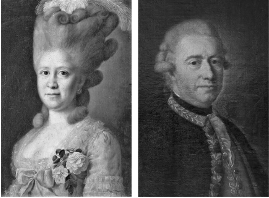
Elena Ivanovna & General Adolf Frantsevich Bandre du Plessis.
A curious incident involving Allen occurred in the Fadeev home before the Quakers left Ekaterinoslav. Hanging on their walls were two waist-length oil paintings of Elena Pavlovna’s grandparents. Elena Ivanovna was depicted in powder, with a rose on her chest. General Adolf Frantsevich, a handsome man with a noble, courageous, well-born face, was depicted in a Lieutenant General’s uniform, with powder on his head. Although the portrait did not contain any symbols, peculiarities, nor the slightest hint of the number three, there was nevertheless some mystery in this portrait—some peculiarity by which Freemasons could recognize him as belonging to their fraternity. Allen noticed the portraits hanging on the walls in the living room, and, pointing to General Adolf Frantsevich, he immediately announced: “This was a Freemason and the highest degree!”
“How did you know that?” asked Elena Pavlovna.
Allen excused himself by saying that he was unable to answer and, despite numerous requests, said nothing more.
In the Autumn of 1819 Andrei Mikhailovich and Elena Pavlovna went to the southern coast again. The painful condition resulting from rheumatism was getting worse for Elena Pavlovna, and the doctors recommended the rejuvenating health benefits of bathing in the sea. Here they met the new Governor of Tauride, Alexander Nikolaevich Baranov, a remarkably gifted official who would die far too young.[8] If relief followed, it was only to the weakest degree, and by the time they returned from Crimea, Andrei Mikhailovich had developed a strong fever.) Andrei Mikhailovich continued to wander around the colonies in 1819, surveying the empty steppes intended for the establishment of new German colonies (which never happened.)[9]
-
- NOVOROSSIYA
- The Arbiter Of Europe’s Destiny.
- The House Dolgorukuy
- Madame Krüdener
- Ekaterinoslav
- The Arabat Arrow
- The Mystery Of General Inzov
- The Doukhobors
- Pushkin
- Chuguev Military Settlement
- “The Blessed”
- The Decembrists
- Penza
- Independence
- Last Words Of Samuel Khristianovich Kontenius
- “Amid Coffins And Desolation”
- Rusalka
- Dead Souls
- Secret Passages
- Astrakhan
- Nevsky Prospekt
- Kalmyk Ulus
- Love And Ambition
- Duellistes
- Pyatigorsk
- A Heroine Of Our Time
- Winter Palace
- Zeneida R-Va
- Steppes
- Letter To Natalya
- Fire And Ice
SOURCES:
[1] Grellet, Stephen. A Concise Memoir Of The Remarkable Evangelist, Etienne De Grellet. Edward C. Alden. Oxford, England. (1877): 169-177.
[2] Sherman, James. Memoir Of William Allen. Henry Longstreth. Philadelphia, Pennsylvania. (1851): 282-283.
[3] Hardwick, Susan W. “Religion And Migration: The Molokan Experience.” Yearbook Of The Association Of Pacific Coast Geographers. Vol. LV (1993): 127-141.
[4] Brock, Peter. “Vasya Pozdnyakov’s Dukhobor Narrative.” The Slavonic And East European Review. Vol. XLIII, No. 100 (December 1964): 152-176.
[5] Palmieri, Aurelio. “The Russian Doukhobors And Their Religious Teachings.” The Harvard Theological Review. Vol. VIII, No. 1 (January 1915): 62-81.
[6] Grellet, Stephen. Memoirs Of The Life And Gospel Labors Of Stephen Grellet: Volumes I & II. Henry Longstreth. Philadelphia, Pennsylvania. (1860): 455-456.
[7] Fadeyev, Andrei Mikhailovich*. Vospominaniia: 1790-1867*. Vysochaishe Utverzhd. Yuzhno-Russkago. Odessa, Ukraine. [Russian Empire.] (1897): Part II: 45-49.
[8] Kravchuk A.S. “On The Biography Of The Tauride Civil Governor Alexander Nikolaevich Baranov (1793–1821) The Crimean Historical Review. No. 3. (2015): 59–73.
[9] Fadeyev, Andrei Mikhailovich*. Vospominaniia: 1790-1867*. Vysochaishe Utverzhd. Yuzhno-Russkago. Odessa, Ukraine. [Russian Empire.] (1897): Part I: 64-67, 70n-71n.
Previous Post
October 5, 2024
Novorossiya: The Mystery Of General Inzov
Next Post
October 5, 2024 Novorossiya: Pushkin
Recent Comments
"This is a cool article thanks!"
"Another facet of the Leo Taxil affair is that he, posing as Diana Vaughan, had ..."
Browse Our Archives
Select a Category Uncategorized
Select a Month October 2025 March 2025 February 2025 January 2025 December 2024 November 2024 October 2024 September 2024 August 2024 July 2024 June 2024 May 2024 April 2024 March 2024 February 2024 January 2024 December 2023 November 2023 October 2023 September 2023 August 2023 July 2023 June 2023 May 2023 April 2023 March 2023 February 2023 January 2023 December 2022 November 2022 October 2022
TAKE THE
Religious Wisdom Quiz
Who said: "Therefore, since we have a great high priest who has ascended into heaven, Jesus the Son of God, let us hold firmly to the faith"?
Select your answer to see how you score.
Paul James Peter John
Related posts from Marginalia
Mothers & Daughters: Prince Tyumen
Mothers & Daughters: Panikhida
Mothers & Daughters: Crime And Punishment
Mothers & Daughters: The Black Sea
TRENDING AT PATHEOS History and Religion

The Dead Man’s Hand: Appalachian Graveyard Magic
When the Mountains Go Dark: Appalachian Folklore for Spooky Season Installment 3...

Angel Crowns: An Eerie Appalachian Death Tradition
When the Mountains Go Dark: Appalachian Folklore for Spooky Season Angel Crowns:...

Is 'Separation of Church and State' Really a...

There has long been a popular belief that Zen Buddhism is as...

Is Our Spirituality Communal or Individual?
Here, I take swings at sacred cows. I suspect that more sacred...

How Could Christianity be Different?
Christians can no longer plead ignorance. And Christians' reluctance to listen will...
view all History and Religion blogs
What Are Your Thoughts?leave a comment
Ad-Free & Subscriber Log-In Subscription Support
- About Us
- 2026 Calendar
- Videos
- Podcasts
- Library of World Religions
- Faith In Media Tracker
- Advertise With Us
- Write for Us
- Privacy Policy
- Terms of Service
- Do Not Sell My Data
- Contact Us
- Radiant Digital
- Manage Newsletter Subscriptions
- Unsubscribe From Notifications
- Sitemap
Copyright 2008-2026, Patheos. All rights reserved.
Subscription Support Ad-Free & Subscriber Log-In
Follow Patheos