
BuddhistCatholicContemplativeEvangelicalGeneral ChristianHinduJewishLatter-day SaintMuslimNew VisionsProgressive Christian
Beliefs
- Buddhist
- Catholic
- Contemplative
- Evangelical
- General Christian
- Hindu
- Jewish
- Latter-day Saint
- More Voices
- Muslim
- New Visions
- Pagan
- Progressive Christian
Topics
- Religion News
- Food and Religion
- Sports and Religion
- Religious Art
- Religious Music and Entertainment
- Religious Events
- History and Religion
- Style and Religion
- Politics and Religion
- Women in Religion
- Recreation Outdoors and Religion
- Business Finance and Religion
- Careers Workplace and Religion
- Education and Religion
- Family Parenting and Religion
- Health Fitness and Religion
- Home and Religion
- Relationships and Religion
- Technology and Religion
- Travel and Religion
Columnists
- Buddhist Columnists
- Business Finance and Religion Columnists
- Careers Workplace and Religion Columnists
- Catholic Columnists
- Contemplative Columnists
- Education and Religion Columnists
- Evangelists Columnists
- Family Parenting and Religion Columnists
- General Christian Columnists
- Health Fitness and Religion Columnists
- Hindu Columnists
- History and Religion Columnists
- Home and Religion Columnists
- Jewish Columnists
- More Voices Columnists
- Latter Day Columnists
- Muslim Columnists
- New Visions Columnists
- Nonreligious Columnists
- Pagan Columnists
- Politics and Religion Columnists
- Progressive Columnists
- Recreation Outdoors and Religion Columnists
- Relationships and Religion Columnists
- Religion News Columnists
- Religious Art Columnists
- Religious Events Columnists
- Religious Music and Entertainment Columnists
- Sports and Religion Columnists
- Style and Religion Columnists
- Technology and Religion Columnists
- Travel and Religion Columnists
- Women in Religion Columnists
Resource Library
- 2026 Calendar
- Library of World Religions
- The 100 Most Holy Places on Earth
- Patheos Answers
- Podcasts
- Videos
- Faith Leaders Database
- Anglican Episcopalian
- Bahai
- Baptist
- Buddhism
- Christianity
- Confucianism
- Eastern Orthodoxy
- Hinduism
- Holiness and Pentecostal
- ISKCON
- Islam
- Judaism
- Lutheran
- Methodist
- The Church of Jesus Christ of Latter-day Saints
- New Age
- Paganism
- Presbytarian and Reformed
- Protestantism
- Religion Behind the Scenes
- Roman Catholic
- Scientology
- Shia Islam
- Sikhism
- Sufism
- Sunni Islam
- Taoism
- Zen
- See all religions
Research Tools
 Ad-Free & Subscriber Log-In Subscription Support
Ad-Free & Subscriber Log-In Subscription Support
Follow Patheos 

- Trending:
- Forgiveness
- |
- Marriage
- |
- Consciousness
- |
- Death Penalty
- |
- Election
- |
- Halloween

- Home
- History and Religion
- Novorossiya: Love And Ambition
Novorossiya: Love And Ambition
Last updated on: October 17, 2024 at 8:59 pm by Shawn F. Higgins
Novorossiya: Love And Ambition 2024-10-17T20:59:17-04:00 Shawn F. Higgins
Patheos Explore the world's faith through different perspectives on religion and spirituality! Patheos has the views of the prevalent religions and spiritualities of the world.
LOVE AND AMBITION
1836
Serving as Vera’s nurse, and far from consoled by the loss of her son, Helena Andreevna nevertheless enriched her usual activities with her joy. She still played the piano with Lelya, sang songs to her, taught her literacy, and rejoiced at the extraordinary abilities and intelligence of her five-year-old girl. She continued her own work, studying Italian, French, German, and her favorite, English. She played the pianoforte, and read a lot, taking an interest in Orest Kiprensky, and the book by Sergei Ivanovich Barshev, banned at that time, which was an essay on the characteristics of some heroes of the revolution. She even read Byron in English. It was an uphill battle for Russian authorities who tried to censor the rebellious wordsmith (who died in 1824 while fighting in the Greek War for Independence.) The more persistent the censorship, the more enthusiastic the Russian people watched Byron’s involvement in Greece. Whereas in his homeland Byron was viewed as an immoral, shocking, narcissist, in Russia he was read in the way in which he wished, as a revolutionary whose words had weight and whose actions were a threat to the political status quo. He had inspired Pushkin, at least early on, but his popularity had cooled after the Decembrist Uprising. Nevertheless, reading Byron, especially in English, was a perfume of rebelliousness.[1]
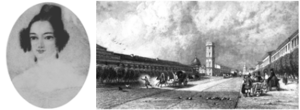
(Left) Ekaterina Alexandrovna Sushkova. (Right) Nevsky Prospekt.[2]
Soon everyone who left the capital for the summer returned, and Helena Andreevna no longer had to walk around St. Petersburg alone. She had a lot of cicerones, of both sexes, in the persons of the enormous family of Fadeevs and Gans. Helena Andreevna’s cousins, Katerina and Lizaveta Aleksandrovna Sushkova, (and their relatives, the Bekleshevs) had returned. As soon as the Sushkovs arrived, they immediately visited the Hahns, but, not finding them at home, they ordered to convey the most kindred feelings, greetings and requests to visit them as soon as possible on an extremely important matter. Helena Andreevna went to see them the following day. The important matter turned out to be a very incredible thing. The Senator, Count Grigory Grigorievich Kushelev, handed over to their common grandfather, Prince Pavel Vasilyevich Dolgoruky “reliable information” about the inheritance of the Dolgoruky family in an English bank. The problem with receiving their great-grandfather’s capital (with compounded interest,) however, was that the documents issued by the bank were burned. The Sushkovs assured that Kushelev found some loopholes and additional proof for their claims.
Pavel Vasilyevich (who still lived in his village in the Penza Province) decided to actively work to secure their lost fortune. Katerina was going to go to Penza herself to learn more about the case, but Helena Andreevna paid no attention to these “fabulous rumors.” Enthusiasm for the scheme soon waned; even the dreamy Katerina Sushkova forgot about it, and her hopes of getting rich sank into oblivion.
Music and literary evenings were sometimes held in Helena Andreevna’s apartment with the Sushkovs and Bekleshevs, but the glimmering sheen of the city was losing its luster, and a feeling of melancholy and spiritual loneliness crept into her heart. Helena Andreevna considered Katerina to be a “secularly empty” and flighty girl, and rather “vain.” Perhaps this opinion was formed due to the fact they openly loved the eternal bustle of beau monde. The Sushkovs were cold with Helena Andreevna who thought her “très chères” cousins treated her with “offensive favor.”[3] More often than not, Helena Andreevna avoided her cousins, and burrowed into her distant, cold apartment, where she enjoyed the company of her old friend Natalya and “Jean.”[4]
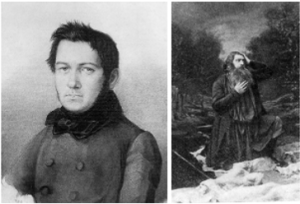
(Left) Mikhail Glinka c. 1840.
(Right) Osip Petrov as Ivan Susanin in the 1836 premiere at the Bolshoi Theatre.
“My husband does not accompany me to the theatre,” Helena Andreevna lamented. “Not only does he not like it, but he also says the tickets are too expensive.”
It was not customary to go to the stalls with a lady, and tickets for a box seat were expensive. Once again, “Jean” came to her aid, and acted as her cicerone. As Helena Andreevna’s greatest pleasures were painting exhibitions and the opera, this was not an unappreciated gesture. Helena Andreevna always found that music was not simply “entertainment,” it was also “the best consolation in this life…after religion.” She often went to the opera and found that the Italian singers in Odessa (with few exceptions) were incomparably superior in terms of vocal quality than the St. Petersburg companies. The scenery and atmosphere on stage at the capital, however, were far ahead of the provincial stage and made her sincerely admire the talent. Even ballet (which she did not much care for) was impressive in Petersburg. She was thrilled to learn of a patriotic new opera titled, A Life For The Tsar, with “music by a young student of the Russian school” named Mikhail Glinka. “It is entirely in the Russian style, and I hear great praise for it everywhere,” she wrote to her family. “Everyone is delighted with this national music.”
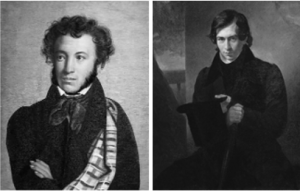
(Left) Alexander Pushkin. (Right) Nestor Vasilyevich Kukolnik.
She was no less fascinated by the great paintings (being particularly fond of Karl Bryullov) and filled pages with her thoughts on the work that she saw at the exhibitions in the Academy of Arts and the Hermitage. During one memorable visit to an exhibition with “Jean,” Helena Andreevna came across a man with long, tousled hair, who seemed very familiar to her. Ivan Alekseevich squeezed her hand at the same time, pointing at the man with his eyes. At the second glance, her heart began to beat fast. She recognized Pushkin! She had always imagined him as a dark brunette, but his hair was no darker than her own. He was small in stature, with an overgrown face, and would have been ugly if not for his eyes which shined like coals and were in constant motion. Helena Andreevna, of course, forgot the pictures in the exhibition and stared at the literary celebrity beloved by all Russians. Her enthusiastic feelings were evidently depicted on her face, as Pushkin looked at Helena Andreevna several times and smiled.
At another exhibition, another young man attracted all her attention. He was very tall, very thin, neither ugly, nor beautiful, but there was something special about him, nonetheless. He had a small, pale face, and large black eyes that struck her with an extraordinary expression. He had long, black, curly hair, which flowed freely around his head. Many of the upper crust of society at the exhibit, wearing stars and ribbons, came up to him and shook his hands. Helena Andreevna looked at him for a long time, guessing who he might be. Finally, Ivan Alekseevich approached him and made the introduction.
“Nestor Vasilyevich!”
Helena Andreevna’s guesses were correct. It was Nestor Vasilyevich Kukolnik! The playwright who wrote the libretto for Glinka’s A Life For The Tsar. “The stamp of genius is visible on him!” she thought.
The return of Pyotr Alekseevich from the camps did not alleviate Helena Andreevna’s loneliness, on the contrary, it made her realize and feel more strongly the whole horror of life together with a man with which she shared nothing in common. Until then she did not notice the abyss that lay between her and her husband. Petersburg had awakened in her the desire to voice the mass of impressions that blossomed in her soul, an urgent need that collided with the nature and tastes of Pyotr Alekseevich. On one autumn evening, Helena Andreevna, her husband, and “Jean,” enjoyed the summer-like weather on a balcony in Oranienbaum. Colonel Hahn went to the hotel lobby to inquire about dinner, and whether it was possible to go to sleep immediately after the meal. Helena Andreevna and “Jean,” meanwhile admired the picturesque views. Unable to take her eyes off the red streaks of the sun dipping into the sea, Helena Andreevna, in a fit of delight, whispered the beginning of her literary career. “The light of day has gone out. There is a blue evening fog on the sea.” The need for aesthetic pleasure was awakened, and her wart was heavy with the knowledge that she would have to leave one day and return to some Romankov or Oskol.
The Sushkova sisters changed at this time, especially Katerina, who turned to Helena Andreevna with caresses, as if at the wave of a wand she had turned from a frog into a bird of paradise. Katerina insisted that she and Helena Andreevna were of the same cloth and excessively affectionate. At first Helena Andreevna could not make sense of the chaotic family embraces.”[5] These caresses outraged Helena Andreevna’s pride more than their former coldness, for there was a sense of cowardice in this. She would never forget the night that she did not sleep because she was translating, in abbreviation, Edward Bulwer-Lytton’s novel, Godolphin. This was to loan her cousins some money. Helena Andreevna and Natalya went to a performance of I. I. Panaev’s newly translated Othello.[6] When they returned home, Helena Andreevna worked throughout the night on the story, which was published under the title: “Love And Ambition” in Biblioteka Dlya Chteniya (1836.) Though she had deprived herself of sleep, Helena Andreevna was able to lend 200 rubles to her “arrogant and wasting cousin,” who had now become “friends” with her. Helena Andreevna found inexpressible pleasure obliging the one from whom, even in her darkest days, she did not even ask for a kind word.
The editor of Biblioteka Dlya Chteniya, Osip Senkovsky, soon took an interest in her. Like the entire reading public of that time, Helena Andreevna greatly appreciated his intelligence, especially his knowledge and wit. However, her first meeting with him did not leave a pleasant impression. “Finally, I saw Senkovsky!” she wrote on September 25, 1836. “This is an example of ugliness! It is impossible to believe that this is the author of the sensitive story: ‘Love and Death.’” Nevertheless, Senkovsky became something of a literary mentor, advising Helena Andreevna to find her voice and write in her own style. She was fascinated at the beginning of their acquaintance. Senkovsky brought her into his home, encouraged her, and showered her with attention and friendship; he sought out everything that could give her pleasure, even instilled a special friendship for her in his wife, Adelaide. He glorified Helena Andreevna’s intelligence and talent so much that, that she dreamed herself a candidate for genius, she dreamed of fame, of acquiring a fortune, and of liberation from penny payments. Being accustomed only to the smoke of artillery pipes, she could not help but be intoxicated by the “incense” of flattery.
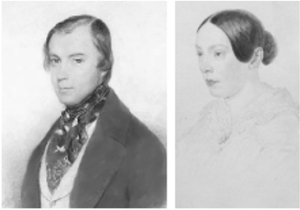
(Left) Osip Ivanovich Senkovsky (Right) Adelaide Alexandrovna Senkovskaya.
At the age of twenty, she had been lost at the bottom of society’s ocean, and only the roar of the sensuous world reached her, only theater posters and signs of luxury! As a stranger, she admired the magnificent sun that illuminated her friends, the “chosen ones,” but she did not take advantage of its warmth. But now Helena Andreevna’s star was ascending, and she became acquainted with many writers, artists, and performers at this time. There were many new faces, strangers, and relatives who, enchanted by her, vied with each other to please, and entertain her. Bowing before the talents of others, Helena Andreevna increasingly attracted the attention of society and became an object of idle curiosity. But she was greatly burdened by this, and her modesty, strengthened by shyness, did not allow her to believe the sincerity of compliments or enthusiastic attention. She was inclined to suspect ridicule, even ill will, in them.
Yes, she was intoxicated by Senkovsky, but she was not blinded. Osip Ivanovich, evidently inflamed with love for Helena Andreevna since the moment they met, pursued her with explanations. He demanded from her some kind of “enthusiastic friendship,” imitating her character. He raved about idealism and Platonism, but such friendship was a “hair stretched across the river of Mohammed’s Hell.” Did he expect her to betray duty and the blind trust of his wife? To sell her soul and conscience? For what? From an early age, she considered the feelings of friendship, as well as love, to be sacred. Was she to be a hypocrite out of self-interest? “Ugh! Disgusting!” she thought. “By doing this I would defile high feelings. I would humiliate myself in my own eyes. I want—I must respect myself.”[7] Having seen through the fog, Helena Andreevna recognized the dark plans under his cloak of friendship and patronage. She could not trust him. At first, he bored her, but now he disgusted her.[8] Helena Andreevna grew closer to Katerina Aleksandrovna whom she learned was very unhappy, who was not leading such a vain life out of desire, but rather to please her aunts. Having learned the truth, Helena Andreevna apologized for being mistaken. Katerina even gave Helena Andreyevna her diary, which contained the “secret story” of a doomed love affair with a dashing hussar of the Leyb Gvardiya (“Life Guards.”)[9]
-
- NOVOROSSIYA
- The Arbiter Of Europe’s Destiny.
- The House Dolgorukuy
- Madame Krüdener
- Ekaterinoslav
- The Arabat Arrow
- The Mystery Of General Inzov
- The Doukhobors
- Pushkin
- Chuguev Military Settlement
- “The Blessed”
- The Decembrists
- Penza
- Independence
- Last Words Of Samuel Khristianovich Kontenius
- “Amid Coffins And Desolation”
- Rusalka
- Dead Souls
- Secret Passages
- Astrakhan
- Nevsky Prospekt
- Kalmyk Ulus
- Love And Ambition
- Duellistes
- Pyatigorsk
- A Heroine Of Our Time
- Winter Palace
- Zeneida R-Va
- Steppes
- Letter To Natalya
- Fire And Ice
SOURCES:
[1] Greenleaf, Monika. “Pushkin’s Byronic Apprenticeship: A Problem In Cultural Syncretism.” The Russian Review. Vol. LIII, No. 3 (July 1994): 382–398; Lansdown, Richard; Reichardt, Dosia. “‘Almost As Far As Petersburg’: Byron And The Russians.” Keats-Shelley Journal. Vol. LVI (2007): 52-77.
[2] Ritchie, Leitch. A Journey To St. Petersburg And Moscow Through Courland And Livonia. Longman, Rees, Orme, Brown. Green, And Longman. London, England. (1836): 83.
[3] [“Letter From E. A. Hahn To Natalya P. Dated January 10, 1839. [Kamenskoye Village, Ekaterinoslav Province.]” [Preparation of the text and comments by A.D. Tyurikov. Bahmut Roerich Center. Originally published in: Gershenzon, M.O. “Russian Woman Of The ‘30s.” Russian Thought. Vol. XII, C. 55 (December 1911.)]
[4] Ibid.
[5] Ibid.
[6] Prikhodka, Irina. “Iconic Characters: Othello.” In: The Cambridge Guide To The Worlds Of Shakespeare: Vol. II. (ed.) Smith, Bruce R. Cambridge University Press. Cambridge, England. (2016): 1332-1334.
[7] [“Letter From E. A. Hahn To Natalya P. Dated January 10, 1839. [Kamenskoye Village, Ekaterinoslav Province.]” [Preparation of the text and comments by A.D. Tyurikov. Bahmut Roerich Center. Originally published in: Gershenzon, M.O. “Russian Woman Of The ‘30s.” Russian Thought. Vol. XII, C. 55 (December 1911.)]
[8] Fadeeva, N. A. “Helena Andreyevna Hahn and Osip Ivanovich Senkovsky In 1836–1838.” Russkaia Starina. Vol. LXVI, No. 4 (April 1890): 185-191.
[9] “Letters From P. A. Hahn To G. V. Nechaev.” Letter 1. Dated June 5, 1836. [Stary Oskol.] [Bahmut Roerich Center.]; Nekrasova, E. S. “Helena Andreyevna Hahn (1814-1842): Part I.” Russkaia Starina. Vol. LI, No. 8 (August 1886): 335-354; Nekrasova, E. S. “Helena Andreyevna Hahn (1814-1842): Part II.” Russkaia Starina. Vol. LI, No. 9 (September 1886): 553-574; Zhelikhovskaya, Vera Petrovna. “Helena Andreyevna Hahn (1835-1842.)” Russkaia Starina. Vol. LII, No. 3 (March 1887): 733-766.
Ekaterina Alexandrovna Sushkova
Previous Post
October 15, 2024
Novorossiya: Kalmyk Ulus
Next Post
October 15, 2024 Novorossiya: Duellistes
Recent Comments
"This is a cool article thanks!"
"Another facet of the Leo Taxil affair is that he, posing as Diana Vaughan, had ..."
Browse Our Archives
Select a Category Uncategorized
Select a Month October 2025 March 2025 February 2025 January 2025 December 2024 November 2024 October 2024 September 2024 August 2024 July 2024 June 2024 May 2024 April 2024 March 2024 February 2024 January 2024 December 2023 November 2023 October 2023 September 2023 August 2023 July 2023 June 2023 May 2023 April 2023 March 2023 February 2023 January 2023 December 2022 November 2022 October 2022
TAKE THE
Religious Wisdom Quiz
What acrostic device is used in many Psalms and Proverbs?
Select your answer to see how you score.
Chronological order Numerical sequence Alphabetic order Reversed order
Related posts from Marginalia
Mothers & Daughters: Panikhida

Mothers & Daughters: Crime And Punishment

Mothers & Daughters: The Black Sea

Mothers & Daughters: "A Winter Evening"
TRENDING AT PATHEOS History and Religion

The Dead Man’s Hand: Appalachian Graveyard Magic
When the Mountains Go Dark: Appalachian Folklore for Spooky Season Installment 3...

Angel Crowns: An Eerie Appalachian Death Tradition
When the Mountains Go Dark: Appalachian Folklore for Spooky Season Angel Crowns:...

Is 'Separation of Church and State' Really a...

There has long been a popular belief that Zen Buddhism is as...

Is Our Spirituality Communal or Individual?
Here, I take swings at sacred cows. I suspect that more sacred...

How Could Christianity be Different?
Christians can no longer plead ignorance. And Christians' reluctance to listen will...
view all History and Religion blogs
What Are Your Thoughts?leave a comment
Ad-Free & Subscriber Log-In Subscription Support
- About Us
- 2026 Calendar
- Videos
- Podcasts
- Library of World Religions
- Faith In Media Tracker
- Advertise With Us
- Write for Us
- Privacy Policy
- Terms of Service
- Do Not Sell My Data
- Contact Us
- Radiant Digital
- Manage Newsletter Subscriptions
- Unsubscribe From Notifications
- Sitemap
Copyright 2008-2026, Patheos. All rights reserved.
Subscription Support Ad-Free & Subscriber Log-In
Follow Patheos