
BuddhistCatholicContemplativeEvangelicalGeneral ChristianHinduJewishLatter-day SaintMuslimNew VisionsProgressive Christian
Beliefs
- Buddhist
- Catholic
- Contemplative
- Evangelical
- General Christian
- Hindu
- Jewish
- Latter-day Saint
- More Voices
- Muslim
- New Visions
- Pagan
- Progressive Christian
Topics
- Religion News
- Food and Religion
- Sports and Religion
- Religious Art
- Religious Music and Entertainment
- Religious Events
- History and Religion
- Style and Religion
- Politics and Religion
- Women in Religion
- Recreation Outdoors and Religion
- Business Finance and Religion
- Careers Workplace and Religion
- Education and Religion
- Family Parenting and Religion
- Health Fitness and Religion
- Home and Religion
- Relationships and Religion
- Technology and Religion
- Travel and Religion
Columnists
- Buddhist Columnists
- Business Finance and Religion Columnists
- Careers Workplace and Religion Columnists
- Catholic Columnists
- Contemplative Columnists
- Education and Religion Columnists
- Evangelists Columnists
- Family Parenting and Religion Columnists
- General Christian Columnists
- Health Fitness and Religion Columnists
- Hindu Columnists
- History and Religion Columnists
- Home and Religion Columnists
- Jewish Columnists
- More Voices Columnists
- Latter Day Columnists
- Muslim Columnists
- New Visions Columnists
- Nonreligious Columnists
- Pagan Columnists
- Politics and Religion Columnists
- Progressive Columnists
- Recreation Outdoors and Religion Columnists
- Relationships and Religion Columnists
- Religion News Columnists
- Religious Art Columnists
- Religious Events Columnists
- Religious Music and Entertainment Columnists
- Sports and Religion Columnists
- Style and Religion Columnists
- Technology and Religion Columnists
- Travel and Religion Columnists
- Women in Religion Columnists
Resource Library
- 2026 Calendar
- Library of World Religions
- The 100 Most Holy Places on Earth
- Patheos Answers
- Podcasts
- Videos
- Faith Leaders Database
- Anglican Episcopalian
- Bahai
- Baptist
- Buddhism
- Christianity
- Confucianism
- Eastern Orthodoxy
- Hinduism
- Holiness and Pentecostal
- ISKCON
- Islam
- Judaism
- Lutheran
- Methodist
- The Church of Jesus Christ of Latter-day Saints
- New Age
- Paganism
- Presbytarian and Reformed
- Protestantism
- Religion Behind the Scenes
- Roman Catholic
- Scientology
- Shia Islam
- Sikhism
- Sufism
- Sunni Islam
- Taoism
- Zen
- See all religions
Research Tools
 Ad-Free & Subscriber Log-In Subscription Support
Ad-Free & Subscriber Log-In Subscription Support
Follow Patheos 

- Trending:
- Forgiveness
- |
- Marriage
- |
- Consciousness
- |
- Death Penalty
- |
- Election
- |
- Halloween

- Home
- History and Religion
- A Tournament Of Shadows: A Sinister Rolling Of Thunder
A Tournament Of Shadows: A Sinister Rolling Of Thunder
Last updated on: September 19, 2024 at 6:20 am by Shawn F. Higgins
A Tournament Of Shadows: A Sinister Rolling Of Thunder 2024-09-19T06:20:01-04:00 Shawn F. Higgins
Patheos Explore the world's faith through different perspectives on religion and spirituality! Patheos has the views of the prevalent religions and spiritualities of the world.
A Tournament Of Shadows:
XXII. A Sinister Rolling Of Thunder
In 1812 rumors began to circulate about an upcoming political storm. The incessant movement of troops, gossip, the barely concealed tension between Poles, and various other events, clearly foreshadowed a coming storm. The administration of the Oginsky Canal as well as the headquarters of the Second Army, both being under the jurisdiction of General Falconi, were subsequently transferred to Slonim.[1] Baron Löwenstern, foreseeing a long conflict in case the theatre of war opened up in Russia, decided to place his wife and two children under the protection of Mikhail Ilyich in Telekhany.
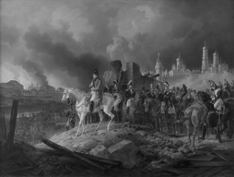
Napoleon and burning Moscow. (Adam Albrecht.)
On June 23, 1812, Napoleon arrived at the Neman, on the extreme frontier between Russia and Prussia. As he appeared on the banks of the river at 2 o’clock in the morning, his horse suddenly stumbled and threw him.
“This is a bad augury,” a voice cried out. “If this occurred to a Roman general, he would turn back.”
Napoleon had scarcely crossed the river the following day when a dull noise agitated the air.
The light became obscured, the wind rose, and a sinister rolling of thunder was heard. The heavens had a menacing aspect, and the naked, shelterless earth had an appearance that filled the soldiers with sadness. Some of those men who were inspired with enthusiasm but a short time before were now trembling with fear, as if they regarded these circumstances as of evil omen. They believed that these fiery clouds, which were gathered together over their heads, were forbidding their entrance into Russia.[2]
“Providence will bless our just cause,” Tsar Alexander Pavlovich declared. “The defense of the nation, the preservation of independence and of the national honor, has forced us to draw the sword. I will not sheathe it again whilst a single enemy remains in arms on the territory of my empire.”[3] The Tsar hurriedly dispatched a courier with the news to Bernadotte.[4] Napoleon’s brutality had galvanized opposition in every corner of society within the Russian empire. Despite his flaws, Tsar Alexander Pavlovich was now regarded by noble and peasant alike as Russia’s only hope, and leader of the only force strong enough to defeat the “Corsican anti-Christ.”[5]
A levee was in progress when the courier reached Stockholm. The English minister was standing near Bernadotte when he read the dispatches.
“I am happy to communicate some good news to you,” Bernadotte remarked when he had finished reading. “The French have crossed the Niemen.”
“But I fail to see how that is good news,” rejoined the minister.
“Until now there was no certainty that Napoleon would not occupy Poland during the winter, arm and discipline the people, collect stores, and invade Russia in the spring. Now it is apparent that he has flung all these advantages behind him, that the Emperor of France is rushing headlong into Russia, and that great disasters await the French army.”[6]
Tsar Alexander Pavlovich received assurance from Bernadotte and Sweden that it would not take advantage of the perilous situation in Russia. The Tsar was now able to transfer to General Kutuzov the 14,000-man garrison that was stationed on the northern frontier. Bernadotte also provided moral support and military advice to Alexander Pavlovich. Avoid major battles at all costs, warned Bernadotte. Concentrate on the enemy’s flanks. Force Napoleon to detach troops. Tire him out with marches and countermarches—the thing French troops loathe the most. This is where they are most vulnerable. Above all else, bring in the Cossacks—the forces most feared by the French. Continue the retreat, Bernadotte concluded. Draw Napolean deeper into the country.
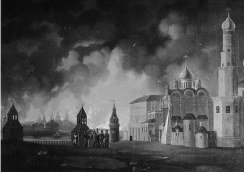
“Fire Of Moscow.” (Alexey Smirnov)
Napoleon celebrated his forty-third birthday on August 15, while engaged in the Battle of Smolensk. The ominous comet, Napoleon’s “star,” left the heavens two days later, having last been observed in Southern Russia on August 17, 1812.[7] The Battle of Smolensk. should have been a decisive victory, but the Russians managed a successful retreat. Napoleon gave the orders to follow them. General Murat implored Napoleon to reconsider, as Winter would soon be upon them. Napoleon could see only Moscow, however, and the glory of conquest. On September 7, Napoleon narrowly defeated the Imperial Russian Army in the Battle of Borodino. Within a week Napoleon stood triumphant at the walls of Moscow.
When the steeples and towers of Moscow rose on the sight, Murat, looking at his battle-worn garments, declared them “unbecoming so great an occasion as the triumphal entrance into the Russian capital,” and retired to change into his most magnificent costume, and properly appareled, rode at the head of his squadrons into the city.[8]
As Napoleon rode into Moscow, he found the city was deserted—only the trotting echoes of horse hooves disrupted the ethereal quietude. Not a soul could be found within the walls; not in the government buildings, palaces, residences, shops, and certainly not in the streets. What the French did not realize was that after the Battle of Smolensk, the 200,000 inhabitants of Moscow had steadily evacuated their holy city. It was far from the triumphant entrance that Napoleon had imagined. The French soldiers quickly went to work looting what they could with frenzied abandon. That night news reached Napoleon that fires were observed in various parts of the city, particularly in the northern district. By midnight the city was fumigated with inky smoke. Great fiery tongues lapped up the skyline with the elegance of a thirsty hound. The French were convinced that these fires were started by the last of the fleeing residents of the conquered city.
~
Baron Löwenstern arrived in Telekhany to retrieve his family who he intended to send to the interior of Russia. He then instructed the crew, treasury, and all the officials of the Orginsky Canal (one hundred people in total,) to take the government barges to Kiev. Mikhail Ilyich, a strict disciplinarian, did not understand how Baron Löwenstern could issue such an order without approval from Petersburg.
“Now is not the time to comply with regulations,” argued Baron Löwenstern. “The authorities do not have time to worry about the fate of a handful of officials—they’re concerned about saving Mother Russia! Every man must now fend for himself.”
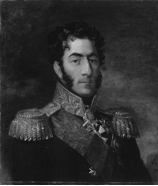
Pyotr Ivanovich Bagration.
Though he did not agree with the order, Mikhail Ilyich sent Andrei Mikhailovich away with Baron Löwenstern. They arrived in Slonim the following day where they found the city in turmoil. Part of the headquarters of the Second Armenian Army was already retreating, the rest were instructed to clear the city that same day. Andrei Mikhailovich was ordered to report to General Falconi. The general, however, without permission, fled with his family on a road to Russia (no one knew where exactly) as soon as he learned of the approaching army. (Had he been a Russian, General Falconi would have surely stood trial, but he was a compatriot of General de Volant, the right-hand chief of Prince Oldenburg, and at the end of the campaign received a medal for his prudence in saving government property.)
“Go, without haste, back to your father,” Baron Löwenstern told Andrei Mikhailovich. “Tell Mikhail Ilyich I send a messenger to Prince Bagration (Commander-In-Chief of the Second Army) requesting further instruction.”
Andrei Mikhailovich set off immediately, but it was difficult to secure a ride. The Oginsky Canal, and its surrounding area, were already under enemy occupation. Post-horses at the stations along the route of trade were already captured by Napoleon’s troops.
“Free people cannot be hired for money,” thought Andrei Mikhailovich, who decided to go one foot to the town of Zhyrovichy, ten miles from Slonim. Fortunately, both the Russian and enemy army, following known direction, marched like a fiery forest along the main highways and paid little attention to any towns more than a mile off the road.
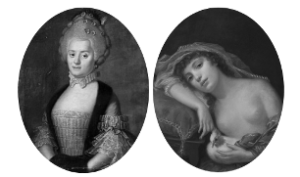
(Left) Ludwika Maria Rzewuska (Right) Rozalia Lubomirska.
When he reached Zhyrovichy, Andrei Mikhailovich found a Jewish man who offered to take him to Telekhany. When they arrived, Andrei Mikhailovich learned that his father was instructed by Prince Bagration to fill the barges and boats with the government people, and go to the city of Mazyr and await further instruction from Colonel Zapolsky. Andrei Mikhailovich and his escort then traveled to Mazyr and, wishing to avoid enemy captivity, moved with incredible speed. (Fortunately, the local residents did not interfere with their mission.) A few days later they arrived in the small town of Mazyr. Here Andrei Mikhailovich was re-united with his father among the detachments of various teams of retreating officials. Colonel Zapolsky, who was in command, asked Andrei Mikhailovich if he wanted to be his adjutant. The boy liked this proposal at first, but when he realized that Colonel Zapolsky was almost certainly drunk, he declined the offer. He was sent, instead, to Kiev, and report to Count Mikhail Andreyevich Miloradovich, the Military Governor. The weather was good, and had it not been for the poisonous reason for the trip, the slow journey could even be called pleasant. Along the way, at the overnight stops, they were received very hospitably by coastal residents and landowners.
In Chernobyl, they stayed as guests of the venerable octogenarian, Ludwika Maria Rzewuska, Countess Khodkevich. She was the mother of Princess Rozalia Lubomirska, a friend of Marie Antoinette, who, like that unhappy Queen, met her demise in France during the Reign of Terror. There were still only dark, vague rumors about Napoleon’s entry into Russia, and Alexander Khodevich, the Countess’s son, assured Andrei Mikhailovich that “the whole war would end on feathers.”
Three weeks later they reached Kiev but Count Miloradovich had gone to Kaluga to form a reserve army, and Commandant General Massé was in charge of the city in his absence. A kindly old man, Massé was known as an incorrigible “red tape” so unconscious of his behavior, he was almost an equal to the famous German Baron Munchausen. Massé, together with Colonel Repninsky, amused the people of Kiev with funny stories.
“When I was a bombardier corporal under Empress Elisaveta Petrovna, there was a big strong man in our unit, but a drunkard,” said Massé. “He once carried two cannons on his shoulder into a tavern and drank away two cannons.”
“Well, I once met siamese twins who were joined together back-to-back,” said Colonel Repninsky. “They grew up happily in this way, but when they reached maturity one went into military service and the other joined a monastery.”
Outlandish as these stories were, both men were incredulous if anyone did not believe them. Every day they quarreled with each other and every day they made up more tall tales.
Kiev was more overcrowded than Mazyr with various units of troops and officials leaving the enemy. There were no vacant apartments, especially since a year earlier the largest and best part of Kiev had burned down.[9]
SOURCES:
[1] Mikaberidze, Alexander Mikaberidze. The Russian Officer Corps Of The Revolutionary And Napoleonic Wars. Savas Beatie. New York, New York. (2005): 232.
[2] “Omens In Wartimes.” The Manning Times. (Manning, South Carolina) September 6, 1905.
[3] Wilson, Robert. Narrative Of Events During The Invasion Of Russia By Napoleon Bonaparte, And The Retreat Of The French Army, 1812. John Murray. London, England. (1860): 24-25.
[4] “Napoleon’s Marshals: VI. Bernadotte, King Of Sweden.” The Illustrated American. Vol. VI, No. 58 (March 28, 1891): 297-301.
[5] Bennett, Richard E. 1820: Dawning Of The Restoration. Brigham Young University. Provo, Utah. (2020): 57‒80. [Chapter Three: “Tsar Alexander I: The King Of The North And His Holy Alliance.”]
[6] “Napoleon’s Marshals: VI. Bernadotte, King Of Sweden.” The Illustrated American. Vol. VI, No. 58 (March 28, 1891): 297-301.
[7] “Long-Tailed Comet Shows In June.” The Spokesman-Review. (Spokane, Washington) May 29, 1921.
[8] Headley, Joel Tyler. Napoleon And His Marshals: Vol. II. Baker And Scribner. New York, New York. (1847): 1-53. [Chapter One: Marshal Murat.]
[9] Fadeyev, Andrei Mikhailovich*. Vospominaniia: 1790-1867*. Vysochaishe Utverzhd. Yuzhno-Russkago. Odessa, Ukraine. [Russian Empire.] (1897): Part I: 17-20.
Previous Post
September 18, 2024
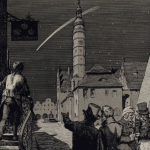
A Tournament Of Shadows: The Corsican Antichrist
Next Post

September 19, 2024 A Tournament Of Shadows: Pestilence That Walketh In Darkness
Recent Comments
"This is a cool article thanks!"
"Another facet of the Leo Taxil affair is that he, posing as Diana Vaughan, had ..."
Browse Our Archives
Select a Category Uncategorized
Select a Month October 2025 March 2025 February 2025 January 2025 December 2024 November 2024 October 2024 September 2024 August 2024 July 2024 June 2024 May 2024 April 2024 March 2024 February 2024 January 2024 December 2023 November 2023 October 2023 September 2023 August 2023 July 2023 June 2023 May 2023 April 2023 March 2023 February 2023 January 2023 December 2022 November 2022 October 2022
TAKE THE
Religious Wisdom Quiz
Who was turned into a pillar of salt?
Select your answer to see how you score.
Ruth Lot Naomi Lot's wife
Related posts from Marginalia
Mothers & Daughters: Prince Tyumen
Mothers & Daughters: Panikhida
Mothers & Daughters: Crime And Punishment
Mothers & Daughters: The Black Sea
TRENDING AT PATHEOS History and Religion

The Dead Man’s Hand: Appalachian Graveyard Magic
When the Mountains Go Dark: Appalachian Folklore for Spooky Season Installment 3...

Angel Crowns: An Eerie Appalachian Death Tradition
When the Mountains Go Dark: Appalachian Folklore for Spooky Season Angel Crowns:...

Is 'Separation of Church and State' Really a...

There has long been a popular belief that Zen Buddhism is as...

Is Our Spirituality Communal or Individual?
Here, I take swings at sacred cows. I suspect that more sacred...

How Could Christianity be Different?
Christians can no longer plead ignorance. And Christians' reluctance to listen will...
view all History and Religion blogs
What Are Your Thoughts?leave a comment
Ad-Free & Subscriber Log-In Subscription Support
- About Us
- 2026 Calendar
- Videos
- Podcasts
- Library of World Religions
- Faith In Media Tracker
- Advertise With Us
- Write for Us
- Privacy Policy
- Terms of Service
- Do Not Sell My Data
- Contact Us
- Radiant Digital
- Manage Newsletter Subscriptions
- Unsubscribe From Notifications
- Sitemap
Copyright 2008-2026, Patheos. All rights reserved.
Subscription Support Ad-Free & Subscriber Log-In
Follow Patheos