
BuddhistCatholicContemplativeEvangelicalGeneral ChristianHinduJewishLatter-day SaintMuslimNew VisionsProgressive Christian
Beliefs
- Buddhist
- Catholic
- Contemplative
- Evangelical
- General Christian
- Hindu
- Jewish
- Latter-day Saint
- More Voices
- Muslim
- New Visions
- Pagan
- Progressive Christian
Topics
- Religion News
- Food and Religion
- Sports and Religion
- Religious Art
- Religious Music and Entertainment
- Religious Events
- History and Religion
- Style and Religion
- Politics and Religion
- Women in Religion
- Recreation Outdoors and Religion
- Business Finance and Religion
- Careers Workplace and Religion
- Education and Religion
- Family Parenting and Religion
- Health Fitness and Religion
- Home and Religion
- Relationships and Religion
- Technology and Religion
- Travel and Religion
Columnists
- Buddhist Columnists
- Business Finance and Religion Columnists
- Careers Workplace and Religion Columnists
- Catholic Columnists
- Contemplative Columnists
- Education and Religion Columnists
- Evangelists Columnists
- Family Parenting and Religion Columnists
- General Christian Columnists
- Health Fitness and Religion Columnists
- Hindu Columnists
- History and Religion Columnists
- Home and Religion Columnists
- Jewish Columnists
- More Voices Columnists
- Latter Day Columnists
- Muslim Columnists
- New Visions Columnists
- Nonreligious Columnists
- Pagan Columnists
- Politics and Religion Columnists
- Progressive Columnists
- Recreation Outdoors and Religion Columnists
- Relationships and Religion Columnists
- Religion News Columnists
- Religious Art Columnists
- Religious Events Columnists
- Religious Music and Entertainment Columnists
- Sports and Religion Columnists
- Style and Religion Columnists
- Technology and Religion Columnists
- Travel and Religion Columnists
- Women in Religion Columnists
Resource Library
- 2026 Calendar
- Library of World Religions
- The 100 Most Holy Places on Earth
- Patheos Answers
- Podcasts
- Videos
- Faith Leaders Database
- Anglican Episcopalian
- Bahai
- Baptist
- Buddhism
- Christianity
- Confucianism
- Eastern Orthodoxy
- Hinduism
- Holiness and Pentecostal
- ISKCON
- Islam
- Judaism
- Lutheran
- Methodist
- The Church of Jesus Christ of Latter-day Saints
- New Age
- Paganism
- Presbytarian and Reformed
- Protestantism
- Religion Behind the Scenes
- Roman Catholic
- Scientology
- Shia Islam
- Sikhism
- Sufism
- Sunni Islam
- Taoism
- Zen
- See all religions
Research Tools
 Ad-Free & Subscriber Log-In Subscription Support
Ad-Free & Subscriber Log-In Subscription Support
Follow Patheos 

- Trending:
- Forgiveness
- |
- Marriage
- |
- Consciousness
- |
- Death Penalty
- |
- Election
- |
- Halloween

- Home
- History and Religion
- A Tournament Of Shadows: A Ballet Of Falling Saber Strokes
A Tournament Of Shadows: A Ballet Of Falling Saber Strokes
Last updated on: September 8, 2024 at 7:28 am by Shawn F. Higgins
A Tournament Of Shadows: A Ballet Of Falling Saber Strokes 2024-09-08T07:28:54-04:00 Shawn F. Higgins
Patheos Explore the world's faith through different perspectives on religion and spirituality! Patheos has the views of the prevalent religions and spiritualities of the world.
A Tournament Of Shadows:
XIII. A Ballet Of Falling Saber Strokes
It was during the second day of the Battle of Eylau that Joachim Murat appeared in his most terrible aspect. This battle, which began February 7, 1807, was the most important (and bloody,) that had yet occurred. France and Russia had never yet brought such to the battlefield, and a complete victory on either side would have settled the fate of Europe. It was during this fight that Murat performed one of those desperate deeds for which he was so renowned.
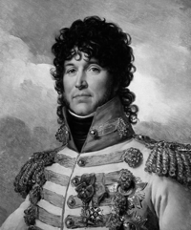
Joachim Murat.
The three distinguishing characteristics of Joachim Murat were great chivalric courage, his skill as a general, and an unequaled coolness in the “hour of peril.” He was tall, walked like a king, and had a strikingly noble face. He had long, wavy black locks that contrasted singularly with his fiery blue eyes. (Few men, it was said, could bear his piercing glance.) He wore a three-cornered hat, with a taunting white plume of ostrich feathers; his dazzling appearance made him a mark for the enemy’s bullets, and it seemed a miracle in itself that, being so conspicuous, he was never shot down, and was only very rarely wounded. The one example that stands out occurred during the Battle of Abukir. Napoleon appointed Murat to force the center of the Turkish lines. Murat routed column after column, driving the Mamluks into the sea. During one of these fierce charges, Murat rode straight through the Turkish ranks and dashed into the camp of Mustafa Pasha, galloping straight up to the Turkish chieftain who stood surrounded by two hundred Janissaries (slave-soldiers.) As the Pasha saw him approach, he advanced rapidly to meet him, and drawing a pistol, aimed it at Murat’s head. The bullet grazed his cheek, and before he could even bleed, Murat’s glittering sword, shimmering before the eyes of the Pasha, descended on his hand, slicing off two of his fingers. The Pasha was seized and carried off as a prisoner into the French camp. His brilliant achievements in this battle placed him forever in the affections of Napoleon.
Though the beginnings of his life were unpromising enough, of Napoleon’s officers, none would have a career as picturesque and romantic as Murat. He was one of the many children born to a country landlord who kept a small tavern in Bastide. None of his siblings showed any remarkable qualities, but Murat’s reckless daring and audacity marked him out at an early age. His parents wanted him for the Church, but he hated books, and he finally declared that he was only fit for a military life. Nevertheless, he entered the college at Toulouse and was jokingly known among his companions as “L’Abbé.” A decidedly unclerical episode ended his priestly career. A love affair with a pretty girl of Toulouse led to a duel which, having won, he “carried off his prize” and lived with her until his last penny was spent. Murat then enlisted in the Twelfth Regiment of Chasseurs where he got some promotion and did well for himself for some time, but, being guilty of insubordination, he was reduced to the ranks and obliged to leave his corps. Abandoning the military life, Murat returned home and took to the stables, first as his father’s ostler, then as groom (horse-keeper) on his own account. The monotony of this life, however, was too much for him. With young Bessières, he traveled to Paris where he enrolled in the Constitutional Guard of Louis XVI. Here he distinguished himself chiefly by fighting duels. (He was known to have fought five times.) Revolutionary ideas were running rampant in Paris at the time, and Murat was an early convert. He was so pronounced a “Jacobin” (Far-Left revolutionary.) Before the end of the “Reign of Terror,” he was a captain in the 13th Chasseurs. He became a member of Napoleon’s personal staff in 1795 and fought with him in the Italian Campaign.[1] During the Egyptian Campaign, he further made his quality known. Once, on the banks of the Jordan, the witchery of Murat’s horsemanship was on full display as he dashed alone into the center of a large body of Turkish cavalry. Nothing could be seen except a mass of turbaned heads, flashing scimitars, and a single white plume tossing like a banner over the enemy throng. The battle thickened, and Murat’s mighty war horse plunged amid the saber strokes that fell on all sides. Then the multitude surged back, and a single rider burst through, his arm that grasped his dripping sword was red to the elbow. Murat said that in the hottest heat of this fight, he thought of Christ’s transfiguration on that same spot nearly two thousand years before, and it gave him “tenfold courage and strength.” He was promoted in rank on the spot, and Napoleon made him one of the few men who returned with him to France in 1799. Murat then took a leading part in the revolution of the 18th Brumaire, standing by Napoleon when he entered the Council of the Five Hundred where he was received with the cry: “Down with the tyrant.”
“Charge!—Bayonets!” answered Murat, as the battalion of soldiers under his command marched into the hall to dissolve the Assembly.[2]
Not long afterward, Napoleon gave him his youngest sister, Caroline Bonaparte, in marriage. A fortnight after the wedding, Murat accompanied Napoleon across the St. Bernard into Italy, where he commanded the cavalry at Marengo. He was later made Governor of Paris, and at the proclamation of the empire, he received the Marshal’s Baton. The Emperor lavished favors on his favorite brother-in-law, who became “Grand Admiral,” “Prince of the Empire,” and “First Horseman of Europe.” In 1806 he was made Grand Duke de Berg and Cleves, and subsequently named Governor of Madrid.
On February 8, 1807, the field of Eylau was covered with snow, and the little ponds that lay scattered around were frozen enough to bear the artillery. Seventy-five thousand men on one side, and eighty-five thousand on the other, arising from the frozen field on which they had slept the night before without tent or covering. Steadily advancing through a snowstorm so thick they could not see the enemy, the Russian cannon mowed down the French ranks with their destructive fire. The menacing Cossack cavalry, ordered to charge, came thundering on, nearly striking the French infantry with their long lances before they were even visible through the storm. It was only when the snowstorm cleared up that Napoleon realized his perilous situation. Though nothing was farther from Napoleon’s wishes than the bringing of his reserve into the engagement at this early stage of the battle, he nevertheless immediately ordered a grand charge by the Imperial Guard and the whole cavalry. Nothing could be more imposing than the battlefield at this time, as Napoleon’s Empire trembled in the balance. It was then that Napoleon saw Murat’s white plume streaming through the snowstorm with a smile passed over his countenance.
Behind Murat, above the dark and angry mass below, there were thousands of glittering helmets and flashing sabers. The seventy squadrons he led were descending in a plunging trot. They resembled the foam of a sea wave as it crests on the deep. The earth groaned as they passed. The rattling of their armor, and the thunderous orchestra of their tread, drowned all the roar of battle as they crashed down upon the foe. Like an avalanche or a falling mountain, Murat’s charge shocked the lines of the Russian army, which went down like frost-work. Then a protracted, primal, fight commenced, hand-to-hand and sword-to-sword, and the clashing of steel was like the ringing of countless hammers.
The Russian reserves were ordered up, but they fell to Murat’s fierce horsemen who trampled them down by thousands. The tenacious Russians disdained to retreat and rallied again and again. It was during this fight that Murat was seen to perform a desperate deed for which he was so renowned. Frenzied to the highest pitch of passion by the obstacles in his way, Murat seemed “endowed with ten-fold strength, and looked more like a superhuman being treading down helpless mortals, than an ordinary man.” Amid the ballet of falling saber strokes, and the roaring symphony of artillery and musketry, that lofty white plume never once went down. He raged with ravenous hunger, like an unloosed lion, as the glow of battle burned with increased luster. Murat’s clear and steady voice was heard above the tumult to cheer on his followers and was worth more than a thousand trumpets. Seeing a knot of Russian soldiers that had kept up a devouring fire on his men, Murat drove his horse full gallop upon their leveled muskets. A few of his guard (who never allowed that white plume to leave their sight) charged after. Without even waiting to count his foes, Murat seized the bridle in his teeth, and with his drawn sword in one hand, and a pistol in the other, he swan-dived in fury upon them, scattering the Russians as if a hurricane had swept by. Though prodigies of valor were performed by belligerents on both sides, tens of thousands of men had been slain, and when night closed on the awful scene, the Russians were compelled to retire from the field.[3]
SOURCES:
[1] “Napoleon’s Marshals: III. Joachim Murat, King Od Naples.” The Illustrated American. Vol. VI, No. 55 (March 7, 1891): 149-152.
[2] Murat, Caroline. My Memoirs. G. P. Putnam’s Sons. New York, New York. (1910): 15-23.
[3] Headley, Joel Tyler. Napoleon And His Marshals: Vol. II. Baker And Scribner. New York, New York. (1847): 1-53. [Chapter One: Marshal Murat.]
Previous Post
September 8, 2024
A Tournament Of Shadows: Le Grand Sanhedrin
Next Post
September 11, 2024 A Tournament Of Shadows: A Raft On The Neman
Recent Comments
"This is a cool article thanks!"
"Another facet of the Leo Taxil affair is that he, posing as Diana Vaughan, had ..."
Browse Our Archives
Select a Category Uncategorized
Select a Month October 2025 March 2025 February 2025 January 2025 December 2024 November 2024 October 2024 September 2024 August 2024 July 2024 June 2024 May 2024 April 2024 March 2024 February 2024 January 2024 December 2023 November 2023 October 2023 September 2023 August 2023 July 2023 June 2023 May 2023 April 2023 March 2023 February 2023 January 2023 December 2022 November 2022 October 2022
TAKE THE
Religious Wisdom Quiz
Who dreamed of a ladder reaching to heaven?
Select your answer to see how you score.
Simeon Joseph Jacob Isaac
Related posts from Marginalia
TRENDING AT PATHEOS History and Religion

The Dead Man’s Hand: Appalachian Graveyard Magic
When the Mountains Go Dark: Appalachian Folklore for Spooky Season Installment 3...

Angel Crowns: An Eerie Appalachian Death Tradition
When the Mountains Go Dark: Appalachian Folklore for Spooky Season Angel Crowns:...

Is 'Separation of Church and State' Really a...

There has long been a popular belief that Zen Buddhism is as...

Is Our Spirituality Communal or Individual?
Here, I take swings at sacred cows. I suspect that more sacred...

How Could Christianity be Different?
Christians can no longer plead ignorance. And Christians' reluctance to listen will...
view all History and Religion blogs
What Are Your Thoughts?leave a comment
Ad-Free & Subscriber Log-In Subscription Support
- About Us
- 2026 Calendar
- Videos
- Podcasts
- Library of World Religions
- Faith In Media Tracker
- Advertise With Us
- Write for Us
- Privacy Policy
- Terms of Service
- Do Not Sell My Data
- Contact Us
- Radiant Digital
- Manage Newsletter Subscriptions
- Unsubscribe From Notifications
- Sitemap
Copyright 2008-2026, Patheos. All rights reserved.
Subscription Support Ad-Free & Subscriber Log-In
Follow Patheos