
BuddhistCatholicContemplativeEvangelicalGeneral ChristianHinduJewishLatter-day SaintMuslimNew VisionsProgressive Christian
Beliefs
- Buddhist
- Catholic
- Contemplative
- Evangelical
- General Christian
- Hindu
- Jewish
- Latter-day Saint
- More Voices
- Muslim
- New Visions
- Pagan
- Progressive Christian
Topics
- Religion News
- Food and Religion
- Sports and Religion
- Religious Art
- Religious Music and Entertainment
- Religious Events
- History and Religion
- Style and Religion
- Politics and Religion
- Women in Religion
- Recreation Outdoors and Religion
- Business Finance and Religion
- Careers Workplace and Religion
- Education and Religion
- Family Parenting and Religion
- Health Fitness and Religion
- Home and Religion
- Relationships and Religion
- Technology and Religion
- Travel and Religion
Columnists
- Buddhist Columnists
- Business Finance and Religion Columnists
- Careers Workplace and Religion Columnists
- Catholic Columnists
- Contemplative Columnists
- Education and Religion Columnists
- Evangelists Columnists
- Family Parenting and Religion Columnists
- General Christian Columnists
- Health Fitness and Religion Columnists
- Hindu Columnists
- History and Religion Columnists
- Home and Religion Columnists
- Jewish Columnists
- More Voices Columnists
- Latter Day Columnists
- Muslim Columnists
- New Visions Columnists
- Nonreligious Columnists
- Pagan Columnists
- Politics and Religion Columnists
- Progressive Columnists
- Recreation Outdoors and Religion Columnists
- Relationships and Religion Columnists
- Religion News Columnists
- Religious Art Columnists
- Religious Events Columnists
- Religious Music and Entertainment Columnists
- Sports and Religion Columnists
- Style and Religion Columnists
- Technology and Religion Columnists
- Travel and Religion Columnists
- Women in Religion Columnists
Resource Library
- 2026 Calendar
- Library of World Religions
- The 100 Most Holy Places on Earth
- Patheos Answers
- Podcasts
- Videos
- Faith Leaders Database
- Anglican Episcopalian
- Bahai
- Baptist
- Buddhism
- Christianity
- Confucianism
- Eastern Orthodoxy
- Hinduism
- Holiness and Pentecostal
- ISKCON
- Islam
- Judaism
- Lutheran
- Methodist
- The Church of Jesus Christ of Latter-day Saints
- New Age
- Paganism
- Presbytarian and Reformed
- Protestantism
- Religion Behind the Scenes
- Roman Catholic
- Scientology
- Shia Islam
- Sikhism
- Sufism
- Sunni Islam
- Taoism
- Zen
- See all religions
Research Tools
 Ad-Free & Subscriber Log-In Subscription Support
Ad-Free & Subscriber Log-In Subscription Support
Follow Patheos 

- Trending:
- Forgiveness
- |
- Marriage
- |
- Consciousness
- |
- Death Penalty
- |
- Election
- |
- Halloween

- Home
- Hindu
- History and Religion
- On The Field Of Plassey
On The Field Of Plassey
Last updated on: February 17, 2024 at 3:57 pm by Shawn F. Higgins
On The Field Of Plassey 2024-02-17T15:57:54-05:00 Shawn F. Higgins
Patheos Explore the world's faith through different perspectives on religion and spirituality! Patheos has the views of the prevalent religions and spiritualities of the world.
ON THE FIELDS OF PLASSEY
Charles Johnston.
November 1889.
In one of the camping expeditions of the cold season we visited Plassey, on the Ganges bank, in a region of tropical woods. It happened that we were at no great distance from the field on which the foundations of India’s military despotism were laid.[1] On the field of Plassey, among the sweet-scented babul-bushes, there is a little village of herdsmen, and in the village are two monuments to the victory that gave us India.[2]
The one, set up after a century of oblivion, by the English authorities, is a lean shaft of granite, some six or eight feet high, on an insignificant pedestal, and surrounded by a broken, rust-eaten iron railing, against which is heaped up every imaginable kind of filth, for this, the meanest monument that ever marked a great event in history, has become the openly acknowledged rubbish heap of the whole village.
The other monument was built without any order in Council or Government decree; it is not recorded in the annals of the Board of Public Works, nor do I remember a description of it in the books of tourist or traveler. Nevertheless, it is very noteworthy in its way. It is a little rounded pyramid of clay, on a smooth clay platform, two or three yards square; in the side of the pyramid, which stands some three feet high, is scooped a shallow hole, where a wick soaked in coconut oil, and held in a shallow saucer of red clay, is burned on high days and holidays, in honor of the spirits of the dead.
These lean and dusky villagers, naked but for the scant loin-cloth, and with a headdress of torn rag, had little interest in the event of the battle, yet they preserve a sort of memory of it, too.[3] The Nawabs, they say, came from the north, with many elephants and horses and the Sahibs, that is, the English, came from the south, with many men and guns; and they met there, under the palms, among the scented mimosas, and they fought and they were slain. What they fought for the villagers never knew; but they built this mud altar, to appease the spirits of the dead. Here on the round summit of their monument are heaped up queer shaped horses of hand-molded clay, hardly a span long, for the dead warriors to ride, if the spirit of restlessness comes on them in the night time. And round the platform are six bamboo staves, set up in order, the tops connected by a silken thread, and from which hang yellow cocoons of silk; this is a magical enclosure, to keep the spirits from wandering, so that they may not molest the villagers. I have often thought that, when the British Government of India is a thing of the past, its fate will be like that lean, dishonored shaft of granite left to be forgotten, beside a green-scummed pond, and that, when it has sunk to oblivion, the Indian millions will stay play at ghost-worship beside their timid shrines, will still mold little clay horses for the dead to ride, and stretch silk threads to keep the wraiths within due bounds.
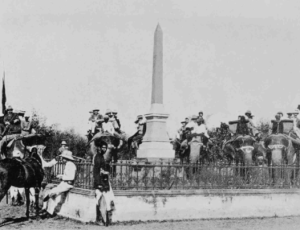
Plassey Monument.[4]
Everyone knows that a prophecy was one of the chief causes of the Indian mutiny—the prophecy that the East India Company’s rule should end just 100 years from the decisive victory in 1757, but very few realize that this prophecy was literally fulfilled, and fewer still know that the first flames of the mutiny broke out, in 1857, within twelve or fifteen miles of the spot where the battle of Plassey made the English practical lords of the land, just one century before.
So close are the two points, Plassey, where the Nawabs of Bengal were defeated in 1757, and Berhampore, where the first acts of revolt broke out over the famous greased cartridges, that an ordinary map would show them as coincident, and it is only a morning’s ride from one point to the other. Both Berhampore and Plassey are on the left bank of the Bhagirathi—the extreme western arm that bounds the Ganges Delta; both lie beneath the huge embankment that time and many races have built up to curb the river; and both are full of the scent of mimosas, whose flowers, like little balls of yellow silk, fill the air with a perfume of almost intolerable sweetness.
But while Berhampore is finely built on a finely planned scale, and with a certain dignity and beauty, Plassey is nothing but a wretched village, of a few mud huts, grouped together in the shadow of a huge banyan tree, and surrounded on all sides by illimitable rice fields, stretching away under the sunlit gaze of the horizon. The dead flatness of the plain is hardly broken by great feathery clumps of bamboos, and thin staggering palms that stretch their ragged fingers towards the sky. Above the village, higher than the palm trees, the brown kites circle, shrilly crying out, with a whistling shriek, and above the kites, like dark specks in the blue, soar the vultures in the wider circles, with unmoving wings. There is a damp, acrid smell of smoke round the village, and a sour vapor from the green-flecked pond, whence the peasants draw their drinking water. And, close to the pond, are two monuments to the battle of Plassey.
It was up the river from Plassey that the tide of victory flowed in 1757; flowed on, along the old Ganges bed, until it had reached great Delhi and the palace of the Moghul kings. All the great cities of the upper provinces were the scenes of victories or acts of strong wrong-doing, in the interest of statecraft, and for the glory of British rule. It was up the river, along the same water highway, that ran the tide of disaster, when the flames that first broke forth at Berhampore in 1857, gained strength and volume, until once more Delhi, with its palace of old Moghuls, was the center of appalling tragedy and disaster. So fate brought in its revenges.
On either side of the cantonment square of Berhampore, behind the officers’ lines and parallel to them, lay the lines of the sepoy regiments, where the first spark was struck, that kindled the mutiny and set the whole of India ablaze. There are no native soldiers in Berhampore, but one cannot pass through the cantonment of a native Indian regiment without seeing with what terrible ease the old conditions might be repeated, and the whole trouble burst forth afresh. There is a mixture of servility and insolence about the men, with their dark faces and glittering shifting eyes, that shows a mood just short of insubordination. A series of petty incidents, to work up the necessary electric atmosphere, an infringement of caste prejudice, for a pretext, and the hesitation or over-boldness of a weak officer, might at any moment be the signal for stray shots towards the officers’ quarters, such as forty years ago warned the British powers that they had played with fire. And there is no real hope from the loyalty of native Indian regiments: interest, inertia, the desire for trained leadership, the necessity of organization, are poor substitutes for loyalty; and any true loyalty towards a conquering alien race, foreign in faith, speech, and ideals, is a stark impossibility; the more so, when the invading aliens hardly disguise their arrogant sense of their own superiority over the not less proud and far more sensitive natives, whom they call on to be loyal.
Now the fulfillment of the prophecy; the flames of mutiny at Berhampore, one hundred years after the victory of Plassey, and a morning’s ride from the scene of that victory, did indeed kindle a conflagration which finally burnt the old Rule of the East India Company to ruins. The Government, fallen from impotent hands, was taken up by the Imperial Powers, who, meaning much benevolence, have done more to weaken their own position during four decades of peace than the old merchant adventurers—for the East India Company was nothing else—had managed to do in a century of war.
Now, the people of India are of far more sensitive fiber than we are, and their every nerve rings to the vibration of religious fanaticism. With them a prophecy will surely work out its own fulfillment; or there may, in very deed, be a law of cyclic return of things which the framers of these prophecies knew; for centuries and millenniums the wise men of India practiced soothsaying and divination—with what true penetration we cannot hardly declare. And for the present troubles, also, there is a prophecy—of far older date than that which followed Plassey, and which, after a century, was almost perfectly fulfilled. The older forecast dates from full five thousand years ago, or, at least speaks of the fulfillment of cyclic changes that began in that remote day.
Five millenniums since there was a famous battle in India, the central fact of a civil war, the like of which few nations have seen and lived. Races were almost destroyed; kingdoms overthrown; dynasties cast down and lifted up; and that internecine strife was kindled which, in the centuries that followed, made the motherland the prey of strangers, of foreign Powers, of invading armies. Well, it is foretold that now, when the Great Year is full, the wrong then done to India will be righted; the fallen once more raised, the youth of India renewed like the eagle, and it is said that this will once more come of a great battle, fought out at Kurukshetra, under Delhi, the field of the Law, the field of fate. Perhaps this prophecy, too, is destined to work its own fulfillment.[5]
← Table Of Contents →
SOURCES:
[1] In “A Perspective On India,” Johnston writes: “Without the aid of villagers we should never have found the monument to Clive’s decisive victory in 1757, a small, lean obelisk languishing within a rusty railing; hardly a dozen Europeans see it in a year, possibly not half that number. There is a second monument, a round-topped pyramid of clay within a fence of split bamboo and adorned with odd little horses of baked red clay no larger than one’s hand; they are the last vestige, perhaps, of the ‘sacrificial horse’ that played a great part in ancient days in the Ashvamedha sacrifice. This second monument records the piety of the villagers, though they were hardly involved on either side, in the battle that began the British Indian Empire.” [Johnston, Charles. “A Perspective On India.” The Atlantic Monthly. Vol. CXXXVIII, No. 6. (December 1926): 848-856.] In “Home Rule And India,” Johnston writes: “The first of these monuments, a lean shaft of granite, with broken iron railings, was erected a few years ago by the British Indian Government. The other monument was built by the villagers themselves. It is a low pyramid of mud, with a cavity in one side to hold a lamp wick on high days and holidays; and on the pyramid are heaped clay horses, a span long, for the spirits of Plassey’s dead to ride. The pyramid is fenced by six bamboo posts, strung together at the top with cotton threads: on each post, a yellow tuft of silk from waste cocoons, an offering to the village gods.” [Johnston, Charles. “Home Rule And India.” The Calcutta Review. Vol. C., No. 200. (April 1895): 244-252.]
[2] P.C. Majumdar writes: “Plassey is situated on the left bank of the Bhagirathi and is about thirty five miles south of Murshidabad City […] The historical mango grove, which formed the bivouac of the English forces, was eight hundred yards long and three hundred yards broad and was surrounded by an earthen bank and ditch. It was planted with trees and diagonal to the river. The last of the trees fell some years ago. Spoons and other things made of the wood were sold as souvenirs and fetched high prices. Just beyond the grove stood a hunting box belonging to the Nawab, surrounded by a masonry wall. The major portion of the field of battle has been cut away by the river. A monument has been erected bearing the following inscription: ‘Plassey. Erected By The Bengal Government, 1883.’” [Majumdar, Purna Chundra. The Musnud Of Murshidabad (1704-1904): Being A Synopsis Of The History Of Murshidabad For The Last Two Centuries. Saroda Ray. Murshidabad, India. (1905): 241.]
[3] In “Home Rule And India,” Johnston writes: “The old men of the village tell you that, years ago, there was a great battle there between the Nawabs and the Sahibs, as they called the old Mussalman rulers of Bengal and their English rivals. The Nawabs, they relate, came from the North, with their elephants; and the Sahibs came from the South, with their guns; and they fought, and many were slain. The old men do not remember why they fought; for it is a long, long time ago.” [Johnston, Charles. “Home Rule And India.” The Calcutta Review. Vol. C., No. 200. (April 1895): 244-252.]
[4] “Old Plassey Monument.” Bengal: Past & Present. Vol. III. (January-April 1909): 316.
[5] Johnston, Charles. “Prophecy Fulfilled.” The Providence Journal. (Providence, Rhode Island) October 3, 1897.
Hindu
Muslim
Politics and Religion
Previous Post

February 14, 2024
Belgaon
Next Post
February 14, 2024 An Indian School
Recent Comments
"This is a cool article thanks!"
"Another facet of the Leo Taxil affair is that he, posing as Diana Vaughan, had ..."
Browse Our Archives
Select a Category Uncategorized
Select a Month October 2025 March 2025 February 2025 January 2025 December 2024 November 2024 October 2024 September 2024 August 2024 July 2024 June 2024 May 2024 April 2024 March 2024 February 2024 January 2024 December 2023 November 2023 October 2023 September 2023 August 2023 July 2023 June 2023 May 2023 April 2023 March 2023 February 2023 January 2023 December 2022 November 2022 October 2022
TAKE THE
Religious Wisdom Quiz
True or False: Micah prophesied that the Messiah would be born in Bethlehem.
Select your answer to see how you score.
TRUE FALSE
Related posts from Marginalia
Charles Johnston, Tolstoyans, And "Rambles In Russia."
Occultism And The Irish Literary Society In America
A Tournament Of Shadows: Pestilence That Walketh In...
TRENDING AT PATHEOS History and Religion

The Dead Man’s Hand: Appalachian Graveyard Magic
When the Mountains Go Dark: Appalachian Folklore for Spooky Season Installment 3...

Angel Crowns: An Eerie Appalachian Death Tradition
When the Mountains Go Dark: Appalachian Folklore for Spooky Season Angel Crowns:...

Is 'Separation of Church and State' Really a...

There has long been a popular belief that Zen Buddhism is as...

Is Our Spirituality Communal or Individual?
Here, I take swings at sacred cows. I suspect that more sacred...

How Could Christianity be Different?
Christians can no longer plead ignorance. And Christians' reluctance to listen will...
view all History and Religion blogs
What Are Your Thoughts?leave a comment
Ad-Free & Subscriber Log-In Subscription Support
- About Us
- 2026 Calendar
- Videos
- Podcasts
- Library of World Religions
- Faith In Media Tracker
- Advertise With Us
- Write for Us
- Privacy Policy
- Terms of Service
- Do Not Sell My Data
- Contact Us
- Radiant Digital
- Manage Newsletter Subscriptions
- Unsubscribe From Notifications
- Sitemap
Copyright 2008-2026, Patheos. All rights reserved.
Subscription Support Ad-Free & Subscriber Log-In
Follow Patheos