
BuddhistCatholicContemplativeEvangelicalGeneral ChristianHinduJewishLatter-day SaintMuslimNew VisionsProgressive Christian
Beliefs
- Buddhist
- Catholic
- Contemplative
- Evangelical
- General Christian
- Hindu
- Jewish
- Latter-day Saint
- More Voices
- Muslim
- New Visions
- Pagan
- Progressive Christian
Topics
- Religion News
- Food and Religion
- Sports and Religion
- Religious Art
- Religious Music and Entertainment
- Religious Events
- History and Religion
- Style and Religion
- Politics and Religion
- Women in Religion
- Recreation Outdoors and Religion
- Business Finance and Religion
- Careers Workplace and Religion
- Education and Religion
- Family Parenting and Religion
- Health Fitness and Religion
- Home and Religion
- Relationships and Religion
- Technology and Religion
- Travel and Religion
Columnists
- Buddhist Columnists
- Business Finance and Religion Columnists
- Careers Workplace and Religion Columnists
- Catholic Columnists
- Contemplative Columnists
- Education and Religion Columnists
- Evangelists Columnists
- Family Parenting and Religion Columnists
- General Christian Columnists
- Health Fitness and Religion Columnists
- Hindu Columnists
- History and Religion Columnists
- Home and Religion Columnists
- Jewish Columnists
- More Voices Columnists
- Latter Day Columnists
- Muslim Columnists
- New Visions Columnists
- Nonreligious Columnists
- Pagan Columnists
- Politics and Religion Columnists
- Progressive Columnists
- Recreation Outdoors and Religion Columnists
- Relationships and Religion Columnists
- Religion News Columnists
- Religious Art Columnists
- Religious Events Columnists
- Religious Music and Entertainment Columnists
- Sports and Religion Columnists
- Style and Religion Columnists
- Technology and Religion Columnists
- Travel and Religion Columnists
- Women in Religion Columnists
Resource Library
- 2026 Calendar
- Library of World Religions
- The 100 Most Holy Places on Earth
- Patheos Answers
- Podcasts
- Videos
- Faith Leaders Database
- Anglican Episcopalian
- Bahai
- Baptist
- Buddhism
- Christianity
- Confucianism
- Eastern Orthodoxy
- Hinduism
- Holiness and Pentecostal
- ISKCON
- Islam
- Judaism
- Lutheran
- Methodist
- The Church of Jesus Christ of Latter-day Saints
- New Age
- Paganism
- Presbytarian and Reformed
- Protestantism
- Religion Behind the Scenes
- Roman Catholic
- Scientology
- Shia Islam
- Sikhism
- Sufism
- Sunni Islam
- Taoism
- Zen
- See all religions
Research Tools
 Ad-Free & Subscriber Log-In Subscription Support
Ad-Free & Subscriber Log-In Subscription Support
Follow Patheos 

- Trending:
- Forgiveness
- |
- Marriage
- |
- Consciousness
- |
- Death Penalty
- |
- Election
- |
- Halloween

- Home
- Hindu
- History and Religion
- Memorial Tree
Memorial Tree
Last updated on: February 17, 2024 at 4:12 pm by Shawn F. Higgins
Memorial Tree 2024-02-17T16:12:41-05:00 Shawn F. Higgins
Patheos Explore the world's faith through different perspectives on religion and spirituality! Patheos has the views of the prevalent religions and spiritualities of the world.
MEMORIAL TREE
May 31, 1889, marked the end of Ramadan, and the great celebration of Eid al-Fitr. After which the Nawab spent the better part of June at the Dalhousie Institute in Calcutta, in an effort to restore his health.[1] Between “routine work” and studying Hindi, Bengali, and Russian, Johnston’s time was “pretty well filled up.” [2] His aptitude at Russian had advanced enough that he was undertaking a translation Vera Petrovna’s new children’s book, Rosanchik, which was published in Russia earlier that year.[3]
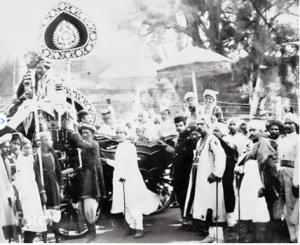
The Eid Procession.[4]
Johnston was probably made aware of a correspondence by his father which appeared in the May 7, 1889, issue of The Evening Standard, in which Ballykilbeg asked that paper to record a “strange fact” concerning the “Memorial Trees” that marked the centenary of the French Revolution.[5] William Johnston’s letter was about his parents, John and Thomasina, and two Lombardy Poplars which were planted in Ballykilbeg, after their marriage, in 1823.[6] He writes: “They grew side by side, and were tall and beautiful, until 1852 and 1853. In those years, my mother first, and then my father, died; and the Poplars, one in 1852 and the other the next year, ceased to exist.”[7] An article particularly strange indeed for the elder Johnston who considered even vegetarianism “a strange mixture of diet and diablism.”[8]
It is curious to note that Kali Prasanna Mukerji, the Secretary of Adhi Bhoutic Bhratri, sent a letter to The Theosophist around this time, discussing a similar topic, and it is not inconceivable that the conversation had its genesis through a discussion with Johnston. Mukerji’s letter was about an Ojah, a kind of “village sorcerer,” who, through trickery, turned the spirit of a Brahmin into a Bhoot (ghost) and tethered it to a tree.[9] He learned the story from Pundit Keshava Chandra Bhuttacharya, a very active and earnest member of the Berhampore Branch. In 1889 Bhuttacharya and fellow member, Nafar Das Roy, opened three clubs in Murshidabad (Gorabazar, Berhampore, and Sydabad) to explain Theosophy to outsiders and new members who felt inconvenienced by attending Branch meetings. It was due to the efforts of these two men that the owing to the exertions of the above two brothers that the Jaina Branch at Balucher was formed.[10]
Not all Ojah were wicked. Johnston would likely have been aware of Nitai Charan Mukherji, a noted Ojah in the Kandi Subdivision who was renowned for his ability to cure snake bites. He would cut a jute plant on an auspicious day, and make a string from its fibers, which was tied to the victim; around the finger if bitten above the waist, around the toe if below the waist. Mantras were chanted, and the poison, which accumulated at the tips of the tied digit. The finger or toe would then be cut, and the poison would secrete like “coal tar.” After recovery, this “quintessence” was given as an offering to Manasa Devi, the goddess of the serpent-race, and when a snake appeared in a house, milk and rice were offered to the god Nag.[11]
← Table Of Contents →
SOURCES:
[1] “The Nawab Of Murshidabad.” The Englishman’s Overland Mail. (Calcutta, India) July 6, 1889.
[2] Guinness, Selina, “Ireland Through The Stereoscope: Reading The Cultural Politics Of Theosophy In The Irish Literary Revival” in Betsey Taylor FitzSimon and James H. Murphy (ed.,) The Irish Revival Reappraised. Four Courts Press. Dublin, Ireland (2004): 19-32.
[3] [Zhelihovskaya, Vera Petrovna. Rosanchik. Izdanie A. F. Devriena. Saint Petersburg, Russia. (1889); Johnston.] Based on the contents of some of Vera’s letters, we might conclude that Johnston was the uncredited translator for the 1894 English translation of Rosanchik, titled Rosy Mite. Vera writes: “Charley sits next to me translating Rosanchik. I’m tired of stupid India—it’s worse than a bitter radish.” [V. V. “Letters of Vera Johnston,” January 19, 1890 [g.,] Kandi , India, entry.] In a letter to Vera Petrovna, Johnston writes: “I’ll finish the translation now. I hope it well be translated well enough; Vera likes it.” [V. V. “Letters of Vera Johnston,” February 25, 1890 [g.,] Kandi, India, entry.] In late August 1894 Faulding decided to publish “Rosanchik.” Truslove and Hanson would print 300 copies for the Christmas season, with the potential for more editions. Vera and Charley would receive nothing for the first thousand, and 10% for the second. “The conditions are good,” Vera states, “as the company is businesslike, and assures us that it will sell at least 2,500 copies.” The publishers wanted to sell Rosanchik for 2 shillings and 6 pence. To reduce the cost of printing, the size of the book was reduced, and the illustrations were colorless. Truslove and Hanson also decided that it would be unwise to mention that it was a translation from Russian, and to let readers “think it [was originally] written in English.” [V. V. “Letters of Vera Johnston,” [August 27, 1894 [g.,] 17 Avenue Road, London, England, entry.] Rosanchik would be published in English under the title “Rosy Mite,” and hit the shelves in time for Christmas 1894. [Zhelihovskaya, Vera Petrovna. Rosy Mite or The Witch’s Spell. Truslove And Hanson. London, England. (1894)] A review in Lucifer for “Rosy Mite” states: “Such a kindly spirit of good fellowship with all that lives speaks throughout the pages of this dainty little story, that no child–old or young–can follow the Rosy Mite’s adventures amongst the insect folk without feeling the better for having read about them. Her unconscious doing of the three great deeds, by which right conquers might and the witch’s spell is broken, is charmingly told.” [H.T.E. “Review: Rosy Mite: Or The Witch’s Spell.” Lucifer. Vol. XV, No. 87. (November 15, 1894): 252.]
[4] Majumdar, Purna Chundra. The Musnud Of Murshidabad (1704-1904): Being A Synopsis Of The History Of Murshidabad For The Last Two Centuries. Saroda Ray. Murshidabad, India. (1905): 132.
[5] “London, Tuesday, May 7.” The Evening Standard. (London, England) May 7, 1889.
[6] Walford, Edward. The County Families Of The United Kingdom Or Royal Manual Of The Titled And Untitled Aristocracy Of Great Britain And Ireland. Chatto & Windus. London, England. (1893): 559.
[7] Johnston, W. M. “Memorial Trees.” The Standard. (London, England) May 8, 1889. This story was recounted in the July, 1889, Supplement To The Theosophist. see “Strange Sympathy.” Supplement To The Theosophist. Vol. X. (July, 1889): cxxvii.
[8] In a note from July, 1889, William Johnston writes: “I have looked at the Vegetarian with a desire to see reasons in favor of the diet recommended; and I have seen its columns advocate socialism and Theosophy. I see a tendency, also, to disparage the Great Sacrifice…while this is so, I cannot embrace Vegetarianism. Rather I would shun it as Anti-Christian. I believe in Christ; and sooner than give up this faith, which is so made made incompatible with the teachings of this new creed, I will antagonize, and not advocate, the strange mixture of diet and diablism.” see Guinness, Selina, “Ireland Through The Stereoscope: Reading The Cultural Politics Of Theosophy In The Irish Literary Revival” in Betsey Taylor FitzSimon and James H. Murphy (ed.,) The Irish Revival Reappraised. Four Courts Press. Dublin, Ireland (2004): 19-32.
[9] A. K. “Psychic Notes.” The Theosophist. Vol. X, No. 119 (August 1889): 693-695.
[10] Mukherji, K.P. “A Good Move.” Supplement To The Theosophist. Vol. XI. (December 1889): xivi.
[11] Walsh, J.H. Tull. A History Of Murshidabad District (Bengal): With Biographies Of Some Of Its Noted Families. Jarrold & Sons. London, England. (1902): 62, 83.
Hindu
Muslim
Previous Post
February 14, 2024
The Tale Of Gunga Ram
Next Post

February 14, 2024 Punagarami
Recent Comments
"This is a cool article thanks!"
"Another facet of the Leo Taxil affair is that he, posing as Diana Vaughan, had ..."
Browse Our Archives
Select a Category Uncategorized
Select a Month October 2025 March 2025 February 2025 January 2025 December 2024 November 2024 October 2024 September 2024 August 2024 July 2024 June 2024 May 2024 April 2024 March 2024 February 2024 January 2024 December 2023 November 2023 October 2023 September 2023 August 2023 July 2023 June 2023 May 2023 April 2023 March 2023 February 2023 January 2023 December 2022 November 2022 October 2022
TAKE THE
Religious Wisdom Quiz
Where was Jesus Born?
Select your answer to see how you score.
Shiloh Jerusalem Bethlehem Nazareth
Related posts from Marginalia
Charles Johnston, Tolstoyans, And "Rambles In Russia."
Occultism And The Irish Literary Society In America
Modern Olympics And Secret Societies
TRENDING AT PATHEOS History and Religion

The Dead Man’s Hand: Appalachian Graveyard Magic
When the Mountains Go Dark: Appalachian Folklore for Spooky Season Installment 3...

Angel Crowns: An Eerie Appalachian Death Tradition
When the Mountains Go Dark: Appalachian Folklore for Spooky Season Angel Crowns:...

Is 'Separation of Church and State' Really a...

There has long been a popular belief that Zen Buddhism is as...

Is Our Spirituality Communal or Individual?
Here, I take swings at sacred cows. I suspect that more sacred...

How Could Christianity be Different?
Christians can no longer plead ignorance. And Christians' reluctance to listen will...
view all History and Religion blogs
What Are Your Thoughts?leave a comment
Ad-Free & Subscriber Log-In Subscription Support
- About Us
- 2026 Calendar
- Videos
- Podcasts
- Library of World Religions
- Faith In Media Tracker
- Advertise With Us
- Write for Us
- Privacy Policy
- Terms of Service
- Do Not Sell My Data
- Contact Us
- Radiant Digital
- Manage Newsletter Subscriptions
- Unsubscribe From Notifications
- Sitemap
Copyright 2008-2026, Patheos. All rights reserved.
Subscription Support Ad-Free & Subscriber Log-In
Follow Patheos