
BuddhistCatholicContemplativeEvangelicalGeneral ChristianHinduJewishLatter-day SaintMuslimNew VisionsProgressive Christian
Beliefs
- Buddhist
- Catholic
- Contemplative
- Evangelical
- General Christian
- Hindu
- Jewish
- Latter-day Saint
- More Voices
- Muslim
- New Visions
- Pagan
- Progressive Christian
Topics
- Religion News
- Food and Religion
- Sports and Religion
- Religious Art
- Religious Music and Entertainment
- Religious Events
- History and Religion
- Style and Religion
- Politics and Religion
- Women in Religion
- Recreation Outdoors and Religion
- Business Finance and Religion
- Careers Workplace and Religion
- Education and Religion
- Family Parenting and Religion
- Health Fitness and Religion
- Home and Religion
- Relationships and Religion
- Technology and Religion
- Travel and Religion
Columnists
- Buddhist Columnists
- Business Finance and Religion Columnists
- Careers Workplace and Religion Columnists
- Catholic Columnists
- Contemplative Columnists
- Education and Religion Columnists
- Evangelists Columnists
- Family Parenting and Religion Columnists
- General Christian Columnists
- Health Fitness and Religion Columnists
- Hindu Columnists
- History and Religion Columnists
- Home and Religion Columnists
- Jewish Columnists
- More Voices Columnists
- Latter Day Columnists
- Muslim Columnists
- New Visions Columnists
- Nonreligious Columnists
- Pagan Columnists
- Politics and Religion Columnists
- Progressive Columnists
- Recreation Outdoors and Religion Columnists
- Relationships and Religion Columnists
- Religion News Columnists
- Religious Art Columnists
- Religious Events Columnists
- Religious Music and Entertainment Columnists
- Sports and Religion Columnists
- Style and Religion Columnists
- Technology and Religion Columnists
- Travel and Religion Columnists
- Women in Religion Columnists
Resource Library
- 2026 Calendar
- Library of World Religions
- The 100 Most Holy Places on Earth
- Patheos Answers
- Podcasts
- Videos
- Faith Leaders Database
- Anglican Episcopalian
- Bahai
- Baptist
- Buddhism
- Christianity
- Confucianism
- Eastern Orthodoxy
- Hinduism
- Holiness and Pentecostal
- ISKCON
- Islam
- Judaism
- Lutheran
- Methodist
- The Church of Jesus Christ of Latter-day Saints
- New Age
- Paganism
- Presbytarian and Reformed
- Protestantism
- Religion Behind the Scenes
- Roman Catholic
- Scientology
- Shia Islam
- Sikhism
- Sufism
- Sunni Islam
- Taoism
- Zen
- See all religions
Research Tools
 Ad-Free & Subscriber Log-In Subscription Support
Ad-Free & Subscriber Log-In Subscription Support
Follow Patheos 

- Trending:
- Forgiveness
- |
- Marriage
- |
- Consciousness
- |
- Death Penalty
- |
- Election
- |
- Halloween

- Home
- Hindu
- History and Religion
- Kandi Subdivision
Kandi Subdivision
Last updated on: February 17, 2024 at 3:48 pm by Shawn F. Higgins
Kandi Subdivision 2024-02-17T15:48:45-05:00 Shawn F. Higgins
Patheos Explore the world's faith through different perspectives on religion and spirituality! Patheos has the views of the prevalent religions and spiritualities of the world.
KANDI SUBDIVISION
Charles Johnston
January 1890
The Civil Station celebrated the Nativity by a tiger-shoot and a pig stick, under the auspices of His Highness the Nawab, and half a dozen of his big gray elephants; and I believe there was an exotic Christmas tree at the silk kuti at Babul bona.[1] Thereafter, in the cool days the turn of the year, I set forth rejoicing now in the rank of Deputy Magistrate and Deputy Collector, enhanced salary, and the power consign my Aryan brothers to durance, to rule over Kandi Subdivision, a kingdom of some quarter of a million souls.
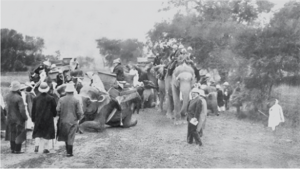
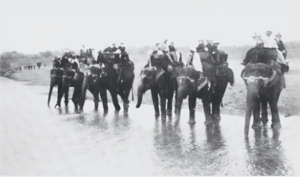
(Top) “At Murshidabad” (Bottom) “Crossing the Bahigarati.”[2]
The road to Kandi lay through a marshy tract of bheels and jheels, where lean fishermen paddled in ladle-shaped canoes, hollowed from the bulbed butt of a fan palm, and cast their nets with a circular throw, gleaning a few poor little fishes for supper. Incidentally, I have known a group of Jaina capitalists buy up the fishing of the Bhagirathi River for many miles, avowedly in the interest of the poor little fish, and somewhat forgetful of the well-being of the fishermen.[3] The Bhagirathi River was now a shrunken blue ribbon in a wide valley of yellow sand with rows of stakes set and there for the nets of the fishermen.
Rounding the big mango tope with its pleasant memories of camp, we drove into the town of Kandi and came to a halt at the little square Board-of-Works bungalow, destined for two months to be our headquarters. It was in a rather deserted-looking part of the town, with red-brick houses up the road a hundred yards away, and the native College, for the making of young Bengali babus, somewhat nearer on the other side, in a garden of coral-blossomed ashoka trees. The bungalow had one large room, opening on a front veranda, and four small ones; with camp-cots, deck-chairs, and blue cotton carpets, the two Punaswamis, and their aides, soon made it presentable; and we settled down to rule a unit of the British Indian Empire.
The brand-new Deputy Magistrate plunged that same evening into the hundred activities of subdivisional life; first betaking himself in white-helmeted dignity to the cutcherry, to take over charge of the court and treasury, opium room, and jail, from the departing Soshi Babu, whose heart already glowed with glad anticipation of visits to his many fathers-in-law.
Soshi Babu, besides being Deputy Magistrate of the Subdivision, was Chairman of the municipality of Kandi, a kind of small lord mayor; so, in his uxorious absence, these cares also, and they were heavy ones, descended upon the shoulders of the incoming Deputy Collector.
One of the drove of big dogs that lolled and snoozed and scratched under the arches and along the streets of Kandi, went mad and, in a paroxysm of folly, bit a municipal policeman, one of a score of red-turbaned knaves under my immediate orders. Thereafter the said mad dog, realizing, I suppose, that it was all up with him, in true Eastern fashion ran amuck, biting and snapping at his colleagues till the whole bazar was a canine pandemonium. Having suffered in honor, the Deputy Magistrate now got his opportunity for revenge on the pariah dogs.
The policeman came wailing to me, and exhibited his wound; Bengalis love to show their wounds. It was a mere scratch on the shin, but the man was half crazy with fright. So I sent him to the subdivisional surgeon, a Boidhyo, a man of the doctor caste, with a shrewd diagnosis and a healing touch, to be cauterized and comforted; and then, as Acting Chairman of the municipality of Kandi, I issued a Hukum, proclaiming a wholesale massacre of stray dogs, and binding, as I remember, the said municipality to pay a reward of eight annas for each dog so slaughtered.
In my inexperience, I made a slip. I should have included in the proclamation a clause directing that the dead dogs above-mentioned and therein aforesaid should be delivered to one of my subordinates conveniently far off—say the bitten policeman, who would have enjoyed it—for due enumeration. I forgot to do that, so they brought the dogs to me.
An ox-cart load of them in the daytime was bad enough; but it was abominable to be awakened after midnight, to take cognizance of slaughtered corpses and sign an invoice of dead dog. Even in death, those beastly pariahs had the better of me.[4]
← Table Of Contents →
SOURCES:
[1] There was also a performance of Jacques Offenbach’s “Les Deux Aveugles,” performed by Ritchie and Page, “the only actors in [the] tiny community.” [Ritchie, John Gerald. The Ritchies In India: Extracts From The Correspondence Of William Ritchie, 1817-1862. J. Murray. London, England. (1920): 370.] On a sadder note, the Johnstons were likely made aware of the death of Pandit Bhashyacharya. In 1889, he again fell ill. This time, however, “neither the entreaties of his friends nor the advice of his doctors could induce him, until it was too late, to go away from the Library.” He died on December 22, 1889, in the home of his brother in Madras. The immediate cause of death, it was said, was “blood poisoning from carbuncle in the hand.” [“Death Of Pandit N. Bashya Charya*.” Supplement To The Theosophist*. Vol. XI. (January 1890): 7.] In his will, he left to the Library his private collection of palm-leaf manuscripts, which would form the nucleus of a fine collection. [Olcott, Henry Steel. Old Diary Leaves: Volume IV. Theosophical Publishing Society. London, England. (1910): 210.] Gopalacharlu (Bhashyacharya’s adopted son) was appointed Treasurer of the Society, but that would ultimately end in tragedy. [Olcott, Henry Steel. Old Diary Leaves: Volume IV. Theosophical Publishing Society. London, England. (1910): 240.] In 1893 Gopalacharlu stole over Rs. 8,649 of Society funds. He ended his life with poison when he was about to be discovered. [“Theosophical Items.” Light Of The East. Vol. II, No. 6 (February 1894): 175-177.]
[2] “At Murshidabad.” Bengal: Past & Present. Vol. II, No. 2 (April 1908): 202; “Crossing The Bahigarati” Bengal: Past & Present. Vol. II, No. 2 (April 1908): 202.
[3] Johnston, Charles. “The Early Races In The Popol Vuh: Pt. III” The Theosophical Forum. Vol. VIII, No. 9 (January 1903): 162-165.
[4] Johnston, Charles. “Helping To Govern India: Kandi Subdivision.” The Atlantic Monthly. Vol. CIX, No. 2. (February 1912): 265-273.
Hindu
Muslim
Politics and Religion
Previous Post

February 15, 2024
Poet Of The Empire
Next Post

February 15, 2024 Rosanchik
Recent Comments
"This is a cool article thanks!"
"Another facet of the Leo Taxil affair is that he, posing as Diana Vaughan, had ..."
Browse Our Archives
Select a Category Uncategorized
Select a Month October 2025 March 2025 February 2025 January 2025 December 2024 November 2024 October 2024 September 2024 August 2024 July 2024 June 2024 May 2024 April 2024 March 2024 February 2024 January 2024 December 2023 November 2023 October 2023 September 2023 August 2023 July 2023 June 2023 May 2023 April 2023 March 2023 February 2023 January 2023 December 2022 November 2022 October 2022
TAKE THE
Religious Wisdom Quiz
What book contains the "Suffering Servant" prophecy?
Select your answer to see how you score.
Zechariah Lamentations Isaiah Jeremiah
Related posts from Marginalia
Charles Johnston, Tolstoyans, And "Rambles In Russia."
Occultism And The Irish Literary Society In America
Modern Olympics And Secret Societies
TRENDING AT PATHEOS History and Religion

The Dead Man’s Hand: Appalachian Graveyard Magic
When the Mountains Go Dark: Appalachian Folklore for Spooky Season Installment 3...

Angel Crowns: An Eerie Appalachian Death Tradition
When the Mountains Go Dark: Appalachian Folklore for Spooky Season Angel Crowns:...

Is 'Separation of Church and State' Really a...

There has long been a popular belief that Zen Buddhism is as...

Is Our Spirituality Communal or Individual?
Here, I take swings at sacred cows. I suspect that more sacred...

How Could Christianity be Different?
Christians can no longer plead ignorance. And Christians' reluctance to listen will...
view all History and Religion blogs
What Are Your Thoughts?leave a comment
Ad-Free & Subscriber Log-In Subscription Support
- About Us
- 2026 Calendar
- Videos
- Podcasts
- Library of World Religions
- Faith In Media Tracker
- Advertise With Us
- Write for Us
- Privacy Policy
- Terms of Service
- Do Not Sell My Data
- Contact Us
- Radiant Digital
- Manage Newsletter Subscriptions
- Unsubscribe From Notifications
- Sitemap
Copyright 2008-2026, Patheos. All rights reserved.
Subscription Support Ad-Free & Subscriber Log-In
Follow Patheos