
BuddhistCatholicContemplativeEvangelicalGeneral ChristianHinduJewishLatter-day SaintMuslimNew VisionsProgressive Christian
Beliefs
- Buddhist
- Catholic
- Contemplative
- Evangelical
- General Christian
- Hindu
- Jewish
- Latter-day Saint
- More Voices
- Muslim
- New Visions
- Pagan
- Progressive Christian
Topics
- Religion News
- Food and Religion
- Sports and Religion
- Religious Art
- Religious Music and Entertainment
- Religious Events
- History and Religion
- Style and Religion
- Politics and Religion
- Women in Religion
- Recreation Outdoors and Religion
- Business Finance and Religion
- Careers Workplace and Religion
- Education and Religion
- Family Parenting and Religion
- Health Fitness and Religion
- Home and Religion
- Relationships and Religion
- Technology and Religion
- Travel and Religion
Columnists
- Buddhist Columnists
- Business Finance and Religion Columnists
- Careers Workplace and Religion Columnists
- Catholic Columnists
- Contemplative Columnists
- Education and Religion Columnists
- Evangelists Columnists
- Family Parenting and Religion Columnists
- General Christian Columnists
- Health Fitness and Religion Columnists
- Hindu Columnists
- History and Religion Columnists
- Home and Religion Columnists
- Jewish Columnists
- More Voices Columnists
- Latter Day Columnists
- Muslim Columnists
- New Visions Columnists
- Nonreligious Columnists
- Pagan Columnists
- Politics and Religion Columnists
- Progressive Columnists
- Recreation Outdoors and Religion Columnists
- Relationships and Religion Columnists
- Religion News Columnists
- Religious Art Columnists
- Religious Events Columnists
- Religious Music and Entertainment Columnists
- Sports and Religion Columnists
- Style and Religion Columnists
- Technology and Religion Columnists
- Travel and Religion Columnists
- Women in Religion Columnists
Resource Library
- 2026 Calendar
- Library of World Religions
- The 100 Most Holy Places on Earth
- Patheos Answers
- Podcasts
- Videos
- Faith Leaders Database
- Anglican Episcopalian
- Bahai
- Baptist
- Buddhism
- Christianity
- Confucianism
- Eastern Orthodoxy
- Hinduism
- Holiness and Pentecostal
- ISKCON
- Islam
- Judaism
- Lutheran
- Methodist
- The Church of Jesus Christ of Latter-day Saints
- New Age
- Paganism
- Presbytarian and Reformed
- Protestantism
- Religion Behind the Scenes
- Roman Catholic
- Scientology
- Shia Islam
- Sikhism
- Sufism
- Sunni Islam
- Taoism
- Zen
- See all religions
Research Tools
 Ad-Free & Subscriber Log-In Subscription Support
Ad-Free & Subscriber Log-In Subscription Support
Follow Patheos 

- Trending:
- Forgiveness
- |
- Marriage
- |
- Consciousness
- |
- Death Penalty
- |
- Election
- |
- Halloween

- Home
- History and Religion
- Bhadra Lok
Bhadra Lok
Last updated on: February 15, 2024 at 8:58 pm by Shawn F. Higgins
Bhadra Lok 2024-02-15T20:58:29-05:00 Shawn F. Higgins
Patheos Explore the world's faith through different perspectives on religion and spirituality! Patheos has the views of the prevalent religions and spiritualities of the world.
BHADRA LOK.
The upheaval of societal change in nineteenth century Bengal resulted in the adoption of a number of progressive reforms aligned with the civilizing standards of the west. A new liberal social class emerged, known self-referentially as the Bhadra Lok, whom Johnston describes as “portly Bengali gentlemen in turbans like pudding molds, and tussore silk frock-coats.”[1] The Bhadra Lok regarded the social reforms of Bengal as their particular achievements. The more conservative Hindu contingent resisted the reforms of the Bhadra Lok as anti-traditional.[2] Whatever the case may be, the Bhadra Lok played an important role in shaping the course of Bengali education in second half of the nineteenth century.[3] The term Bhadra Lok itself was a Sanskritised synonym of the English term “gentleman.” It was derived from the Sanskrit word bhadra, which carried connotations “cultivated taste” and “civilized manners,” and born of “good lineage” (satbangshajata.) The social antonym, Chhotolok (lowly people,) however, had no English analogue, as it was a direct reference to the caste system of varna and jati in the Bengali Hindu society. (A crude approximation would be “lower class” or “serf.”)[4] Thus, middle class Bengalis had established new social binaries, shifting from the earlier categories of Brahmin/Sudra to the bhadra/itar.[5] In describing the sartorial traits of the Bhadra Lok, Johnston writes:
The clothing of the [Bhadra-lok] consisted of three strips of cotton: a waist cloth to the knee, or longer for the better folk, a scarf thrown over the shoulder, and a piece of cotton twisted about the head to form the turban, though many of them went bareheaded, arming themselves with a white umbrella against the moon. For the women, a single piece of cotton, gracefully wound and draped, formed both skirt and bodice. The better folk of the male sex wore shoes, and sometimes socks. But in those days all the women of India, save only the Parsee ladies of Bombay, went barefoot. All ate with their fingers, rice and curried vegetables and fish, deftly tossing pellets of food into their mouths, and using broad leaves for plates. So there was no sewing, no cleaning of table forks and knives, no washing of dishes.[6]
Somewhat connected with the Bhadra Lok were the babus, another group which emerged in this milieu, and a word which Johnston frequently employs. Like the term Bhadra Lok, babu literally meant “gentleman,” but the two were not exactly synonyms. There was a fluidity in meaning, even in Bengali, which made it difficult to differentiate between babus and Bhadra Lok, and more difficult still in English. The Bengali writer, Bankimchandra Chattopadhyay, who once served as the Deputy Magistrate of Murshidabad, said that the word babu had different meanings depending on who used it. For the Englishman, a babu was a clerk. For Bengalis, it had more texture. The poor used the term babu to mean wealthy; for servants it meant master. A third set of Bengalis desired to lead a hedonistic life of a babu with its crude pleasures.[7] Contemporary Bengali literature often portrayed the babu of this third category, that is, an effete urban group playboys.[8] Johnston largely uses the term in its Englishman context, that is, a babu being a clerk. On occasion his portrayal of babus as dandys is hardly hidden, but it never veers towards malice, and largely for comic effect.
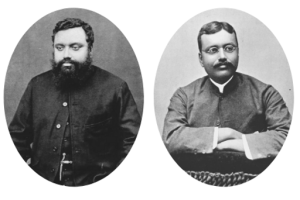
(Left) Hari Kishto Mozumdar. (Right) Charu Kishto Mozumdar.[9]
In the chronology of events which Johnston leaves us, the first babu that makes an appearance is “Babu Hari Kishto Mozumdar,” a poetry reciting, “fat-bellied jail superintendent.”[10] This man is probably one in the same as Hari Kishto Mozumdar (1856-1895,) the Honorary Magistrate, and Chairman of the Sadr (headquarters) Local Board in Murshidabad during the time of Johnston’s tenure.[11] (Johnston’s preference in spelling “Hari Kishto” can be explained by his own philological theory of “prākritizing,” or the “softening and weakening,” of Sanskrit words, i.e. Kishto being a softened form of Krishna.)[12] Hari Kishto was a zamindar from Islampore. Together with his brother, Charu Kishto, he established two schools in Islampore (one for boys, and one for girls.) In addition to his administerial responsibilities, Hari Kishto was a philanthropist and author of The History of Ancient India.[13] Hari Kishto was also a poet, being the author of Kusumakalikā: Descriptive Poems (1874.)[14] In addition to Johnston’s article, we have a letter that Verochka wrote to her family dated May 11, 1889, in which she describes some individuals who have a strong resemblance to the Mozumdar brothers.[15]
← Table Of Contents →
SOURCES
[1] Johnston, Charles. “Helping To Govern India: Kandi Subdivision.” The Atlantic Monthly. Vol. CIX, No. 2. (February 1912): 265-273.
[2] Chatterjee, Ratnabali. “Prostitution In Nineteenth Century Bengal: Construction Of Class and Gender.” Social Scientist. Vol. XXI, No. 9/11 (September-October 1993): 159- 172.
[3] Acharya, Poromesh. “Bengali ‘Bhadralok’ and Educational Development in 19th Century Bengal.” Economic and Political Weekly. Vol. XXX, No. 13 (April 1, 1995): 670-673.
[4] Sinha, Surajit; Bhattacharya, Ranjit. “Bhadralok and Chhotolok in a Rural Area of West Bengal.” Sociological Bulletin. Vol. XVIII, No. 1 (March 1969): 50–66.
[5] Chatterjee, Ratnabali. “Prostitution In Nineteenth Century Bengal: Construction Of Class and Gender.” Social Scientist. Vol. XXI, No. 9/11 (September-October 1993): 159- 172.
[6] [Johnston, Charles. “A Perspective On India.” The Atlantic Monthly. Vol. CXXXVIII, No. 6. (December 1926): 848-856.]
[7] Bandyopadhyay, Aparna. “Chronicles of Love Betrayal and Prostitution in Late Colonial Bengal.” Proceedings of the Indian History Congress. Vol. LXXV (2014): 723-728; Chakrabarti, Sumit. “Space of Deprivation: The 19th Century Bengali Kerani in the Bhadrolok Milieu of Calcutta.” The Asian Journal of Social Science. Vol. XLV, No. 1/2 (2017): 55–72.
[8] Banerjee, Sumanta. “The ‘Beshya’ and the ‘Babu’: Prostitute and Her Clientele in 19th Century Bengal.” Economic and Political Weekly. Vol. XXVIII, No. 45 (November 6, 1993): 2461-2472.
[9] Walsh, A History Of Murshidabad, 224-225.
[10] Johnston, Charles. “The Reincarnation Of Maung Hkin.” The Atlantic Monthly. Vol. CXVI, No. 5. (November 1915): 616-624.
[11] Walsh, J. H. Tull. A History of Murshidabad District (Bengal): With Biographies of Some of Its Noted Families. Jarrold & Sons. London, England. (1902): 224-225.
[12] Johnston, Charles. “Bengali Philology And Ethnography.” The Imperial and Asiatic Quarterly Review And Oriental And Colonial Record. Vol. IV, No. 7. (July 1892): 110-123; Johnston, Charles. “Bengali Philology And Ethnography.” The Academy. No. 1060. (August 27, 1892): 175.
[13] The biographies of the Mozumdar brothers can be found in J.H.T. Walsh’s A History of Murshidabad District in which he writes: “Babu Hari Krishna Mojumdar was created a “Rai Bahadur” in January, 1895, as a well-merited reward for years of devotion to public duties as an Honorary Magistrate, and as Chairman of the Sudder (headquarters) Local Board. This honour, unfortunately, he did not long enjoy, as in that very same year he died, at the early age of thirty-nine. In the midst of public and private duties he found time for literary work. He was the author of The History of Ancient India, and was at the time of his death still engaged on a critical review of Sanskrit verse. He was fully conscious of the backwardness of his birthplace, and tried his best to promote the spread of higher, and primary education, among the people of his part of the district, by founding and maintaining a High School and a school for girls […] Babu Charu K. Mojumdar, a leading Zemindar of Islampur, in Murshidabad, made some interesting experiments with potatoes, cassava, sugar-cane, and other crops.” [Walsh, A History Of Murshidabad, 224-225.]
[14] Majumdar, Harikrishna. Kusumakalikā: Descriptive Poems, With A Short Story Entitled Sarala. Murshidabad, India. (1874.)
[15] Vera writes: “Generally speaking, my relationship with India turns out to be much more remarkable than I would have thought. Aunt is referred to as “mother” in all letters in which the honor of being introduced is requested. Yesterday, once again, one of her “spiritual sons,” as he calls himself (though not a member of the Society) called on us. He is in alliance with two or three cultivators in the city of Islamapore and operates two schools for boys and girls. This indicates that he is very enlightened, for most of the Brahmins find it shameful for an honest woman to be literate.” In another letter from this time (May 11, 1889) Vera states, “Aunt instructs us to spread Theosophy.” [Johnston, V. V. “Letters of Vera Johnston,” May 11, 1889 [g.] , Berhampore , India, entry.] This might be a clue to the nature of that visit. Hari Kishto and Charu Kishto would ultimately join the Adhi Bhoutic Bhratri T.S. on July 23, 1889.) [Theosophical Society General Membership Register, 1875-1942 at http://tsmembers.org/. See book 1, entry 5174. (website file: 1B:1885-1890) Hari Krishna Mozumdar. (July 23, 1889); Theosophical Society General Membership Register, 1875-1942 at http://tsmembers.org/. See book 1, entry 5175. (website file: 1B:1885-1890) Charu Krishna Mozumdar. (July 23, 1889.)] During the first year of their membership, both brothers would make also make a generous financial contribution to the Society. [Dvivedi, Manilal K. “Recording Secretary’s Report.” General Report Of The Fifteenth Convention Of The Theosophical Society. (1891): 13-31.]
Previous Post

February 11, 2024
Tussar Silk
Next Post

February 11, 2024 The Daghee
Recent Comments
"This is a cool article thanks!"
"Another facet of the Leo Taxil affair is that he, posing as Diana Vaughan, had ..."
Browse Our Archives
Select a Category Uncategorized
Select a Month October 2025 March 2025 February 2025 January 2025 December 2024 November 2024 October 2024 September 2024 August 2024 July 2024 June 2024 May 2024 April 2024 March 2024 February 2024 January 2024 December 2023 November 2023 October 2023 September 2023 August 2023 July 2023 June 2023 May 2023 April 2023 March 2023 February 2023 January 2023 December 2022 November 2022 October 2022
TAKE THE
Religious Wisdom Quiz
What does "Pentecost" mean in Greek?
Select your answer to see how you score.
First Fortieth Seventh Fiftieth
Related posts from Marginalia
Charles Johnston, Tolstoyans, And "Rambles In Russia."
Occultism And The Irish Literary Society In America
Modern Olympics And Secret Societies
TRENDING AT PATHEOS History and Religion

The Dead Man’s Hand: Appalachian Graveyard Magic
When the Mountains Go Dark: Appalachian Folklore for Spooky Season Installment 3...

Angel Crowns: An Eerie Appalachian Death Tradition
When the Mountains Go Dark: Appalachian Folklore for Spooky Season Angel Crowns:...

Is 'Separation of Church and State' Really a...

There has long been a popular belief that Zen Buddhism is as...

Is Our Spirituality Communal or Individual?
Here, I take swings at sacred cows. I suspect that more sacred...

How Could Christianity be Different?
Christians can no longer plead ignorance. And Christians' reluctance to listen will...
view all History and Religion blogs
What Are Your Thoughts?leave a comment
Ad-Free & Subscriber Log-In Subscription Support
- About Us
- 2026 Calendar
- Videos
- Podcasts
- Library of World Religions
- Faith In Media Tracker
- Advertise With Us
- Write for Us
- Privacy Policy
- Terms of Service
- Do Not Sell My Data
- Contact Us
- Radiant Digital
- Manage Newsletter Subscriptions
- Unsubscribe From Notifications
- Sitemap
Copyright 2008-2026, Patheos. All rights reserved.
Subscription Support Ad-Free & Subscriber Log-In
Follow Patheos