
BuddhistCatholicContemplativeEvangelicalGeneral ChristianHinduJewishLatter-day SaintMuslimNew VisionsProgressive Christian
Beliefs
- Buddhist
- Catholic
- Contemplative
- Evangelical
- General Christian
- Hindu
- Jewish
- Latter-day Saint
- More Voices
- Muslim
- New Visions
- Pagan
- Progressive Christian
Topics
- Religion News
- Food and Religion
- Sports and Religion
- Religious Art
- Religious Music and Entertainment
- Religious Events
- History and Religion
- Style and Religion
- Politics and Religion
- Women in Religion
- Recreation Outdoors and Religion
- Business Finance and Religion
- Careers Workplace and Religion
- Education and Religion
- Family Parenting and Religion
- Health Fitness and Religion
- Home and Religion
- Relationships and Religion
- Technology and Religion
- Travel and Religion
Columnists
- Buddhist Columnists
- Business Finance and Religion Columnists
- Careers Workplace and Religion Columnists
- Catholic Columnists
- Contemplative Columnists
- Education and Religion Columnists
- Evangelists Columnists
- Family Parenting and Religion Columnists
- General Christian Columnists
- Health Fitness and Religion Columnists
- Hindu Columnists
- History and Religion Columnists
- Home and Religion Columnists
- Jewish Columnists
- More Voices Columnists
- Latter Day Columnists
- Muslim Columnists
- New Visions Columnists
- Nonreligious Columnists
- Pagan Columnists
- Politics and Religion Columnists
- Progressive Columnists
- Recreation Outdoors and Religion Columnists
- Relationships and Religion Columnists
- Religion News Columnists
- Religious Art Columnists
- Religious Events Columnists
- Religious Music and Entertainment Columnists
- Sports and Religion Columnists
- Style and Religion Columnists
- Technology and Religion Columnists
- Travel and Religion Columnists
- Women in Religion Columnists
Resource Library
- 2026 Calendar
- Library of World Religions
- The 100 Most Holy Places on Earth
- Patheos Answers
- Podcasts
- Videos
- Faith Leaders Database
- Anglican Episcopalian
- Bahai
- Baptist
- Buddhism
- Christianity
- Confucianism
- Eastern Orthodoxy
- Hinduism
- Holiness and Pentecostal
- ISKCON
- Islam
- Judaism
- Lutheran
- Methodist
- The Church of Jesus Christ of Latter-day Saints
- New Age
- Paganism
- Presbytarian and Reformed
- Protestantism
- Religion Behind the Scenes
- Roman Catholic
- Scientology
- Shia Islam
- Sikhism
- Sufism
- Sunni Islam
- Taoism
- Zen
- See all religions
Research Tools
 Ad-Free & Subscriber Log-In Subscription Support
Ad-Free & Subscriber Log-In Subscription Support
Follow Patheos 

- Trending:
- Forgiveness
- |
- Marriage
- |
- Consciousness
- |
- Death Penalty
- |
- Election
- |
- Halloween

- Home
- Hindu
- History and Religion
- Belgaon
Belgaon
Last updated on: February 17, 2024 at 3:59 pm by Shawn F. Higgins
Belgaon 2024-02-17T15:59:21-05:00 Shawn F. Higgins
Patheos Explore the world's faith through different perspectives on religion and spirituality! Patheos has the views of the prevalent religions and spiritualities of the world.
BELGAON
Charles Johnston.
Early November 1889.
It was a heartening sight in the approaching twilight, to see the servants and orderlies, aided by impressed village watchmen, clearing a fair space for the camp, under shady mango trees at the village of Belgaon. They scraped the sandy soil clean, laid on it a thick layer of sweet-smelling rice straw, and spread on this blue-and-white cotton carpets. In the center, they laid the butt of the big tent-pole, shook out the skirts of the tent, and then hauled away, unfurling the tent within a tent, a square home of canvas with a pyramid roof and an-air space a yard wide between the inner and the outer tent. This, with the ample shade of the glossy mango boughs, keeps one from roasting in camp in the “cold” season: cold enough, that is, for peaches to hold something of their flavor, but too hot, even at Christmas, for strawberries, save on the mountain-tops about Mussurie.
![[]](https://lh3.googleusercontent.com/blogger_img/ACSeONfG3nQdsTco83T6EQOwY7HhF-wr2O5Ydxo7t169DSP1itmbfe3hTDy-Qma_dFVnVKjOgXOxCMBSyp2Fjw=s1600)
Setting Up Camp. (Source: Old Indian Photos)

The wings of night were spread over Bengal. The moon poured white showers through the darkness, silvering the rice-fields, that faded away to dim infinitudes, under a pale blue veil of mist. Our tents, now pitched, stood ankle deep in their own shadows in a grove of mango trees. The moonlight sparkled on the glossy blackness of the leaves, and fell in white splashes on the canvas. Ghostly figures of watchmen snored beside the ashes of their fires, their spears resting against the tree-stems. A stillness throbbed over all. Suddenly the veil of silence was rent in pieces. A piercing shriek came out of the mist Another answered it, from far off, then another. Then shriek followed shriek on all sides, quick, ear-splitting, horrible, full of tortured and tormented wailing. The air was shattered into short waves of terror, that changed slowly into mocking laughter, and then vanished in sudden silence. The jackals were gathering in the rice-fields.
The moon looked down upon the night; she even peeped within my tent and smiled an inscrutable Eastern smile. Outside it was cold enough, and the coats of the jackals were wet with dew. But I did not feel cold within the double shelter of my tent. I sat on my camp bed with my feet tucked up, feeling oppressively hot; I was thoroughly down-hearted and wretched. The mosquito curtain let down round my bed seemed a cloud of black melancholy, instead of white gauze. The figured brown lining of the inner tent looked dull and dispiriting. The lamp seemed to radiate heat on my hot back, and the whirring wings of the fans in its draught-chamber tormented me. I was dressed in a Jaeger vest and hose, for coolness, and my feet were bare. Yet I was heated, red-faced, and disconsolate. Desolation was heavy upon me, and jackal-voices were howling in my heart. I felt like a little child left alone in the dark; I felt as if all my friends were dead, and as if I hated everybody. I tried to think of my mother, and of the consolations of religion, and of my soul; but only to decide that it would probably not be saved, and that I no longer cared. I felt utterly deserted and alone, with that ghostly world of chill mist all about me, where the jackals howled, in the dim and gruesome vastness of the night.[1]
Theo had a charming way of coming to my tent in the cool of the morning, calling me till she saw my eyes open, and then saying in her pretty Hindi
“Johnston, hamare sung kelo!” which is to say, “Come play with me!”
She had picked up my name from her great big papa, the Collector Sahib.
The glossy depths of the leaves were full of the contralto gurglings of golden orioles; now and then they flamed across a bar of sunlight. In the crown of one huge tree a heavy-winged vulture had her nest, while her mate soared and circled, a speck in the illimitable blue. Streaked squirrels frisked hither and yon, chattering sarcastic disapproval of rude British ways. Our tents, as big as cottages, whitened the vast green shadow of the mango grove. The horses stamped contentedly beneath the boughs.
Echoes of a noisy dispute came from the servants’ quarters. A loaf of bread was missing—a serious matter in camp. Punaswami of the crimson and gold turban, accused Punaswami the second, of stealing it. Punaswami the second said a jackal had taken it, which happened to be true. But the elder Punaswami sneered.
“A jackal eat bread?”
“A jackal will eat anything,” retorted the angry butler, “even the flesh of a cook.”
And so the swarm of turbaned bare-footed servants gossiped and quarreled in their quarters, deftly performing their tasks, and going their crafty inscrutable ways.[2]
In the dew-bespangled sunrise, while the air was caressingly cool, we went forth to ride along the river bank and beside fields of yellow mustard or dun stubble; then, on our return to the shadowed tents, a bath, breakfast, and the day’s occupation.
I had my office-table set up under the trees, and summoned the weighty men of the village to give an account of their doings and their people. They came, reverend seniors, elected by the householders of those reed-thatched mud-houses, to form the Council of Five, signified by their title of Panchayet. [3] Very good men they were, with much native mother-wit, palpably well-chosen and thorough masters of their duties—the settling of village disputes concerning lands, the division of the fruits of harvest between communal tillers, the levying of village rates, the payment of the watchmen—those indigo-coated, white-turbaned chowkidars with their pikes, who had snored the night through over the ashes of their campfires, as the jackals flitted among the ropes, and night-owls hooted in the branches.[4]
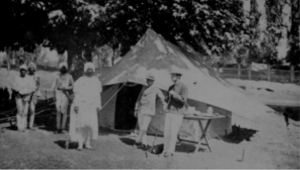
“A Visit To The Camp.”[5]
I had the indigo-coated chowkidars up before me, in an abashed row, and made them testify as to the peace the village; then I looked over their wage-books to make sure that each them got his five rupees a month regularly, lest they might fall into thieving. When I had duly verified these things, going over one grubby booklet after another, making out the crabbed entries in village Bengali, and cross-questioning the illiterate chowkidars, to check the written figures, I came to the conclusion that the village accounts were honestly and effectively kept, and that the Bengali village was a model of good local government. Its structure is, indeed, by all odds the oldest thing we have in India; older by ages than the British Raj, older than the Mughal invaders whom “John Company” superseded, older than the era of Persian and Arab raiders, older than Chandragupta or Ashoka, older than the venerable laws of Manu, son of the Sun.
Impressed at finding myself in the living presence of this fragment of an elder world, I relieved the tension between two ages by having the chowkidars drawn up in line, and putting them through marching and pike exercises, to the ecstatic admiration naked little Bengalis of both sexes, who had mysteriously found their way to the Sahib’s camp, and were peeping like big-eyed brown fairies from behind the smooth boles of the mango trees.
Then I read petitions about all kinds of little local ills; gorgeously worded petitions, in which I was addressed as Dharmavatar and Garibparwar: Incarnation of Righteousness, and Umbrella of the Poor. One can do much to lift heavy burdens in this summary fashion, and, on the whole, I think I got at the truth. It was borne in upon me, and often verified thereafter, that the life of these humble Indian villages is, on the whole, very happy, despite superstitions and lean days and a climate exasperatingly hard. We of the British Raj shield these poor folk from battle, murder, sudden death, if not always from plague, pestilence, famine; we guard them against rapacious, lazy overlings, who have preyed on them from generation to generation, and who pay us in angry discontent for thus interfering with their prey. These villagers and their like have learned by experience that they can trust implicitly in our law and even-handed justice. No small thing, this, to do for nigh three hundred millions of the poorest, most defenseless folk on earth.[6]
Then again, in the swift dusk of evening, when furtive jackals rent the twilight stillness with wailing and demoniac laughter, or the silver bark of little foxes echoed over the mist-veiled rice-fields, white under the moon, we gathered in comfortable deck chairs in a great, dim aisle of the mango grove, while the tents shone orange in the lamp-light, to tell sad stories of the deaths of kings, or listen to Castle, the Police Chota Sahib—who had a pretty sentimental tenor—sing “The Long Indian Day.”[7]
← Table Of Contents →
SOURCES:
[1] [This description is from Johnston’s novella, Kela Bai.] Johnston, Charles. Kela Bai: An Anglo-Indian Idyl. Doubleday & McClure Co. New York, New York. (1900): 39-41.
[2] [This description is from Johnston’s novella, Kela Bai.] Johnston, Charles. Kela Bai: An Anglo-Indian Idyl. Doubleday & McClure Co. New York, New York. (1900): 82.
[3] Johnston writes: “There were, in every district, at least four types of bodies having activities that were genuinely legislative. Beginning with the simplest, there was in every village the elected Panchayet, lineal descendant of the self-governing body in the age-old village community. Next came the elected local board, for each subdivision, not indigenous, but quite recently overlaid on the native life by the British administrators. Then there was an elected district board, with supervision over roads, bridges, hospitals, and schools, and with power to raise local taxes. These district boards had in them the germs of the county councils of modern England, themselves remote successors of the Saxon shire mote. Finally, the municipalities were governed by elected bodies, predominantly native. So there were elements of self-government in India, as well as opportunities for qualified natives to share in the daily work of administration. All these elements might well have developed along indigenous lines.” [Johnston, Charles. “A Perspective On India.” The Atlantic Monthly. Vol. CXXXVIII, No. 6. (December 1926): 848-856.]
[4] In late 1889, Steuart Bayley thought it desirable to examine the working of the rural police generally. He decided to depute an officer who was conversant with the working of the Village Chowkidari Act (Act. I.B.C. of 1886,) Colonel H.M. Ramsay on the special duty of gathering as complete information as possible regarding the way in which the rural police was generally worked in each district of Bengal, and of devoting special attention to the chowkidars employed under Act. I.B.C. of 1886. [“Occasional Notes.” Englishman’s Overland Mail. (London, England) February 25, 1890.]
[5] Compton, Herbert. Indian Life In Town And Country. G.P. Putnam’s Sons. New York, New York. (1904): 162.
[6] Johnston, Charles. “Helping To Govern India: Kandi Subdivision.” The Atlantic Monthly. Vol. CIX, No. 2. (February 1912): 265-273.
[7] The “Long Indian Day,” was a popular parody of the German song, “The Long, Long, Weary Day.” It was penned by the anonymous “Mario,” and published by Rose of Bombay in 1889 (just after the Johnstons arrived in India.) The lyrics were: “Thus on from day to day, Wags the long Indian day. Until grown old and grey, We get one pound a day, And totter home to die in England. A worthy recompense, For loss of health and sense. Thus ends my story, Of soldier’s glory.” [Compton, Herbert. Indian Life in Town and Country. G.P. Putnam’s Sons. New York, New York. (1904): 228-229; Winstock, Lewis S. “Rudyard Kipling And Army Music.” The Kipling Journal. Vol. XXXVIII, No. 178. (June 1971): 6-12.]
Hindu
Muslim
Recreation, Outdoors and Religion
Previous Post
February 14, 2024
Out-Of-Door Life
Next Post
February 14, 2024 On The Field Of Plassey
Recent Comments
"This is a cool article thanks!"
"Another facet of the Leo Taxil affair is that he, posing as Diana Vaughan, had ..."
Browse Our Archives
Select a Category Uncategorized
Select a Month October 2025 March 2025 February 2025 January 2025 December 2024 November 2024 October 2024 September 2024 August 2024 July 2024 June 2024 May 2024 April 2024 March 2024 February 2024 January 2024 December 2023 November 2023 October 2023 September 2023 August 2023 July 2023 June 2023 May 2023 April 2023 March 2023 February 2023 January 2023 December 2022 November 2022 October 2022
TAKE THE
Religious Wisdom Quiz
Be strong and work, for I am with you. My Spirit remains among you according to what covenant?
Select your answer to see how you score.
The Abrahamic Covenant The Mosaic covenant The new covenant The covenant made when Israel came out of Egypt
Related posts from Marginalia
Charles Johnston, Tolstoyans, And "Rambles In Russia."

Occultism And The Irish Literary Society In America

Modern Olympics And Secret Societies
TRENDING AT PATHEOS History and Religion

The Dead Man’s Hand: Appalachian Graveyard Magic
When the Mountains Go Dark: Appalachian Folklore for Spooky Season Installment 3...

Angel Crowns: An Eerie Appalachian Death Tradition
When the Mountains Go Dark: Appalachian Folklore for Spooky Season Angel Crowns:...

Is 'Separation of Church and State' Really a...

There has long been a popular belief that Zen Buddhism is as...

Is Our Spirituality Communal or Individual?
Here, I take swings at sacred cows. I suspect that more sacred...

How Could Christianity be Different?
Christians can no longer plead ignorance. And Christians' reluctance to listen will...
view all History and Religion blogs
What Are Your Thoughts?leave a comment
Ad-Free & Subscriber Log-In Subscription Support
- About Us
- 2026 Calendar
- Videos
- Podcasts
- Library of World Religions
- Faith In Media Tracker
- Advertise With Us
- Write for Us
- Privacy Policy
- Terms of Service
- Do Not Sell My Data
- Contact Us
- Radiant Digital
- Manage Newsletter Subscriptions
- Unsubscribe From Notifications
- Sitemap
Copyright 2008-2026, Patheos. All rights reserved.
Subscription Support Ad-Free & Subscriber Log-In
Follow Patheos