
BuddhistCatholicContemplativeEvangelicalGeneral ChristianHinduJewishLatter-day SaintMuslimNew VisionsProgressive Christian
Beliefs
- Buddhist
- Catholic
- Contemplative
- Evangelical
- General Christian
- Hindu
- Jewish
- Latter-day Saint
- More Voices
- Muslim
- New Visions
- Pagan
- Progressive Christian
Topics
- Religion News
- Food and Religion
- Sports and Religion
- Religious Art
- Religious Music and Entertainment
- Religious Events
- History and Religion
- Style and Religion
- Politics and Religion
- Women in Religion
- Recreation Outdoors and Religion
- Business Finance and Religion
- Careers Workplace and Religion
- Education and Religion
- Family Parenting and Religion
- Health Fitness and Religion
- Home and Religion
- Relationships and Religion
- Technology and Religion
- Travel and Religion
Columnists
- Buddhist Columnists
- Business Finance and Religion Columnists
- Careers Workplace and Religion Columnists
- Catholic Columnists
- Contemplative Columnists
- Education and Religion Columnists
- Evangelists Columnists
- Family Parenting and Religion Columnists
- General Christian Columnists
- Health Fitness and Religion Columnists
- Hindu Columnists
- History and Religion Columnists
- Home and Religion Columnists
- Jewish Columnists
- More Voices Columnists
- Latter Day Columnists
- Muslim Columnists
- New Visions Columnists
- Nonreligious Columnists
- Pagan Columnists
- Politics and Religion Columnists
- Progressive Columnists
- Recreation Outdoors and Religion Columnists
- Relationships and Religion Columnists
- Religion News Columnists
- Religious Art Columnists
- Religious Events Columnists
- Religious Music and Entertainment Columnists
- Sports and Religion Columnists
- Style and Religion Columnists
- Technology and Religion Columnists
- Travel and Religion Columnists
- Women in Religion Columnists
Resource Library
- 2026 Calendar
- Library of World Religions
- The 100 Most Holy Places on Earth
- Patheos Answers
- Podcasts
- Videos
- Faith Leaders Database
- Anglican Episcopalian
- Bahai
- Baptist
- Buddhism
- Christianity
- Confucianism
- Eastern Orthodoxy
- Hinduism
- Holiness and Pentecostal
- ISKCON
- Islam
- Judaism
- Lutheran
- Methodist
- The Church of Jesus Christ of Latter-day Saints
- New Age
- Paganism
- Presbytarian and Reformed
- Protestantism
- Religion Behind the Scenes
- Roman Catholic
- Scientology
- Shia Islam
- Sikhism
- Sufism
- Sunni Islam
- Taoism
- Zen
- See all religions
Research Tools
 Ad-Free & Subscriber Log-In Subscription Support
Ad-Free & Subscriber Log-In Subscription Support
Follow Patheos 

- Trending:
- Forgiveness
- |
- Marriage
- |
- Consciousness
- |
- Death Penalty
- |
- Election
- |
- Halloween

- Home
- Progressive Christian
- History and Religion
- The Eruption Of The End
The Eruption Of The End
Last updated on: April 18, 2024 at 7:18 am by Shawn F. Higgins
The Eruption Of The End 2024-04-18T07:18:16-04:00 Shawn F. Higgins
Patheos Explore the world's faith through different perspectives on religion and spirituality! Patheos has the views of the prevalent religions and spiritualities of the world.
Just before noon on Saturday, March 28, New York’s unemployed laborers, socialists, anarchists, communists, and the “broadly discontented,” swarmed upon Union Square. The mob, numbering seven thousand, grew so dense that a person could lift their feet off the ground and easily be upheld by the press of the bodies about them. It looked like Trafalgar Square the night of the Relief of Ladysmith.
Plains-clothed police began to cut out small parties and redirect them down the side streets, until, eventually, the whole mass was set in motion. It was then when the crowd began to chant, The Marseillaise. “Stand up, damned of the Earth, Stand up, prisoners of starvation…”
Irvine’s lips flexed a smile—a proud, defiant, kind of smile. It was nearly two years to the day, when, as a labor organizer in New Haven, he stirred up a “hornet’s nest” at the Trades Council meeting when he stated his preference for the Marseillaise over the Star Spangled Banner. The delegates of the Trades Council, of course, were offended. “Shame,” they told him. “I do not care a snap for the opinion of the public,” Irvine told them, “I am a citizen of the world. I am a citizen of no country. I do prefer the ‘Marseillaise.’ It has been adopted by the labor masses as a representative song, to the ‘Star Spangled Banner,’ which is but the national song of a country. It is an inspiring song, and…means much to the laboring man. As for public opinion on it, I do not care a thing.”[1]
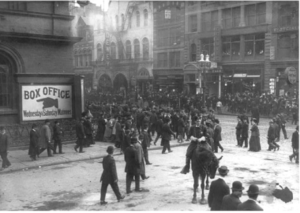
Union Square Meeting.[2]
Inspector Schmittberger, remembering the Berlin riots, recognized the peril, and quickly martialized his men. Forcing the crowd toward the plaza and 17th Street, the weight of the mounted officers, as their horses threw their shoulders against the closely knit mob, could not be withstood; the pressure of the crowd, like wave rushing over a shallow beach, crashed upon the police. Wanting to be where the clashes were most dangerous, Irvine kept moving, inching to the front of the crowd, in front of the horses. His provocations were matched with a policeman’s baton, and he was struck from behind “for not moving fast enough.” The whole crowd, all the while, chanting.
The police drove them from the avenue toward the side streets. On the fringes of the crowd, wild-voiced orators, like the street-preachers of the past, exhorted the mob to resist the tyranny of the the police. From the steps of a house at 17th Street, Robert Hunter, the son-in-law of Anson Phelps Stokes, struggled to make a speech. The police stopped him, showing no favors to anyone. (Link)
“I am Robert Hunter. I have been invited here to deliver an address. Why are we not permitted to assemble?”
“There is to be no meeting,” the policeman said.
“If we cannot meet here in Union Square,” said Hunter,” it is your duty to tell us where we may assemble.”
“You may not assemble anywhere near here.”[3]
The crowd continued to chant.
The Deputy Commissioner came rushing to the Square from headquarters, in an automobile filled with headquarters men, as the police reserves, on horse and on foot, poured into the plaza from all quarters— now wielding their 26-inch night-sticks, a baton twice as long as their regular day-stick.[4]
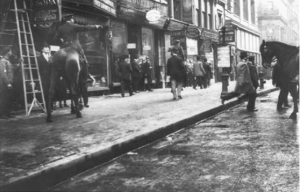
Mounted Police Clearing Sidewalk.[5]
The crowd, emboldened and frenzied, shoved cards and circulars, written in Russian, German, English, and Yiddish defiantly in the faces of authority. “We will fight until we die!” they shouted, “We demand work!” and variations of demands for the overthrow of “everyone with the clean collar habit.” Flooding the side streets were small parades of men and women, marching together, and singing—suggestive of “some Russian city rather than New York.” The thundering hymn of the Internazionale echoing in the alleys.
Rioters congregated in the doorways of the nearby theaters and hotel lobbies until forced-out by frightened proprietors. They surged up against the Keith & Proctor Theatre with such force, the front wall threatened to crack, and broke down the front entrance of Huber’s Museum.
After three hours of clashes, the Square and bounding streets were cleared—that is, the people were allowed to cross it in all directions—and as the crowd began to melt away. Irvine, too, began walking back to his study—just an avenue away at 15th and Fifth. As he made his way down the mid-seam of the park, Irvine was pleased to see that the few remaining police were drawing up in double ranks opposite of his direction, facing Fourth Avenue.
Something caught his attention, something strange that cannot be explained in fractions of seconds, a sensation he, and others, experienced in the Colonial Army. Three men approaching the fountain from Broadway were unremarkable in dress, looking no more out of place than the other protestors earlier that day. It was the rapidity with which they walked that caught his attention; the shorter man trailing behind practically running to catch up to his companions.
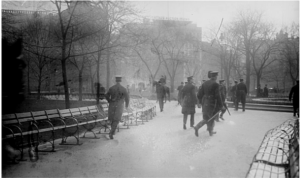
Police Hurry To Bomb-Throwing Scene.[6]
One of the men in front, Irvine could now see, was carrying, in his right hand, a parcel, about the size of a grapefruit, and wrapped in brown paper. He was scarcely older than a boy with a stunted body, and possessing the same anemic pallor of the slum-dwellers and sweatshop workers, who had nothing to live for. Irvine now realized what was happening, for in lieu of something to live for, this boy had found something to die for. Just a few paces away from the line of police, the man with the parcel paused as he fumbled the object in his hand. Regaining his balance, there were sputter sparks, as he stretched back his arm to throw his missile at the unsuspecting patrolmen.
The explosion was like a 6-inch gun. Irvine was hurled off his feet; the shock to his nervous system being so great, that he collapsed. His first flash of thought was of the battlefield.
Fifteen feet away the two assailants staggered. The bombardier, before toppling over on his face, stood upright long enough for Irvine to see that half of his upper body was torn away. Writhing in shredded mutilation, he was able to gurgle his final words. “I tried to get the police…I wanted…to…kill…them.”
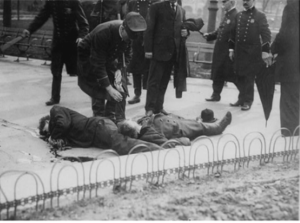
20 Seconds After Bomb Was Thrown.[7]
For the space of a breath, no one moved—and then—a frantic rush from the patrolmen. Pandemonium broke-out as bystanders on the banks of the Square surged forward with ferocious momentum. The mounted police officers galloped toward the crowd and hurled them toward the entrance of Hotel Hungaria.
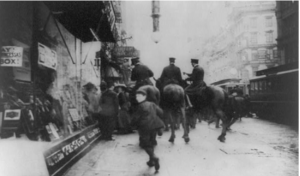
Police Driving People Back.[5]
Irvine staggered to his feet. The policemen that were swarming around him were now crazed. As he gained his footing, out of nowhere, a terrific blow landed between his shoulders. Wincing, he glanced upward, toward the mounted officer with a nightstick. Just another “Gallagher” with a copper badge. Another strike found the back of his head. He tumbled over. With his last bit of fury, Irvine raised his knees from off the cold cement, and locked eyes with his aggressor—for he knew—this next strike would be the deathblow. There were those, however, who preferred flogging to begging.[9]
But the blow did not arrive. A moment of distraction meant a moment for escape, and Irvine staggered back to his apartment.
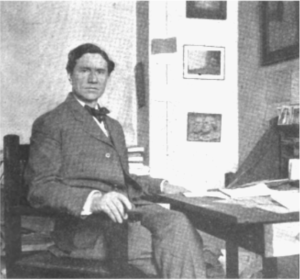
Irvine at Home.
The following day Irvine met with one of the vestry of The Church of the Ascension. “Would you mind telling me why you were there Saturday afternoon?” he asked.
“Well,” Irvine said, the furrows in his face sharpening, “that is a pretty personal question, but I don’t mind telling you. I was there because I have a big reserve in me; for ten years I have had it. Sometime it will be called upon. That is the first reason. And I was there, secondly, because there is a difference between differing with a man on the best way to do a thing, and wanting to see him suffer if he should make a mistake. And I was there thirdly as a representative of this church.” His face blazed up. “I thought there might be trouble, and if there was, this church ought to be there. I thought there might be a fight, and when there is a fight for something that is right, the place for a Christian minister is in the thick of it.”
PEOPLE OF THE UNDERWORLD
I. INTERCOLLEGIATE SOCIALIST SOCIETY.
II. THE CRY OF PEONAGE.
III. MUCKERS.
IV. GALLAGHER’S HELL.
V. PUNK.
VI. SOUDAN.
VII. BOWERY.
VIII. “IT IS A BETTER FLAG THAN THE AMERICAN FLAG.”
IX. PENETRATING THE ASCENSION.
X. “THE UNIVERSE IS BASED ON THE SUBJECTION OF WOMAN.”
XI. PROGRESSIVE WOMAN SUFFRAGE UNION.
XII. THE CHRISTIAN SOCIALIST FELLOWSHIP.
XIII. THE ERUPTION OF THE END.
SOURCES:
[1] “Shocked By Mr. Irvine.” The Ridgewood Herald. (Ridgewood, New Jersey) April 27, 1906.
[2] Crowd driven from Union Square turning back through 14th St. toward the Square again, after Anarchist bombing., 1908. Photograph. https://www.loc.gov
[3] “News Narrative.” The Public. Vol. XI, No. 522 (April 3, 1908): 6-10.
[4] (The New York Police wielded two kinds of batons, depending on the time of day.) Brunisholz, Corey. “NYPD History.” Archived from the original on 2 April 2012. Retrieved 22 March 2012.
[5] N.Y.C. – Broadway-mounted police clearing sidewalk., 1908. Photograph. https://www.loc.gov
[6] Bain News Service, Publisher. Police hurry to bomb-throwing scene, Union Square, anarchist riot, New York. , . 3/28/08 date created or published later by Bain. Photograph. https://www.loc.gov
[7] Anarchists-casualties of anarchist riot, Union Square Taken 20 seconds after bomb thrown. New York, 1908. [New York City, N.Y.:] Photograph. https://www.loc.gov
[8] Anarchist riot, police on horseback driving people, Broadway and 14th streets, New York. New York, 1908. Photograph. https://www.loc.gov
[9] Irvine, Alexander.” From the Bottom Up: The Life Story of Alexander Irvine. Gosset & Dunlop. New York, New York (1910): 277-278; “Bomb In Union Square” The New York Tribune (New York, New York) March 29, 1908.
Progressive Christian
Politics and Religion
Previous Post
October 31, 2022
Histro-Demonopathy
Next Post

November 24, 2022 THE ESOTERIC SCHOOL
Browse Our Archives
Select a Category Uncategorized
Select a Month October 2025 March 2025 February 2025 January 2025 December 2024 November 2024 October 2024 September 2024 August 2024 July 2024 June 2024 May 2024 April 2024 March 2024 February 2024 January 2024 December 2023 November 2023 October 2023 September 2023 August 2023 July 2023 June 2023 May 2023 April 2023 March 2023 February 2023 January 2023 December 2022 November 2022 October 2022
TAKE THE
Religious Wisdom Quiz
True or False: Twelve spies were sent to explore Canaan, and all gave a positive report.
Select your answer to see how you score.
TRUE FALSE
Related posts from Marginalia

Inexplicable & Unexplained Pt. VII

Inexplicable & Unexplained Pt. VI

Inexplicable & Unexplained Pt. V

Inexplicable & Unexplained Pt. IV
TRENDING AT PATHEOS History and Religion

The Dead Man’s Hand: Appalachian Graveyard Magic
When the Mountains Go Dark: Appalachian Folklore for Spooky Season Installment 3...

Angel Crowns: An Eerie Appalachian Death Tradition
When the Mountains Go Dark: Appalachian Folklore for Spooky Season Angel Crowns:...

Is 'Separation of Church and State' Really a...

There has long been a popular belief that Zen Buddhism is as...

Is Our Spirituality Communal or Individual?
Here, I take swings at sacred cows. I suspect that more sacred...

How Could Christianity be Different?
Christians can no longer plead ignorance. And Christians' reluctance to listen will...
view all History and Religion blogs
Ad-Free & Subscriber Log-In Subscription Support
- About Us
- 2026 Calendar
- Videos
- Podcasts
- Library of World Religions
- Faith In Media Tracker
- Advertise With Us
- Write for Us
- Privacy Policy
- Terms of Service
- Do Not Sell My Data
- Contact Us
- Radiant Digital
- Manage Newsletter Subscriptions
- Unsubscribe From Notifications
- Sitemap
Copyright 2008-2026, Patheos. All rights reserved.
Subscription Support Ad-Free & Subscriber Log-In
Follow Patheos