
BuddhistCatholicContemplativeEvangelicalGeneral ChristianHinduJewishLatter-day SaintMuslimNew VisionsProgressive Christian
Beliefs
- Buddhist
- Catholic
- Contemplative
- Evangelical
- General Christian
- Hindu
- Jewish
- Latter-day Saint
- More Voices
- Muslim
- New Visions
- Pagan
- Progressive Christian
Topics
- Religion News
- Food and Religion
- Sports and Religion
- Religious Art
- Religious Music and Entertainment
- Religious Events
- History and Religion
- Style and Religion
- Politics and Religion
- Women in Religion
- Recreation Outdoors and Religion
- Business Finance and Religion
- Careers Workplace and Religion
- Education and Religion
- Family Parenting and Religion
- Health Fitness and Religion
- Home and Religion
- Relationships and Religion
- Technology and Religion
- Travel and Religion
Columnists
- Buddhist Columnists
- Business Finance and Religion Columnists
- Careers Workplace and Religion Columnists
- Catholic Columnists
- Contemplative Columnists
- Education and Religion Columnists
- Evangelists Columnists
- Family Parenting and Religion Columnists
- General Christian Columnists
- Health Fitness and Religion Columnists
- Hindu Columnists
- History and Religion Columnists
- Home and Religion Columnists
- Jewish Columnists
- More Voices Columnists
- Latter Day Columnists
- Muslim Columnists
- New Visions Columnists
- Nonreligious Columnists
- Pagan Columnists
- Politics and Religion Columnists
- Progressive Columnists
- Recreation Outdoors and Religion Columnists
- Relationships and Religion Columnists
- Religion News Columnists
- Religious Art Columnists
- Religious Events Columnists
- Religious Music and Entertainment Columnists
- Sports and Religion Columnists
- Style and Religion Columnists
- Technology and Religion Columnists
- Travel and Religion Columnists
- Women in Religion Columnists
Resource Library
- 2026 Calendar
- Library of World Religions
- The 100 Most Holy Places on Earth
- Patheos Answers
- Podcasts
- Videos
- Faith Leaders Database
- Anglican Episcopalian
- Bahai
- Baptist
- Buddhism
- Christianity
- Confucianism
- Eastern Orthodoxy
- Hinduism
- Holiness and Pentecostal
- ISKCON
- Islam
- Judaism
- Lutheran
- Methodist
- The Church of Jesus Christ of Latter-day Saints
- New Age
- Paganism
- Presbytarian and Reformed
- Protestantism
- Religion Behind the Scenes
- Roman Catholic
- Scientology
- Shia Islam
- Sikhism
- Sufism
- Sunni Islam
- Taoism
- Zen
- See all religions
Research Tools
 Ad-Free & Subscriber Log-In Subscription Support
Ad-Free & Subscriber Log-In Subscription Support
Follow Patheos 

- Trending:
- Forgiveness
- |
- Marriage
- |
- Consciousness
- |
- Death Penalty
- |
- Election
- |
- Halloween
 Manic Pagan Dream Grrl
- Home
- Pagan
- The Disir Circle
The Disir Circle
Last updated on: August 3, 2023 at 9:13 am by Katie Gerrard
The Disir Circle 2023-08-03T09:13:09+00:00 Katie Gerrard
Patheos Explore the world's faith through different perspectives on religion and spirituality! Patheos has the views of the prevalent religions and spiritualities of the world.
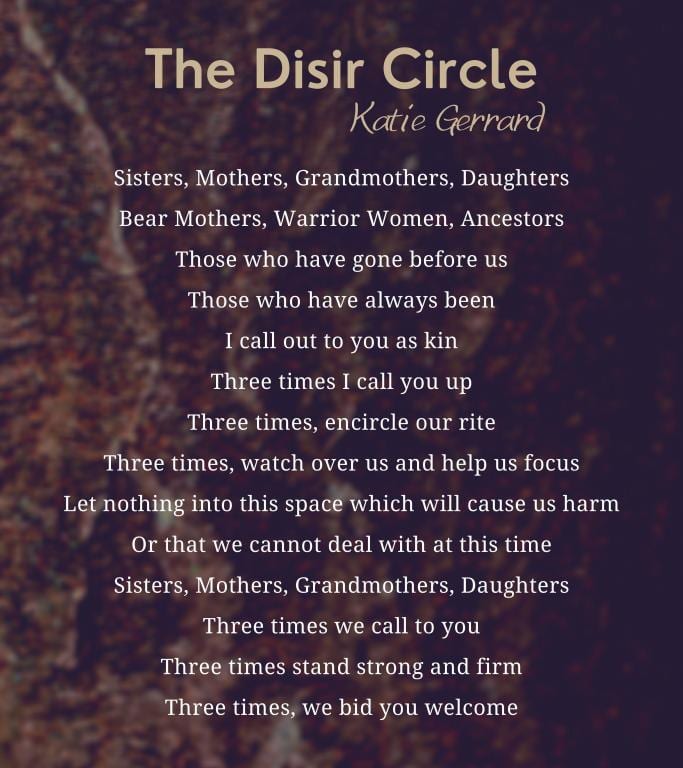
Image credit: Katie Gerrard @ Manic Pagan Dream Grrl for Patheos
In a previous post I mentioned I rarely cast a full Wiccan circle anymore. The reality is I’ve been using a Disir circle rather than a traditional one in seidr rites now for nearly twenty years.
Back then I thought long and hard about how I wanted to work with the norse deities in ritual and the idea of using something based on the Wiccan circle but just making it square seemed unhelpful. Rooms may be square, but they have corners we don’t use in ritual.
Similarly, in rituals people stand in a circle (or a slightly wonky oval at least).
I don’t ask them to line the walls in a square formation.
Therefore, for me, the shape of the ritual enclosure wasn’t the issue.
I also felt it was important to have some level of demarcation to create a ritual space.
The Wiccan circle is not so much about protecting the inhabitants as it is creating a rampart to designate the inside as ritual space and the outside as every day.
Cats are well known for wandering in and out of them, so I figured they probably aren’t that great at keeping entities out either.
Besides, when I’m working with ancestors or land spirits, I want them to wander in and out of the space. The goal is usually to communicate with them in some way.
You could cut a doorway, but what if you built the circle like a row of spiritual bouncers rather than just opened a door in the corner for certain entities to walk in? After all, spirits don’t usually wear microchips on their collars like cats wandering in and out of cat flaps.
The best kind of spiritual bouncer, I reasoned, was one whose role it already was to look out for your body and soul.
The disir.
Who are the disir?
Image credit: Katie Gerrard @ Manic Pagan Dream Grrl for Patheos
I’m quoting directly from my Seidr book here so please forgive me not paraphrasing, there didn’t seem any need to:
“The disir were female spirits who were attached to a person (or more commonly a family) and were responsible for protecting and guarding. Your disir were important to your wellbeing and safety.
At birth a person might be attributed a collection of disir and these would stay with them throughout their life.
It’s unclear whether these disir were ancestors who had undertaken this role after death or whether they were similar to the norns, and the disir were responsible for fate.”
The disir already had the job of looking after us. Why not ask them to step up their responsibility a little during ritual?
The disir circle I created works on the assumption that everyone has disir and we invoke each person’s personal disir to keep them safe.
The words of the chant I use to cast the disir circle are as follows:
“Sisters, Mothers, Grandmothers, Daughters
Bear Mothers, Warrior Women, Ancestors
Those who have gone before us
Those who have always been
I call out to you as kin
Three times I call you up
Three times, encircle our rite
Three times, watch over us and help us focus
Let nothing into this space which will cause us harm
Or that we cannot deal with at this time
Sisters, Mothers, Grandmothers, Daughters
Three times we call to you
Three times stand strong and firm
Three times, we bid you welcome”
I don’t use the term disir within the chant, which allows those present in the room to visualise their own ancestral spirits however they see them.
In recent years I’ve considered the heavy gendering of the text but decided the intent it was written for was female spirits. When other people use it, they are free to remove the genders but for me it feels important to call out specifically to my matriarchal line. So much of inheritance in my life follows my patriarchal line, including name. It feels important to acknowledge and specifically invoke my foremothers.
To cast the circle, I walk around the inside of the circle three times whilst saying the chant, spacing the words out to ensure I start and finish in the right place.
For me, the three times round feels like I’m spiralling and calling up the entities, intensifying the energy and creating an energy spiral rather than a simple circle shape being cut into the air.
I use a wooden knife made by a friend of mine many years ago for a client who then changed their mind leaving him with an expensive piece of work with no home. It was perfect for my seidr rites and I gladly exchanged it for money!
Of course, you don’t need to use anything, but an athame, sword, or wand works just as well. If I’m working a bit more on the fly or am in a space where I don’t want to take knives through security (bog oak or not) I’ll just use a smoking incense stick.
You’ll notice when I ask for protection from entities, I include both those who will harm and those we can’t deal with right at this moment.
Sometimes a spirit might not wish us harm and ultimately the result of their appearance and lesson might be beneficial in the long run whilst causing chaos to begin with. However, we don’t want chaos within our rite, and we don’t want someone walking away feeling a level of trauma they’re unable to deal with at this time. Therefore, the stipulation is there as an extra precaution.
To un-invoke the disir from the rite (the term banish is not appropriate for entities who are always protecting you) I say the following words
“Sisters, Mothers, Grandmothers, Daughters
Bear Mothers, Warrior Women, Ancestors
Three times we called you up
And three times we wind the circle down
Three times you stand down
We know you are always with us
But for now this rite is ended and this circle fades
Sisters, Mothers, Grandmothers, Daughters,
Three times we called you up
Three times we stand you down
Three times we honour and thank you.”
I invoke the circle clockwise and un-invoke the circle anti clockwise but there’s no reason other than a background of Alexandrian Wiccan training for this.
You might notice the wording is slightly different from the one given in my book, that’s because it’s a living rite. I use this circle for most, if not all, of my open seidr rites. Over the years it’s become adapted and changed just like any oral tradition does.
I’m sure many of those I’ve taught and worked with over the last two decades have their own version they use or that the words have morphed for them too throughout the years.
I’ve also seen this circle reproduced on websites over the years.
Mostly it comes with a line or two to say they hope it’s ok to republish in that way as they’ve quoted me.
I’m more than happy to see them.
In fact, in all honesty, the disir circle is hidden in the final third of the Seidr book and I find it impossible to find when I need it. When I want to give someone the words I now google “Katie Gerrard” and “disir circle” which helps me too!

About Katie Gerrard
Author of "Seidr: The Gate is Open" and "Odin’s Gateways", Katie Gerrard is a witch working as a hypnotherapist, yoga teacher and workshop facilitator. You can read more about the author here.

Next Post

December 4, 2020 Snowflakes and Avalanches – Being Present Whilst Staying Sane
Browse Our Archives
Select a Category Ancestors Doing the work Hypnosis Pagan Groups Shamanism Spiritual Leadership The Pagan Year Uncategorized Yoga
Select a Month June 2024 January 2024 October 2023 September 2023 August 2023 July 2023 June 2023 January 2023 December 2022 September 2022 August 2022 March 2022 February 2022 July 2021 June 2021 April 2021 March 2021 February 2021 January 2021 December 2020 November 2020 October 2020 September 2020
Follow Us!
TAKE THE
Religious Wisdom Quiz
How long did Persian empire rule?
Select your answer to see how you score.
200 years 150 years 250 years 180 years
Related posts from Manic Pagan Dream Grrl

On spiritual inheritance: What to keep and what...

Working with the Jera Rune for Abundance at...

Harvesting the grain: A bread baking ritual for...
Ritual design for witches and pagans who’ve stepped...
TRENDING AT PATHEOS Pagan

I was recently chatting with someone on Instagram. She asked me what...

While there are many people who share their results, the end of...

On July 23, I saw Christopher Nolan's The Odyssey which is Homer’s...

As I write this two big events have just finished up. One...

Restoring the Watershed of Divine Love
Perhaps cooperation is not something we manufacture through legislation, ideology, or moral...

Many UUs don’t pray because of bad experiences in a previous religion,...
view all Pagan blogs
Ad-Free & Subscriber Log-In Subscription Support
- About Us
- 2026 Calendar
- Videos
- Podcasts
- Library of World Religions
- Faith In Media Tracker
- Advertise With Us
- Write for Us
- Privacy Policy
- Terms of Service
- Do Not Sell My Data
- Contact Us
- Radiant Digital
- Manage Newsletter Subscriptions
- Unsubscribe From Notifications
- Sitemap
Copyright 2008-2026, Patheos. All rights reserved.
Subscription Support Ad-Free & Subscriber Log-In
Follow Patheos