
BuddhistCatholicContemplativeEvangelicalGeneral ChristianHinduJewishLatter-day SaintMuslimNew VisionsProgressive Christian
Beliefs
- Buddhist
- Catholic
- Contemplative
- Evangelical
- General Christian
- Hindu
- Jewish
- Latter-day Saint
- More Voices
- Muslim
- New Visions
- Pagan
- Progressive Christian
Topics
- Religion News
- Food and Religion
- Sports and Religion
- Religious Art
- Religious Music and Entertainment
- Religious Events
- History and Religion
- Style and Religion
- Politics and Religion
- Women in Religion
- Recreation Outdoors and Religion
- Business Finance and Religion
- Careers Workplace and Religion
- Education and Religion
- Family Parenting and Religion
- Health Fitness and Religion
- Home and Religion
- Relationships and Religion
- Technology and Religion
- Travel and Religion
Columnists
- Buddhist Columnists
- Business Finance and Religion Columnists
- Careers Workplace and Religion Columnists
- Catholic Columnists
- Contemplative Columnists
- Education and Religion Columnists
- Evangelists Columnists
- Family Parenting and Religion Columnists
- General Christian Columnists
- Health Fitness and Religion Columnists
- Hindu Columnists
- History and Religion Columnists
- Home and Religion Columnists
- Jewish Columnists
- More Voices Columnists
- Latter Day Columnists
- Muslim Columnists
- New Visions Columnists
- Nonreligious Columnists
- Pagan Columnists
- Politics and Religion Columnists
- Progressive Columnists
- Recreation Outdoors and Religion Columnists
- Relationships and Religion Columnists
- Religion News Columnists
- Religious Art Columnists
- Religious Events Columnists
- Religious Music and Entertainment Columnists
- Sports and Religion Columnists
- Style and Religion Columnists
- Technology and Religion Columnists
- Travel and Religion Columnists
- Women in Religion Columnists
Resource Library
- 2026 Calendar
- Library of World Religions
- The 100 Most Holy Places on Earth
- Patheos Answers
- Podcasts
- Videos
- Faith Leaders Database
- Anglican Episcopalian
- Bahai
- Baptist
- Buddhism
- Christianity
- Confucianism
- Eastern Orthodoxy
- Hinduism
- Holiness and Pentecostal
- ISKCON
- Islam
- Judaism
- Lutheran
- Methodist
- The Church of Jesus Christ of Latter-day Saints
- New Age
- Paganism
- Presbytarian and Reformed
- Protestantism
- Religion Behind the Scenes
- Roman Catholic
- Scientology
- Shia Islam
- Sikhism
- Sufism
- Sunni Islam
- Taoism
- Zen
- See all religions
Research Tools
 Ad-Free & Subscriber Log-In Subscription Support
Ad-Free & Subscriber Log-In Subscription Support
Follow Patheos 

- Trending:
- Forgiveness
- |
- Marriage
- |
- Consciousness
- |
- Death Penalty
- |
- Election
- |
- Halloween
 Manic Pagan Dream Grrl
- Home
- Pagan
- When Is Your Paganism Cultural Appropriation?
When Is Your Paganism Cultural Appropriation?
Last updated on: August 3, 2023 at 9:18 am by Katie Gerrard
When Is Your Paganism Cultural Appropriation? 2023-08-03T09:18:59+00:00 Katie Gerrard
Patheos Explore the world's faith through different perspectives on religion and spirituality! Patheos has the views of the prevalent religions and spiritualities of the world.

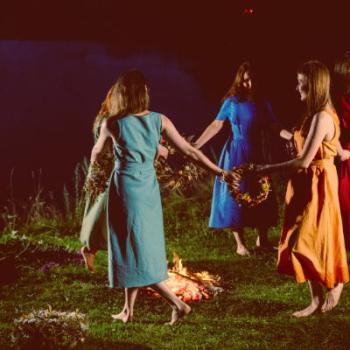
Image credit: Katie Gerrard @ Manic Pixie Dream Grrl for Patheos
What is Cultural Appropriation? As I ask this, I’m sitting in my Baltic Amber necklace listening to Finnish folk music. Sandalwood from India shaped into a wax melt by a lovely person in Cornwall fills the air. My breakfast was Plantain, my tea most likely a New York style Italian.
It’s not like I’m wearing a feather headdress to a music festival, so am I ok?
I really don’t know anymore.
We live in a globalised world. So much of our daily life is syncretic. Tea is British, Coffee and cake is Swedish. Who can argue with those, right?
But wait?
What is borrowed, what is stolen? At what point does my inclusive Paganism cross into culturally inappropriate?
I genuinely don’t believe anyone sets out to appropriate another culture’s sacred elements. They do set out to double down and insist they were right at times, for sure. But I don’t believe they deliberately tried to offend anyone.
Our instincts when faced with something we thought was ok and are now told isn’t is disbelief.
I worked for a racial equality charity a few years back. As the resident Pagan I was asked “Is Morris Dancing racist?”
“Of course not,” I laughed. “It’s historical”
Then I did some research.
I came into work the next day with an apology.
“We don’t *think* of it as racist, but the root form of the word *might* come from Moorish. I guess that makes the face paint less coal miners shirking their work and more black face than I’m comfortable with.”
The things we hold dear as part of our own culture didn’t necessarily start out that way. That which seems harmless to me may not be to another.
Native American shamans have asked Wiccans very clearly to stop using their chants for rituals out of context.
Siberian shamans have asked anthropologists and scholars to stop using the term Shaman for anything which isn’t related to Evenk spirituality.
My Welsh downline beg the internet to stop using their mythology out of context every September.
“You don’t speak for me”, say others of those heritages, “I think it’s fine. Keep going.”
Who even ‘owns’ a song or a deity or a title?
And yet when something you love and are spiritually connected to is taken out of context it really hurts.
“No, no, no,” I scream every time Freyja is referred to as a goddess of love and beauty. “Frigga is more about love, and Baldr is the god of beauty. Beauty was a male attribute.”
“Freyja does not map onto Aphrodite and Venus.”
“You can’t sticky tape her into your Paganism to play a role which she doesn’t fulfil.”
I can’t stop anyone else worshipping Freyja in the way they see fit. Nor can I stop an artist drawing her in a way I personally don’t envision. I wouldn’t expect to.
But if someone designed a tshirt which said “Freyja, wife of Thor”, how would I feel?
How about “Freyja, wife of Zeus”?
No one owns a goddess, or myth, but it feels confusing when someone takes those elements out of context.
It makes sense then when someone asks those within another culture not to appropriate. Especially when it’s clear they don’t understand the symbolism.
But what happens when they do understand? When someone has spent a long time researching and honouring that culture and wants to worship those deities? When they’ve travelled to learn that religion in its original culture?
Is that still appropriation?
I think we can all agree white supremacy in heathenry is trash. It’s completely unacceptable.
Frankly, the Norse gods don’t give two hoots what colour your flesh suit is or for your background. There’s no room for expecting to search for Nordic ancestry to prove your ability to work with these deities.
The same goes for British Traditional Wicca. No one expects you to be British or to trace your British ancestry to justify your interest in the tradition. Anyone who does has completely missed the point. But you *do* need to be initiated by someone who has been initiated by someone… blablabla… and that’s ok.
Does that mean if I want to study Native American spirituality, I can learn it from someone Native American with an open heart and open mind? If I do that does it become more culturally appropriate?
Not necessarily.
So what’s the difference?
It’s impossible to look at what is and isn’t cultural appropriation without your head hurting a bit.
There are no resolute answers.
Some people say if your ancestors raped and pillaged that society you need to leave well alone. That makes sense. Except does that mean I can’t visit Lindisfarne if I have Viking blood? Or as an English person I can’t work with the Welsh deities? Just because most of the world can’t remember how oppressed Wales has been by the English doesn’t mean it didn’t happen.
Why is my working with the Welsh culture “better” than my working within African spirituality?
Does that mean the Voudun and Hoodoo traditions aren’t for white people?
Although many of these Syncretic religions were just that… syncretic. They’re a fusion of cultures including Catholicism with some spirits being given the names of Saints.
Is Voudou then cultural misappropriation in and of itself?
Can you misappropriate a religion which has caused you harm by teaching you to deny your sexuality (for example)?
It’s easy to throw your hands up and simply say, it’s ok, we’re a global society. We can’t get it right all the time, we just need to stop trying so hard.
If you didn’t mean to cause offence, it’s not your fault. You did nothing wrong, crack on.
Yet this can’t be the default.
I saw an article on a facebook group saying, “please don’t use the word tribe to describe people as it was misused by colonialism”. Except Jewish people have used the term for many generations before this.
The same article suggested “spirit animals” were wrong for anyone but Native Americans to use. Except the Norse had a spirit animal tradition – the Fylgja.
Whilst I don’t need to refer to pop singers as my spirit animal, I would like to continue working with my own personal fylgjas without feeling ashamed.
And what of Isis?
The goddess was worshipped by the Greek, Romans, and Egyptians in slightly different ways, then absorbed into modern paganism with a slightly different twist again. Now her name is associated with Islamic fighters.
How do we even begin to unpick this?
Living in a multicultural world means some things are associated with more than one tradition. Wearing a feathered headdress to a festival if you didn’t personally earn each of those feathers with brave deeds is clearly problematic. Calling yourself a Shaman when you aren’t of Siberian heritage maybe less so (maybe).
How do we work with the spirituality of other cultures whilst acknowledging the damage cultural appropriation can do?
Firstly, I think we need to be careful not to take things completely out of their original context. It’s harder to unpick when it’s something which exists in many cultures or has been assimilated into a tradition from the very beginning. Yet, it’s not impossible. I learnt Native American chants as part of my Wiccan practise yet could easily find other ways to raise energy.
Things which were taken and used but became a lynchpin of that tradition are harder to unpick. Take Aiden Kelly’s use of the word Mabon to become the Autumn Equinox festival for example.
Is it ok if you continue to use these appropriated traditions privately without publishing them everywhere?
Again, I’m not sure.
Deities and rituals amass energy. Your use of my goddess to represent something she didn’t originally might affect the face she shows me.
Does that matter?
Is it too late, after so many years, to do anything about it?
How do I know the spirits of a tradition didn’t *want* to be appropriated? How wrong does that sentance sound full stop in the days of consent culture?
We’re all human beings with common sense. There’s little point going out of your way to offend someone if you don’t have to. Surely, this should be the bottom line. If you have the power to change something, go ahead and do it.
As authors and practitioners, it’s time now to say we need to do better. Once upon a time we maybe didn’t think through the implications, but now we can. We can consider the affect our actions have for other people and it’s time we did.

About Katie Gerrard
Author of "Seidr: The Gate is Open" and "Odin’s Gateways", Katie Gerrard is a witch working as a hypnotherapist, yoga teacher and workshop facilitator. You can read more about the author here.
Previous Post

October 16, 2020
The Creative Industries Have Been Eroded And Undervalued For Years
Next Post

October 24, 2020 Magick Without Spoons
Browse Our Archives
Select a Category Ancestors Doing the work Hypnosis Pagan Groups Shamanism Spiritual Leadership The Pagan Year Uncategorized Yoga
Select a Month June 2024 January 2024 October 2023 September 2023 August 2023 July 2023 June 2023 January 2023 December 2022 September 2022 August 2022 March 2022 February 2022 July 2021 June 2021 April 2021 March 2021 February 2021 January 2021 December 2020 November 2020 October 2020 September 2020
Follow Us!
TAKE THE
Religious Wisdom Quiz
Who was Paul's mentor mentioned in his letters to Timothy?
Select your answer to see how you score.
Onesimus Silas Lois Phoebe
Related posts from Manic Pagan Dream Grrl

The importance of spiritual supervision and mentoring

Exploring Past Life regression through spiritual belief and...

Running a virtual pagan moot, my year of...
Ritual design for witches and pagans who’ve stepped...
TRENDING AT PATHEOS Pagan

I was recently chatting with someone on Instagram. She asked me what...

While there are many people who share their results, the end of...

On July 23, I saw Christopher Nolan's The Odyssey which is Homer’s...

As I write this two big events have just finished up. One...

Restoring the Watershed of Divine Love
Perhaps cooperation is not something we manufacture through legislation, ideology, or moral...

Many UUs don’t pray because of bad experiences in a previous religion,...
view all Pagan blogs
Ad-Free & Subscriber Log-In Subscription Support
- About Us
- 2026 Calendar
- Videos
- Podcasts
- Library of World Religions
- Faith In Media Tracker
- Advertise With Us
- Write for Us
- Privacy Policy
- Terms of Service
- Do Not Sell My Data
- Contact Us
- Radiant Digital
- Manage Newsletter Subscriptions
- Unsubscribe From Notifications
- Sitemap
Copyright 2008-2026, Patheos. All rights reserved.
Subscription Support Ad-Free & Subscriber Log-In
Follow Patheos