
BuddhistCatholicContemplativeEvangelicalGeneral ChristianHinduJewishLatter-day SaintMuslimNew VisionsProgressive Christian
Beliefs
- Buddhist
- Catholic
- Contemplative
- Evangelical
- General Christian
- Hindu
- Jewish
- Latter-day Saint
- More Voices
- Muslim
- New Visions
- Pagan
- Progressive Christian
Topics
- Religion News
- Food and Religion
- Sports and Religion
- Religious Art
- Religious Music and Entertainment
- Religious Events
- History and Religion
- Style and Religion
- Politics and Religion
- Women in Religion
- Recreation Outdoors and Religion
- Business Finance and Religion
- Careers Workplace and Religion
- Education and Religion
- Family Parenting and Religion
- Health Fitness and Religion
- Home and Religion
- Relationships and Religion
- Technology and Religion
- Travel and Religion
Columnists
- Buddhist Columnists
- Business Finance and Religion Columnists
- Careers Workplace and Religion Columnists
- Catholic Columnists
- Contemplative Columnists
- Education and Religion Columnists
- Evangelists Columnists
- Family Parenting and Religion Columnists
- General Christian Columnists
- Health Fitness and Religion Columnists
- Hindu Columnists
- History and Religion Columnists
- Home and Religion Columnists
- Jewish Columnists
- More Voices Columnists
- Latter Day Columnists
- Muslim Columnists
- New Visions Columnists
- Nonreligious Columnists
- Pagan Columnists
- Politics and Religion Columnists
- Progressive Columnists
- Recreation Outdoors and Religion Columnists
- Relationships and Religion Columnists
- Religion News Columnists
- Religious Art Columnists
- Religious Events Columnists
- Religious Music and Entertainment Columnists
- Sports and Religion Columnists
- Style and Religion Columnists
- Technology and Religion Columnists
- Travel and Religion Columnists
- Women in Religion Columnists
Resource Library
- 2026 Calendar
- Library of World Religions
- The 100 Most Holy Places on Earth
- Patheos Answers
- Podcasts
- Videos
- Faith Leaders Database
- Anglican Episcopalian
- Bahai
- Baptist
- Buddhism
- Christianity
- Confucianism
- Eastern Orthodoxy
- Hinduism
- Holiness and Pentecostal
- ISKCON
- Islam
- Judaism
- Lutheran
- Methodist
- The Church of Jesus Christ of Latter-day Saints
- New Age
- Paganism
- Presbytarian and Reformed
- Protestantism
- Religion Behind the Scenes
- Roman Catholic
- Scientology
- Shia Islam
- Sikhism
- Sufism
- Sunni Islam
- Taoism
- Zen
- See all religions
Research Tools
 Ad-Free & Subscriber Log-In Subscription Support
Ad-Free & Subscriber Log-In Subscription Support
Follow Patheos 

- Trending:
- Forgiveness
- |
- Marriage
- |
- Consciousness
- |
- Death Penalty
- |
- Election
- |
- Halloween
 The Manhattan Project
- Home
- Evangelical
- What the Bible says about Kim Davis
What the Bible says about Kim Davis
Last updated on: September 8, 2015 at 2:32 pm by Eric Teetsel
What the Bible says about Kim Davis 2015-09-08T14:32:48-04:00 Eric Teetsel
Patheos Explore the world's faith through different perspectives on religion and spirituality! Patheos has the views of the prevalent religions and spiritualities of the world.
Today, presidential candidate Mike Huckabee will host a campaign event at the Carter County Detention Center in Grayson, KY. The jail is housing Kim Davis, who is being held in contempt of court for her failure to heed
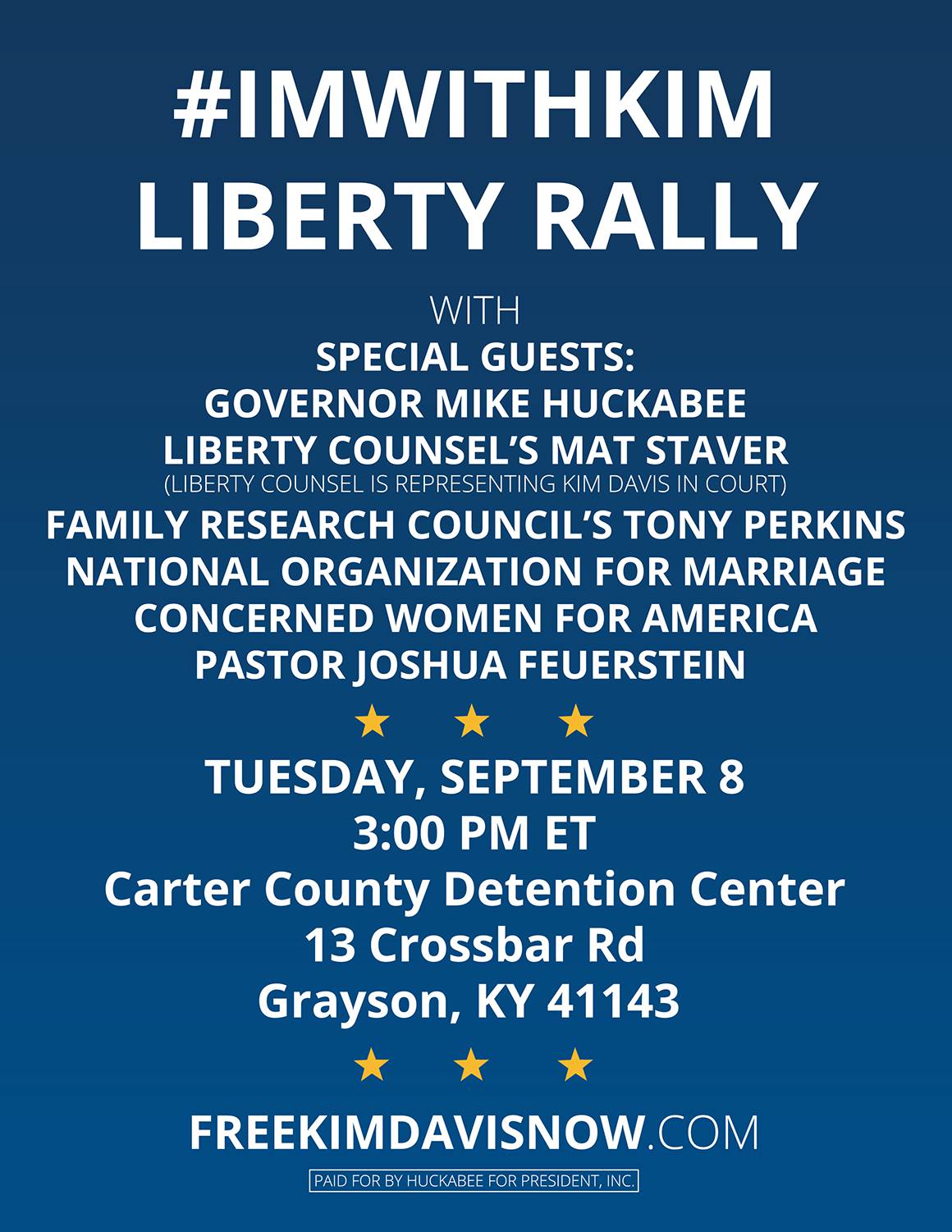
Flier for Huckabee’s Kim Davis event.
judicial rulings requiring her to administer the duties of her office, or resign. Huckabee will be flanked by representatives from Liberty Counsel, National Organization for Marriage, Family Research Council, and Concerned Women for America.
It will be a busy day in for Davis; another presidential candidate, Senator Ted Cruz, will also be visiting.
Is Kim Davis a hero? A Rosa Parks of religious liberty? Her case does raise important concerns about the acceptability of religious expression in the age of Obergefell. There is an argument that her civil disobedience is in the tradition established by Lincoln in his response to the abhorrent Dred Scott decision, and King in his Letter from a Birmingham Jail. The courageous men and women rallying around Davis today are colleagues and friends for whom I have admiration and respect. We are united in the fights for life, marriage, and religious liberty, and their support of her has caused me to question my position on this situation.
While I share the pro-Davis camp’s convictions about the meaning of marriage, and their zeal to stand firm for what is true, the touchstone of truth is not Lincoln, King, or the Founding Fathers. The ultimate source of authority is the Bible. As I’ve read the arguments from Davis supporters I’m surprised by their lack of biblical evidence. There tends to be a lot of talk about God without reference to God’s own Word.
Perhaps that is because there isn’t much there? Christians may arrive at different conclusions about what the Bible teaches about civil disobedience, and the particulars of each situation must inform attempts to apply complex biblical reasoning. The details are the reason Christians view Bonhoeffer and John Brown differently. As I’ve sought the scriptures, I’ve become increasingly convinced that there is no biblical justification for Kim Davis’ resistance.
The greatest act of injustice in history is the murder of Jesus. He is a perfect man who knew no sin whose torture and execution was devised by an evil political contingent threatened by his message of freedom. John describes the betrayal and arrest of Jesus:
When Jesus had spoken these words, he went out with his disciples across the brook Kidron, where there was a garden, which he and his disciples entered. Now Judas, who betrayed him, also knew the place, for Jesus often met there with his disciples. So Judas, having procured a band of soldiers and some officers from the chief priests and the Pharisees, went there with lanterns and torches and weapons. Then Jesus, knowing all that would happen to him, came forward and said to them, “Whom do you seek?” They answered him, “Jesus of Nazareth.” Jesus said to them, “I am he.” Judas, who betrayed him, was standing with them. When Jesus said to them, “I am he,” they drew back and fell to the ground. So he asked them again, “Whom do you seek?” And they said, “Jesus of Nazareth.” Jesus answered, “I told you that I am he. So, if you seek me, let these men go.” This was to fulfill the word that he had spoken: “Of those whom you gave me I have lost not one.” Then Simon Peter, having a sword, drew it and struck the high priest’s servant and cut off his right ear. (The servant’s name was Malchus.) So Jesus said to Peter, “Put your sword into its sheath; shall I not drink the cup that the Father has given me?” (John 18:1-11 ESV)
Peter is the most fascinating disciple. Courageous and intemperate, one moment he is correctly identifying Jesus as the Christ and the next being rebuked by him, “Get behind me, Satan” (Mark 8:29-33). When Jesus walks on water, Peter is the one with faith enough to join him before his faith wanes and he begins to sink (Matthew 14:22-33). At the Last Supper Peter boldly pledges his fidelity to Jesus, and then denies him three times in one day. Yet, when news arrives of the empty tomb, Peter is the first to go in and see (John 20). After the Resurrection, when the disciples realize Jesus is waiting for them on the shore, it is with typical zeal that Peter “threw himself into the sea” (John 21:7).
We ought not be surprised by Peter’s response in the garden. He is a fighter, impulsive to a fault, but driven by commitment to the Lord. I imagine myself standing side by side with Jesus at his betrayal, as the soldiers move forward to take him to his death. The magnitude of the wrong that is about to occur causes my head to spin and my hands to shake. I have a sword. What would I do?
But Jesus stops Peter, and heals the guard he attacked. “Put your sword into its sheath; shall I not drink the cup that the Father has given me?” And, a little while later, while standing before Pilate, he explains, “My kingdom is not of this world. If my kingdom were of this world, my servants would have been fighting, that I might not be delivered over to the Jews. But my kingdom is not from the world” (John 18:36).
Peter’s ministry continues after the Ascension, and the Bible contains two letters he wrote to the Church, the books of 1 and 2 Peter. In 1 Peter 4:7 Peter writes, “The end of all things is at hand; therefore be self-controlled and sober-minded for the sake of your prayers.” Self-controlled and sober-minded? Attributes Peter so often failed to exemplify throughout his life, but which he seems eventually to have learned.
Later, in the same chapter, Peter writes:
Beloved, do not be surprised at the fiery trial when it comes upon you to test you, as though something strange were happening to you. But rejoice insofar as you share Christ’s sufferings, that you may also rejoice and be glad when his glory is revealed. If you are insulted for the name of Christ, you are blessed, because the Spirit of glory and of God rests upon you. But let none of you suffer as a murderer or a thief or an evildoer or as a meddler. Yet if anyone suffers as a Christian, let him not be ashamed, but let him glorify God in that name. For it is time for judgment to begin at the household of God; and if it begins with us, what will be the outcome for those who do not obey the gospel of God? And “If the righteous is scarcely saved, what will become of the ungodly and the sinner?” Therefore let those who suffer according to God’s will entrust their souls to a faithful Creator while doing good. (1 Peter 4:12-19 ESV)
The Bill of Rights begins with two foundational principles: barring the establishment of a state religion, and preserving the freedom to exercise religious belief. Christians who face a conflict between the law and their faith rightfully appeal to the protections of the Constitution, just as Paul appealed to his Roman citizenship for relief. By doing so they acknowledge the authority of the law whatever the result, just as Paul did. “But Paul said, “I am standing before Caesar’s tribunal, where I ought to be tried. To the Jews I have done no wrong, as you yourself know very well. If then I am a wrongdoer and have committed anything for which I deserve to die, I do not seek to escape death” (Acts 25:10-11).
Christians cannot appeal to the authority of the Constitution when it suits them, but take the law into their own hands when they do not like the determinations of governmental authorities endowed by God with the right to rule (Romans 13). This does not mean that we violate our consciences and the higher laws of God, but it means we suffer the consequences of conflict between faith and law respectfully, remembering that God’s kingdom is not of this world, and that suffering as Christ suffered is an opportunity for rejoicing (Acts 5:41).
*****
And here’s this just for fun:

Calvin seeks a religious accommodation.
Previous Post

September 4, 2015
Is Kim Davis doing the right thing?
Browse Our Archives
Select a Category Life Marriage Politics Religious Freedom Uncategorized
Select a Month September 2015 August 2015 July 2015 June 2015 April 2015 March 2015 May 2014 April 2014 March 2014 February 2014 January 2014 December 2013 November 2013 September 2013 June 2013 March 2013 February 2013 January 2013 November 2012 October 2012
Follow Us!
TAKE THE
Religious Wisdom Quiz
What city was Job from?
Select your answer to see how you score.
Susa Edom Uz Shiloh
Related posts from The Manhattan Project

Is Kim Davis doing the right thing?

The present evil age, and what you can...

Wheaton College counselor resigns, admits support for same-sex...
TRENDING AT PATHEOS Evangelical

The REST of Your Life: A Creative Wrestles...
This week I had a conversation with a good friend from church....

How the author of the world's best hymn...
I've been working with John Newton for a while now. This makes...

Long before this Lectio Divina, Psalm 130 - the song - started...

What About the Trees? Another Living Parable
After I finished writing the last article about falling leaves as a...

Why Classical Education Is a Conversation, Not a...
Come and Read: Joy in Classical Education When I was a little...

Cornell University has received a great deal of negative publicity and intense...
view all Evangelical blogs
Ad-Free & Subscriber Log-In Subscription Support
- About Us
- 2026 Calendar
- Videos
- Podcasts
- Library of World Religions
- Faith In Media Tracker
- Advertise With Us
- Write for Us
- Privacy Policy
- Terms of Service
- Do Not Sell My Data
- Contact Us
- Radiant Digital
- Manage Newsletter Subscriptions
- Unsubscribe From Notifications
- Sitemap
Copyright 2008-2026, Patheos. All rights reserved.
Subscription Support Ad-Free & Subscriber Log-In
Follow Patheos