
BuddhistCatholicContemplativeEvangelicalGeneral ChristianHinduJewishLatter-day SaintMuslimNew VisionsProgressive Christian
Beliefs
- Buddhist
- Catholic
- Contemplative
- Evangelical
- General Christian
- Hindu
- Jewish
- Latter-day Saint
- More Voices
- Muslim
- New Visions
- Pagan
- Progressive Christian
Topics
- Religion News
- Food and Religion
- Sports and Religion
- Religious Art
- Religious Music and Entertainment
- Religious Events
- History and Religion
- Style and Religion
- Politics and Religion
- Women in Religion
- Recreation Outdoors and Religion
- Business Finance and Religion
- Careers Workplace and Religion
- Education and Religion
- Family Parenting and Religion
- Health Fitness and Religion
- Home and Religion
- Relationships and Religion
- Technology and Religion
- Travel and Religion
Columnists
- Buddhist Columnists
- Business Finance and Religion Columnists
- Careers Workplace and Religion Columnists
- Catholic Columnists
- Contemplative Columnists
- Education and Religion Columnists
- Evangelists Columnists
- Family Parenting and Religion Columnists
- General Christian Columnists
- Health Fitness and Religion Columnists
- Hindu Columnists
- History and Religion Columnists
- Home and Religion Columnists
- Jewish Columnists
- More Voices Columnists
- Latter Day Columnists
- Muslim Columnists
- New Visions Columnists
- Nonreligious Columnists
- Pagan Columnists
- Politics and Religion Columnists
- Progressive Columnists
- Recreation Outdoors and Religion Columnists
- Relationships and Religion Columnists
- Religion News Columnists
- Religious Art Columnists
- Religious Events Columnists
- Religious Music and Entertainment Columnists
- Sports and Religion Columnists
- Style and Religion Columnists
- Technology and Religion Columnists
- Travel and Religion Columnists
- Women in Religion Columnists
Resource Library
- 2026 Calendar
- Library of World Religions
- The 100 Most Holy Places on Earth
- Patheos Answers
- Podcasts
- Videos
- Faith Leaders Database
- Anglican Episcopalian
- Bahai
- Baptist
- Buddhism
- Christianity
- Confucianism
- Eastern Orthodoxy
- Hinduism
- Holiness and Pentecostal
- ISKCON
- Islam
- Judaism
- Lutheran
- Methodist
- The Church of Jesus Christ of Latter-day Saints
- New Age
- Paganism
- Presbytarian and Reformed
- Protestantism
- Religion Behind the Scenes
- Roman Catholic
- Scientology
- Shia Islam
- Sikhism
- Sufism
- Sunni Islam
- Taoism
- Zen
- See all religions
Research Tools
 Ad-Free & Subscriber Log-In Subscription Support
Ad-Free & Subscriber Log-In Subscription Support
Follow Patheos 

- Trending:
- Forgiveness
- |
- Marriage
- |
- Consciousness
- |
- Death Penalty
- |
- Election
- |
- Halloween

- Home
- Progressive Christian
- Recreation, Outdoors and Religion
- Meditations on John 17:20-26
Meditations on John 17:20-26
Last updated on: May 30, 2025 at 12:24 pm by Rob Giannamore
Meditations on John 17:20-26 2025-05-30T12:24:55-04:00 Rob Giannamore
Patheos Explore the world's faith through different perspectives on religion and spirituality! Patheos has the views of the prevalent religions and spiritualities of the world.
In the “High Priestly Prayer”, Jesus passionately pleads for unity among his believers, a sentiment that strongly resonates today. With themes of Trinity, Divine nature and hints about the nature of who Jesus was, we end up with a Trinitarian prayer that reveals God’s desire to draw humanity into the very heart of God’s divine communion. The unity among believers is a direct reflection of the unity within the Godhead, powered by the love that flows between the Father, Son, and Holy Spirit, and intended as a powerful witness to the world.
The Nature of Jesus
From a teacher/parent/pastor/leadership perspective, I can really appreciate what Jesus is doing in this passage. In the other Gospels this prayer comes after dinner, right before he is arrested. Jesus, considering his time with his diciples and anticipating the hardships they are going to face, challenges them with a passionate prayer that reminds them of the Trinitarian action of God and the need for unity.
This passage highlights the Jewish heritage of Jesus. Previously, I have discussed the concept of Tikkun Olam (repairing the world). Here, it is important to acknowledge that Jesus was indeed Jewish, and the principle of Tikkun Olam underscores the Jewish imperative to perceive one’s life as part of a greater purpose, thereby finding meaning in one’s actions.
In later texts, such as those of Paul, we observe the influence of Jesus’s teachings on Tikkun Olam. For instance, Paul emphasizes “unifying love in the body of Christ,” which entails a committed effort to perform good deeds for the Christian community, irrespective of personal feelings (Galatians 6:10). Paul further elaborates that Christian unity extends beyond mere sacrifice for those one may not favor; it also involves affectionate love. He advocates for a deep sense of endearment towards fellow believers in Christ.
Paul’s exhortations include: “Love one another with brotherly affection” (Romans 12:10), “Having purified your souls by your obedience to the truth for a sincere brotherly love, love one another earnestly from a pure heart” (1 Peter 1:22), and “All of you, have sympathy, brotherly love, a tender heart, and a humble mind” (1 Peter 3:8).
The nature of Jesus then is one of compassion and empathy, being mindful of his community as well as of himself. If we explore other passages in the New Testament, we will see multiple examples of this. To be Christian, in the image of Jesus, with Jesus as our role model, is to embody this ‘Jesus nature’.
Power of the Trinity
At the core of my spiritual study is John Wesley. Among the various Reformers and thinkers from the 18th century that I have studied, it is Wesley who consistently resonates with me. His preaching, which challenged and shaped society, particularly influenced my perspective during my college years. When examining Wesley’s views on the nature of the Trinity as presented in scripture, one can observe his strong commitment to Trinitarian doctrine and his thorough engagement with these themes.
Four themes pop out after looking through Wesley’s writings on this passage:
Christian Perfection and Love: According to Wesley, the unity described in John 17 is an essential aspect of “Christian perfection” or “holiness of heart and life.” This concept involves being perfected in love (note that this is a process of becoming) – encompassing both love for God and love for one another, which originates from divine love. This unity of love signifies a Spirit-filled life.
Social Holiness: Wesley’s focus on “social holiness” would interpret the unity in Christ as extending beyond individual devotion to an active, loving community. The church, as a united body, aims to demonstrate God’s love and justice to the world, serving as a visible sign of God’s kindom.
Witness and Evangelism: The missional directive of John 17:21 (“so that the world may believe”) aligned with Wesley’s evangelical enthusiasm. For him, the unity of believers was not the ultimate goal (Conversion is a personal choice, but it is our responsibility to tell the good news) but rather a powerful method for attracting others to Christ. He held the view that when Christians genuinely loved and lived in unity, it would prompt the world to acknowledge the divine truth of the Gospel.
Spiritual Experience: Wesley emphasized that this unity is not purely organizational or intellectual, but a spiritual experience facilitated by the indwelling Holy Spirit, bringing believers into living communion with the Father and the Son. It represents a tangible, experienced presence of God’s love within the community.
Divine Union
Unity with each other is unity with God. Whether we look at Jesus’ orientation from his Jewish faith or from the writings about the Acts 2 church to the call in Psalm 82, we are called as a people to be unified in Christ. Galatians challenges us to erase the lines that divide us. This unity, however, is not a passive ideal but a transformative call that requires active participation and intentionality from believers. It involves striving for mutual understanding, cultivating a spirit of forgiveness, and embodying the selfless love exemplified in Christ. Through this divine union, the boundaries that separate individuals—be they cultural, social, or ideological—are dissolved, allowing the Christian community to reflect the sacred harmony of the Trinity. This unified body, empowered by the Spirit, serves not only as a beacon of hope but also as a living testimony to the world, demonstrating the redemptive and unifying power of God’s love.
Our Christian faith, our country’s morals continue to suffer an identity crisis. Christ poured himself out so we could all be whole, not divided. We must take up the cross with Christ and bear witness to the poor, to the widowed, the hungry, to those we deem different. We must share the unifying love of God with others.
Previous Post

May 28, 2025
The Socialist Gospel: What Would Jesus Really Do?
Next Post
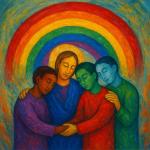
June 4, 2025 Faith, Inclusion, and the LGBTQ+ Journey Toward Belonging
Recent Comments
Browse Our Archives
Select a Category Uncategorized
Select a Month October 2026 September 2026 August 2026 July 2026 June 2026 May 2026 April 2026 March 2026 February 2026 January 2026 December 2025 November 2025 October 2025 September 2025 August 2025 July 2025 June 2025 May 2025 April 2025 March 2025 February 2025 January 2025 December 2024 November 2024 October 2024 September 2024 August 2024 July 2024 June 2024 May 2024 April 2024 March 2024 February 2024 January 2024 December 2023 November 2023 October 2023 September 2022 July 2021 June 2021 May 2021 April 2021 March 2021 February 2021 January 2021 December 2020 November 2020 October 2020 February 2020 October 2019 February 2018
TAKE THE
Religious Wisdom Quiz
What did the Israelites put on their doorposts during Passover?
Select your answer to see how you score.
Olive oil Gold dust Incense Lamb’s blood
Related posts from Love Opens Doors


You Are Enough – The Spiritual Practice of...

Election Fear, Holiday Excess and the Way of...

TRENDING AT PATHEOS Progressive Christian

A new article, written by Jeff Lindsay and Gale L. Pooley,...

Swimfan: Forgotten Aughts Pleasures
This is a recovery effort. In 2002, My Big Fat Greek Wedding...

Top Three Anti-Catholic Lies About Catholicism
This is my initial transcript for the video, "THE 3 WORST...

Pope Leo Celebrates Mass for Nurses & Docs...
I don't have any idea how he did it, but Pope Leo...

The Sermon on the Mount, Part I: Matthew...
The Sermon on the Mount, Part I (Matthew 4:12-5:12) St. Matthew moves...

What's up from Crossway: Reviewing some of their latest A few weeks...
view all Progressive Christian blogs
What Are Your Thoughts?leave a comment
Ad-Free & Subscriber Log-In Subscription Support
- About Us
- 2026 Calendar
- Videos
- Podcasts
- Library of World Religions
- Faith In Media Tracker
- Advertise With Us
- Write for Us
- Privacy Policy
- Terms of Service
- Do Not Sell My Data
- Contact Us
- Radiant Digital
- Manage Newsletter Subscriptions
- Unsubscribe From Notifications
- Sitemap
Copyright 2008-2026, Patheos. All rights reserved.
Subscription Support Ad-Free & Subscriber Log-In
Follow Patheos