
BuddhistCatholicContemplativeEvangelicalGeneral ChristianHinduJewishLatter-day SaintMuslimNew VisionsProgressive Christian
Beliefs
- Buddhist
- Catholic
- Contemplative
- Evangelical
- General Christian
- Hindu
- Jewish
- Latter-day Saint
- More Voices
- Muslim
- New Visions
- Pagan
- Progressive Christian
Topics
- Religion News
- Food and Religion
- Sports and Religion
- Religious Art
- Religious Music and Entertainment
- Religious Events
- History and Religion
- Style and Religion
- Politics and Religion
- Women in Religion
- Recreation Outdoors and Religion
- Business Finance and Religion
- Careers Workplace and Religion
- Education and Religion
- Family Parenting and Religion
- Health Fitness and Religion
- Home and Religion
- Relationships and Religion
- Technology and Religion
- Travel and Religion
Columnists
- Buddhist Columnists
- Business Finance and Religion Columnists
- Careers Workplace and Religion Columnists
- Catholic Columnists
- Contemplative Columnists
- Education and Religion Columnists
- Evangelists Columnists
- Family Parenting and Religion Columnists
- General Christian Columnists
- Health Fitness and Religion Columnists
- Hindu Columnists
- History and Religion Columnists
- Home and Religion Columnists
- Jewish Columnists
- More Voices Columnists
- Latter Day Columnists
- Muslim Columnists
- New Visions Columnists
- Nonreligious Columnists
- Pagan Columnists
- Politics and Religion Columnists
- Progressive Columnists
- Recreation Outdoors and Religion Columnists
- Relationships and Religion Columnists
- Religion News Columnists
- Religious Art Columnists
- Religious Events Columnists
- Religious Music and Entertainment Columnists
- Sports and Religion Columnists
- Style and Religion Columnists
- Technology and Religion Columnists
- Travel and Religion Columnists
- Women in Religion Columnists
Resource Library
- 2026 Calendar
- Library of World Religions
- The 100 Most Holy Places on Earth
- Patheos Answers
- Podcasts
- Videos
- Faith Leaders Database
- Anglican Episcopalian
- Bahai
- Baptist
- Buddhism
- Christianity
- Confucianism
- Eastern Orthodoxy
- Hinduism
- Holiness and Pentecostal
- ISKCON
- Islam
- Judaism
- Lutheran
- Methodist
- The Church of Jesus Christ of Latter-day Saints
- New Age
- Paganism
- Presbytarian and Reformed
- Protestantism
- Religion Behind the Scenes
- Roman Catholic
- Scientology
- Shia Islam
- Sikhism
- Sufism
- Sunni Islam
- Taoism
- Zen
- See all religions
Research Tools
 Ad-Free & Subscriber Log-In Subscription Support
Ad-Free & Subscriber Log-In Subscription Support
Follow Patheos 

- Trending:
- Forgiveness
- |
- Marriage
- |
- Consciousness
- |
- Death Penalty
- |
- Election
- |
- Halloween

- Home
- Nonreligious
- Relationships and Religion
- When Faithful People Suffer and God Stays Silent
When Faithful People Suffer and God Stays Silent
Last updated on: August 10, 2026 at 9:08 am by Derrick Day
When Faithful People Suffer and God Stays Silent 2026-08-10T09:08:12-07:00 Derrick Day
Patheos Explore the world's faith through different perspectives on religion and spirituality! Patheos has the views of the prevalent religions and spiritualities of the world.

Picture by DALL-E from prompt by the author.
It Started With the Discomfort of Death…
A pastor friend of mine will bury a woman this week. Not a stranger, not a name on a prayer list — a friend. By every metric the church sells as proof of a life well-lived, she passed. She served. She showed up. She never wasted a chance to tell a room how good God was to her. And then cancer, or a clot, or whatever the body finally surrenders to, took her anyway. Her pastor is now standing at the front of a sanctuary explaining to grieving people why the God she advertised so faithfully declined to advertise back.
I want to sit with that discomfort, because the church usually won’t. It reaches for a script instead. And the script, examined in daylight, is one of the strangest pieces of marketing ever written.
The Advertising Problem Nobody in the Pulpit Wants to Name
Here’s a straightforward business question. If you ran the most powerful entity in existence and you wanted people to trust you, what would you do with your best customers?
You’d take care of them. Visibly. You’d make loyalty pay so obviously that the whole market noticed. Word would spread on its own. Blessing the faithful would be the cleanest conversion funnel ever built — no ad spend, no persuasion, just results people could see and want for themselves. I wrote an entire piece on this that you can find here.
Now look at the actual data. I’ve watched people who treat God like a rumor — casual believers, cheerful agnostics, the flatly indifferent — get wealth, health, and a kind of untroubled peace that the devoted would trade a limb for. Meanwhile the ones who tithe on the gross, who run the youth ministry, who fast and pray and mean it, get lack, illness, and turmoil. If faithfulness were the product, the testimonials would sink the company.
The believer’s rebuttal is that earthly rewards aren’t the point, that the real payoff is spiritual and eternal. Fine. But that’s a retreat, not an answer. It concedes that in the one arena we can actually measure — this life, these bodies, these bank accounts — devotion shows no reliable edge. You don’t get to preach “God will bless you” on Sunday and then, when He doesn’t, tell the widow her reward is in a ledger she can’t audit until she’s dead.
Excuse One: “God’s Ways Are Higher Than Ours”
This is the closer. When every other explanation collapses, out comes Isaiah 55 — His ways are not our ways, His thoughts higher than our thoughts. Case closed, mystery invoked, congregation soothed.
Except every functional parent alive rejects this exact logic in their own home.
If you’re raising a child, “my reasons are above your comprehension, so stop asking” is not wisdom — it’s the thing bad parents say right before they do something they can’t justify. Good parents explain themselves at the child’s level. They say not the hot stove, because it burns. They don’t say the nature of the stove exceeds your ontological grasp, small one. The whole point of love plus power is that you bend down to be understood by the one who depends on you.
The defense quietly demands two contradictory things at once. God is close enough to be your Father — personal, present, listening — but distant enough that His reasoning is sealed behind glass you’re forbidden to knock on. You can’t have both. A father who could explain and refuses isn’t mysterious. He’s withholding. The higher-ways move isn’t an answer to the problem of suffering; it’s the announcement that no answer is coming, dressed up as reverence. Philosophers have a colder name for what it’s covering up: the problem of evil, the oldest open wound in theology.
Excuse Two: “God Needed Another Flower for His Garden”
At the funeral you’ll hear it. God needed another flower in His garden. Another angel in His army. Heaven was one soul short and your person filled the vacancy.
Picture what this actually claims. An infinite being — lacking nothing, by definition — developed a shortage. A gardening deficit. A staffing gap in a celestial military that, being omnipotent, needs no soldiers at all. And to close this imaginary gap, He reached into a marriage, a family, a friend group, and pulled out a load-bearing wall.
The metaphor only works if you never look at what got left behind. A picked flower leaves a garden slightly emptier. A dead spouse leaves someone eating dinner alone for the next thirty years. A recruited “angel” leaves children who will grow up assembling a parent from photographs. The comfort runs entirely in one direction — toward the dead, who no longer need it — and skips the living, who are drowning in a grief the metaphor was engineered to shush.
And notice the theft underneath the poetry. If God needed her, then her death wasn’t tragic, it was requisitioned. It reframes an act of taking as an act of receiving, so no one has to say the harder sentence out loud: a person who was needed here is gone, and the explanation on offer is that Someone with infinite resources wanted her more.
Excuse Three: The Omniscience Trap
Here’s the one the scripts can’t wriggle out of, and it’s worth slowing down for.
God is omniscient. All-knowing. Not “well-informed” — complete. He knows every consequence of every act before it happens, down to the last tremor of grief in the last person who’ll ever hear the news.
Then He knew.
Before the diagnosis, before the funeral, before the pastor stood up with nothing but Isaiah in his pocket — God already saw, in full and unbearable detail, every night of weeping this death would cause. He saw the empty side of the bed. He saw the child asking where Mommy went. He saw the faith it would crack. None of it surprised Him. None of it could.
Which forecloses the usual escape hatches. You can’t say He didn’t realize how much it would hurt — omniscience means He measured the hurt to the decimal. You can’t say He’ll bring good out of it without conceding He deliberately chose a path that ran straight through this specific agony when, being omnipotent, He had infinite other routes. The suffering wasn’t a side effect He tolerated. It was a feature He selected, foreseeing all of it, and proceeded anyway.
This is the ancient dilemma Epicurus laid out roughly twenty-three centuries ago, and no amount of Sunday polish has closed it: Is He willing to prevent evil but not able? Then He is not omnipotent. Is He able but not willing? Then He is malevolent. Theologians have spent two thousand years building defenses and theodicies to escape the pinch — free will, soul-making, the mystery card. Every one of them runs aground on the same reef the moment the sufferer is an infant.
The Line the Scripts Can’t Cross: A Child
Which brings me to the case that ends the debate, because it strips away every excuse the adult versions lean on.
My great-niece died of brain cancer. A child. Not even ten years old.
Try the scripts on her and watch them disintegrate. Free will — whose? Hers? She hadn’t lived long enough to misuse it. Soul-making, suffering builds character — the Stanford Encyclopedia of Philosophy flags exactly this case, a child dying by slow cancer, as the kind of evil that breaks the standard defenses, and for good reason: character built by a tumor in a toddler is a character no one gets to keep. A lesson for the parents — what curriculum requires a dead child as the textbook, and what teacher assigns it?
Here is the sequence the believer has to defend. An omniscient God — who already knew the whole arc — let two people conceive a child. Let them feel the first kick. Let them choose the name, paint the room, fall the specific bottomless way parents fall. Watched them build an entire future around a person He already knew He was going to remove by way of a disease that eats the brain from the inside. He didn’t spare them the love so He could spare them the loss. He handed over the whole gift and then, on a timeline only He could see, took it back through maximum pain.
There’s a word for giving something precious to someone, letting them bond to it completely, and reclaiming it when the attachment is total. We don’t call it a blessing. Not from anyone else. Not ever.
Where That Leaves Us
I’m not going to hand you a tidy landing. That would make me the pastor with Isaiah in his pocket, and I’d rather leave you honest than comforted.
But we can name the fork the funeral scripts are built to hide. Either the universe runs on no author at all — in which case suffering is brutal but not aimed, not chosen, not a decision made about you by Someone who could’ve chosen otherwise. Or there is an author, and the oldest question in the discipline stands where Epicurus left it: the same Being praised for the sunset signed off on the tumor, foreseeing every scream.
The believer’s real work isn’t defending God’s existence. It’s defending His character — and that’s a far harder brief. The devout woman advertised a good God to the end and got no return on the pitch. Somewhere a father is negotiating with the sky over a child who is not coming back. The higher-ways line, the garden line, the angel line — they don’t answer these people. They’re there to end the conversation before the dangerous question surfaces:
If that’s who’s in charge, is good the word we’re looking for?
Ask it. Out loud. The scripts were written specifically so you wouldn’t.
If you’re wrestling your way out of the faith you were handed, you’re not the first and you’re not broken for it. Sound off in the comments!
Derrick Day is the author of multiple books and the host of The Forward Podcast.
Follow his website or catch him on Facebook, Instagram, TikTok, and YouTube
Relationships and Religion
Family, Parenting and Religion
Previous Post

July 2, 2026
Dethroning Jesus and Enthroning Yourself
Next Post

September 2, 2026 Do Atheism and Agnosticism Require Faith?
Recent Comments
"Excellent, non-partisan explanations. It’s really hard to find that nowadays. Thank you very much for ..."
Oligopoly, Oligarchy, Socialism, and Fascism in ..."
"Charming. Mythicism was always a fringe idea and its brief fad among online atheist a ..."
Did Jesus Exist: The Case of ..."
"I reject Xtianity as scripted in large part because Communism is what is left when ..."
Capitalism, Socialism, and Christians Who Ignore ..."
"Oh please. You make the bog Irish Einsteins."
Did Jesus Exist: The Case of ..."
Browse Our Archives
Select a Category agnostic antitheist antitheist atheistic antitheist atheistic theist gnosticism Love Minus Religion Politics and Policies of Love Uncategorized
Select a Month September 2026 August 2026 July 2026 June 2026 May 2026 March 2026 January 2026 December 2025 October 2025 September 2025 August 2025 July 2025 March 2025 February 2025 January 2025 December 2024 November 2024 October 2024 September 2024 August 2024 July 2024 June 2024 May 2024 April 2024 March 2024 February 2024 January 2024 December 2023 September 2023 November 2022 October 2022 April 2022 February 2022 January 2022 October 2021 May 2021 April 2021 March 2021 January 2021 November 2020 August 2020 July 2020 June 2020 May 2020 April 2020 March 2020 February 2020
Follow Us!
TAKE THE
Religious Wisdom Quiz
What was the first miracle Jesus performed according to John's Gospel?
Select your answer to see how you score.
Feeding the 5000 Raising Lazarus Walking on water Turning water into wine
Related posts from Love Minus Religion

Do Atheism and Agnosticism Require Faith?
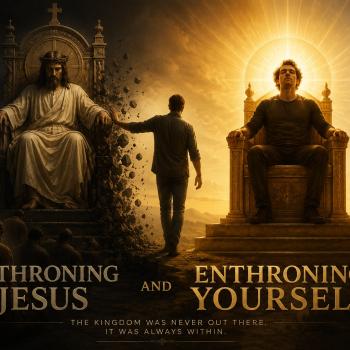
Dethroning Jesus and Enthroning Yourself

Can Religion be Intellectually Honest?
The Gospel According to the Third Eye
TRENDING AT PATHEOS Nonreligious

In "Irreplaceable," our book on vocation and technology, Trevor Sutton and I...

I was strolling through the top floor of the brand new Parthenon...

What Does Gêvâh Mean For Kimberley Guifoyle &...
This week, a lot of the news is focused on Kimberly Guilfoyle....

INNER CIRCLE: Profound Mystery (Of Christ In All...
Ephesians 5:31-32 “For this reason, a man will leave his father and...

Do Not Rejoice When Your Enemy Falls: The...
Turning an execution into a public spectacle is a disturbing expression of...

'The Chosen' S6 Trailer: The Passion Gets Very...
Not many watching 'The Chosen' worry about spoilers, but just because they...
view all Nonreligious blogs
What Are Your Thoughts?leave a comment
Ad-Free & Subscriber Log-In Subscription Support
- About Us
- 2026 Calendar
- Videos
- Podcasts
- Library of World Religions
- Faith In Media Tracker
- Advertise With Us
- Write for Us
- Privacy Policy
- Terms of Service
- Do Not Sell My Data
- Contact Us
- Radiant Digital
- Manage Newsletter Subscriptions
- Unsubscribe From Notifications
- Sitemap
Copyright 2008-2026, Patheos. All rights reserved.
Subscription Support Ad-Free & Subscriber Log-In
Follow Patheos