
BuddhistCatholicContemplativeEvangelicalGeneral ChristianHinduJewishLatter-day SaintMuslimNew VisionsProgressive Christian
Beliefs
- Buddhist
- Catholic
- Contemplative
- Evangelical
- General Christian
- Hindu
- Jewish
- Latter-day Saint
- More Voices
- Muslim
- New Visions
- Pagan
- Progressive Christian
Topics
- Religion News
- Food and Religion
- Sports and Religion
- Religious Art
- Religious Music and Entertainment
- Religious Events
- History and Religion
- Style and Religion
- Politics and Religion
- Women in Religion
- Recreation Outdoors and Religion
- Business Finance and Religion
- Careers Workplace and Religion
- Education and Religion
- Family Parenting and Religion
- Health Fitness and Religion
- Home and Religion
- Relationships and Religion
- Technology and Religion
- Travel and Religion
Columnists
- Buddhist Columnists
- Business Finance and Religion Columnists
- Careers Workplace and Religion Columnists
- Catholic Columnists
- Contemplative Columnists
- Education and Religion Columnists
- Evangelists Columnists
- Family Parenting and Religion Columnists
- General Christian Columnists
- Health Fitness and Religion Columnists
- Hindu Columnists
- History and Religion Columnists
- Home and Religion Columnists
- Jewish Columnists
- More Voices Columnists
- Latter Day Columnists
- Muslim Columnists
- New Visions Columnists
- Nonreligious Columnists
- Pagan Columnists
- Politics and Religion Columnists
- Progressive Columnists
- Recreation Outdoors and Religion Columnists
- Relationships and Religion Columnists
- Religion News Columnists
- Religious Art Columnists
- Religious Events Columnists
- Religious Music and Entertainment Columnists
- Sports and Religion Columnists
- Style and Religion Columnists
- Technology and Religion Columnists
- Travel and Religion Columnists
- Women in Religion Columnists
Resource Library
- 2026 Calendar
- Library of World Religions
- The 100 Most Holy Places on Earth
- Patheos Answers
- Podcasts
- Videos
- Faith Leaders Database
- Anglican Episcopalian
- Bahai
- Baptist
- Buddhism
- Christianity
- Confucianism
- Eastern Orthodoxy
- Hinduism
- Holiness and Pentecostal
- ISKCON
- Islam
- Judaism
- Lutheran
- Methodist
- The Church of Jesus Christ of Latter-day Saints
- New Age
- Paganism
- Presbytarian and Reformed
- Protestantism
- Religion Behind the Scenes
- Roman Catholic
- Scientology
- Shia Islam
- Sikhism
- Sufism
- Sunni Islam
- Taoism
- Zen
- See all religions
Research Tools
 Ad-Free & Subscriber Log-In Subscription Support
Ad-Free & Subscriber Log-In Subscription Support
Follow Patheos 

- Trending:
- Forgiveness
- |
- Marriage
- |
- Consciousness
- |
- Death Penalty
- |
- Election
- |
- Halloween

- Home
- Nonreligious
- History and Religion
- Dethroning Jesus and Enthroning Yourself
Dethroning Jesus and Enthroning Yourself
Last updated on: July 2, 2026 at 10:46 am by Derrick Day
Dethroning Jesus and Enthroning Yourself 2026-07-02T10:46:43-07:00 Derrick Day
Patheos Explore the world's faith through different perspectives on religion and spirituality! Patheos has the views of the prevalent religions and spiritualities of the world.
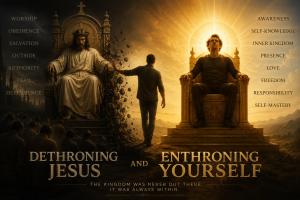
Dethroning Jesus – By DALL-E with prompt by the author
Jesus Never Asked to Be Worshipped. He Asked to Be Understood.
Christianity spent two thousand years building a throne. Then it installed a Galilean carpenter on it, dressed him in gold, and told everyone to bow. Here’s the uncomfortable twist: the man may never have existed as a single historical individual at all — and the teachings assembled under his name were curated, in large part, to manufacture the very myth we’re told to worship. Which makes it stranger still that buried inside that manufactured myth is a body of teaching that keeps refusing the worship it was built to generate.
The Myth-Making Was the Point
Start with the uncomfortable premise first, because everything downstream depends on it. No contemporary of Jesus wrote about him. Not one. The earliest surviving references come decades after the fact, from writers assembling theology, not eyewitnesses filing reports. The gospels aren’t biographies in any modern sense — they’re constructed narratives, written in Greek by unknown authors, decades removed from the events, shaped to fulfill prophecy, to answer rival sects, to fit the template of the dying-and-rising savior figure that shows up across the Mediterranean world in Osiris, Dionysus, Mithras, and a dozen other mystery cults. A virgin birth. A star at the nativity. Death and resurrection on a three-day cycle. These aren’t unique historical fingerprints. They’re the standard furniture of ancient god-man narratives, and the gospel authors were working with familiar materials.
None of this makes the gospels garbage. It makes them what they actually are: theology written as narrative, myth constructed with intention. And a myth needs sayings. A god-man narrative doesn’t cohere on miracles alone — it needs a voice, a doctrine, an ethical center that gives the divine claim substance. So the sayings tradition gets built, layered in over decades of oral transmission and competing communities, each adding material that reinforces the case being made: this figure is special, this figure is divine, this figure is the fulfillment of what came before. The teachings, in other words, aren’t just wisdom preserved. They’re scaffolding, engineered to hold up the myth.
Which is exactly why it’s so strange that the scaffolding keeps refusing to do its job.
The Kingdom Was Never a Place
Read the “kingdom” sayings and a pattern jumps out immediately: they don’t build divine status, they dissolve it. “The kingdom of God is within you,” the Jesus-figure says in Luke. Not arriving. Not elsewhere. Already present, waiting to be recognized. Every synoptic gospel has him fielding the same question — when is the kingdom coming, where is it — and every time he refuses the terms of the question. No observation required. A mustard seed. Leaven in dough. Treasure already buried in the field.
That’s not the language of myth-building. Myth-building wants a throne, a return, a cosmic event with the hero at the center. What the sayings tradition delivers instead is closer to sabotage: a kingdom that was never a place to travel toward, but a condition already available to anyone paying attention. If the gospel writers were assembling material to inflate a god-man’s authority, this is oddly self-defeating material to include.
“I and the Father Are One” Is Not What the Myth Wanted It to Mean
This is the line doing the most theological heavy lifting in Christian history, and even inside a text built to argue for Jesus’s divinity, it slips its leash. “I and the Father are one” gets read as an exclusive claim — Jesus alone, uniquely divine. But John’s own narrative undercuts the exclusive reading in the very next breath. The crowd picks up stones; Jesus asks why; they answer that a man is making himself God. His response isn’t retreat, it’s expansion: he cites Psalm 82, where God addresses an entire assembly of humans and calls all of them gods. If scripture already applies that word to everyone who receives the word, he asks, why is it blasphemy for one more?
That’s an argument from precedent, not a fence around a category of one — and it’s a strange thing for a myth engineered to elevate a single divine figure to preserve. The Gospel of Thomas, excluded from the canon precisely because it resisted the institutional reading, says it outright: know yourself, and you’ll realize you are a child of the living Father — plural, available, not restricted to the man doing the talking.
A Character Who Kept Redirecting His Own Worship
Even inside a narrative built to deify him, the character declines the role. A rich man calls him “good teacher”; he deflects — no one is good but God alone. Heal someone, and the instruction is often to tell no one, which is not how you build a personality cult. Asked for the greatest commandment, he doesn’t say “worship me.” He says love God and love your neighbor as yourself, routing devotion outward and inward, never toward his own person. The one prayer he explicitly teaches — the Lord’s Prayer — contains no petition to himself at all.
If this figure is myth, he’s oddly engineered: a god-man character who keeps declining godhood and pointing the audience back at their own capacity. Either the myth-makers were unusually bad at their job, or something older and more interesting survived their editing — a wisdom tradition about consciousness and self-recognition, later wrapped in the miracle-and-resurrection packaging that the religious marketplace of the first century demanded to be taken seriously.
Self-Actualization Wearing First-Century Clothes
Strip the divinity claims away and what’s left reads like a manual for psychological maturity, not a membership form for an afterlife club. Stop performing righteousness for an audience — pray, fast, give in private, because external validation and internal integrity are different currencies. Stop outsourcing your worth to comparison — the log in your own eye disqualifies you from judging the speck in someone else’s. Stop living in anxious deferral — today’s burdens are sufficient for today. Forgive as a precondition for your own release, not a transaction — the parable of the unforgiving servant is really about the prison he builds for himself.
Compare that to Maslow’s self-actualized individual: present-focused, internally validated, undefended, capable of what he called peak experiences — moments of unity and effortless being. Now compare it to the Beatitudes, where the poor in spirit and the pure in heart are named blessed because their internal condition already is the kingdom. Two different eras, two different vocabularies, describing the same internal architecture. That correspondence is either a remarkable coincidence, or evidence that whoever assembled these sayings — real teacher, composite character, or literary invention — was transmitting something psychologically real, independent of whether a single miracle-working man ever walked around Galilee saying it.
Why the Institution Needed the Myth to Win
None of this is accidental. A teaching that says the kingdom is already within you, accessible without intermediary, is structurally useless to any institution that wants to control access to the sacred. But a resurrected god who must be worshipped, whose favor runs through priesthood and sacrament, is a durable operating model. Nicaea didn’t settle a theological dispute so much as it chose a business model — the divine, worship-demanding version of the story over the version that told people to look inward and stop looking to Rome, or the Temple, or anyone else, for permission.
So the myth won the packaging fight. Divinity, virgin birth, bodily resurrection, worship — that’s the layer that got councils, creeds, and empires. The self-realization material survived only because it was useful camouflage: sayings wise enough to make the myth’s central character worth following, embedded inside a narrative built to make him worth worshipping instead.
What It Means to Dethrone Jesus and Enthrone Yourself
Dethroning Jesus doesn’t mean deciding he was a fraud or that the teachings are worthless. It means refusing the transaction the myth was built to sell you — obedience in exchange for salvation, submission in exchange for belonging — and taking the content seriously enough to apply it without the throne attached. The throne was never load-bearing. It was packaging.
Enthroning yourself is not narcissism dressed in spiritual language. It’s the recognition the sayings themselves keep pointing at: the kingdom was never elsewhere, the sonship was never exclusive, the capacity described in the Beatitudes was never contingent on a resurrection you have to take on faith. If the internal condition Jesus describes — undefended, present, free of resentment, immune to comparison — is available to “the sons of the living Father,” plural, then it was never his throne to occupy alone. It was a vacancy he kept describing and kept declining to fill by himself.
That shift changes the posture of practice entirely. Prayer stops being a request submitted upward to a distant authority and becomes a discipline of attention. Forgiveness stops being compliance with a divine command and becomes a technology for your own release. The Golden Rule stops being an obligation owed to a watching God and becomes a description of how an integrated person actually behaves, because cruelty stopped being available to them.
Enthroning yourself means you stop asking whether you’re worthy of the kingdom and start asking whether you’re willing to occupy it. Nobody is going to coronate you. There’s no priesthood that can grant this, no sacrament that confers it, no creed you have to recite to qualify — which is precisely why the institution built around Jesus needed you to believe otherwise. Sovereignty over your own psychological and spiritual condition was never theirs to give. It was never anyone’s but yours, and the myth spent two thousand years making sure you’d forget that.
What’s Actually Being Asked of You
You don’t have to resolve the historicity question to see the trap. Whether Jesus was one man, several teachers folded into a composite, or a fully literary construction built from older mythic templates, the outcome is the same: a tradition handed you a myth to worship when the material inside that myth was pointing at a method to practice. Worship keeps you on your knees, outsourcing the work to somebody else’s story. Self-realization asks you to stand up and do the work yourself — with or without the miracle narrative attached.
So do this. Stop treating the sayings as proof of someone else’s divinity and start treating them as instructions. Pick one — pray in private instead of for an audience, forgive one specific grudge this week and notice what it frees up in you, stop measuring your worth against someone else’s log-and-speck comparison — and run it as an experiment for seven days. Not as devotion. As practice. The myth was built to be worshipped. The method was built to be used. Use it.
Even if Jesus were real, his teachings did not demand external worship but to teach his followers to look within. What do you think? Hit me up in the comments below…
Derrick Day is the author of multiple books and the host of The Forward Podcast.
Follow his website or catch him on Facebook, Instagram, TikTok, and YouTube
History and Religion
Education and Religion
Previous Post

June 19, 2026
Why Most Christians are Really Paulians and Jobians
Next Post

August 10, 2026 When Faithful People Suffer and God Stays Silent
Recent Comments
"Excellent, non-partisan explanations. It’s really hard to find that nowadays. Thank you very much for ..."
Oligopoly, Oligarchy, Socialism, and Fascism in ..."
"Charming. Mythicism was always a fringe idea and its brief fad among online atheist a ..."
Did Jesus Exist: The Case of ..."
"I reject Xtianity as scripted in large part because Communism is what is left when ..."
Capitalism, Socialism, and Christians Who Ignore ..."
"Oh please. You make the bog Irish Einsteins."
Did Jesus Exist: The Case of ..."
Browse Our Archives
Select a Category agnostic antitheist antitheist atheistic antitheist atheistic theist gnosticism Love Minus Religion Politics and Policies of Love Uncategorized
Select a Month September 2026 August 2026 July 2026 June 2026 May 2026 March 2026 January 2026 December 2025 October 2025 September 2025 August 2025 July 2025 March 2025 February 2025 January 2025 December 2024 November 2024 October 2024 September 2024 August 2024 July 2024 June 2024 May 2024 April 2024 March 2024 February 2024 January 2024 December 2023 September 2023 November 2022 October 2022 April 2022 February 2022 January 2022 October 2021 May 2021 April 2021 March 2021 January 2021 November 2020 August 2020 July 2020 June 2020 May 2020 April 2020 March 2020 February 2020
Follow Us!
TAKE THE
Religious Wisdom Quiz
Who prophesied destruction for Jerusalem but also promised a New Covenant?
Select your answer to see how you score.
Ezekiel Joel Jeremiah Isaiah
Related posts from Love Minus Religion

Do Atheism and Agnosticism Require Faith?
When Faithful People Suffer and God Stays Silent

Can Religion be Intellectually Honest?
The Gospel According to the Third Eye
TRENDING AT PATHEOS Nonreligious

I was strolling through the top floor of the brand new Parthenon...

What Does Gêvâh Mean For Kimberley Guifoyle &...
This week, a lot of the news is focused on Kimberly Guilfoyle....

INNER CIRCLE: Profound Mystery (Of Christ In All...
Ephesians 5:31-32 “For this reason, a man will leave his father and...

Do Not Rejoice When Your Enemy Falls: The...
Turning an execution into a public spectacle is a disturbing expression of...

'The Chosen' S6 Trailer: The Passion Gets Very...
Not many watching 'The Chosen' worry about spoilers, but just because they...

The purpose-driven labor priest
A labor activist reads Rick Warren and it gets me wondering about...
view all Nonreligious blogs
What Are Your Thoughts?leave a comment
Ad-Free & Subscriber Log-In Subscription Support
- About Us
- 2026 Calendar
- Videos
- Podcasts
- Library of World Religions
- Faith In Media Tracker
- Advertise With Us
- Write for Us
- Privacy Policy
- Terms of Service
- Do Not Sell My Data
- Contact Us
- Radiant Digital
- Manage Newsletter Subscriptions
- Unsubscribe From Notifications
- Sitemap
Copyright 2008-2026, Patheos. All rights reserved.
Subscription Support Ad-Free & Subscriber Log-In
Follow Patheos