
BuddhistCatholicContemplativeEvangelicalGeneral ChristianHinduJewishLatter-day SaintMuslimNew VisionsProgressive Christian
Beliefs
- Buddhist
- Catholic
- Contemplative
- Evangelical
- General Christian
- Hindu
- Jewish
- Latter-day Saint
- More Voices
- Muslim
- New Visions
- Pagan
- Progressive Christian
Topics
- Religion News
- Food and Religion
- Sports and Religion
- Religious Art
- Religious Music and Entertainment
- Religious Events
- History and Religion
- Style and Religion
- Politics and Religion
- Women in Religion
- Recreation Outdoors and Religion
- Business Finance and Religion
- Careers Workplace and Religion
- Education and Religion
- Family Parenting and Religion
- Health Fitness and Religion
- Home and Religion
- Relationships and Religion
- Technology and Religion
- Travel and Religion
Columnists
- Buddhist Columnists
- Business Finance and Religion Columnists
- Careers Workplace and Religion Columnists
- Catholic Columnists
- Contemplative Columnists
- Education and Religion Columnists
- Evangelists Columnists
- Family Parenting and Religion Columnists
- General Christian Columnists
- Health Fitness and Religion Columnists
- Hindu Columnists
- History and Religion Columnists
- Home and Religion Columnists
- Jewish Columnists
- More Voices Columnists
- Latter Day Columnists
- Muslim Columnists
- New Visions Columnists
- Nonreligious Columnists
- Pagan Columnists
- Politics and Religion Columnists
- Progressive Columnists
- Recreation Outdoors and Religion Columnists
- Relationships and Religion Columnists
- Religion News Columnists
- Religious Art Columnists
- Religious Events Columnists
- Religious Music and Entertainment Columnists
- Sports and Religion Columnists
- Style and Religion Columnists
- Technology and Religion Columnists
- Travel and Religion Columnists
- Women in Religion Columnists
Resource Library
- 2026 Calendar
- Library of World Religions
- The 100 Most Holy Places on Earth
- Patheos Answers
- Podcasts
- Videos
- Faith Leaders Database
- Anglican Episcopalian
- Bahai
- Baptist
- Buddhism
- Christianity
- Confucianism
- Eastern Orthodoxy
- Hinduism
- Holiness and Pentecostal
- ISKCON
- Islam
- Judaism
- Lutheran
- Methodist
- The Church of Jesus Christ of Latter-day Saints
- New Age
- Paganism
- Presbytarian and Reformed
- Protestantism
- Religion Behind the Scenes
- Roman Catholic
- Scientology
- Shia Islam
- Sikhism
- Sufism
- Sunni Islam
- Taoism
- Zen
- See all religions
Research Tools
 Ad-Free & Subscriber Log-In Subscription Support
Ad-Free & Subscriber Log-In Subscription Support
Follow Patheos 

- Trending:
- Forgiveness
- |
- Marriage
- |
- Consciousness
- |
- Death Penalty
- |
- Election
- |
- Halloween

- Home
- Nonreligious
- History and Religion
- Why Most Christians are Really Paulians and Jobians
Why Most Christians are Really Paulians and Jobians
Last updated on: June 19, 2026 at 9:31 am by Derrick Day
Why Most Christians are Really Paulians and Jobians 2026-06-19T09:31:18-07:00 Derrick Day
Patheos Explore the world's faith through different perspectives on religion and spirituality! Patheos has the views of the prevalent religions and spiritualities of the world.
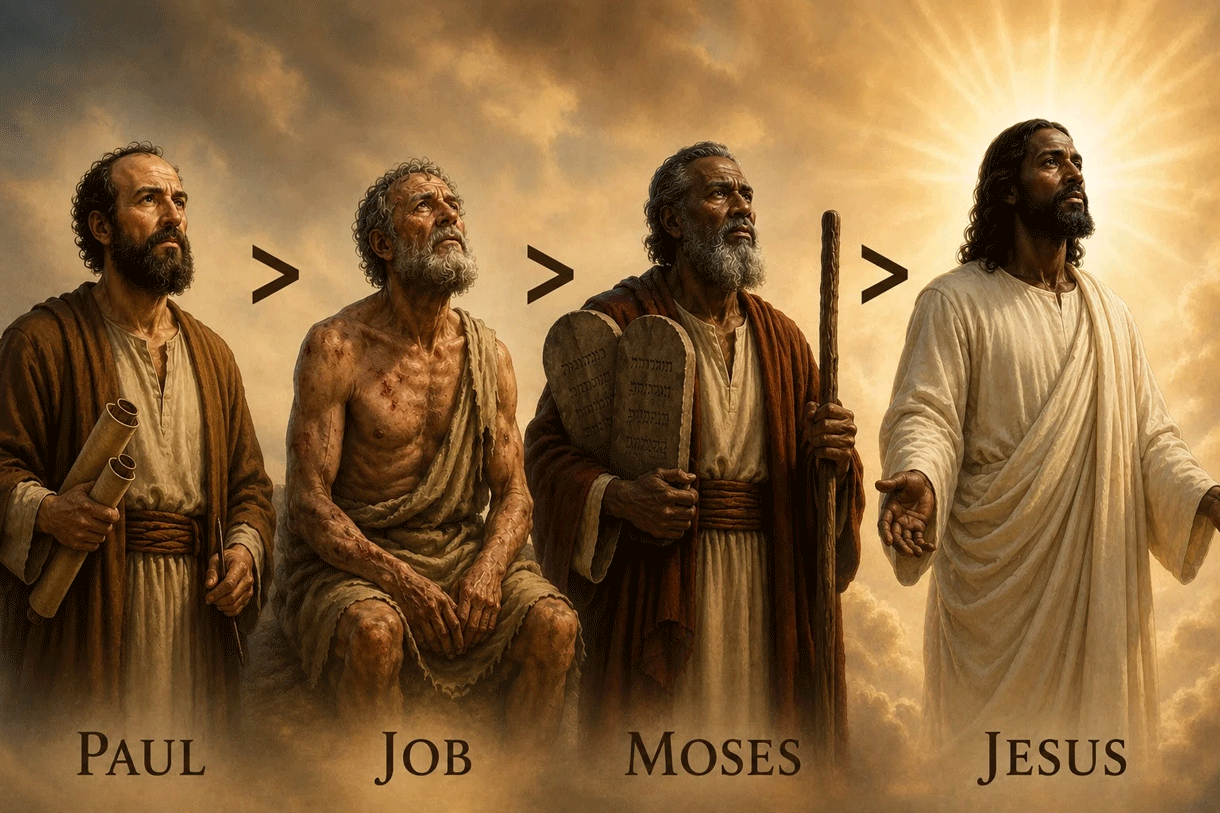
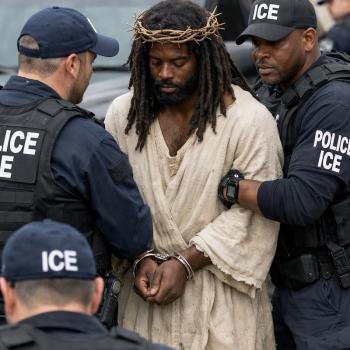
Why don’t Christians question what they believe? | Image created in GPT by the author.
I Don’t Care, But It Matters
Let’s get this out of the way: I’m not a Christian. Haven’t been for a while. I don’t care what you believe. Honestly, if worshipping a carpenter-rabbi from Nazareth, a fiery desert prophet, or a guy who wrote letters while dodging Roman guards gives you peace, have at it. You do you.
But here’s the kicker: while I don’t care for me, it absolutely matters for you. Because if you’re still carrying around the cross like it’s a gym membership card that proves your spiritual fitness, then what you believe—and who you choose to elevate as your theological GPS—has consequences. For your life. For your politics. For the way you treat people who don’t share your Sunday playlist.
And that’s where the problem comes in: modern Christianity has quietly (or maybe not so quietly) shifted the spotlight from Jesus onto other figures—Paul, Job, and the Old Testament prophets. In doing so, Christians have ended up building entire theological McMansions on foundations Jesus never laid.
A couple of weeks ago, I talked about how, theologically speaking, Adam > Jesus with regard to contemporary theology. In that light, let’s talk about why most Christians never even question what they believe, why Paul and Job get more airplay than Jesus, and why subordinating Jesus to Paul makes you a Paulian, not a Christian. And along the way, we’ll roast the nonsense with some humor, wit, and irreverence—because if theology can’t take a joke, maybe it shouldn’t be running your life.
Why Most Christians Don’t Ask “Why?”
First question: why don’t Christians question what they believe? The short answer: conditioning. The long answer: conditioning with a side of fear, control, and a dollop of laziness.
- Fear of Hellfire. From Sunday School onward, believers are spoon-fed the idea that doubt isn’t curiosity—it’s treason. Question the pastor? Risk eternal torment. Question Paul? Risk eternal torment. Question Jesus? Risk eternal torment and the church potluck committee cutting you off from the mac and cheese.
- Authority Structures. Religion runs like a well-oiled multi-level marketing scheme. Your upline (pastor, bishop, pope) assures you that the product works. If you question the product, you don’t just question them—you threaten the whole pyramid scheme.
- Confirmation Bias. Once you’ve memorized a handful of Bible verses and welded them into your worldview, every new piece of information gets filtered through that lens. Think of it like theological duct tape: once stuck, it only tears flesh if you try to rip it off.
- Comfort in Certainty. Let’s be real: certainty feels good. Asking “why?” means walking into the fog where the answers aren’t neat, where life is messy, and where you might realize the foundation you’ve built your life on is more like a Jenga tower than a fortress.
So, most Christians simply don’t. They take their theology like they take their Starbucks orders: pre-packaged, branded, and delivered to them without ever looking behind the counter.
Why Paul Gets More Mic Time Than Jesus
Now let’s talk about the elephant in the cathedral: Paul. If Christianity were a band, Jesus would’ve been the founding singer-songwriter who got the group together, but Paul is the over-zealous manager who decided the brand needed re-packaging for the Gentile market. And somehow, two thousand years later, Paul gets more stage time than Jesus.
Why?
- Volume of Material. Paul wrote more. Or at least, letters attributed to him wrote more. Jesus shows up in four short gospels, Paul’s got a whole New Testament mixtape. Volume equals authority in religious marketing.
- Theological Rigidity. Jesus was annoyingly flexible. Love your neighbor. Turn the other cheek. Forgive seventy times seven. Paul, on the other hand, gave church leaders the rulebook they craved: women shut up, gays bad, slavery fine. Structure sells.
- Institutional Preference. Church fathers building doctrine didn’t want followers running around like free-spirited hippies quoting “Blessed are the peacemakers.” They wanted order. Obedience. Hierarchies. Paul gave them that in spades.
But here’s the part most Christians don’t stop to consider: Paul never actually met Jesus. Not once. His “authority” comes from a vision on the road to Damascus that, let’s be honest, looks a lot like a heat stroke or a migraine with aura. He wasn’t there for the Sermon on the Mount. He didn’t break bread at the Last Supper. He didn’t hear Jesus say “Blessed are the poor in spirit.” Yet somehow, his words are treated as equal—or superior—to the actual words of Jesus. That’s like quoting a roadie over the lead singer.
Was Paul a Roman Agent? The Conspiracy Theory That Refuses to Die
Here’s where things get spicy. Some scholars and skeptics have floated the theory that Paul wasn’t just a zealous convert with a shaky backstory—he might have been a Roman agent, intentionally rebranding the Jesus movement to neuter its revolutionary bite.
The Context
Rome had a Jesus problem. Not Jesus the man—he was already crucified—but the movement he sparked. The Way (as it was called before it was ever branded “Christianity”) was gaining traction. It wasn’t just a religion; it was a direct threat to empire. Equality, compassion, liberation, community—all the stuff that undermines hierarchy, exploitation, and Caesar’s absolute authority.
Enter Paul
Paul was uniquely positioned. He was a Roman citizen (a rare privilege in the ancient world). He had the education, the connections, and the mobility to move freely across Roman territories. He also had the audacity to flip from persecutor to preacher overnight. That’s either the biggest spiritual turnaround in history or the smoothest undercover op ever run.
The Subversion
What did Paul do? He shifted the narrative:
- Jesus the revolutionary became Jesus the sacrificial lamb.
- Liberation here-and-now became salvation someday-later.
- Equality of all people became obedience to church leaders.
Sound familiar? That’s exactly the kind of ideological pivot an empire would love. Take the teeth out of a rebellion, dress it up in theology, and—voilà—you’ve got a docile, empire-friendly religion. It bears mentioning that Paul never actually met Jesus—he claimed he had a “divine revelation.” There was no fact-checking back then; the person who was the most vociferous and persuasive won the day. Compare this with modern-day preachers and theologians—if any of them claimed a similar supernatural encounter, they would be ridiculed and scorned.
Why It Sticks
Now, to be clear: this is still theory, not fact. But it lingers because it makes sense. If Paul was a Roman agent, then Christianity isn’t the Way of Jesus at all—it’s the Way of Rome, with a Nazarene mascot.
And if that’s true, then calling yourself a Christian while quoting Paul more than Jesus is doubly absurd. You’re not following Christ. You’re following Rome’s PR department.
Why Job Gets Misused as a Model of Faith
Now, let’s drag Job into the spotlight. Poor guy gets misquoted more than a teenager in a group chat.
Here’s where my own book Deconstructing Religion comes in. In the chapter Jobian Theology, I make the case that Job is basically the poster child for divine gaslighting. He loses everything—family, wealth, health—because of a cosmic bar bet between God and Satan. Then, when he dares to ask why, his so-called friends lecture him, and God finally shows up not with answers but with a divine flex: “Where were you when I laid the foundations of the earth?”
Jobian Theology, as I wrote it, illustrates how modern Christianity weaponizes Job’s story to demand blind faith in the face of suffering. Got cancer? Be a Job. Lost a child? Be a Job. Can’t pay rent? Be a Job. Translation: don’t question God, just suffer quietly, because questioning is dangerous.
But here’s the problem: if you’re modeling your theology off Job instead of Jesus, you’re not practicing Christianity—you’re practicing Jobianity. You’re following a story of submission to divine bullying rather than the teachings of love, liberation, and justice that Jesus supposedly embodied.
Paul vs. Jesus vs. Job vs. the Prophets: Who Wins Theology Idol?
So, between Paul, Jesus, Job, and the Prophets—who’s got the superior theology? Spoiler: if you’re still calling yourself a Christian, the answer has to be Jesus. Otherwise, what’s the point?
- Paul. Sharp mind, relentless missionary, but let’s not kid ourselves—Paul twisted Jesus into a Greco-Roman religious framework. He turned a movement of liberation into a rulebook for controlling communities. And if the Roman-agent theory holds water, then he didn’t just twist it—he hijacked it for the empire.
- Job. Inspiring in endurance, yes. Useful in teaching resilience, maybe. But as theology? It’s masochism with a divine stamp.
- The Prophets. Fire-breathing truth-tellers who demanded justice. They set the stage, but they weren’t the headliner.
- Jesus. If Christianity means anything, it’s supposed to mean Christ. His message boiled down to radical love, inclusion, and flipping tables in the temple of hypocrisy.
So if you’re prioritizing Paul, Job, or Isaiah over Jesus, you’ve effectively swapped out the brand. You’re not a Christian. You’re a Paulian. Or a Jobian. Or an Isaiah-ite. Own it.
The Adam > Jesus Problem
Here’s a link to my previous article on this subject. It’s great for context!
Why Subordinating Jesus Is Spiritual Identity Theft
When you subordinate Jesus’ teachings to Paul’s rulebook or Job’s stoicism, you’re committing spiritual identity theft. It’s like calling yourself a Beatles fan but only listening to Wings.
- Prioritize Paul, and you’re a Paulian.
- Prioritize Job, and you’re a Jobian.
- Prioritize Moses, and you’re a Mosian.
But don’t call yourself a Christian unless Jesus is actually your theological North Star. Otherwise, you’re embracing false advertising.
Wrap Up: Call It What It Is
I don’t care if you call yourself a Christian, a Paulian, or a Jobian. That’s between you and your Spotify playlist of sermons. But it matters if you keep claiming allegiance to Jesus while subordinating his words to others. Because that kind of hypocrisy doesn’t just warp your theology—it warps how you treat others, how you vote, and how you justify exclusion instead of inclusion.
If Christianity is going to mean anything, it has to be Christ-centered, inclusionist, and universalist. Otherwise, you’ve built a faith where Adam > Jesus, Paul > Christ, and Job > Gospel.
And at that point, maybe it’s time to admit you’re not a Christian at all. You’re just another fan club president for your chosen biblical celebrity. Own it.
I think the words of Paul get more scholarly respect than the words of Jesus. What do you think? Sound off in the comments below.
Derrick Day is the author of multiple books and the host of The Forward Podcast.
Follow his website or catch him on Facebook, Instagram, TikTok, and YouTube
Contemplative
History and Religion
Education and Religion
why Christians don’t question beliefs
Previous Post

June 8, 2026
Can Religion be Intellectually Honest?
Next Post

July 2, 2026 Dethroning Jesus and Enthroning Yourself
Recent Comments
"Excellent, non-partisan explanations. It’s really hard to find that nowadays. Thank you very much for ..."
Oligopoly, Oligarchy, Socialism, and Fascism in ..."
"Charming. Mythicism was always a fringe idea and its brief fad among online atheist a ..."
Did Jesus Exist: The Case of ..."
"I reject Xtianity as scripted in large part because Communism is what is left when ..."
Capitalism, Socialism, and Christians Who Ignore ..."
"Oh please. You make the bog Irish Einsteins."
Did Jesus Exist: The Case of ..."
Browse Our Archives
Select a Category agnostic antitheist antitheist atheistic antitheist atheistic theist gnosticism Love Minus Religion Politics and Policies of Love Uncategorized
Select a Month September 2026 August 2026 July 2026 June 2026 May 2026 March 2026 January 2026 December 2025 October 2025 September 2025 August 2025 July 2025 March 2025 February 2025 January 2025 December 2024 November 2024 October 2024 September 2024 August 2024 July 2024 June 2024 May 2024 April 2024 March 2024 February 2024 January 2024 December 2023 September 2023 November 2022 October 2022 April 2022 February 2022 January 2022 October 2021 May 2021 April 2021 March 2021 January 2021 November 2020 August 2020 July 2020 June 2020 May 2020 April 2020 March 2020 February 2020
Follow Us!
TAKE THE
Religious Wisdom Quiz
Who prophesied destruction for Jerusalem but also promised a New Covenant?
Select your answer to see how you score.
Ezekiel Joel Jeremiah Isaiah
Related posts from Love Minus Religion
Did Jesus Exist: The Case of the Vanishing...
Capitalism, Socialism, and Christians Who Ignore Jesus
When Christian Politics Deport Compassion
TRENDING AT PATHEOS Nonreligious

I was strolling through the top floor of the brand new Parthenon...

What Does Gêvâh Mean For Kimberley Guifoyle &...
This week, a lot of the news is focused on Kimberly Guilfoyle....

INNER CIRCLE: Profound Mystery (Of Christ In All...
Ephesians 5:31-32 “For this reason, a man will leave his father and...

Do Not Rejoice When Your Enemy Falls: The...
Turning an execution into a public spectacle is a disturbing expression of...

'The Chosen' S6 Trailer: The Passion Gets Very...
Not many watching 'The Chosen' worry about spoilers, but just because they...

The purpose-driven labor priest
A labor activist reads Rick Warren and it gets me wondering about...
view all Nonreligious blogs
What Are Your Thoughts?leave a comment
Ad-Free & Subscriber Log-In Subscription Support
- About Us
- 2026 Calendar
- Videos
- Podcasts
- Library of World Religions
- Faith In Media Tracker
- Advertise With Us
- Write for Us
- Privacy Policy
- Terms of Service
- Do Not Sell My Data
- Contact Us
- Radiant Digital
- Manage Newsletter Subscriptions
- Unsubscribe From Notifications
- Sitemap
Copyright 2008-2026, Patheos. All rights reserved.
Subscription Support Ad-Free & Subscriber Log-In
Follow Patheos