
BuddhistCatholicContemplativeEvangelicalGeneral ChristianHinduJewishLatter-day SaintMuslimNew VisionsProgressive Christian
Beliefs
- Buddhist
- Catholic
- Contemplative
- Evangelical
- General Christian
- Hindu
- Jewish
- Latter-day Saint
- More Voices
- Muslim
- New Visions
- Pagan
- Progressive Christian
Topics
- Religion News
- Food and Religion
- Sports and Religion
- Religious Art
- Religious Music and Entertainment
- Religious Events
- History and Religion
- Style and Religion
- Politics and Religion
- Women in Religion
- Recreation Outdoors and Religion
- Business Finance and Religion
- Careers Workplace and Religion
- Education and Religion
- Family Parenting and Religion
- Health Fitness and Religion
- Home and Religion
- Relationships and Religion
- Technology and Religion
- Travel and Religion
Columnists
- Buddhist Columnists
- Business Finance and Religion Columnists
- Careers Workplace and Religion Columnists
- Catholic Columnists
- Contemplative Columnists
- Education and Religion Columnists
- Evangelists Columnists
- Family Parenting and Religion Columnists
- General Christian Columnists
- Health Fitness and Religion Columnists
- Hindu Columnists
- History and Religion Columnists
- Home and Religion Columnists
- Jewish Columnists
- More Voices Columnists
- Latter Day Columnists
- Muslim Columnists
- New Visions Columnists
- Nonreligious Columnists
- Pagan Columnists
- Politics and Religion Columnists
- Progressive Columnists
- Recreation Outdoors and Religion Columnists
- Relationships and Religion Columnists
- Religion News Columnists
- Religious Art Columnists
- Religious Events Columnists
- Religious Music and Entertainment Columnists
- Sports and Religion Columnists
- Style and Religion Columnists
- Technology and Religion Columnists
- Travel and Religion Columnists
- Women in Religion Columnists
Resource Library
- 2026 Calendar
- Library of World Religions
- The 100 Most Holy Places on Earth
- Patheos Answers
- Podcasts
- Videos
- Faith Leaders Database
- Anglican Episcopalian
- Bahai
- Baptist
- Buddhism
- Christianity
- Confucianism
- Eastern Orthodoxy
- Hinduism
- Holiness and Pentecostal
- ISKCON
- Islam
- Judaism
- Lutheran
- Methodist
- The Church of Jesus Christ of Latter-day Saints
- New Age
- Paganism
- Presbytarian and Reformed
- Protestantism
- Religion Behind the Scenes
- Roman Catholic
- Scientology
- Shia Islam
- Sikhism
- Sufism
- Sunni Islam
- Taoism
- Zen
- See all religions
Research Tools
 Ad-Free & Subscriber Log-In Subscription Support
Ad-Free & Subscriber Log-In Subscription Support
Follow Patheos 

- Trending:
- Forgiveness
- |
- Marriage
- |
- Consciousness
- |
- Death Penalty
- |
- Election
- |
- Halloween

- Home
- Nonreligious
- Politics and Religion
- Can Religion be Intellectually Honest?
Can Religion be Intellectually Honest?
Last updated on: June 8, 2026 at 6:51 pm by Derrick Day
Can Religion be Intellectually Honest? 2026-06-08T18:51:19-07:00 Derrick Day
Patheos Explore the world's faith through different perspectives on religion and spirituality! Patheos has the views of the prevalent religions and spiritualities of the world.
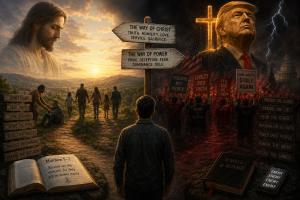
Image by DALL-E from prompt by the author.
Intellectual honesty and religion
Intellectual honesty means you do not protect a belief from evidence just because the belief is precious to you. It means admitting uncertainty, distinguishing faith from fact, changing your mind when the case collapses, and refusing to use convenient standards only when they help your side. Intellectual honesty is one of my life tenets; it guides my thinking toward openness and not holding on to anything tightly.
Religion, especially Christianity in its institutional forms, often struggles here because it begins with protected premises:
Christianity asks people to accept claims that are not merely ethical or poetic, but historical, metaphysical, and cosmic: God exists; Jesus was divine; miracles occurred; scripture carries divine authority; salvation depends on truths that cannot be verified in the ordinary way. A Christian can believe these sincerely, but intellectual honesty requires admitting that these claims are not established in the same way as, say, a medical trial, a court record, or a mathematical proof.
The dishonesty enters when faith is marketed as certainty.
There is a difference between saying, “I believe this and organize my life around it,” and saying, “This is unquestionably true, and those who reject it are morally deficient, rebellious, deceived, or damned.” The first is faith with humility. The second is epistemic armor. It turns belief into a fortress with the drawbridge welded shut.
Christianity also frequently benefits from selective literalism. The Bible is treated as plain and binding when it supports a desired conclusion, then metaphorical, contextual, mysterious, or culturally bounded when it becomes morally inconvenient. Christians who quote Leviticus on sexuality may not feel equally bound by other Levitical laws. Christians who invoke Paul on obedience may ignore Jesus on wealth, enemy-love, forgiveness, and care for the stranger. That is not merely inconsistency. It is the smell of motivated reasoning in liturgical robes.
Why Christianity is especially vulnerable to this charge
Christianity has a built-in tension: it claims moral humility while often functioning as moral supremacy.
At its best, Christianity says humans are fallen, self-deceived, proud, and in need of grace. That should make Christians unusually suspicious of their own motives. In theory, Christianity should produce radical self-criticism.
But in practice, many Christians aim that doctrine outward. Sin becomes what they do. Corruption becomes what the world does. Deception becomes what liberals, atheists, secularists, immigrants, feminists, Muslims, academics, queer people, or political enemies do. The doctrine of human fallenness becomes a searchlight pointed at everyone except the person holding it.
That is where the faith hollows itself out.
A Christian who says “all have sinned” but treats his own tribe as God’s emergency vehicle is not practicing Christianity. He is practicing exemption with hymns.
The problem is not that Christianity contains no intellectual resources for honesty. It does. Confession, repentance, humility, doubt, lament, and prophetic critique are all deep parts of the tradition. The problem is that much of American Christianity, especially in its politicized forms, has treated those resources as decorative china rather than daily tools.
Trumpian Christianity as a credibility crisis
The Trumpian interpretation of Christianity is not simply “Christians voting Republican.” People can vote for imperfect candidates for all kinds of prudential reasons. The deeper problem is theological inversion: vices Christianity traditionally condemns are rebranded as virtues when attached to the right political champion.
Cruelty becomes “strength.”
Boasting becomes “confidence.”
Vengeance becomes “justice.”
Contempt becomes “truth-telling.”
Authoritarian appetite becomes “order.”
Indifference to the vulnerable becomes “realism.”
Lying becomes “fighting back.”
This does not merely damage Christianity’s public reputation. It scrambles its moral vocabulary. Once a faith community trains itself to call vice virtue, it loses the ability to explain why anyone else should take its moral claims seriously.
There is data behind the cultural credibility problem. Recent Pew-related reporting shows that 62% of U.S. adults identify as Christian, down from 78% in 2007, while religiously unaffiliated Americans have risen to 29%. Separately, Pew’s work on the religiously unaffiliated found that 28% of U.S. adults identify with no religion, with many citing nonbelief, skepticism, or both.
Trumpian Christianity accelerates the suspicion that Christianity is not a search for truth, but a tribal identity machine.
And the contradiction is glaring. Many Americans do not view Trump himself as especially religious, yet he has maintained strong support among white evangelicals. The result is a moral bargain that looks, from the outside, less like faithfulness and more like transaction.
That bargain teaches outsiders a brutal lesson: Christian moral outrage is negotiable.
How Trumpism can spell Christianity’s demise
Not the numerical end of Christianity, probably. Christianity is globally vast, diverse, and much older than the United States. But Trumpian Christianity can spell the demise of Christianity as a morally credible public witness in America.
Its danger is not that it makes Christianity too political. Christianity has always had political implications. The danger is that it makes Christianity transparently transactional.
When Christians excuse behavior in their champion that they would condemn in their enemy, they announce that the real standard is not Christ. It is power.
When they invoke “family values” but excuse sexual predation, cruelty, mockery, and serial dishonesty, they announce that “family values” was often just branding.
When they defend religious liberty only for themselves, they announce that liberty was never the principle. Dominance was.
When they treat immigrants, the poor, prisoners, outsiders, and enemies as disposable, they saw off the very branch on which the Gospels sit.
That is why Trumpian Christianity is so corrosive. It does not merely fail to live up to Christianity. Every religion fails its ideals in practice. The deeper problem is that it often appears to celebrate the failure as toughness, patriotism, masculinity, realism, or divine strategy.
At that point, Christianity stops being a mirror that reveals sin and becomes a makeup kit for power.
Even Christian critics have warned about this. Christianity Today’s 2019 editorial calling for Trump’s removal argued that his conduct was morally indefensible and warned that excusing it damaged evangelical credibility. More recently, projects like the documentary God & Country have explored how Christian nationalism fuses religious identity with authoritarian politics, exclusion, and nationalism.
What Christians can do to be taken seriously
Christians who want to be taken seriously should stop asking for automatic respect and start practicing visible integrity.
First, they should admit what is faith and what is knowledge. “I believe” is more honest than “everyone knows.” The former invites conversation. The latter starts a hostage negotiation with reality.
Second, Christians should apply the same moral standards to their own leaders that they apply to opponents. This is the big one. If adultery, cruelty, dishonesty, corruption, racism, greed, and contempt matter when the other party does them, they matter when your candidate does them. No special pleading. No “Cyrus” loophole. No “God uses flawed men” escape hatch unless you are willing to use it equally for everyone.
Third, they should recover repentance as a public practice. Not vague “we all fall short” fog-machine language. Specific repentance. Churches should be able to say: we were wrong about this leader, this policy, this abuse scandal, this racial compromise, this conspiracy theory, this treatment of gay people, this demonization of immigrants, this silence when cruelty benefited us.
Fourth, they should stop confusing persecution with loss of dominance. Not being allowed to impose your theology through the state is not martyrdom. It is pluralism. Christians would be more credible if they defended religious freedom for Muslims, Jews, atheists, Hindus, Sikhs, and others with the same urgency they defend it for themselves.
Fifth, they should make truth-telling a sacrament-level obligation. That means rejecting conspiracy theories, fake martyr narratives, propaganda outlets, doctored stories, and charismatic liars even when those things are politically useful. A church that cannot say “that claim is false” because the lie helps its tribe is not a church with a politics problem. It is a church with a truth problem.
Sixth, they should center the Sermon on the Mount more than the culture war. If Christianity’s public face is mostly resentment, anti-intellectualism, sexual panic, nationalism, and partisan rage, outsiders will reasonably conclude that Jesus is not the operating system. He is the logo.
The most intellectually honest critique
Christianity contains profound moral language about humility, repentance, truth, mercy, and love. But when Christians use that language to discipline outsiders while exempting themselves, Christianity becomes intellectually dishonest. Trumpian Christianity reveals this failure with unusual clarity because it asks the public to believe that a movement centered on Jesus can excuse cruelty, deceit, vanity, domination, and contempt as long as those things serve the tribe. That contradiction may not destroy Christianity as a religion, but it can destroy its credibility as a moral authority.
Christianity becomes intellectually dishonest when it demands moral seriousness from outsiders while exempting its own claims, leaders, institutions, and political bargains from the same scrutiny.
Here is the pressure point. Not “Christians are stupid” or “religion is all lies,” but: Does the tradition submit itself to the standards it asks everyone else to honor?
I think religion, especially christianity, does not inherently lend itself to intellectual honesty.What do you think? Sound off in the commnts below.
Derrick Day is the author of multiple books and the host of The Forward Podcast.
Follow his website or catch him on Facebook, Instagram, TikTok, and YouTube
Politics and Religion
History and Religion
Previous Post
June 1, 2026
The Gospel According to the Third Eye
Next Post

June 19, 2026 Why Most Christians are Really Paulians and Jobians
Recent Comments
"Excellent, non-partisan explanations. It’s really hard to find that nowadays. Thank you very much for ..."
Oligopoly, Oligarchy, Socialism, and Fascism in ..."
"Charming. Mythicism was always a fringe idea and its brief fad among online atheist a ..."
Did Jesus Exist: The Case of ..."
"I reject Xtianity as scripted in large part because Communism is what is left when ..."
Capitalism, Socialism, and Christians Who Ignore ..."
"Oh please. You make the bog Irish Einsteins."
Did Jesus Exist: The Case of ..."
Browse Our Archives
Select a Category agnostic antitheist antitheist atheistic antitheist atheistic theist gnosticism Love Minus Religion Politics and Policies of Love Uncategorized
Select a Month September 2026 August 2026 July 2026 June 2026 May 2026 March 2026 January 2026 December 2025 October 2025 September 2025 August 2025 July 2025 March 2025 February 2025 January 2025 December 2024 November 2024 October 2024 September 2024 August 2024 July 2024 June 2024 May 2024 April 2024 March 2024 February 2024 January 2024 December 2023 September 2023 November 2022 October 2022 April 2022 February 2022 January 2022 October 2021 May 2021 April 2021 March 2021 January 2021 November 2020 August 2020 July 2020 June 2020 May 2020 April 2020 March 2020 February 2020
Follow Us!
TAKE THE
Religious Wisdom Quiz
According to 1 John, what three things testify on earth?
Select your answer to see how you score.
Prayer, fasting, and almsgiving The Father, the Son, and the Holy Spirit The Spirit, the water, and the blood Faith, hope, and love
Related posts from Love Minus Religion

Do Atheism and Agnosticism Require Faith?

When Faithful People Suffer and God Stays Silent
Dethroning Jesus and Enthroning Yourself
The Gospel According to the Third Eye
TRENDING AT PATHEOS Nonreligious

The Sermon on the Mount, Part I: Matthew...
The Sermon on the Mount, Part I (Matthew 4:12-5:12) St. Matthew moves...

What's up from Crossway: Reviewing some of their latest A few weeks...

Janie Learns the Way of the Cross: A...
Teaching children about Jesus' Passion can be challenging. Many parents and educators...

Looking For Good Catholic Writing - October 2026
He alone extends the heavens, and he walks upon the waves of...

In "Irreplaceable," our book on vocation and technology, Trevor Sutton and I...

I was strolling through the top floor of the brand new Parthenon...
view all Nonreligious blogs
What Are Your Thoughts?leave a comment
Ad-Free & Subscriber Log-In Subscription Support
- About Us
- 2026 Calendar
- Videos
- Podcasts
- Library of World Religions
- Faith In Media Tracker
- Advertise With Us
- Write for Us
- Privacy Policy
- Terms of Service
- Do Not Sell My Data
- Contact Us
- Radiant Digital
- Manage Newsletter Subscriptions
- Unsubscribe From Notifications
- Sitemap
Copyright 2008-2026, Patheos. All rights reserved.
Subscription Support Ad-Free & Subscriber Log-In
Follow Patheos