
BuddhistCatholicContemplativeEvangelicalGeneral ChristianHinduJewishLatter-day SaintMuslimNew VisionsProgressive Christian
Beliefs
- Buddhist
- Catholic
- Contemplative
- Evangelical
- General Christian
- Hindu
- Jewish
- Latter-day Saint
- More Voices
- Muslim
- New Visions
- Pagan
- Progressive Christian
Topics
- Religion News
- Food and Religion
- Sports and Religion
- Religious Art
- Religious Music and Entertainment
- Religious Events
- History and Religion
- Style and Religion
- Politics and Religion
- Women in Religion
- Recreation Outdoors and Religion
- Business Finance and Religion
- Careers Workplace and Religion
- Education and Religion
- Family Parenting and Religion
- Health Fitness and Religion
- Home and Religion
- Relationships and Religion
- Technology and Religion
- Travel and Religion
Columnists
- Buddhist Columnists
- Business Finance and Religion Columnists
- Careers Workplace and Religion Columnists
- Catholic Columnists
- Contemplative Columnists
- Education and Religion Columnists
- Evangelists Columnists
- Family Parenting and Religion Columnists
- General Christian Columnists
- Health Fitness and Religion Columnists
- Hindu Columnists
- History and Religion Columnists
- Home and Religion Columnists
- Jewish Columnists
- More Voices Columnists
- Latter Day Columnists
- Muslim Columnists
- New Visions Columnists
- Nonreligious Columnists
- Pagan Columnists
- Politics and Religion Columnists
- Progressive Columnists
- Recreation Outdoors and Religion Columnists
- Relationships and Religion Columnists
- Religion News Columnists
- Religious Art Columnists
- Religious Events Columnists
- Religious Music and Entertainment Columnists
- Sports and Religion Columnists
- Style and Religion Columnists
- Technology and Religion Columnists
- Travel and Religion Columnists
- Women in Religion Columnists
Resource Library
- 2026 Calendar
- Library of World Religions
- The 100 Most Holy Places on Earth
- Patheos Answers
- Podcasts
- Videos
- Faith Leaders Database
- Anglican Episcopalian
- Bahai
- Baptist
- Buddhism
- Christianity
- Confucianism
- Eastern Orthodoxy
- Hinduism
- Holiness and Pentecostal
- ISKCON
- Islam
- Judaism
- Lutheran
- Methodist
- The Church of Jesus Christ of Latter-day Saints
- New Age
- Paganism
- Presbytarian and Reformed
- Protestantism
- Religion Behind the Scenes
- Roman Catholic
- Scientology
- Shia Islam
- Sikhism
- Sufism
- Sunni Islam
- Taoism
- Zen
- See all religions
Research Tools
 Ad-Free & Subscriber Log-In Subscription Support
Ad-Free & Subscriber Log-In Subscription Support
Follow Patheos 

- Trending:
- Forgiveness
- |
- Marriage
- |
- Consciousness
- |
- Death Penalty
- |
- Election
- |
- Halloween

- Home
- Nonreligious
- History and Religion
- When Christian Politics Deport Compassion
When Christian Politics Deport Compassion
Last updated on: March 12, 2026 at 4:51 pm by Derrick Day
When Christian Politics Deport Compassion 2026-03-12T16:51:00-07:00 Derrick Day
Patheos Explore the world's faith through different perspectives on religion and spirituality! Patheos has the views of the prevalent religions and spiritualities of the world.
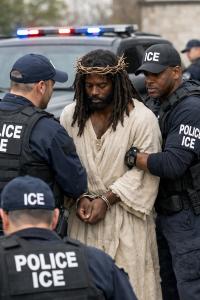
Picture by DALL-E with prompt from the author
Faith, Fear, and Immigration Politics
If you ever want to see theological gymnastics that would make the Apostle Paul pull a hamstring, just watch modern American immigration politics collide with Christianity, because nothing says “love thy neighbor” quite like cheering policies that terrify desperate families while clutching a Bible like it’s a backstage pass to righteousness. We’ve arrived at a cultural moment where aggressive immigration enforcement — particularly under Trump-era policies — became not just politically popular in certain circles but spiritually rationalized, even sanctified, as if Jesus spent the Sermon on the Mount workshopping border security strategies instead of preaching compassion. The irony is thick enough to spread on communion wafers.
Christianity, at least in its own origin story, revolves around an itinerant brown Middle Eastern refugee whose parents fled state violence. Yet some of his loudest modern defenders sound less like disciples and more like TSA agents with scripture memorized for moral cover. Policies like nationality-based travel bans affecting Muslim-majority and African countries sparked legal and ethical concerns about discrimination, forcing believers to wrestle with whether fear can really be baptized as righteousness or whether compassion is still supposed to outrank suspicion.
Family Separation and Enforcement Reality
The “zero tolerance” enforcement strategy led to widespread family separations at the U.S.–Mexico border, and congressional research confirmed that this outcome was predictable rather than accidental. When every border crossing is prosecuted criminally, children inevitably get separated from parents because minors can’t be held in criminal custody with adults. That wasn’t an unforeseen glitch — it was the logical consequence of the enforcement design.
For many observers, the ethical tension wasn’t simply political but spiritual. Churches that preach compassion found themselves explaining why traumatized children were an acceptable policy side effect. Critics argued that deterrence through suffering contradicts core Christian teachings about mercy and care for the vulnerable, while supporters framed it as necessary law enforcement. Either way, it exposed a deep rift between professed faith values and real-world policy outcomes.
Public Charge Policy and Chilling Effects
Changes to the public charge rule created measurable chilling effects, where immigrant families avoided public benefits — including healthcare and nutrition assistance — out of fear those services might jeopardize immigration status. Research showed that confusion alone caused eligible families to step back from assistance programs, not because they didn’t need help but because they feared future consequences.
From a faith perspective, that tension hits hard. Christianity historically emphasizes care for the poor and sick, yet policies that discourage vulnerable families from seeking help create a moral paradox. Some believers view the rule as safeguarding economic self-sufficiency, while others see it as punishing need itself. The practical effect, however, is clear: fear changed behavior, and families who might otherwise have received assistance often chose silence over support.
Local Policing and Immigration Enforcement Expansion
Programs like 287(g) expand immigration enforcement by partnering federal authorities with local law enforcement, effectively turning routine policing encounters into potential immigration checkpoints. That means a traffic stop or minor local violation can escalate into an immigration case, increasing the reach of federal enforcement far beyond traditional border contexts.
Civil rights advocates warn that blending local policing with immigration enforcement can amplify profiling concerns and strain community trust in police. Communities with large immigrant populations may become less likely to report crimes or cooperate with investigations if any interaction with law enforcement could trigger immigration scrutiny. For faith communities concerned with both public safety and human dignity, this creates another complicated balancing act between order, compassion, and constitutional protections.
Christian Compassion vs Policy Reality
That’s not partisan rhetoric, that’s documented policy impact, and if you’re a Christian reading this while preparing a sermon about kindness, it might be worth asking whether defending fear-based enforcement while preaching radical love is theological consistency or spiritual cosplay, because the contradiction isn’t subtle — it’s Vegas billboard obvious — yet many believers resolve it by redefining compassion as conditional, empathy as weakness, and mercy as a luxury reserved for people who look, sound, and vote like them, which would be funny if it weren’t also shaping real human outcomes, including aggressive enforcement practices that have sometimes swept up U.S. citizens themselves, because once you normalize “detain first, verify later,” due process starts looking less like a right and more like a customer service option.
When Enforcement Targets Citizens Too
Investigative reporting has documented cases of American citizens detained in immigration operations, sometimes for extended periods. The Associated Press reported a Minnesota U.S. citizen detained during an ICE action and released only after proving citizenship The Government Accountability Office has flagged gaps in how agencies verify citizenship status and track such encounters, which doesn’t mean citizens are routinely deported but absolutely does mean the enforcement machinery is imperfect enough that mistakes happen, and mistakes with armed federal authority are not clerical errors — they’re life disruptions with legal bills, trauma, and sometimes jail time attached.
Greasing the Skids: A Historical Pattern
This is what civil liberties advocates mean by “greasing the skids,” not some conspiracy theory but a historical pattern where aggressive enforcement normalized against one group lowers the political cost of broader overreach later, and if you think that sounds dramatic, remember American history includes Japanese-American internment, COINTELPRO surveillance of Black leaders, and more recent stop-and-frisk policing controversies, so institutional overreach isn’t a hypothetical future risk — it’s a documented past habit.
The Role of the Black Church
And here’s where the Black church conversation becomes especially relevant, because historically Black Christian institutions like the Church of God in Christ, the National Baptist Convention, Pentecostal Assemblies of the World, the Full Gospel Baptist Church Fellowship International, and the Joint College of African-American Pentecostal Bishops were never just worship centers, they were civil rights command posts, mutual aid societies, political education hubs, and moral megaphones when the broader church stayed silent, which is why some observers argue these bodies could be speaking more forcefully now, issuing unified statements against policies that weaponize fear, organizing “know your rights” sessions, partnering with legal defense groups, and reminding congregations that Christianity didn’t survive slavery, segregation, and systemic racism by becoming cruel in return, it survived by insisting dignity is nonnegotiable.
Blasphemous Humor Break (Because Jesus Had Wit Too)
And let’s be honest with a little irreverent humor here — if your Jesus is comfortable with kids in detention centers but furious about Starbucks holiday cups, you may have accidentally downloaded Nationalism 3.0 instead of Christianity, check your theology settings — because the theological throughline of the New Testament, whether you read it devotionally or academically, emphasizes care for outsiders, humility in power, and suspicion toward empire, which makes modern Christian enthusiasm for harsh immigration enforcement feel like cheering Rome while quoting Jesus, a theological mashup that would probably confuse both.
Borders, Enforcement, and Moral Questions
None of this means borders shouldn’t exist or immigration policy shouldn’t be enforced — sovereign nations regulate entry, that’s reality — but the debate isn’t whether enforcement exists, it’s how it’s done, whether it respects human dignity, whether deterrence relies on suffering, whether due process is preserved, and whether faith communities challenge cruelty or bless it, because the church’s historic role wasn’t to rubber-stamp state policy but to confront injustice, even when politically inconvenient.
Prophetic Faith vs Political Convenience
And if that sounds like a high bar, well, Christianity literally claims to worship someone executed by the state for challenging religious hypocrisy and political power, so “prophetic discomfort” kind of comes with the brand.
Government Power and Selective Outrage
What’s especially striking in today’s landscape is how quickly some believers pivot from “government overreach is tyranny” when discussing taxes or pandemic restrictions to “government force is righteous” when aimed at immigrants, which suggests the real dividing line isn’t government power but who it targets, a distinction that raises both ethical and constitutional questions.
Policing, Immigration, and Civil Rights Spillover
Meanwhile, enforcement expansion into local policing environments means ordinary encounters — traffic stops, workplace inspections, neighborhood complaints — can become immigration touchpoints, and historically marginalized communities understand how easily that bleeds into broader surveillance cultures, which is why many civil rights leaders see immigration enforcement not as an isolated policy silo but part of a larger conversation about policing, race, and state authority.
Administrative Warrants and Constitutional Concerns
Add to that the documented administrative warrant controversies, including reporting on forced entries tied to non-judicial warrants, and you get a legal landscape where constitutional debates aren’t academic — they’re happening in real time.
The Core Moral Dilemma
The Christian moral dilemma, then, isn’t simply “immigration yes or no,” it’s whether compassion has borders, whether fear can be baptized as virtue, whether national identity outranks human dignity, and whether faith communities will speak prophetically or politely when policies harm vulnerable people, because historically, silence from religious institutions often ages poorly — ask any church historian about segregation-era sermons defending “order”.
A Broader Takeaway
If you’re looking for a takeaway beyond the political noise, it’s this: systems trained to dehumanize outsiders rarely stay confined to outsiders, enforcement cultures shape institutional habits, and faith traditions that emphasize love, mercy, and justice face credibility crises when they appear selectively compassionate.
Closing Reflection (Heretical but Hopeful)
So whether you’re conservative, progressive, religious, secular, or just tired of culture-war theatrics, the conversation worth having isn’t “who belongs” as much as “how do we treat people,” because dignity isn’t a partisan value, due process isn’t optional, and compassion — despite some modern marketing — was never meant to require a passport; and if that realization feels uncomfortable, congratulations, you’re probably closer to the spirit of the original gospel than the political version currently trending, because historically the most authentic religious voices weren’t the ones blessing power, they were the ones challenging it, sometimes with courage, sometimes with humor, and occasionally — let’s be honest — with just enough blasphemous wit to keep everyone awake during the sermon.
What do you think about the administration’s approach to immigration and deportation? Does this align with your core values? Share your thoughts in the comments!
Derrick Day is the author of multiple books and the host of The Forward Podcast.
Follow his website or catch him on Facebook, Instagram, TikTok, and YouTube
History and Religion
Politics and Religion
Previous Post

January 19, 2026
The Uncomfortable King
Next Post
May 6, 2026 Capitalism, Socialism, and Christians Who Ignore Jesus
Recent Comments
"Excellent, non-partisan explanations. It’s really hard to find that nowadays. Thank you very much for ..."
Oligopoly, Oligarchy, Socialism, and Fascism in ..."
"Charming. Mythicism was always a fringe idea and its brief fad among online atheist a ..."
Did Jesus Exist: The Case of ..."
"I reject Xtianity as scripted in large part because Communism is what is left when ..."
Capitalism, Socialism, and Christians Who Ignore ..."
"Oh please. You make the bog Irish Einsteins."
Did Jesus Exist: The Case of ..."
Browse Our Archives
Select a Category agnostic antitheist antitheist atheistic antitheist atheistic theist gnosticism Love Minus Religion Politics and Policies of Love Uncategorized
Select a Month September 2026 August 2026 July 2026 June 2026 May 2026 March 2026 January 2026 December 2025 October 2025 September 2025 August 2025 July 2025 March 2025 February 2025 January 2025 December 2024 November 2024 October 2024 September 2024 August 2024 July 2024 June 2024 May 2024 April 2024 March 2024 February 2024 January 2024 December 2023 September 2023 November 2022 October 2022 April 2022 February 2022 January 2022 October 2021 May 2021 April 2021 March 2021 January 2021 November 2020 August 2020 July 2020 June 2020 May 2020 April 2020 March 2020 February 2020
Follow Us!
TAKE THE
Religious Wisdom Quiz
Which church did Martin Luther post his famous 95 Theses on?
Select your answer to see how you score.
Canterbury Cathedral Notre Dame Wittenberg Castle Church St. Peter's
Related posts from Love Minus Religion
Why Most Christians are Really Paulians and Jobians
Can Religion be Intellectually Honest?


Did Jesus Exist: The Case of the Vanishing...
TRENDING AT PATHEOS Nonreligious

Janie Learns the Way of the Cross: A...
Teaching children about Jesus' Passion can be challenging. Many parents and educators...

Looking For Good Catholic Writing - October 2026
He alone extends the heavens, and he walks upon the waves of...

In "Irreplaceable," our book on vocation and technology, Trevor Sutton and I...

I was strolling through the top floor of the brand new Parthenon...

What Does Gêvâh Mean For Kimberley Guifoyle &...
This week, a lot of the news is focused on Kimberly Guilfoyle....

INNER CIRCLE: Profound Mystery (Of Christ In All...
Ephesians 5:31-32 “For this reason, a man will leave his father and...
view all Nonreligious blogs
What Are Your Thoughts?leave a comment
Ad-Free & Subscriber Log-In Subscription Support
- About Us
- 2026 Calendar
- Videos
- Podcasts
- Library of World Religions
- Faith In Media Tracker
- Advertise With Us
- Write for Us
- Privacy Policy
- Terms of Service
- Do Not Sell My Data
- Contact Us
- Radiant Digital
- Manage Newsletter Subscriptions
- Unsubscribe From Notifications
- Sitemap
Copyright 2008-2026, Patheos. All rights reserved.
Subscription Support Ad-Free & Subscriber Log-In
Follow Patheos