
BuddhistCatholicContemplativeEvangelicalGeneral ChristianHinduJewishLatter-day SaintMuslimNew VisionsProgressive Christian
Beliefs
- Buddhist
- Catholic
- Contemplative
- Evangelical
- General Christian
- Hindu
- Jewish
- Latter-day Saint
- More Voices
- Muslim
- New Visions
- Pagan
- Progressive Christian
Topics
- Religion News
- Food and Religion
- Sports and Religion
- Religious Art
- Religious Music and Entertainment
- Religious Events
- History and Religion
- Style and Religion
- Politics and Religion
- Women in Religion
- Recreation Outdoors and Religion
- Business Finance and Religion
- Careers Workplace and Religion
- Education and Religion
- Family Parenting and Religion
- Health Fitness and Religion
- Home and Religion
- Relationships and Religion
- Technology and Religion
- Travel and Religion
Columnists
- Buddhist Columnists
- Business Finance and Religion Columnists
- Careers Workplace and Religion Columnists
- Catholic Columnists
- Contemplative Columnists
- Education and Religion Columnists
- Evangelists Columnists
- Family Parenting and Religion Columnists
- General Christian Columnists
- Health Fitness and Religion Columnists
- Hindu Columnists
- History and Religion Columnists
- Home and Religion Columnists
- Jewish Columnists
- More Voices Columnists
- Latter Day Columnists
- Muslim Columnists
- New Visions Columnists
- Nonreligious Columnists
- Pagan Columnists
- Politics and Religion Columnists
- Progressive Columnists
- Recreation Outdoors and Religion Columnists
- Relationships and Religion Columnists
- Religion News Columnists
- Religious Art Columnists
- Religious Events Columnists
- Religious Music and Entertainment Columnists
- Sports and Religion Columnists
- Style and Religion Columnists
- Technology and Religion Columnists
- Travel and Religion Columnists
- Women in Religion Columnists
Resource Library
- 2026 Calendar
- Library of World Religions
- The 100 Most Holy Places on Earth
- Patheos Answers
- Podcasts
- Videos
- Faith Leaders Database
- Anglican Episcopalian
- Bahai
- Baptist
- Buddhism
- Christianity
- Confucianism
- Eastern Orthodoxy
- Hinduism
- Holiness and Pentecostal
- ISKCON
- Islam
- Judaism
- Lutheran
- Methodist
- The Church of Jesus Christ of Latter-day Saints
- New Age
- Paganism
- Presbytarian and Reformed
- Protestantism
- Religion Behind the Scenes
- Roman Catholic
- Scientology
- Shia Islam
- Sikhism
- Sufism
- Sunni Islam
- Taoism
- Zen
- See all religions
Research Tools
 Ad-Free & Subscriber Log-In Subscription Support
Ad-Free & Subscriber Log-In Subscription Support
Follow Patheos 

- Trending:
- Forgiveness
- |
- Marriage
- |
- Consciousness
- |
- Death Penalty
- |
- Election
- |
- Halloween

- Home
- Nonreligious
- Business, Finance and Religion
- Oligopoly, Oligarchy, Socialism, and Fascism in America
Oligopoly, Oligarchy, Socialism, and Fascism in America
Last updated on: August 23, 2024 at 10:27 am by Derrick Day
Oligopoly, Oligarchy, Socialism, and Fascism in America 2024-08-23T10:27:45-07:00 Derrick Day
Patheos Explore the world's faith through different perspectives on religion and spirituality! Patheos has the views of the prevalent religions and spiritualities of the world.
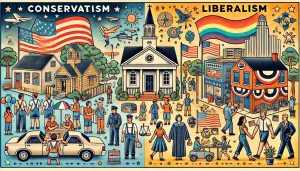 The American political landscape is shaped by various ideologies influencing how we view governance, economics, and society. This blog post will explore the key differences between conservative and liberal ideologies, specifically focusing on their perspectives regarding oligopoly, oligarchy, diversity, and democracy. We will also clarify the distinctions between nascent socialism and fascism in America, including an explanation of why Adolf Hitler and the Nazis were not socialists, despite the term “socialist” in their party name. Finally, we’ll articulate the differences between the Democratic ticket of Kamala Harris and Tim Walz and the Republican ticket of Donald Trump and J.D. Vance.
Conservative Ideology: Oligopoly and Oligarchy
Oligopoly and Oligarchy Defined:
- Oligopoly is a market structure where a small number of firms dominate the industry, leading to limited competition. These firms have significant control over pricing, production, and market entry, often resulting in higher prices, reduced choices for consumers, and decreased innovation.
- Oligarchy refers to a political system where power is concentrated in the hands of a small, elite group, often determined by wealth, corporate control, or familial connections. This elite group wields significant influence over political decisions, typically prioritizing their interests over those of the broader population.
Conservative Views on Oligopoly and Oligarchy:
Conservative ideology traditionally supports free-market capitalism, advocating for minimal government intervention in economic affairs. Conservatives often argue that market forces, even within oligopolistic structures, can drive efficiency and innovation through competition. However, this view tends to overlook how oligopolies, by their very nature, can stifle innovation and creativity.
How Oligopoly Stifles Innovation and Creativity:
In an oligopolistic market, the dominant firms can suppress competition by leveraging their market power to set high barriers to entry for new companies. This lack of competition often leads to complacency among the leading firms, reducing their incentive to innovate. Smaller companies, which are typically the most agile and creative, may struggle to enter the market or gain significant market share, leading to a stagnation of new ideas and technologies.
For example, in the tech industry, a few large companies control significant portions of the market. This dominance can lead to a lack of competition and innovation, as these companies may focus more on maintaining their market position than on developing new products or services. Additionally, they may acquire smaller, innovative firms to eliminate potential competition, further stifling creativity in the industry.
How Oligarchy Dampens the Democratic Process:
Oligarchy, by concentrating power in the hands of a few, undermines the democratic process, which relies on the equal participation of all citizens. In an oligarchic system, the elite use their influence to shape policies and political outcomes in ways that benefit their interests, often at the expense of the broader population. This can lead to a lack of representation for ordinary citizens, as their voices are drowned out by the power and resources of the oligarchs.
In the United States, the influence of wealthy individuals and corporations on the political process is a prime example of oligarchy in action. Through campaign contributions, lobbying, and control of media narratives, the wealthy elite can sway elections and policy decisions in their favor. This concentration of power not only diminishes the effectiveness of democratic institutions but also erodes public trust in the political system.
Donald Trump epitomizes a textbook oligarch due to his vast personal wealth, business empire, and influence over political and economic systems. As a billionaire with extensive holdings in real estate, media, and various other industries, Trump has leveraged his financial resources to exert significant control over political processes, both through direct involvement in government and by shaping public opinion. His tenure as President further highlighted his oligarchic tendencies, as he consistently prioritized the interests of the wealthy and powerful, including his own, while diminishing the role of democratic institutions and norms. Trump’s ability to blur the lines between his business interests and political power reflects the essence of oligarchy, where a few elite individuals wield disproportionate influence over society.
Liberal Ideology: Diversity and Democracy
Diversity and Democracy Defined:
- Diversity refers to the inclusion and representation of various groups, such as those defined by race, ethnicity, gender, religion, sexual orientation, and socioeconomic status, in society and decision-making processes.
- Democracy is a political system in which power is vested in the people, who exercise it directly or through elected representatives. It emphasizes equality, individual rights, and the rule of law.
Liberal Views on Diversity and Democracy:
Liberal ideology places a strong emphasis on diversity as a cornerstone of a healthy democracy. Liberals argue that for a democracy to be truly representative, it must include the voices and perspectives of all its citizens, not just those of a privileged few. This belief underpins liberal support for policies that promote equal opportunities, social justice, and inclusive representation in political and economic systems.
Why Diversity is Essential to Democracy:
Diversity enriches the democratic process by bringing a wide range of perspectives and ideas to the table. This inclusivity helps ensure that policies and decisions reflect the needs and interests of the entire population, rather than just a select few. Furthermore, diversity strengthens social cohesion by fostering mutual understanding and respect among different groups, which is essential for a functioning democracy.
For instance, in legislative bodies, diverse representation can lead to more comprehensive and effective policymaking. When decision-makers come from various backgrounds and experiences, they are more likely to consider the needs of different segments of society, leading to policies that are more equitable and just.
The Liberal Approach to Preventing Oligopoly and Oligarchy:
Liberals advocate for government intervention to prevent the formation of oligopolies and oligarchies, which they see as threats to both economic fairness and democratic governance. They support regulations that promote competition, prevent monopolistic practices, and ensure that political power is distributed more evenly across society. By doing so, liberals aim to create a more inclusive and equitable society where everyone has a voice in the democratic process.
Nascent Socialism vs. Fascism in America
Socialism Defined:
Socialism is an economic and political system in which the means of production, distribution, and exchange are owned or regulated by the community as a whole, often through the state. Socialists advocate for the redistribution of wealth and resources to achieve greater social and economic equality.
Fascism Defined:
Fascism is an authoritarian and nationalist ideology characterized by dictatorial power, centralized control, suppression of opposition, and strong regimentation of society and the economy. Fascists often promote a homogeneous national identity, frequently defined by race or ethnicity, and reject democratic principles in favor of a totalitarian state.
The Distinction Between Socialism and Fascism:
Although socialism and fascism are often conflated due to their shared opposition to liberal democracy and capitalism, they are fundamentally different ideologies. Socialism emphasizes economic and social equality through collective ownership and democratic control of resources, whereas fascism is characterized by authoritarianism, nationalism, and the suppression of individual freedoms.
Nascent Socialism in America:
In the American context, nascent socialism refers to emerging movements advocating for increased government intervention in the economy, universal healthcare, higher taxes on the wealthy, and expanded social safety nets. These movements, often associated with the progressive wing of the Democratic Party, are driven by concerns about economic inequality, corporate power, and the perceived failures of capitalism to address the needs of all citizens.
Fascism in America:
Fascism in America has been associated with far-right movements that prioritize nationalism, xenophobia, and authoritarian leadership. These movements often reject pluralism, scapegoat minority groups, and seek to undermine democratic institutions in favor of a strong, centralized authority. Unlike socialism, which advocates for collective ownership and equality, fascism seeks to consolidate power in the hands of a single leader or party, often through violent and repressive means.
Why Hitler and the Nazis Were Not Socialists
Despite the presence of the word “socialist” in the Nazi Party’s full name (the National Socialist German Workers’ Party, or NSDAP), the Nazis were not socialists. The use of the term “socialist” was a strategic move to attract working-class support, but the party’s ideology and policies were fundamentally opposed to the principles of socialism.
Key Differences:
- Economic Policy: Socialists advocate for the collective ownership of the means of production, aiming to eliminate class distinctions and achieve economic equality. The Nazis, however, maintained private ownership of industry, while exerting state control over production to serve their nationalist and militaristic goals. This approach aligns more closely with fascism than socialism.
- Social Equality: Socialism promotes social equality and the redistribution of wealth to achieve a more just society. In contrast, the Nazis promoted a hierarchical society based on race, with Aryans at the top and other groups (e.g., Jews, Romani people, and Slavs) considered inferior. This racial hierarchy is antithetical to socialist principles of equality.
- Political Ideology: Socialism is inherently democratic, advocating for the participation of all citizens in political decision-making. The Nazis, however, established a totalitarian regime that suppressed political dissent, controlled the media, and eliminated democratic institutions. Their focus was on creating a unified, ethnically homogeneous state under dictatorial rule, rather than a society based on equality and collective ownership.
The 2024 Election: Harris-Walz vs. Trump-Vance
Kamala Harris and Tim Walz (Democratic Ticket):
- Policy Focus: The Harris-Walz ticket is likely to emphasize diversity, social justice, and government intervention to address economic inequality and systemic racism. They are expected to support policies that expand access to healthcare, education, and social services, as well as efforts to combat climate change through green energy initiatives.
- Economic Approach: Harris and Walz are likely to advocate for progressive taxation, increased regulation of large corporations, and policies aimed at reducing income inequality. They may also support labor unions and workers’ rights as part of their broader economic platform, reflecting a commitment to ensuring that the benefits of economic growth are shared more equitably.
Donald Trump and J.D. Vance (Republican Ticket):
- Policy Focus: The Trump-Vance ticket is expected to prioritize nationalism, economic deregulation, and limited government intervention. They may focus on issues such as immigration control, reducing taxes on corporations and the wealthy, and rolling back regulations perceived as burdensome to businesses.
- Economic Approach: Trump and Vance are likely to advocate for free-market policies, opposing increased government spending on social programs, and supporting policies that favor corporate interests. Their economic platform may emphasize reducing the national debt, lowering taxes, and promoting business growth through deregulation.
Contrasting Visions for America:
The Harris-Walz ticket represents a vision of America that emphasizes inclusivity, diversity, and a more active role for government in ensuring economic and social equity. Their policies are likely to reflect liberal values, focusing on expanding the social safety net, addressing climate change, and promoting civil rights.
In contrast, the Trump-Vance ticket is expected to champion conservative values, emphasizing individual liberty, free-market capitalism, and a limited role for government in economic affairs. Their policies may prioritize national sovereignty, deregulation, and traditional social values, appealing to voters who are skeptical of government intervention and concerned about preserving American identity and culture.
Wrap-Up
The ideological divide between conservatism and liberalism in America is deep, with each side offering a distinct vision for the nation’s future. Conservatives tend to favor free-market capitalism, even if it leads to oligopolies and oligarchies, while liberals advocate for a more inclusive democracy that protects against the concentration of power. Oligopolies and oligarchies, by stifling innovation and creativity and dampening the democratic process, present significant challenges to both economic and political equity.
The distinctions between nascent socialism and fascism are equally important to understand. Socialism focuses on equality and collective ownership, while fascism embraces authoritarianism and nationalism. The misuse of the term “socialist” in the Nazi Party’s name has led to widespread confusion, but a closer examination reveals that the Nazis were fundamentally opposed to socialist principles.
As the 2024 election approaches, the American electorate faces a clear choice between two competing visions. The Democratic ticket of Harris and Walz emphasizes diversity, social justice, and government intervention, while the Republican ticket of Trump and Vance focuses on nationalism (which is divisive), deregulation (which benefits the wealthy and corporate interests only), and limited government (which will weaken safeguards for the most vulnerable and disenfranchised of US citizens). Understanding these differences is crucial for making informed decisions about the direction of the country.
Derrick Day is the author of Deconstructing Religion, and the host of The Forward Podcast.
Follow him on Facebook, Instagram, Twitter, TikTok, and YouTube
Business, Finance and Religion
Politics and Religion
Previous Post
August 8, 2024
The Failures of Church and Government in American History
Next Post

September 26, 2024 The GOP Playbook: Haitians Eating Pets Beats Real Issues
Recent Comments
"Excellent, non-partisan explanations. It’s really hard to find that nowadays. Thank you very much for ..."
Oligopoly, Oligarchy, Socialism, and Fascism in ..."
"Charming. Mythicism was always a fringe idea and its brief fad among online atheist a ..."
Did Jesus Exist: The Case of ..."
"I reject Xtianity as scripted in large part because Communism is what is left when ..."
Capitalism, Socialism, and Christians Who Ignore ..."
"Oh please. You make the bog Irish Einsteins."
Did Jesus Exist: The Case of ..."
Browse Our Archives
Select a Category agnostic antitheist antitheist atheistic antitheist atheistic theist gnosticism Love Minus Religion Politics and Policies of Love Uncategorized
Select a Month September 2026 August 2026 July 2026 June 2026 May 2026 March 2026 January 2026 December 2025 October 2025 September 2025 August 2025 July 2025 March 2025 February 2025 January 2025 December 2024 November 2024 October 2024 September 2024 August 2024 July 2024 June 2024 May 2024 April 2024 March 2024 February 2024 January 2024 December 2023 September 2023 November 2022 October 2022 April 2022 February 2022 January 2022 October 2021 May 2021 April 2021 March 2021 January 2021 November 2020 August 2020 July 2020 June 2020 May 2020 April 2020 March 2020 February 2020
Follow Us!
TAKE THE
Religious Wisdom Quiz
I am the resurrection and the life. Whoever believes in me will live, even though they do what?
Select your answer to see how you score.
Die Suffer Fall Sin
Related posts from Love Minus Religion
Why Most Christians are Really Paulians and Jobians

Did Jesus Exist: The Case of the Vanishing...
Capitalism, Socialism, and Christians Who Ignore Jesus
TRENDING AT PATHEOS Nonreligious

Looking at the Largest Orthodox Cathedral on Earth
There is often a considerable amount of anger and, shall we...

The Problem with False Prophets
Miller’s Station UMC| 10/18/26| Anchor Verse: Jeremiah 23: 1, 9-23 I...

Emotion in Early Christianity by Andrew Crislip
Andrew Crislip’s Emotion in Early Christianity examines an often overlooked dimension of...

16 Spiritual Touchstones for a More Grounded Life
After decades of spiritual study, here are 16 principles I try...

Catholic Evangelization: Sharing Your Faith Every Day
Welcome back to the Graceful Awakening mini-series called, “From Faith to Mission.” ...

The Pillar of the Boatmen: the Ancient Monument...
The Pillar of the Boatmen is a Romano-Gaulish sculpture that dates from...
view all Nonreligious blogs
What Are Your Thoughts?leave a comment
Ad-Free & Subscriber Log-In Subscription Support
- About Us
- 2026 Calendar
- Videos
- Podcasts
- Library of World Religions
- Faith In Media Tracker
- Advertise With Us
- Write for Us
- Privacy Policy
- Terms of Service
- Do Not Sell My Data
- Contact Us
- Radiant Digital
- Manage Newsletter Subscriptions
- Unsubscribe From Notifications
- Sitemap
Copyright 2008-2026, Patheos. All rights reserved.
Subscription Support Ad-Free & Subscriber Log-In
Follow Patheos