
BuddhistCatholicContemplativeEvangelicalGeneral ChristianHinduJewishLatter-day SaintMuslimNew VisionsProgressive Christian
Beliefs
- Buddhist
- Catholic
- Contemplative
- Evangelical
- General Christian
- Hindu
- Jewish
- Latter-day Saint
- More Voices
- Muslim
- New Visions
- Pagan
- Progressive Christian
Topics
- Religion News
- Food and Religion
- Sports and Religion
- Religious Art
- Religious Music and Entertainment
- Religious Events
- History and Religion
- Style and Religion
- Politics and Religion
- Women in Religion
- Recreation Outdoors and Religion
- Business Finance and Religion
- Careers Workplace and Religion
- Education and Religion
- Family Parenting and Religion
- Health Fitness and Religion
- Home and Religion
- Relationships and Religion
- Technology and Religion
- Travel and Religion
Columnists
- Buddhist Columnists
- Business Finance and Religion Columnists
- Careers Workplace and Religion Columnists
- Catholic Columnists
- Contemplative Columnists
- Education and Religion Columnists
- Evangelists Columnists
- Family Parenting and Religion Columnists
- General Christian Columnists
- Health Fitness and Religion Columnists
- Hindu Columnists
- History and Religion Columnists
- Home and Religion Columnists
- Jewish Columnists
- More Voices Columnists
- Latter Day Columnists
- Muslim Columnists
- New Visions Columnists
- Nonreligious Columnists
- Pagan Columnists
- Politics and Religion Columnists
- Progressive Columnists
- Recreation Outdoors and Religion Columnists
- Relationships and Religion Columnists
- Religion News Columnists
- Religious Art Columnists
- Religious Events Columnists
- Religious Music and Entertainment Columnists
- Sports and Religion Columnists
- Style and Religion Columnists
- Technology and Religion Columnists
- Travel and Religion Columnists
- Women in Religion Columnists
Resource Library
- 2026 Calendar
- Library of World Religions
- The 100 Most Holy Places on Earth
- Patheos Answers
- Podcasts
- Videos
- Faith Leaders Database
- Anglican Episcopalian
- Bahai
- Baptist
- Buddhism
- Christianity
- Confucianism
- Eastern Orthodoxy
- Hinduism
- Holiness and Pentecostal
- ISKCON
- Islam
- Judaism
- Lutheran
- Methodist
- The Church of Jesus Christ of Latter-day Saints
- New Age
- Paganism
- Presbytarian and Reformed
- Protestantism
- Religion Behind the Scenes
- Roman Catholic
- Scientology
- Shia Islam
- Sikhism
- Sufism
- Sunni Islam
- Taoism
- Zen
- See all religions
Research Tools
 Ad-Free & Subscriber Log-In Subscription Support
Ad-Free & Subscriber Log-In Subscription Support
Follow Patheos 

- Trending:
- Forgiveness
- |
- Marriage
- |
- Consciousness
- |
- Death Penalty
- |
- Election
- |
- Halloween

- Home
- Nonreligious
- History and Religion
- Why I Left Christianity and Will Never Return
Why I Left Christianity and Will Never Return
Last updated on: May 22, 2024 at 10:32 am by Derrick Day
Why I Left Christianity and Will Never Return 2024-05-22T10:32:58-07:00 Derrick Day
Patheos Explore the world's faith through different perspectives on religion and spirituality! Patheos has the views of the prevalent religions and spiritualities of the world.
 Leaving a faith tradition as deeply rooted and pervasive as Christianity is not a decision made lightly. For many, it is a process fraught with internal conflict, societal pressure, and the fear of eternal repercussions. My journey away from Christianity was long and arduous, involving deep introspection and extensive research. It began in earnest with deconstruction, followed by a foray into inclusionist/universalist theology, a segue to atheism, ultimately leading to where I am now – an “agnostic antitheist” (I’ll cover that more in a later blog post). Here, I outline the five main reasons that ultimately led to my departure and my resolution never to return: the biased canonization of scripture, the lack of historical evidence for biblical events, the absence of anthropological or archaeological evidence of Jesus, the failure to see Christ modeled in modern Christians, and the weaponization of faith for political gain.
-
Canonization of Scripture Reflects the Biases of First- through Fourth-Century Men
The canonization of Christian scripture is a topic that often goes unexamined by many believers. However, understanding the process by which certain texts were deemed sacred while others were discarded reveals much about the biases and agendas of early church leaders.
The formation of the Christian biblical canon was not a straightforward divine revelation but a series of human decisions made over centuries. The criteria for including certain texts and excluding others were influenced by theological, political, and cultural biases. The Council of Nicaea in 325 AD and subsequent councils played pivotal roles in deciding which books would be included in the New Testament. The men who made these decisions were influenced by their own theological perspectives, cultural contexts, and political motivations.
For example, texts that supported orthodox views and centralized church authority were favored, while those that presented divergent theological ideas, such as the Gnostic Gospels, were excluded. This process was not about preserving an objective truth but rather about consolidating power and creating a unified doctrine that could be easily controlled and disseminated.
This realization was a significant factor in my decision to leave Christianity. If the foundation of my faith was built on the selective choices of early church leaders, how could I trust its integrity? The idea that my beliefs were shaped by the biases and agendas of men living centuries ago was profoundly unsettling.
-
Lack of Historical Evidence of Biblical Events
The historical accuracy of biblical events has been a contentious issue among scholars for centuries. Many events described in the Bible, especially in the Old Testament, lack corroborating evidence from other historical sources.
Take the story of the Exodus, for example. According to the Bible, Moses led the Israelites out of Egypt, and they wandered in the desert for 40 years before entering the Promised Land. Despite extensive archaeological research, there is no evidence to support the mass exodus of a large group of people from Egypt during the time period in question. Additionally, Egyptian records, which are typically detailed and meticulous, make no mention of such an event.
Similarly, the conquests of Joshua, which describe the Israelites taking over Canaan, lack archaeological support. Jericho, one of the key cities supposedly destroyed by Joshua, shows no signs of destruction during the period described in the Bible. These discrepancies between biblical narratives and historical evidence cast doubt on the reliability of the scriptures as historical documents.
For me, the lack of historical evidence for these foundational stories undermined the credibility of the Bible. If the events that were supposed to demonstrate God’s direct intervention in human history did not actually happen, then what did that say about the nature of the faith itself?
-
No Anthropological or Archaeological Evidence of Jesus
The figure of Jesus Christ is central to Christianity, yet the historical evidence for his existence is surprisingly scant. While there are a few references to Jesus in historical texts outside the Bible, such as those by Tacitus and Josephus, these are brief and non-contemporaneous; considered by scholars to be second-hand accounts at best.
More importantly, there is a complete lack of archaeological evidence to support the existence of Jesus. No physical artifacts, inscriptions, or contemporaneous records have been found that confirm the life and activities of Jesus as described in the Gospels. This absence is striking, given the significant impact Jesus is said to have had during his lifetime.
The lack of tangible evidence made it difficult for me to reconcile the idea of a historical Jesus with the Jesus of faith. The narratives of his miraculous birth, life, death, and resurrection seemed more like mythological constructs than historical facts. This realization further eroded my belief in the divine nature of the scriptures and the faith built upon them.
-
Failure to See Christ Modeled in Modern Christians
One of the core teachings of Christianity is to model one’s life after Jesus Christ. Christians are called to emulate his love, compassion, humility, and selflessness. However, in my experience, I often found a stark contrast between these ideals and the behavior of many self-proclaimed Christians.
I encountered numerous instances of hypocrisy, judgment, and intolerance within the Christian community. Many individuals who professed to follow Christ were quick to condemn others, often based on superficial or dogmatic criteria. Instead of embodying the unconditional love and acceptance that Jesus ostensibly preached, they seemed more focused on maintaining a facade of piety and righteousness.
This dissonance between the teachings of Christ and the actions of his followers was disheartening. It led me to question whether the transformative power of Christianity was as real and effective as it claimed to be. If the faith could not produce individuals who genuinely lived out its core principles, then what was its true value?
-
Weaponization of Faith for Political Gain
The intersection of religion and politics has always been a complex and often troubling issue. In recent years, the weaponization of Christianity for political gain has become increasingly apparent. Political leaders and movements have frequently invoked Christian rhetoric and symbols to advance their agendas, often in ways that contradict the teachings of Jesus.
For example, the American political right has used Christianity to justify policies that marginalize and discriminate against minority groups, promote nationalism, and resist social progress. This exploitation of faith for power and control is antithetical to the message of love, justice, and compassion that Jesus preached.
Witnessing the ways in which Christianity was being manipulated for political purposes made it difficult for me to remain part of a faith that was so easily co-opted. It highlighted the susceptibility of religious beliefs to be twisted and used as tools of oppression and division rather than instruments of peace and unity.
Conclusion
My journey away from Christianity was not a sudden or impulsive decision but rather the result of years of reflection and investigation. The biased canonization of scripture, the lack of historical evidence for biblical events, the absence of archaeological evidence for Jesus, the failure of modern Christians to model Christ’s teachings, and the weaponization of faith for political gain all contributed to my departure.
Leaving a faith tradition is never easy, especially one as deeply ingrained as Christianity. However, I found that stepping away allowed me to pursue a path of inquiry, reason, and authenticity that felt more aligned with my values and understanding of the world. While I respect the right of others to find meaning and comfort in their faith, I have concluded that Christianity, as it currently exists, is not the path for me. Moreover, knowing what I know and having seen what I’ve seen, it would be impossible to return to what I left behind.
That’s my take – what do you think? Where do you lie on the faith spectrum? Does Christianity or any other religion work for you? Why? I’m sincerely interested in your comments!
Derrick Day is the author of Deconstructing Religion, and the host of The Forward Podcast.
Follow him on Facebook, Instagram, Twitter, TikTok, and YouTube
History and Religion
Education and Religion
Previous Post

April 23, 2024
Quantum Physics Better Explains Spirituality Than Religion
Next Post

June 5, 2024 Agnostic Antitheist - Esteeming Logic and Reason Over Faith
Recent Comments
"Excellent, non-partisan explanations. It’s really hard to find that nowadays. Thank you very much for ..."
Oligopoly, Oligarchy, Socialism, and Fascism in ..."
"Charming. Mythicism was always a fringe idea and its brief fad among online atheist a ..."
Did Jesus Exist: The Case of ..."
"I reject Xtianity as scripted in large part because Communism is what is left when ..."
Capitalism, Socialism, and Christians Who Ignore ..."
"Oh please. You make the bog Irish Einsteins."
Did Jesus Exist: The Case of ..."
Browse Our Archives
Select a Category agnostic antitheist antitheist atheistic antitheist atheistic theist gnosticism Love Minus Religion Politics and Policies of Love Uncategorized
Select a Month September 2026 August 2026 July 2026 June 2026 May 2026 March 2026 January 2026 December 2025 October 2025 September 2025 August 2025 July 2025 March 2025 February 2025 January 2025 December 2024 November 2024 October 2024 September 2024 August 2024 July 2024 June 2024 May 2024 April 2024 March 2024 February 2024 January 2024 December 2023 September 2023 November 2022 October 2022 April 2022 February 2022 January 2022 October 2021 May 2021 April 2021 March 2021 January 2021 November 2020 August 2020 July 2020 June 2020 May 2020 April 2020 March 2020 February 2020
Follow Us!
TAKE THE
Religious Wisdom Quiz
According to the Beatitudes, who will be blessed?
Select your answer to see how you score.
The merciful The strongest The most powerful The wealthiest
Related posts from Love Minus Religion
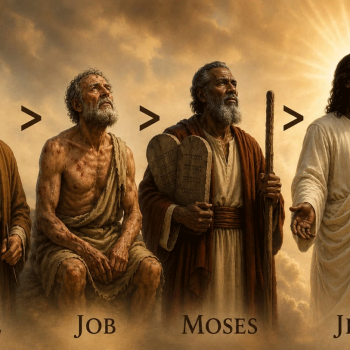
Why Most Christians are Really Paulians and Jobians
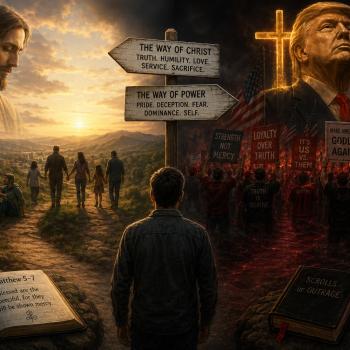
Can Religion be Intellectually Honest?
Did Jesus Exist: The Case of the Vanishing...
TRENDING AT PATHEOS Nonreligious

Swimfan: Forgotten Aughts Pleasures
This is a recovery effort. In 2002, My Big Fat Greek Wedding...

Top Three Anti-Catholic Lies About Catholicism
This is my initial transcript for the video, "THE 3 WORST...

Pope Leo Celebrates Mass for Nurses & Docs...
I don't have any idea how he did it, but Pope Leo...

The Sermon on the Mount, Part I: Matthew...
The Sermon on the Mount, Part I (Matthew 4:12-5:12) St. Matthew moves...

What's up from Crossway: Reviewing some of their latest A few weeks...

Janie Learns the Way of the Cross: A...
Teaching children about Jesus' Passion can be challenging. Many parents and educators...
view all Nonreligious blogs
What Are Your Thoughts?leave a comment
Ad-Free & Subscriber Log-In Subscription Support
- About Us
- 2026 Calendar
- Videos
- Podcasts
- Library of World Religions
- Faith In Media Tracker
- Advertise With Us
- Write for Us
- Privacy Policy
- Terms of Service
- Do Not Sell My Data
- Contact Us
- Radiant Digital
- Manage Newsletter Subscriptions
- Unsubscribe From Notifications
- Sitemap
Copyright 2008-2026, Patheos. All rights reserved.
Subscription Support Ad-Free & Subscriber Log-In
Follow Patheos