
BuddhistCatholicContemplativeEvangelicalGeneral ChristianHinduJewishLatter-day SaintMuslimNew VisionsProgressive Christian
Beliefs
- Buddhist
- Catholic
- Contemplative
- Evangelical
- General Christian
- Hindu
- Jewish
- Latter-day Saint
- More Voices
- Muslim
- New Visions
- Pagan
- Progressive Christian
Topics
- Religion News
- Food and Religion
- Sports and Religion
- Religious Art
- Religious Music and Entertainment
- Religious Events
- History and Religion
- Style and Religion
- Politics and Religion
- Women in Religion
- Recreation Outdoors and Religion
- Business Finance and Religion
- Careers Workplace and Religion
- Education and Religion
- Family Parenting and Religion
- Health Fitness and Religion
- Home and Religion
- Relationships and Religion
- Technology and Religion
- Travel and Religion
Columnists
- Buddhist Columnists
- Business Finance and Religion Columnists
- Careers Workplace and Religion Columnists
- Catholic Columnists
- Contemplative Columnists
- Education and Religion Columnists
- Evangelists Columnists
- Family Parenting and Religion Columnists
- General Christian Columnists
- Health Fitness and Religion Columnists
- Hindu Columnists
- History and Religion Columnists
- Home and Religion Columnists
- Jewish Columnists
- More Voices Columnists
- Latter Day Columnists
- Muslim Columnists
- New Visions Columnists
- Nonreligious Columnists
- Pagan Columnists
- Politics and Religion Columnists
- Progressive Columnists
- Recreation Outdoors and Religion Columnists
- Relationships and Religion Columnists
- Religion News Columnists
- Religious Art Columnists
- Religious Events Columnists
- Religious Music and Entertainment Columnists
- Sports and Religion Columnists
- Style and Religion Columnists
- Technology and Religion Columnists
- Travel and Religion Columnists
- Women in Religion Columnists
Resource Library
- 2026 Calendar
- Library of World Religions
- The 100 Most Holy Places on Earth
- Patheos Answers
- Podcasts
- Videos
- Faith Leaders Database
- Anglican Episcopalian
- Bahai
- Baptist
- Buddhism
- Christianity
- Confucianism
- Eastern Orthodoxy
- Hinduism
- Holiness and Pentecostal
- ISKCON
- Islam
- Judaism
- Lutheran
- Methodist
- The Church of Jesus Christ of Latter-day Saints
- New Age
- Paganism
- Presbytarian and Reformed
- Protestantism
- Religion Behind the Scenes
- Roman Catholic
- Scientology
- Shia Islam
- Sikhism
- Sufism
- Sunni Islam
- Taoism
- Zen
- See all religions
Research Tools
 Ad-Free & Subscriber Log-In Subscription Support
Ad-Free & Subscriber Log-In Subscription Support
Follow Patheos 

- Trending:
- Forgiveness
- |
- Marriage
- |
- Consciousness
- |
- Death Penalty
- |
- Election
- |
- Halloween
 Love, Joy, Feminism
-
More
- Home
- Nonreligious
- We need a lot more therapists in this world
We need a lot more therapists in this world
Last updated on: April 14, 2020 at 5:07 pm by Libby Anne
We need a lot more therapists in this world 2020-04-14T17:07:27-04:00 Libby Anne
Patheos Explore the world's faith through different perspectives on religion and spirituality! Patheos has the views of the prevalent religions and spiritualities of the world.
No Greater Joy, a fundamentalist ministry that focuses primarily on telling wives to submit to their husbands, recently posted a piece titled “Did I seriously just question God’s Word?” by Beth Determan. In it, Beth details her frustrations with submitting to her husband.
Beth begins as follows:
I have been a Christian for 17 years. I have loved getting to know God, learning about his love for me and others, reading the Bible, and knowing what God has for women and wives. I love encouraging you all daily.
I will admit it has been hard sometimes understanding why HE (God) has authority set in place. I was raised a rebel. It didn’t seem fair that WE had to do what our husbands asked but they didn’t have to do what we wanted.
No, it’s not fair, but on some level that’s the least of my worries— this arrangement is also not healthy. This will become more important in a moment.
And in our culture today, it’s shoved down our throats to speak our mind and do what we feel is right. I mean, he should listen to me too, right? Marriage should be 50/50, right?
The phrasing here is actually really interesting. There’s a verse in Judges that I remember hearing growing up: “In those days there was no king in Israel; everyone did what was right in his own eyes.” This was, of course, supposed to be a bad thing (although it occurs to me that I don’t know how these passages have been interpreted within Judaism, only Christianity).
But let me ask you this. Is it a good idea to prevent someone from doing something they believe is right, particularly if it means forcing them do something they believe is wrong? Ah, but that’s a different phrasing, isn’t it! It’s easy to read “everyone did what was right in his own eyes” and see moral excess, but if “do what we feel is right” is a reference to our own moral compass that sounds quite a bit different. In that sense, we absolutely should “do what we feel is right.”
But I feel like I’m getting a bit afield, here. Back to Beth:
I’m going to get super personal.
I have an amazing marriage but we are not perfect. Shocker.
In an argument with my husband, I once said to him: “If I asked this of you, you would not do it, so why do I have to listen to you? I think this is nonsense, and I know God tells me this is the way it is, but it’s not fair!”
*Gasp* My dear, wise husband just looked at me and said in a calm voice, “That is between you and God. Sounds like you just called his Word nonsense.”
Does Beth think this makes her husband look good? Because it does not. It does not at all.
I froze. Did I seriously just question God’s Word? I was devastated. I went to the bathroom and cried out to God in apology, and Ephesians 5:22 popped into my head.
Wives, submit yourselves unto your own husbands, as unto the Lord.
Would I dare question God to his face? If he asked anything of me, would I obey?
Of course I would. So what was I doing being prideful about submitting myself to my husband?
Lady, your husband is not God.
God never once said “if it’s fair” or “if you feel like it” or “if your husband would do it himself.” He said “submit yourselves” as unto the Lord. Ouch. I will humble myself and admit this was a recent event.
So with a deep breath and a repentant heart, I walked out and apologized to my husband. I realized that my emotions had rule over my mind, and my husband mostly rules with logic. He is the head that God knew I needed.
(Of course, I am not in any way speaking of abuse—just normal, everyday life here.)
Oh. No. No, no, no.
If a husband expects his wife to obey him because he’s the man and throws religion in her face when she disagrees with something he has ordered her to do, that is abuse. You can’t make it not abuse by asserting that you are not talking about abuse. Beth says she’s talking about “just normal, everyday life here” when she says she’s not talking about abuse, and that really is the problem—fundamentalist teachings about gender and women’s role normalize abuse.
Here, take a look athlete power and control wheel:
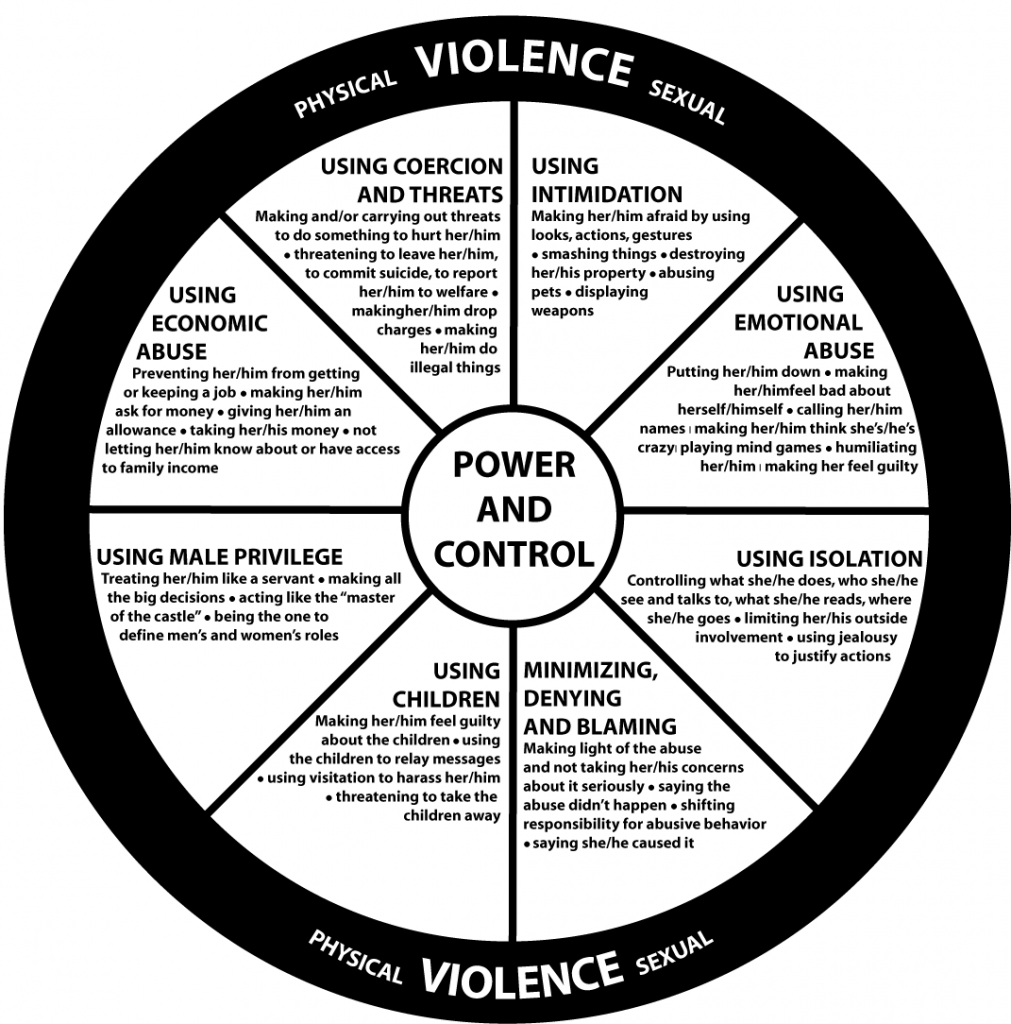
Many women who promote patriarchal teachings seem to think that abuse has to be physical to be abuse—or that it has to involve out of control rageful screaming. This is simply not the case. Reducing your wife to tears and making her feel that she has to apologize, all for saying that it’s not fair that she has to obey you, is big flashing neon warning sign territory.
Beth would likely defend her husband; she says later that her husband rarely speaks up and that “when he does I know it’s important.” But a man with a healthy approach to relationships who also believes in male headship is not going to put his wife in a situation like this; he’s not going to pull rank and make his wife do things she doesn’t want to do. Instead, he’ll listen to his wife, explain his own perspective in turn, and work with—and not against—her.
There are men who believe in male headship but in practice have healthy relationship skills. It happens, especially when married couples realize that egalitarianism just works better, but aren’t in a position where they feel they can question that particular piece of evangelical teaching.
Beth’s backstory made me profoundly sad:
Pride and selfishness will ruin you.
I had a root hidden away, planted by feminism and growing up watching my mama be abused and “told what to do.” It was not in a biblical sense for her own protection or good, but in a controlling atmosphere permeated by fear. There is a CLEAR difference.
Nonetheless, it was there, a thorn in my side that I didn’t realize was so deep. My husband is a Steady/Command man who rarely “speaks up,” so when he does I know it’s important. But this time, my true heart showed. How awful.
I didn’t want to do what he asked. I wanted my own way. I could see that I only submitted when it suited me.
No more! I learned a good lesson, ladies. I had a hard look at my own heart. Yes, I have past trauma. Yes, I have a deep need to control and protect my circumstances to feel safe. Anyone who has suffered abuse knows this.
But, I CHOOSE TO TRUST GOD.
I will never again question his Word. No matter my past or my circumstances, I will submit myself to my husband as unto the Lord God himself standing before me face to face.
What Beth is describing is triggers. After watching her abusive father tell her mother what to do and rule over her in an atmosphere of fear, she was triggered when her husband insisted that he had the right to order her to do something she did not want to do.
Here’s how I see it: if you grew up with an abusive father who told your mother what to do and ruled her in an atmosphere of fear, your husband should keep your past trauma in mind and avoid saying anything that would make you think he’s telling you what to do.
Early on in our marriage, my husband had to learn not to use certain phrases that my parents used to use, because of the reaction they would create in me. Beth’s husband has every reason in the world not to pull rank on her and order her to obey him—both because doing so is unhealthy and because it triggers her childhood traumas—and yet still he does it.
Beth’s takeaway is that she needs to swallow her trauma and obey her husband as though he’s God—she literally says this—and also that wanting something different is just feminism lying to her, or her own insecurities resulting from past trauma speaking, and thus invalid.
I wonder how many women with horrifically abusive fathers end up in patriarchal marriages that they justify by telling themselves that their husband is not what their father was.
Beth describes one conflict as follows:
I recently had a disagreement with my daughter. She felt she was right, I demanded that I was right, and she walked away with hurt feelings. My husband told me to go get her and restore fellowship. I didn’t like being told what to do, not the tiniest bit. Ugh, pride is an ugly thing . . . But fellowship restored is sweet, and my husband knew it was what both my daughter and I needed.
This just feels … off. Did her husband actually order her to make up with her kid, or did he say that he thought maybe she’d been a bit hard on her, and she just took that as an order?
There have been times when my husband and my daughter have fought where I’ve told my husband, afterwards, that I thought he should go make things right with her. This has never been an order. How would that even work? Anyone who has ever tried ordering two children to make up knows that you can’t order people to make up. You can’t command the heart.
In cases like this, “don’t you think you were a bit hard on her?” is plenty. It is not an order. It’s a second opinion. Marriages are full of second opinions—and that’s good! We need second opinions. We need people to bounce ideas off of, people to ask for feedback from, people to support us and encourage us and hold us up when we fall. That’s what marriage is supposed to be about, not this nonsense where one partner treats the other as though he’s literally God.
Perhaps part of the problem is that we never educate people on how to do relationships. No, think about it—we don’t! We take math, biology, and government, but do we take human behavior? Not usually! We each grow up with our parents as models, and that model is often shit. Then when we’re grown we try to muck through things on our own. We repeat some of our parents’ mistakes, avoid others, and make mistakes of our own. But nobody ever sits everyone down and says “okay, this is what a healthy relationship looks like.”
Now that I think about it, it’s wild that we don’t teach this. We teach kids not to do drugs and how to have safe sex (well, sometimes), but we don’t teach them how to do relationships.
And that’s a problem.
I have a Patreon! Please support my writing!
Previous Post

April 13, 2020
This Missionary Adventure Board Game Has Dinosaurs
Next Post

April 15, 2020 Franklin Graham: When I Said Anti-Gay, I Meant Clean Living
Browse Our Archives
Select a Category Atheism Evangelicalism/Fundamentalism Family Feminism Homeschool Meta Parenting Patriarchy Politics Purity Quiverfull Social Justice Uncategorized Worthwhile reads
Select a Month February 2021 January 2021 December 2020 November 2020 October 2020 September 2020 August 2020 July 2020 June 2020 May 2020 April 2020 March 2020 February 2020 January 2020 December 2019 November 2019 October 2019 September 2019 August 2019 July 2019 June 2019 May 2019 April 2019 March 2019 February 2019 January 2019 December 2018 November 2018 October 2018 September 2018 August 2018 July 2018 June 2018 May 2018 April 2018 March 2018 February 2018 January 2018 December 2017 November 2017 October 2017 September 2017 August 2017 July 2017 June 2017 May 2017 April 2017 March 2017 February 2017 January 2017 December 2016 November 2016 October 2016 September 2016 August 2016 July 2016 June 2016 May 2016 April 2016 March 2016 February 2016 January 2016 December 2015 November 2015 October 2015 September 2015 August 2015 July 2015 June 2015 May 2015 April 2015 March 2015 February 2015 January 2015 December 2014 November 2014 October 2014 September 2014 August 2014 July 2014 June 2014 May 2014 April 2014 March 2014 February 2014 January 2014 December 2013 November 2013 October 2013 September 2013 August 2013 July 2013 June 2013 May 2013 April 2013 March 2013 February 2013 January 2013 December 2012 November 2012 October 2012 September 2012 August 2012 July 2012 June 2012 May 2012 April 2012 March 2012 February 2012 January 2012 December 2011 November 2011 October 2011 September 2011 August 2011 July 2011 June 2011
Follow Us!
TAKE THE
Religious Wisdom Quiz
What was the primary form of transportation in Biblical times?
Select your answer to see how you score.
Donkey Camel Chariot Horse
Related posts from Love, Joy, Feminism

Maybe Let's Not Read More Puritans


"So Your Problem with Christianity is the Jesus...

TRENDING AT PATHEOS Nonreligious

Dethroning Jesus and Enthroning Yourself
Jesus Never Asked to Be Worshipped. He Asked to Be Understood. Christianity...

Why Most Christians are Really Paulians and Jobians
I Don't Care, But It Matters Let's get this out of the...

Essential Tips to Successfully Navigate the Selling Process
Selling a house can feel overwhelming, but it doesn’t have to be....

To Make Remote Work Effective, Think About Others
The COVID-19 pandemic forced many companies to rapidly transition to remote work....

Flexibility Is Key to Solving Problems of Tomorrow
The world of work is undergoing a dramatic transformation. The COVID-19 pandemic...
view all Nonreligious blogs
Ad-Free & Subscriber Log-In Subscription Support
- About Us
- 2026 Calendar
- Videos
- Podcasts
- Library of World Religions
- Faith In Media Tracker
- Advertise With Us
- Write for Us
- Privacy Policy
- Terms of Service
- Do Not Sell My Data
- Contact Us
- Radiant Digital
- Manage Newsletter Subscriptions
- Unsubscribe From Notifications
- Sitemap
Copyright 2008-2026, Patheos. All rights reserved.
Subscription Support Ad-Free & Subscriber Log-In
Follow Patheos