
BuddhistCatholicContemplativeEvangelicalGeneral ChristianHinduJewishLatter-day SaintMuslimNew VisionsProgressive Christian
Beliefs
- Buddhist
- Catholic
- Contemplative
- Evangelical
- General Christian
- Hindu
- Jewish
- Latter-day Saint
- More Voices
- Muslim
- New Visions
- Pagan
- Progressive Christian
Topics
- Religion News
- Food and Religion
- Sports and Religion
- Religious Art
- Religious Music and Entertainment
- Religious Events
- History and Religion
- Style and Religion
- Politics and Religion
- Women in Religion
- Recreation Outdoors and Religion
- Business Finance and Religion
- Careers Workplace and Religion
- Education and Religion
- Family Parenting and Religion
- Health Fitness and Religion
- Home and Religion
- Relationships and Religion
- Technology and Religion
- Travel and Religion
Columnists
- Buddhist Columnists
- Business Finance and Religion Columnists
- Careers Workplace and Religion Columnists
- Catholic Columnists
- Contemplative Columnists
- Education and Religion Columnists
- Evangelists Columnists
- Family Parenting and Religion Columnists
- General Christian Columnists
- Health Fitness and Religion Columnists
- Hindu Columnists
- History and Religion Columnists
- Home and Religion Columnists
- Jewish Columnists
- More Voices Columnists
- Latter Day Columnists
- Muslim Columnists
- New Visions Columnists
- Nonreligious Columnists
- Pagan Columnists
- Politics and Religion Columnists
- Progressive Columnists
- Recreation Outdoors and Religion Columnists
- Relationships and Religion Columnists
- Religion News Columnists
- Religious Art Columnists
- Religious Events Columnists
- Religious Music and Entertainment Columnists
- Sports and Religion Columnists
- Style and Religion Columnists
- Technology and Religion Columnists
- Travel and Religion Columnists
- Women in Religion Columnists
Resource Library
- 2026 Calendar
- Library of World Religions
- The 100 Most Holy Places on Earth
- Patheos Answers
- Podcasts
- Videos
- Faith Leaders Database
- Anglican Episcopalian
- Bahai
- Baptist
- Buddhism
- Christianity
- Confucianism
- Eastern Orthodoxy
- Hinduism
- Holiness and Pentecostal
- ISKCON
- Islam
- Judaism
- Lutheran
- Methodist
- The Church of Jesus Christ of Latter-day Saints
- New Age
- Paganism
- Presbytarian and Reformed
- Protestantism
- Religion Behind the Scenes
- Roman Catholic
- Scientology
- Shia Islam
- Sikhism
- Sufism
- Sunni Islam
- Taoism
- Zen
- See all religions
Research Tools
 Ad-Free & Subscriber Log-In Subscription Support
Ad-Free & Subscriber Log-In Subscription Support
Follow Patheos 

- Trending:
- Forgiveness
- |
- Marriage
- |
- Consciousness
- |
- Death Penalty
- |
- Election
- |
- Halloween
 Love, Joy, Feminism
-
More
- Home
- Nonreligious
- This Is Not Millennials’ First Rodeo
This Is Not Millennials’ First Rodeo
Last updated on: April 7, 2020 at 10:19 am by Libby Anne
This Is Not Millennials’ First Rodeo 2020-04-07T10:19:02-04:00 Libby Anne
Patheos Explore the world's faith through different perspectives on religion and spirituality! Patheos has the views of the prevalent religions and spiritualities of the world.
Why is the media still using “Millennials” as shorthand for college kids? Words have meanings, and this ain’t it. Remember all the talk about the “Millennials” on the beaches in Florida during spring break last month?

There is some disagreement on what years bracket the Millennial generation. While the most commonly accepted dates are 1980 and 1996, some use 1982 to 2000. Personally, I’m preferential to the former age range. But even if you use the later age range, college students today are a mixture of Millennials and Gen Z.
But I want to discuss something slightly different—something more related to the Millennial experience than to any specific age range. It’s a recent NYT piece by Nathaniel Popper, which ran under the following headline: 
“Millennials, burdened with debt, are now facing their first economic crisis,” the headline declares. Here’s the thing, though. That’s not true. I’m a middling Millennial, and this is not our first economic crisis. The 2008 financial crisis hit my peers and I hard. We left college into a world where there were no jobs. Many of us went to grad school to delay hitting the job market. Others of us struggled to find work. Older Millennials saw their careers derailed.
Hearing about the stock market and concerns about recession these past months has evoked a sense of underlying terror in me, because I remember 2008 and I don’t want to go back there. First economic crisis my foot!
Yes, younger Millennials had a different experience. But even Millennials currently in their mid-twenties graduated into an economy whose looks were deceptive. While the stock market went up, up, and up, many younger Millennials found themselves saddled with college debt and stuck in a gig economy.
Popper doesn’t address any of this, which is odd, given that his focus is on how much less wealth Millennials have now than Gen Xers had in 2008:
Going into the financial crisis of 2008, Generation X was roughly the same age as millennials today, but had on average twice the total assets that millennials have now when all bank accounts, stocks and loans are added together, according to an analysis done for The New York Times by economists at the St. Louis Federal Reserve.
This is absolutely true: Millennials today have far less wealth than previous generations at their same age. Bafflingly, Popper doesn’t discuss the reasons Millennials have so much more debt and so many fewer assets—reasons that have a lot to do with 2008. It’s not just college debt—it’s also that many of us graduated into one of the worst job markets in generations, an economy that proved to be permanently changed even as the stock market recovered and then rocketed past prior highs. The closest Popper comes to addressing this is noting that many Millennials today are involved in the gig economy, which is particularly vulnerable to disruption, but he never addresses why.
Popper’s assumption that this is Millennials’ first economic crisis seems to have warped his ability to address or effectively analyze why Millennials have fewer assets than previous generations have at the onset of a recession like the one that’s looming. One big reason for that is that this is not our first economic crisis.
Popper’s only reference to the 2008 financial crisis’ impact on Millennials is as follows:
The 2008 crisis made young Americans then more reluctant to invest in the stock market. Millennials today have, on average, only a third of the stock market holdings that Generation X did before the 2008 financial crisis, according to the data from the St. Louis Federal Reserve.
That means that young households have not enjoyed the market gains that came over the last decade. Today, the average member of Generation X has 10 times more wealth from the stock market then millennials.
Yes, that’s right. Popper suggests that the 2008 financial crisis affected Millennials by making them “more reluctant to invest in the stock market,” and that it is because of this that “young households have not enjoyed the market gains that came over the last decade.” This, he suggests, is the reason Gen Xers haves so much more stock market wealth than Millennials—and presumably helps explain why Millennials have so many fewer assets.
What utter bull. You can’t invest money you don’t have.
To suggest that Millennials’ reluctance to invest in the stock market—as opposed to the impact the 2008 recession had on their careers and thus their earning potential—is responsible for their lack of assets compared to prior generations facing economic downturns is beyond bizarre. What rock has Popper lived under? But again, this is the consequence of his insistence on believing that this is Millennials’ first financial crisis.
The absence of any discussion of the impact the last financial crisis had on Millennials makes passages like this feel unexplained, verging on victim blaming:
While the last few years were largely good ones for the American economy, that did little to help set millennials up with a solid financial foundation. Overloaded with credit card and student debt, and underrepresented in the housing and stock markets, they entered this uncertain period with significant obligations and few resources.
There is no attempt to explore why Millennials are underrepresented in the housing and stock markets. (Oh, I don’t know, maybe because so many of us graduated into one of the worst financial recessions in decades, and because even when the stock market bounced back real wages remained severely depressed, forcing many Millennials into the gig academy, saddled with college debt they’d been promised good jobs would allow them to pay off, leading to their inability to buy a house or invest in the stock market, let alone pay for groceries. But I digress.)
(Also, is Popper really suggesting that Millennials’ problem was not investing in the stock market, at a time when the stock market has plummeted and remained extremely volatile, at times erasing al of the gains of the past four years? It would seem that Millennials may have dodged a bullet in being shy of the stock market, if indeed that—rather than lack of money to invest—is why they have put less in the stock market than other generations.)
This all brings me to an important point: if you convince yourself that Millennials is shorthand for college students and twenty-somethings, you will write articles about Millennials that fail to tell the actual and full story of Millennials. The widespread misuse of the label “Millennials” is not without its analytical consequences.
Oh by the way—the NYT changed the headline.
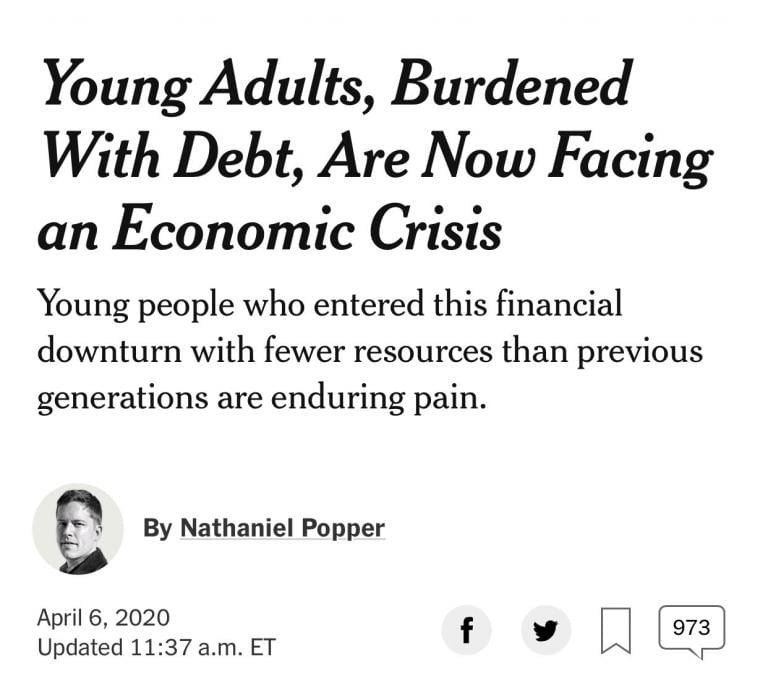
The text remains the same, still focusing squarely on Millennials, which means that the analytical problems remain. The headline wasn’t the problem. The analysis was. First financial crisis my foot.
I have a Patreon! Please support my writing!
Previous Post

April 6, 2020
What Is Going on at the New York Times?!
Next Post

April 9, 2020 But What Did Obama Ever Do to Stop This?
Browse Our Archives
Select a Category Atheism Evangelicalism/Fundamentalism Family Feminism Homeschool Meta Parenting Patriarchy Politics Purity Quiverfull Social Justice Uncategorized Worthwhile reads
Select a Month February 2021 January 2021 December 2020 November 2020 October 2020 September 2020 August 2020 July 2020 June 2020 May 2020 April 2020 March 2020 February 2020 January 2020 December 2019 November 2019 October 2019 September 2019 August 2019 July 2019 June 2019 May 2019 April 2019 March 2019 February 2019 January 2019 December 2018 November 2018 October 2018 September 2018 August 2018 July 2018 June 2018 May 2018 April 2018 March 2018 February 2018 January 2018 December 2017 November 2017 October 2017 September 2017 August 2017 July 2017 June 2017 May 2017 April 2017 March 2017 February 2017 January 2017 December 2016 November 2016 October 2016 September 2016 August 2016 July 2016 June 2016 May 2016 April 2016 March 2016 February 2016 January 2016 December 2015 November 2015 October 2015 September 2015 August 2015 July 2015 June 2015 May 2015 April 2015 March 2015 February 2015 January 2015 December 2014 November 2014 October 2014 September 2014 August 2014 July 2014 June 2014 May 2014 April 2014 March 2014 February 2014 January 2014 December 2013 November 2013 October 2013 September 2013 August 2013 July 2013 June 2013 May 2013 April 2013 March 2013 February 2013 January 2013 December 2012 November 2012 October 2012 September 2012 August 2012 July 2012 June 2012 May 2012 April 2012 March 2012 February 2012 January 2012 December 2011 November 2011 October 2011 September 2011 August 2011 July 2011 June 2011
Follow Us!
TAKE THE
Religious Wisdom Quiz
There is a season for everything under heaven—a time to be born and a time to do what?
Select your answer to see how you score.
Rest Live Sing Die
Related posts from Love, Joy, Feminism

How Not to Talk Millennials Out of Supporting...


Lesbian Duplex 310: An Open Thread

The Vision: NASA Is On the Case
TRENDING AT PATHEOS Nonreligious

Dethroning Jesus and Enthroning Yourself
Jesus Never Asked to Be Worshipped. He Asked to Be Understood. Christianity...

Why Most Christians are Really Paulians and Jobians
I Don't Care, But It Matters Let's get this out of the...

Essential Tips to Successfully Navigate the Selling Process
Selling a house can feel overwhelming, but it doesn’t have to be....

To Make Remote Work Effective, Think About Others
The COVID-19 pandemic forced many companies to rapidly transition to remote work....

Flexibility Is Key to Solving Problems of Tomorrow
The world of work is undergoing a dramatic transformation. The COVID-19 pandemic...
view all Nonreligious blogs
Ad-Free & Subscriber Log-In Subscription Support
- About Us
- 2026 Calendar
- Videos
- Podcasts
- Library of World Religions
- Faith In Media Tracker
- Advertise With Us
- Write for Us
- Privacy Policy
- Terms of Service
- Do Not Sell My Data
- Contact Us
- Radiant Digital
- Manage Newsletter Subscriptions
- Unsubscribe From Notifications
- Sitemap
Copyright 2008-2026, Patheos. All rights reserved.
Subscription Support Ad-Free & Subscriber Log-In
Follow Patheos