
BuddhistCatholicContemplativeEvangelicalGeneral ChristianHinduJewishLatter-day SaintMuslimNew VisionsProgressive Christian
Beliefs
- Buddhist
- Catholic
- Contemplative
- Evangelical
- General Christian
- Hindu
- Jewish
- Latter-day Saint
- More Voices
- Muslim
- New Visions
- Pagan
- Progressive Christian
Topics
- Religion News
- Food and Religion
- Sports and Religion
- Religious Art
- Religious Music and Entertainment
- Religious Events
- History and Religion
- Style and Religion
- Politics and Religion
- Women in Religion
- Recreation Outdoors and Religion
- Business Finance and Religion
- Careers Workplace and Religion
- Education and Religion
- Family Parenting and Religion
- Health Fitness and Religion
- Home and Religion
- Relationships and Religion
- Technology and Religion
- Travel and Religion
Columnists
- Buddhist Columnists
- Business Finance and Religion Columnists
- Careers Workplace and Religion Columnists
- Catholic Columnists
- Contemplative Columnists
- Education and Religion Columnists
- Evangelists Columnists
- Family Parenting and Religion Columnists
- General Christian Columnists
- Health Fitness and Religion Columnists
- Hindu Columnists
- History and Religion Columnists
- Home and Religion Columnists
- Jewish Columnists
- More Voices Columnists
- Latter Day Columnists
- Muslim Columnists
- New Visions Columnists
- Nonreligious Columnists
- Pagan Columnists
- Politics and Religion Columnists
- Progressive Columnists
- Recreation Outdoors and Religion Columnists
- Relationships and Religion Columnists
- Religion News Columnists
- Religious Art Columnists
- Religious Events Columnists
- Religious Music and Entertainment Columnists
- Sports and Religion Columnists
- Style and Religion Columnists
- Technology and Religion Columnists
- Travel and Religion Columnists
- Women in Religion Columnists
Resource Library
- 2026 Calendar
- Library of World Religions
- The 100 Most Holy Places on Earth
- Patheos Answers
- Podcasts
- Videos
- Faith Leaders Database
- Anglican Episcopalian
- Bahai
- Baptist
- Buddhism
- Christianity
- Confucianism
- Eastern Orthodoxy
- Hinduism
- Holiness and Pentecostal
- ISKCON
- Islam
- Judaism
- Lutheran
- Methodist
- The Church of Jesus Christ of Latter-day Saints
- New Age
- Paganism
- Presbytarian and Reformed
- Protestantism
- Religion Behind the Scenes
- Roman Catholic
- Scientology
- Shia Islam
- Sikhism
- Sufism
- Sunni Islam
- Taoism
- Zen
- See all religions
Research Tools
 Ad-Free & Subscriber Log-In Subscription Support
Ad-Free & Subscriber Log-In Subscription Support
Follow Patheos 

- Trending:
- Forgiveness
- |
- Marriage
- |
- Consciousness
- |
- Death Penalty
- |
- Election
- |
- Halloween
 Love, Joy, Feminism
-
More
- Home
- Nonreligious
- Young Earth Creationism: The Ultimate Fandom
Young Earth Creationism: The Ultimate Fandom
Last updated on: February 3, 2020 at 9:37 am by Libby Anne
Young Earth Creationism: The Ultimate Fandom 2020-02-03T09:37:25-04:00 Libby Anne
Patheos Explore the world's faith through different perspectives on religion and spirituality! Patheos has the views of the prevalent religions and spiritualities of the world.
Could Noah’s Ark Have Been Made of Wood? reads an Answers in Genesis headline. What interested me more was the summary on my feed reader.

Say what now? There’s a sort of flippancy to their statement. It sounds like something a flippant atheist would say to summarize Answers in Genesis’ position. “Noah built it somehow, with or without some mysterious ancient technology.” Mysterious ancient technology.
But these summaries that show up in feed readers are selected by the author, not the feed reader service. Indeed, the article itself leads with this:
There’s a biblical ark that rode out the Flood, and it was no bathtub. Noah built it somehow, with or without some mysterious ancient technology or extreme gopherwood. Does this mean God had to suspend the laws of physics to keep Noah afloat?
Let’s say He didn’t. In that case, could Noah get through the whole ark operation?
I can’t get over how much this sort of exercise feels like the discussions that take place on hardcore Star Wars forums, where fans discuss the dimensions of star destroyers and whether they could do X or Y without violating the basic rules of physics. It’s common for fans to discuss whether and how various aspects of their given fandom can be understood according to the laws of our physical universe, falling back on “mysterious technology that doesn’t exist in our world” when needed. The same is happening here.
Noah built the ark somehow—maybe through ordinary processes and with ordinary products, or maybe with “mysterious ancient technology” or “extreme gopherwood.” Did God have to suspend the laws of physics to make it work? Maybe. But let’s explore how it could have worked if he didn’t.
It’s like this throughout the piece:
Did Noah need help? A pit-sawing team (of two) would take many decades to cut the wood for one ark. That’s cutting it close. Noah and sons had other things to focus on, so it makes sense that labor was hired, or that processed materials like sawn lumber were purchased. Noah should have been extremely wealthy having lived 480 years before the project even began. He probably had the help of his grandfather Methuselah, who lived to see the ark constructed.
This reads like every fan everywhere defending their fandom.
Any flood that rapidly inundates the world (in 40 days or less) will involve massive high-speed currents that would dwarf any modern tsunami. In fact, no modern flood lays down sediments anything like the huge, fossil-filled rock layers deposited all over the world.
Hmm. That might be something to think harder about.
Such a sudden inundation would pulverize everything in its path, including all shipping and coastal settlements.
How could the ark survive? One solution is to launch from the highest point. This keeps Noah out of the violence of the initial inflows of ocean water as predicted by the Catastrophic Plate Tectonics model. The Flood went on to drown every mountain in the pre-Flood world (Genesis 7:19). Since modern oceans contain enough water to drown the planet to a depth of about 1.8 miles (2.85 km), the pre-Flood terrain was probably limited to within this elevation. By the time the water reached the ark, the currents would have slowed to manageable levels before the launch.
Here, have a look at this handy image they include:
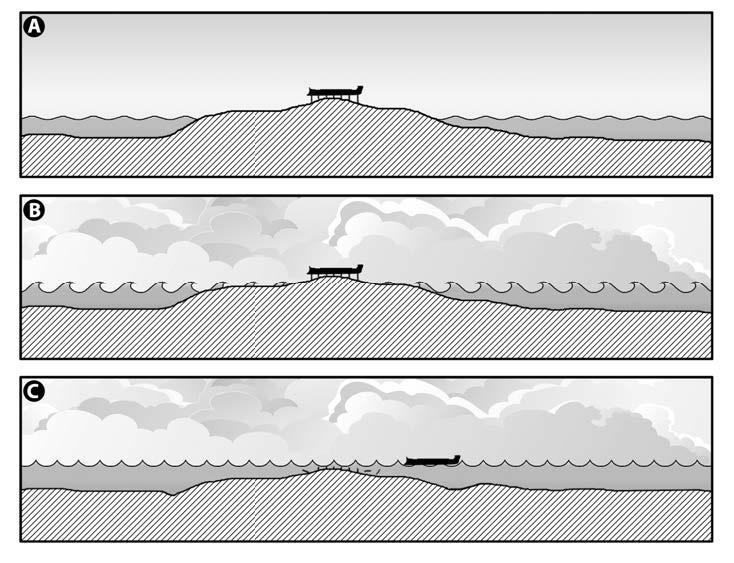
To be clear, the Bible does not say that Noah built the ark on high ground. It says nothing at all about where he built the ark. Here is what the Bible says:
- For forty days the flood kept coming on the earth, and as the waters increased they lifted the ark high above the earth. 18. The waters rose and increased greatly on the earth, and the ark floated on the surface of the water. 19. They rose greatly on the earth, and all the high mountains under the entire heavens were covered. 20. The waters rose and covered the mountains to a depth of more than fifteen cubits.
There’s nothing there to suggest that the ark was built on particularly high ground. That’s something the author of this Answers in Genesis article is adding, that is not stated in the text. And sure, that’s fine. But that’s definite fandom territory. “Well maybe that would have worked if X.”
Look, if they believe God did it and nothing will change their mind—if they’re willing to suspend the laws of physics if they have to, with the aid of an all-powerful deity—why not just say that it happened and leave it at that? All of this technical debate about how it really could have happened without violating the laws of physics, when they wouldn’t change their mind even if the event did require violating the laws of physics, feels silly.
The article is filled with images like this:
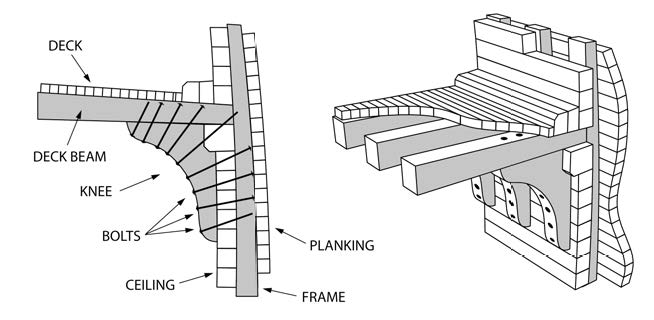
Look, it’s not like they’re not arguing that God did not exist, but every story in the Bible still happened. If they were arguing that, this technical debate would make more sense. If divine intervention isn’t a possibility and the Noah’s Ark story happened as written in the Bible, you have to figure out a way to make that boat work according to the laws of physics. But that’s not the case here. So why, then, is all of this so important?
I’ve never seen an Answers in Genesis article trying to find a way that widow’s flour and oil could have lasted forever without running out. They accept the reality of miracles, and of divine intervention. So why here? Why the need to be all scientific instead of saying “we know it happened”?
After discussing the fact that no wooden ship has ever been as massively long as the ark was, because wooden ships that even approach that size are under enormous physical stress and prone to leaking, the author asks:
Is this proof positive that the laws of physics must be suspended to keep Noah afloat?
The author explains that it is not, that Noah probably just used resilient ship building methods that have since been lost to humankind. But notice that the laws of physics being suspended remains as a viable backup option. If for some reason there is no physical solution, the author will not conclude that the Noah’s Ark story in Genesis must not have literally happened, but rather that God intervened and suspended the laws of physics.
While 330 feet (100 m) may well be the practical limit for a carvel-built hull with a single layer of planking, more appropriate construction methods would extend that boundary by at least 50 percent.
As for the compulsory miracles: God gave instructions to Noah, He brought the animals, He closed the door, and He even sent a wind. But was supernatural intervention the only thing holding Noah’s ark together?
Not necessarily. Maybe Noah used ancient bulkheads and ancient planking to build a ship that was more than able to withstand the stresses it faced during the Flood.
You see what I mean about accepting some miracles, while being willing to entertain the idea that the ark was held together by divine intervention?
Let’s return to the issue of fandoms. There is at least one significant difference between young earth creationism and most fandoms. When fans come up with scientific ways this or that part of their fandom could have really happened, they’re not trying to convince anyone that star destroyers are real, or that Tatooine is out there somewhere. When fans science their fandoms, they’re just having fun. Not so, for Answers in Genesis. When they science their fandom, so to speak, they’re trying to convince.
I have a guess to what’s going on. In the modern era, science has grown in importance while religion has increasingly taken a back seat in the mind of the general public. An increasing number of people are skeptical of miracles, and it seems likely, although I haven’t seen it studied, that people are more skeptical of big, geological miracles that reshape the planet than they are of small, everyday ones like recovery from cancer, or finding a missing phone.
In this changing environment, young earth creationists understand that appealing to divine intervention and miracles to explain things that don’t make sense scientifically is not as palatable as it once was. My guess is that this is the reason they cover their miracles with a healthy helping of modern science. For young earth creationists, though, whether the science they slather on their religious theories actually works out or not is irrelevant, because it’s not the science that matters. It’s what’s underneath.
Noah built it somehow, with or without some mysterious ancient technology.
I have a Patreon! Please support my writing!
Previous Post

February 2, 2020
Lesbian Duplex 261: An Open Thread
Next Post

February 4, 2020 But Freedom of Speech! Evangelicals and College Campuses
Browse Our Archives
Select a Category Atheism Evangelicalism/Fundamentalism Family Feminism Homeschool Meta Parenting Patriarchy Politics Purity Quiverfull Social Justice Uncategorized Worthwhile reads
Select a Month February 2021 January 2021 December 2020 November 2020 October 2020 September 2020 August 2020 July 2020 June 2020 May 2020 April 2020 March 2020 February 2020 January 2020 December 2019 November 2019 October 2019 September 2019 August 2019 July 2019 June 2019 May 2019 April 2019 March 2019 February 2019 January 2019 December 2018 November 2018 October 2018 September 2018 August 2018 July 2018 June 2018 May 2018 April 2018 March 2018 February 2018 January 2018 December 2017 November 2017 October 2017 September 2017 August 2017 July 2017 June 2017 May 2017 April 2017 March 2017 February 2017 January 2017 December 2016 November 2016 October 2016 September 2016 August 2016 July 2016 June 2016 May 2016 April 2016 March 2016 February 2016 January 2016 December 2015 November 2015 October 2015 September 2015 August 2015 July 2015 June 2015 May 2015 April 2015 March 2015 February 2015 January 2015 December 2014 November 2014 October 2014 September 2014 August 2014 July 2014 June 2014 May 2014 April 2014 March 2014 February 2014 January 2014 December 2013 November 2013 October 2013 September 2013 August 2013 July 2013 June 2013 May 2013 April 2013 March 2013 February 2013 January 2013 December 2012 November 2012 October 2012 September 2012 August 2012 July 2012 June 2012 May 2012 April 2012 March 2012 February 2012 January 2012 December 2011 November 2011 October 2011 September 2011 August 2011 July 2011 June 2011
Follow Us!
TAKE THE
Religious Wisdom Quiz
Who danced with all his might before the LORD as the Ark was brought to Jerusalem?
Select your answer to see how you score.
Samuel David Jonathan Nathan
Related posts from Love, Joy, Feminism

Maybe Let's Not Read More Puritans


"So Your Problem with Christianity is the Jesus...

No, the "Second Shift" Isn't Feminism's Fault
TRENDING AT PATHEOS Nonreligious

Dethroning Jesus and Enthroning Yourself
Jesus Never Asked to Be Worshipped. He Asked to Be Understood. Christianity...

Why Most Christians are Really Paulians and Jobians
I Don't Care, But It Matters Let's get this out of the...

Essential Tips to Successfully Navigate the Selling Process
Selling a house can feel overwhelming, but it doesn’t have to be....

To Make Remote Work Effective, Think About Others
The COVID-19 pandemic forced many companies to rapidly transition to remote work....

Flexibility Is Key to Solving Problems of Tomorrow
The world of work is undergoing a dramatic transformation. The COVID-19 pandemic...
view all Nonreligious blogs
Ad-Free & Subscriber Log-In Subscription Support
- About Us
- 2026 Calendar
- Videos
- Podcasts
- Library of World Religions
- Faith In Media Tracker
- Advertise With Us
- Write for Us
- Privacy Policy
- Terms of Service
- Do Not Sell My Data
- Contact Us
- Radiant Digital
- Manage Newsletter Subscriptions
- Unsubscribe From Notifications
- Sitemap
Copyright 2008-2026, Patheos. All rights reserved.
Subscription Support Ad-Free & Subscriber Log-In
Follow Patheos