
BuddhistCatholicContemplativeEvangelicalGeneral ChristianHinduJewishLatter-day SaintMuslimNew VisionsProgressive Christian
Beliefs
- Buddhist
- Catholic
- Contemplative
- Evangelical
- General Christian
- Hindu
- Jewish
- Latter-day Saint
- More Voices
- Muslim
- New Visions
- Pagan
- Progressive Christian
Topics
- Religion News
- Food and Religion
- Sports and Religion
- Religious Art
- Religious Music and Entertainment
- Religious Events
- History and Religion
- Style and Religion
- Politics and Religion
- Women in Religion
- Recreation Outdoors and Religion
- Business Finance and Religion
- Careers Workplace and Religion
- Education and Religion
- Family Parenting and Religion
- Health Fitness and Religion
- Home and Religion
- Relationships and Religion
- Technology and Religion
- Travel and Religion
Columnists
- Buddhist Columnists
- Business Finance and Religion Columnists
- Careers Workplace and Religion Columnists
- Catholic Columnists
- Contemplative Columnists
- Education and Religion Columnists
- Evangelists Columnists
- Family Parenting and Religion Columnists
- General Christian Columnists
- Health Fitness and Religion Columnists
- Hindu Columnists
- History and Religion Columnists
- Home and Religion Columnists
- Jewish Columnists
- More Voices Columnists
- Latter Day Columnists
- Muslim Columnists
- New Visions Columnists
- Nonreligious Columnists
- Pagan Columnists
- Politics and Religion Columnists
- Progressive Columnists
- Recreation Outdoors and Religion Columnists
- Relationships and Religion Columnists
- Religion News Columnists
- Religious Art Columnists
- Religious Events Columnists
- Religious Music and Entertainment Columnists
- Sports and Religion Columnists
- Style and Religion Columnists
- Technology and Religion Columnists
- Travel and Religion Columnists
- Women in Religion Columnists
Resource Library
- 2026 Calendar
- Library of World Religions
- The 100 Most Holy Places on Earth
- Patheos Answers
- Podcasts
- Videos
- Faith Leaders Database
- Anglican Episcopalian
- Bahai
- Baptist
- Buddhism
- Christianity
- Confucianism
- Eastern Orthodoxy
- Hinduism
- Holiness and Pentecostal
- ISKCON
- Islam
- Judaism
- Lutheran
- Methodist
- The Church of Jesus Christ of Latter-day Saints
- New Age
- Paganism
- Presbytarian and Reformed
- Protestantism
- Religion Behind the Scenes
- Roman Catholic
- Scientology
- Shia Islam
- Sikhism
- Sufism
- Sunni Islam
- Taoism
- Zen
- See all religions
Research Tools
 Ad-Free & Subscriber Log-In Subscription Support
Ad-Free & Subscriber Log-In Subscription Support
Follow Patheos 

- Trending:
- Forgiveness
- |
- Marriage
- |
- Consciousness
- |
- Death Penalty
- |
- Election
- |
- Halloween
 Love, Joy, Feminism
-
More
- Home
- Nonreligious
- The Federalist: “If People Can’t Get Married On Plantations, They Can’t Get Married Anywhere”
The Federalist: “If People Can’t Get Married On Plantations, They Can’t Get Married Anywhere”
Last updated on: January 15, 2020 at 9:09 am by Libby Anne
The Federalist: “If People Can’t Get Married On Plantations, They Can’t Get Married Anywhere” 2020-01-15T09:09:38-04:00 Libby Anne
Patheos Explore the world's faith through different perspectives on religion and spirituality! Patheos has the views of the prevalent religions and spiritualities of the world.
What. What just happened.

When I first saw this shared on twitter, I genuinely thought it must be photoshopped. But no, it is not. There is an actual article in the Federalist, in the year of our lord 2020, titled “If People Can’t Get Married On Plantations, They Can’t Get Married Anywhere.” It was published yesterday, and is written by Casey Chalk of the American Conservative.
Chalk offers this explanation in his byline:
Yes, horrible things happened at Southern plantations. But horrible things have happened all across the entire nation. To start banning venues due to evils is to prevent attempts to replace evil with good.
It is absolutely true that horrible things have happened across the entire United States. As further explanation, Chalk notes that “the entire country was once the land of American Indians, and a good deal of it deceptively or violently taken from them.” (This is an interesting admission coming from the Federalist, which tends to dismiss people who talk about stolen land as lefties.) And you know what? I genuinely do not recommend having a wedding at the Little Bighorn Battlefield National Monument or at the Wounded Knee Massacre Memorial. Just, don’t do that.
But there is a very big difference between having your wedding at a site that was designed to serve as a locus for generations of chattel enslavement, imprisonment, and brutal torture, on the one hand, and having your wedding at a church is located on land that once belonged to Native Americans, in that it is located in the United States.
Chalk’s argument would be akin to saying that if you can’t get married at Auschwitz, you can’t get married anywhere in Germany, because horrible things happened across the entire nation under the Nazi regime. It should not be difficult to see that there is a very big difference between getting married at a place built to function as a locus of imprisonment and genocide, and getting married at a church that probably once flew a Nazi flag, by virtue of being located in Germany.
Chalk says that plantations are beautiful. “Is it not appropriate to celebrate momentous occasions in beautiful places?” He then adds this:
If such locales have tragic histories, this is all the more reason to reimagine them in ways that both recognize and overcome that past. An example of this occurred in December, when a number of black medical students posed for a photo at a former slave plantation, a site some of them called “holy.” Heck, why not celebrate their graduation there? Now, that’s poetic justice.
I actually hadn’t seen the photo he references.
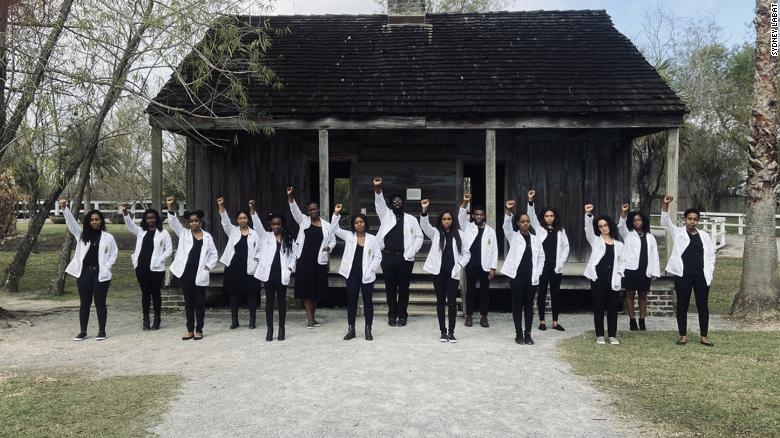
Now that is badass.
I have to imagine, though, that Chalk can do logic well enough to see the difference between a white couple getting married at a plantation, and black medical students posing for a photo in a plantation’s former slave quarters. The entire reason this photo exists is that these places still hold potent meaning for those whose ancestors were enslaved.
The very fact that black medical students would find having their photos taken in the slave quarters of a plantation empowering undermines Chalk’s argument. These locations are not value neutral today. Chalk says it is useful to “reimagine [plantations] in ways that both recognize and overcome that past.” Turning plantations into wedding venues (that almost by definition will cater primarily to white couples) does nothing to recognize or overcome their past.
If an interracial couple wanted to get married at a planation, that would offer a way to recognize and give the finger to the location’s past. That could be a form of poetic justice not unlike the photo of the Tulane medical students. If someone wanted to purchase a plantation house and open it exclusively to events and ceremonies with a racial justice aspect—acts of “poetic justice”—that could actually be really interesting. But that’s not what people are upset about.
Chalk adds this, further demonstrating his inability to understand why people are actually upset:
We might also remember that many of the most celebrated and visited historical sites in our country are Southern manors built and worked by slaves: Mount Vernon (itself a wedding venue), Monticello (another wedding venue), and Montpelier (also a wedding venue) among them.
The fact that Mount Vernon, Monticello, and Montpelier are all wedding venues isn’t a justification of using lesser known plantations as wedding venues, as Chalk seems to think it is. No one who criticizes plantation weddings thinks any of those locations—all of which served as sites for the exploitation of enslaved peoples—are some sort of gold standards.
Will we need Google to warn us that searching for such places — or even worse, planning a vacation to visit them — are microaggressive acts, as if we are unable to contemplate both the good and bad of such places?
This is some serious bad faith argumentation.
Chalk may not realize it, but by evoking Mount Vernon, Monticello, and Montpelier in his defense of using plantations as wedding venues, he has also brought the plantations as wedding venues discussion more firmly into a broader and longer discussion of the whitewashing of historical locations and the erasure of the chattel enslavement that undergirded them. There was a time when each of these three locations were interpreted in a way that erased or mishandled the presence of enslaved peoples. In each case, there has been pressure from historians and others, and, gradually, change.
Even today, none of these locations handle enslavement perfectly, and all are still under pressure to improve. There is a difference between historical tourism and whitewashed celebration of the past. Activists and historians have spent decades pushing Mount Vernon, Monticello, and Montpelier toward doing actual history, and not just celebration of an imagined past. But the plantations as wedding venues that Chalk is defending? These locations don’t even pretend to be solid historical tourism. They are fully in the whitewashed celebrations of the past camp. So Chalk can come right down off his “can anyone ever visit any historical site ever if people can’t get married at random plantations” high horse.
I’m also genuinely curious what Chalk would say was the “good” of such places. Presumably he is referring to the fact that some of our earliest presidents lived at them, including individuals who were the architects of the rights we hold today. Chalk should remember that, at the time, these rights did not apply to everyone. These men may have stumbled upon a formula that, once applied to more peoples through rights movements bought of blood, sweat, and tears, did some genuine good. But at the time when they created these structures, they were motivated by their own self interest.
Regardless, Chalk goes on:
Moreover, blacks, both free and slave, provided the bulk of labor that built the White House, the U.S. Capitol, and other early government buildings. All of these places, despite their histories, are objectively beautiful. Because of the tragedies that transpired therin, they powerfully communicate how far America has come.
I only quote this bit to contrast it with what he says later: he has a whole section titled “This Generation Isn’t Morally Superior to Others.” Oh really? Whatever happened to powerfully communicating “how far America has come”?
I’ll give one one paragraph as a sample:
Nor do the sins of our forefathers nullify their many acts of virtue or the great political and cultural gifts they bestowed upon future generations. Indeed, it is the Christian character of America that has allowed us to recognize and seek to rectify our past errors. How many of the great nations of human history have so actively beat their breasts over their sins, both against their own citizens and the peoples of the world? Only a country with a conscience — in our case informed by the Christian beliefs of our ancestors — would bother to engage in the kinds of self-criticism and atonement visible in American society.
This is absolute horse shit. Every step of the way, Christians were the strongest opponent of change. Do I need to start quoting Dabney at Chalk? It was bad. It was so, so, so bad. Christians argued that God sanctioned enslavement and pointed to the Bible. Christians argued that the state should not pay to educate the children of newly freed black citizens. Christians argued that black children should never be allowed to attend school with white children, because God forbad interracial marriage. When did these Christians ever beat their breasts over their sins?
Were there also Christian abolitionists? Certainly, but other Christians dismissed them as unitarians and thus not true Christians. And some abolitionists weren’t Christians—see transcendentalists, for instance. Were there Christians who took part in the civil rights movement? Yes, but the other Christians dismissed them as Communists and worse, and many of those involved in the civil rights movement weren’t Christians. See Jews, for instance.
And with that last paragraph I quoted above, made up of complete tripe, I am so done. Does Chalk not even realize that he’s here refusing to engage in the very self-criticism he’s claiming Christians have led the country in doing? That he’s claiming that Christians like him enabled our nation to get rid of slavery and Jim Crow, while simultaneously arguing that a movement against plantation weddings being led by people of color is misguided and wrong?
There is no atonement in plantation weddings.
I have a Patreon! Please support my writing!
Previous Post

January 13, 2020
Harry, Meghan, and the Decision to Leave
Next Post

January 15, 2020 Fake News and Public School Textbooks
Browse Our Archives
Select a Category Atheism Evangelicalism/Fundamentalism Family Feminism Homeschool Meta Parenting Patriarchy Politics Purity Quiverfull Social Justice Uncategorized Worthwhile reads
Select a Month February 2021 January 2021 December 2020 November 2020 October 2020 September 2020 August 2020 July 2020 June 2020 May 2020 April 2020 March 2020 February 2020 January 2020 December 2019 November 2019 October 2019 September 2019 August 2019 July 2019 June 2019 May 2019 April 2019 March 2019 February 2019 January 2019 December 2018 November 2018 October 2018 September 2018 August 2018 July 2018 June 2018 May 2018 April 2018 March 2018 February 2018 January 2018 December 2017 November 2017 October 2017 September 2017 August 2017 July 2017 June 2017 May 2017 April 2017 March 2017 February 2017 January 2017 December 2016 November 2016 October 2016 September 2016 August 2016 July 2016 June 2016 May 2016 April 2016 March 2016 February 2016 January 2016 December 2015 November 2015 October 2015 September 2015 August 2015 July 2015 June 2015 May 2015 April 2015 March 2015 February 2015 January 2015 December 2014 November 2014 October 2014 September 2014 August 2014 July 2014 June 2014 May 2014 April 2014 March 2014 February 2014 January 2014 December 2013 November 2013 October 2013 September 2013 August 2013 July 2013 June 2013 May 2013 April 2013 March 2013 February 2013 January 2013 December 2012 November 2012 October 2012 September 2012 August 2012 July 2012 June 2012 May 2012 April 2012 March 2012 February 2012 January 2012 December 2011 November 2011 October 2011 September 2011 August 2011 July 2011 June 2011
Follow Us!
TAKE THE
Religious Wisdom Quiz
What book contains the "Suffering Servant" prophecy?
Select your answer to see how you score.
Zechariah Isaiah Lamentations Jeremiah
Related posts from Love, Joy, Feminism

"Liberal" and "Conservative" Have Actual Meanings

It's not about the economy, it's about being...


Impeachment Could Have Been a Gift to Republicans
TRENDING AT PATHEOS Nonreligious

Dethroning Jesus and Enthroning Yourself
Jesus Never Asked to Be Worshipped. He Asked to Be Understood. Christianity...

Why Most Christians are Really Paulians and Jobians
I Don't Care, But It Matters Let's get this out of the...

Essential Tips to Successfully Navigate the Selling Process
Selling a house can feel overwhelming, but it doesn’t have to be....

To Make Remote Work Effective, Think About Others
The COVID-19 pandemic forced many companies to rapidly transition to remote work....

Flexibility Is Key to Solving Problems of Tomorrow
The world of work is undergoing a dramatic transformation. The COVID-19 pandemic...
view all Nonreligious blogs
Ad-Free & Subscriber Log-In Subscription Support
- About Us
- 2026 Calendar
- Videos
- Podcasts
- Library of World Religions
- Faith In Media Tracker
- Advertise With Us
- Write for Us
- Privacy Policy
- Terms of Service
- Do Not Sell My Data
- Contact Us
- Radiant Digital
- Manage Newsletter Subscriptions
- Unsubscribe From Notifications
- Sitemap
Copyright 2008-2026, Patheos. All rights reserved.
Subscription Support Ad-Free & Subscriber Log-In
Follow Patheos