
BuddhistCatholicContemplativeEvangelicalGeneral ChristianHinduJewishLatter-day SaintMuslimNew VisionsProgressive Christian
Beliefs
- Buddhist
- Catholic
- Contemplative
- Evangelical
- General Christian
- Hindu
- Jewish
- Latter-day Saint
- More Voices
- Muslim
- New Visions
- Pagan
- Progressive Christian
Topics
- Religion News
- Food and Religion
- Sports and Religion
- Religious Art
- Religious Music and Entertainment
- Religious Events
- History and Religion
- Style and Religion
- Politics and Religion
- Women in Religion
- Recreation Outdoors and Religion
- Business Finance and Religion
- Careers Workplace and Religion
- Education and Religion
- Family Parenting and Religion
- Health Fitness and Religion
- Home and Religion
- Relationships and Religion
- Technology and Religion
- Travel and Religion
Columnists
- Buddhist Columnists
- Business Finance and Religion Columnists
- Careers Workplace and Religion Columnists
- Catholic Columnists
- Contemplative Columnists
- Education and Religion Columnists
- Evangelists Columnists
- Family Parenting and Religion Columnists
- General Christian Columnists
- Health Fitness and Religion Columnists
- Hindu Columnists
- History and Religion Columnists
- Home and Religion Columnists
- Jewish Columnists
- More Voices Columnists
- Latter Day Columnists
- Muslim Columnists
- New Visions Columnists
- Nonreligious Columnists
- Pagan Columnists
- Politics and Religion Columnists
- Progressive Columnists
- Recreation Outdoors and Religion Columnists
- Relationships and Religion Columnists
- Religion News Columnists
- Religious Art Columnists
- Religious Events Columnists
- Religious Music and Entertainment Columnists
- Sports and Religion Columnists
- Style and Religion Columnists
- Technology and Religion Columnists
- Travel and Religion Columnists
- Women in Religion Columnists
Resource Library
- 2026 Calendar
- Library of World Religions
- The 100 Most Holy Places on Earth
- Patheos Answers
- Podcasts
- Videos
- Faith Leaders Database
- Anglican Episcopalian
- Bahai
- Baptist
- Buddhism
- Christianity
- Confucianism
- Eastern Orthodoxy
- Hinduism
- Holiness and Pentecostal
- ISKCON
- Islam
- Judaism
- Lutheran
- Methodist
- The Church of Jesus Christ of Latter-day Saints
- New Age
- Paganism
- Presbytarian and Reformed
- Protestantism
- Religion Behind the Scenes
- Roman Catholic
- Scientology
- Shia Islam
- Sikhism
- Sufism
- Sunni Islam
- Taoism
- Zen
- See all religions
Research Tools
 Ad-Free & Subscriber Log-In Subscription Support
Ad-Free & Subscriber Log-In Subscription Support
Follow Patheos 

- Trending:
- Forgiveness
- |
- Marriage
- |
- Consciousness
- |
- Death Penalty
- |
- Election
- |
- Halloween
 Love, Joy, Feminism
-
More
- Home
- Nonreligious
- Some Thoughts on the New Little Women Movie
Some Thoughts on the New Little Women Movie
Last updated on: January 3, 2020 at 5:27 pm by Libby Anne
Some Thoughts on the New Little Women Movie 2020-01-03T17:27:49-04:00 Libby Anne
Patheos Explore the world's faith through different perspectives on religion and spirituality! Patheos has the views of the prevalent religions and spiritualities of the world.
I saw the new Little Women movie this week, and I thoroughly enjoyed it! It was beautifully made, it drew me in immediately, it made me actually like Amy, and it focused less on marriage and becoming wives than it did on navigating the world as a woman—Amy delivers some of the best speeches in this vein—and on figuring out what one wants in life. I loved it.
In talking with friends, though, I quickly learned that there were going to be a diversity of opinions on this movie. If you didn’t like it that’s fine! Many viewer’s opinions—mine included—are also going to be influenced by an ongoing attachment to the 1994 version. In this post, I want to share a few of my thoughts on the movie, and then open the floor to other’s reactions as well.
Quick word of warning—there will be spoilers after the break!
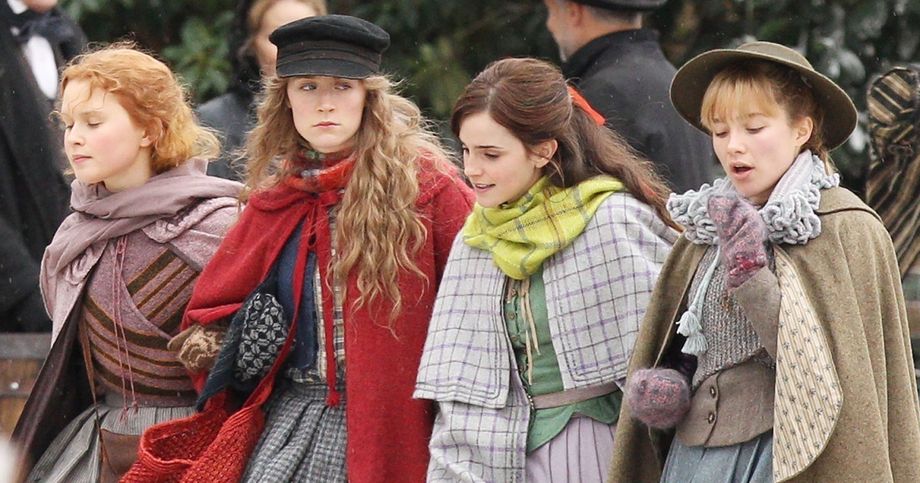
I’ll start with a few things I loved.
The film started with Jo as an adult, living in New York, and then alternated between the four sisters’ adult years and their childhood. Doing this made it clear from the outset that the story was a coming of age story focused on Jo, an aspiring writer. I’ve never seen another Little Women adaption do this. This switching back and forth also helped with the book’s vignette feeling, as it allowed the filmmakers to stick individual stories from the girls’ childhood into the story of their present where relevant.
This adaption also succeeded in making Amy genuinely likable. I’ve never been an Amy hater, but I’ve often found her annoying. I appreciated her candor—“I always knew I would marry rich”—but her motivations always felt self-centered. Less so here. Aunt March informs Amy early that it is her duty to marry well, and to support her whole family, providing context to Amy’s decisions. Amy in France gets a lot more screen time than in other adaptions, and I ended up feeling strongly for her—and admiring her.
Amy also gives a kick-ass speech about women, marriage, and money, delivered as a rebuke of sorts to Laurie. And it was beautiful. Amy recognizes the reality of the world she lives in, and the compromises she must sometimes make to navigate it.
Other good things to like—this adaption actually has black characters. Not many, unfortunately, and only one with speaking lines, but enough to remind the viewer that this wasn’t an all-white world. While the book is only semi-autobiographical, the real life Alcotts harbored a fugitive slave; Bronson Alcott went bankrupt after admitting a black child into his school as a matter of principle; and hosted Frederick Douglass in their home. They were staunch abolitionists. The directors and writers could have done even more with this than they did—and I wish they had—but this did feel at least like progress.
What I adored most, however, was how the film ended. I knew that Louisa May Alcott only married Jo off because the editors made her. (Louisa May Alcott never married.) Because we spend so much time in the sisters’ present, we get to see Jo pitch her book to a publisher. In this, the writers echoed the conceit of the 1994 film—that Jo is the author of Little Women. But in the 1994 film, we never got to see her argue with her publisher, and here we do. When she insists that Jo didn’t marry “either of them,” her publisher tells her that Jo must marry. After some assertive haggling, Jo alters her manuscript.
The ending of the film, then, turns on Jo’s back and forth with her publisher, and not on whether or not she marries Friedrich Bhaer. This seems a fitting tribute to Louisa May Alcott, who never wanted to write a book for girls anyway, and ended her family’s financial troubles by insisting that she keep the copyright, without knowing then the success her book would be.
That bit where the publisher thinks it’s boring, and only decides to publish it after his daughters absconded with the manuscript of the first few chapters and then return demanding more? That’s true! Well, mostly true: the publisher thought it dry stuff, but when he had some girls read it—as they would be the target audience—found to his surprise that they loved it.
So, what did I not like? Meg’s storyline left me feeling unsatisfied. Just as they give extra scenes to Amy and Jo’s adulthood, so they do with Meg. Meg, now married to John Brooks, is persuaded by Sally Brooks to buy some silk for a dress, which means that they couple now have no money to buy a needed new coat for John for the winter. John is upset; Meg is upset. Meg talks about how much she has to give up; John is all “so sorry you had to marry a poor man, but you did know that I was poor.” A few scenes later, John tells her he’s found a way to afford the expense, and Meg tells him that she’s already sold the cloth to Sally.
And that’s really … it. There’s a scene where John tells her not to worry about the children, that he’ll take care of them while she’s at her sister’s deathbed. And you know what’s really curious? I returned to the book, trying to remember whether there were any stories in it of Meg and John’s married life and … there is. There’s a whole sequence that is incredibly relevant even today. After Meg has her twins, she spends every second tending them. She refuses to leave them. Everything is about her babies.
When he went out in the morning he was bewildered by small commissions for the captive mamma, if he came gaily in at night, eager to embrace his family, he was quenched by a “Hush! They are just asleep after worrying all day.” If he proposed a little amusement at home, “No, it would disturb the babies.” If he hinted at a lecture or a concert, he was answered with a reproachful look, and a decided—”Leave my children for pleasure, never!” … And when he read his paper of an evening, Demi’s colic got into the shipping list and Daisy’s fall affected the price of stocks, for Mrs. Brooke was only interested in domestic news.
The poor man was very uncomfortable, for the children had bereft him of his wife, home was merely a nursery and the perpetual ‘hushing’ made him feel like a brutal intruder whenever he entered the sacred precincts of Babyland.
While the passage’s solution reads as very dated—Marmee tells Meg that she has neglected her husband when, really, she has neglected herself—there’s no reason to make up a brand new drama about silks and financial trouble rather than telling a story like this, especially when it’s a situation I have seen affect so many of my friends today. In fact, based on conversations I had with friends just yesterday, I would say Meg might have had something like postpartum anxiety. Certainly, they didn’t have these terms back then—but Meg’s actions after her twins’ birth isn’t unique, or of the past.
All of this is to say that I really didn’t like what they did with Meg’s storyline, given the material they had to work with (and chose not to), and given the flexibility they gave themselves in giving the sisters’ adult lives more screen time.
Also, for all that there was a bit more about the Alcott’s abolitionist bent in this version, I still didn’t end up feeling like there was enough. I wanted a Frederich Douglass cameo. Perhaps they could have attended an abolitionist lecture—although perhaps not, given that the four sisters’ girlhood was pushed forward into the Civil War, in this telling. The bits of history that were dropped in, though, felt slightly out of place, because there wasn’t more. I wanted more.
Next, I ended up unclear on what happened with Jo and Friedrich Bhaer. The scene where Jo runs after him in the rain feels over the top compared to the rest of the film, and is inserted immediately after her publisher tells her she must marry Jo off, so my takeaway is that we were now on two separate sort of timelines—the real one, and the fake one she created for the book. But when, as the book is published, we are shown scenes of Jo’s new school, offering a sort of closure for our characters—Meg is there teaching drama, and Amy is there teaching painting, and Laurie holding their baby—Friedrich Bhaer is there, too.
I didn’t like Friedrich Bhaer in this version at all. He’s younger, yes, but he’s only critical. At the beginning of the book, he tells Jo she shouldn’t be writing trash. Knowing that, in real life, thrillers were exactly what Alcott liked to write best, this feels gross. If Jo likes to write tales of intrigue and romance and high drama, support her in that! Don’t be an ass about it! We are never shown any acts of kindness, on Friedrich Bhaer’s part, and we never see any reason Jo might like him—much less fall in love with him.
In my head cannon version of the movie, Jo does go after Friedrich Bhaer, but only because she’s remembered that she’s going to need teachers in her new school. She hires him, but does not marry him, and never does. He finds someone else and settles in the area, still teaching at Jo’s school. Jo, in her spare time, goes on spinning her wild tales, and getting them published.
My final quibble is something almost impossible to do right in a film adaption of Little Women. The first half of the book is about the girls as children, aged roughly 12 (Amy), 13 (Beth), 15 (Jo), and 16 (Meg). The second half of the book is about the girls as women, beginning when they are aged roughly 16, 17, 19, and 20, and continuing until they are a few years later (Beth dies at age 19; and Meg marries at 20, but by the time Professor Bhaer comes calling, Meg’s children are old enough to talk in sentences).
In the 1994 version, one actor played Amy as a child and a different actor played her as an adult, while the other three sisters were played by the same actor as both adolescents and adults. In this version, Florence Pugh plays Amy aged 12, and Amy aged 16 through 20. This doesn’t always come off perfectly, although I really wanted it to. But it’s not just Amy. They’re switching back and forth between adulthood and girlhood for all four sisters, and they don’t always appear to age up or down properly.
Sometimes it felt like I was watching the adult characters I’d just seen pretend to be children. It’s odd, sometimes, to see characters that act in mature ways and in mature situations suddenly dressed down and acting like children. That said, I was never completely happy with the solution in the 1994 version—switching actors for Amy and only Amy felt odd. I never had much attachment for adult Amy, who felt like a brand new character, and the actors who played Meg and Jo were far too old to play 15- and 16-year-old children (Meg especially), creating some scenes that felt just odd.
I don’t know what the right solution is. We in theory could go with the Harry Potter solution, and film the book over the course of years, watching as our characters grow. But unless there’s enough material—and interest—for multiple Little Women movies, though—and I don’t think there is—that’s not going to happen. In some sense, then, this complaint has more to do with a difficult needle every Little Women film has to try to thread, with varying degrees of success.
So, what about you? What did you like—or not like—about this version?
I have a Patreon! Please support my writing!

Next Post

January 3, 2020 Door in the Dragon's Throat: Meet Jay and Lila
Browse Our Archives
Select a Category Atheism Evangelicalism/Fundamentalism Family Feminism Homeschool Meta Parenting Patriarchy Politics Purity Quiverfull Social Justice Uncategorized Worthwhile reads
Select a Month February 2021 January 2021 December 2020 November 2020 October 2020 September 2020 August 2020 July 2020 June 2020 May 2020 April 2020 March 2020 February 2020 January 2020 December 2019 November 2019 October 2019 September 2019 August 2019 July 2019 June 2019 May 2019 April 2019 March 2019 February 2019 January 2019 December 2018 November 2018 October 2018 September 2018 August 2018 July 2018 June 2018 May 2018 April 2018 March 2018 February 2018 January 2018 December 2017 November 2017 October 2017 September 2017 August 2017 July 2017 June 2017 May 2017 April 2017 March 2017 February 2017 January 2017 December 2016 November 2016 October 2016 September 2016 August 2016 July 2016 June 2016 May 2016 April 2016 March 2016 February 2016 January 2016 December 2015 November 2015 October 2015 September 2015 August 2015 July 2015 June 2015 May 2015 April 2015 March 2015 February 2015 January 2015 December 2014 November 2014 October 2014 September 2014 August 2014 July 2014 June 2014 May 2014 April 2014 March 2014 February 2014 January 2014 December 2013 November 2013 October 2013 September 2013 August 2013 July 2013 June 2013 May 2013 April 2013 March 2013 February 2013 January 2013 December 2012 November 2012 October 2012 September 2012 August 2012 July 2012 June 2012 May 2012 April 2012 March 2012 February 2012 January 2012 December 2011 November 2011 October 2011 September 2011 August 2011 July 2011 June 2011
Follow Us!
TAKE THE
Religious Wisdom Quiz
In 1 Timothy, what does Paul say is the root of all kinds of evil?
Select your answer to see how you score.
The love of money Money itself Greed Pride
Related posts from Love, Joy, Feminism


The Bachelorette and the Bible Thumper

Explaining in the Guise of Listening: A Review...

Why the Ghostbusters Women Are the Role Models...
TRENDING AT PATHEOS Nonreligious

Dethroning Jesus and Enthroning Yourself
Jesus Never Asked to Be Worshipped. He Asked to Be Understood. Christianity...

Why Most Christians are Really Paulians and Jobians
I Don't Care, But It Matters Let's get this out of the...

Essential Tips to Successfully Navigate the Selling Process
Selling a house can feel overwhelming, but it doesn’t have to be....

To Make Remote Work Effective, Think About Others
The COVID-19 pandemic forced many companies to rapidly transition to remote work....

Flexibility Is Key to Solving Problems of Tomorrow
The world of work is undergoing a dramatic transformation. The COVID-19 pandemic...
view all Nonreligious blogs
Ad-Free & Subscriber Log-In Subscription Support
- About Us
- 2026 Calendar
- Videos
- Podcasts
- Library of World Religions
- Faith In Media Tracker
- Advertise With Us
- Write for Us
- Privacy Policy
- Terms of Service
- Do Not Sell My Data
- Contact Us
- Radiant Digital
- Manage Newsletter Subscriptions
- Unsubscribe From Notifications
- Sitemap
Copyright 2008-2026, Patheos. All rights reserved.
Subscription Support Ad-Free & Subscriber Log-In
Follow Patheos