
BuddhistCatholicContemplativeEvangelicalGeneral ChristianHinduJewishLatter-day SaintMuslimNew VisionsProgressive Christian
Beliefs
- Buddhist
- Catholic
- Contemplative
- Evangelical
- General Christian
- Hindu
- Jewish
- Latter-day Saint
- More Voices
- Muslim
- New Visions
- Pagan
- Progressive Christian
Topics
- Religion News
- Food and Religion
- Sports and Religion
- Religious Art
- Religious Music and Entertainment
- Religious Events
- History and Religion
- Style and Religion
- Politics and Religion
- Women in Religion
- Recreation Outdoors and Religion
- Business Finance and Religion
- Careers Workplace and Religion
- Education and Religion
- Family Parenting and Religion
- Health Fitness and Religion
- Home and Religion
- Relationships and Religion
- Technology and Religion
- Travel and Religion
Columnists
- Buddhist Columnists
- Business Finance and Religion Columnists
- Careers Workplace and Religion Columnists
- Catholic Columnists
- Contemplative Columnists
- Education and Religion Columnists
- Evangelists Columnists
- Family Parenting and Religion Columnists
- General Christian Columnists
- Health Fitness and Religion Columnists
- Hindu Columnists
- History and Religion Columnists
- Home and Religion Columnists
- Jewish Columnists
- More Voices Columnists
- Latter Day Columnists
- Muslim Columnists
- New Visions Columnists
- Nonreligious Columnists
- Pagan Columnists
- Politics and Religion Columnists
- Progressive Columnists
- Recreation Outdoors and Religion Columnists
- Relationships and Religion Columnists
- Religion News Columnists
- Religious Art Columnists
- Religious Events Columnists
- Religious Music and Entertainment Columnists
- Sports and Religion Columnists
- Style and Religion Columnists
- Technology and Religion Columnists
- Travel and Religion Columnists
- Women in Religion Columnists
Resource Library
- 2026 Calendar
- Library of World Religions
- The 100 Most Holy Places on Earth
- Patheos Answers
- Podcasts
- Videos
- Faith Leaders Database
- Anglican Episcopalian
- Bahai
- Baptist
- Buddhism
- Christianity
- Confucianism
- Eastern Orthodoxy
- Hinduism
- Holiness and Pentecostal
- ISKCON
- Islam
- Judaism
- Lutheran
- Methodist
- The Church of Jesus Christ of Latter-day Saints
- New Age
- Paganism
- Presbytarian and Reformed
- Protestantism
- Religion Behind the Scenes
- Roman Catholic
- Scientology
- Shia Islam
- Sikhism
- Sufism
- Sunni Islam
- Taoism
- Zen
- See all religions
Research Tools
 Ad-Free & Subscriber Log-In Subscription Support
Ad-Free & Subscriber Log-In Subscription Support
Follow Patheos 

- Trending:
- Forgiveness
- |
- Marriage
- |
- Consciousness
- |
- Death Penalty
- |
- Election
- |
- Halloween
 Love, Joy, Feminism
-
More
- Home
- Nonreligious
- We Need to Talk about White Women and Race
We Need to Talk about White Women and Race
Last updated on: December 10, 2019 at 11:01 am by Libby Anne
We Need to Talk about White Women and Race 2019-12-10T11:01:46-04:00 Libby Anne
Patheos Explore the world's faith through different perspectives on religion and spirituality! Patheos has the views of the prevalent religions and spiritualities of the world.
Last month, I went to see the movie Harriet. The only white woman in the film was Eliza Brodess, the wife and mother of the men who enslaved Harriet Tubman. Eliza has no redeemable characteristics. She is devoid of empathy toward the people her family has enslaved. She callously suggests the sale of slaves and the breaking up of families, and treats Harriet’s sister, Rachel, who works in the house, with casual cruelty.
The scene where Eliza lashes out at Rachel’s newly motherless young daughter, Angerine, violently accusing her of plotting against her, is one of the most painful in the whole movie.
As a mother, my heart twisted. As a white woman, I felt deeply ashamed.
Many white women in feminist and activist circles seem to take it for granted that black women will be their natural allies. After all, both white women and black women have been oppressed at the hands of men, right? And both have faced oppression at the hands of white men in particular, right? This ignores the utter complicity of white women in the oppression of black women for centuries.
And this isn’t just in some longtime past.
Let’s start with slavery. Were white women who lived in the south subject to the constraints of patriarchy? Absolutely. But owning enslaved people could give a white woman status and power. And many white women absolutely took out any frustrations they might have felt in their personal lives on their enslaved people, as Eliza does in Harriet. Having that kind of power over someone is corrosive.
Facing the constraints of patriarchy did not make white women any more likely to identify with, ally with, or support black women. Not in the least.
Let’s fast forward for a moment. For a century after the end of slavery, black women worked in domestic service in the homes of white women, often in conditions that differed mirrored those that had existed under slavery. Black women could now leave, or quit their job, but if they did, an employer might blackball them. And, once again, white women could take out frustrations in other parts of their lives on the people they employed—people who earned low wages and frequently had few options.
The Help is a white savior movie, but it portrays many aspects of the constraints of domestic work well. White women were not the heroes of this story. They were the villains. In most cases, the best a black domestic worker could hope for was a white employer who left her more or less alone. There was no solidarity between black domestic workers and their white female employers.
And then there were lynchings, and, once again, white women were front and center. Many lynchings began when a white woman accused a black man of rape—or merely of looking at her the wrong way. Remember, Emmett Till’s murder was precipitated by a white woman’s claim that he whistled at her. Do you think Emmett Till’s mother felt solidarity with the struggles of white women? Why would she?
White women were dangerous. White women presented a real and present threat to black people—especially to black men and boys. But it’s not over. It’s not really were.
Consider all of stories where white women have called the police on black people for frivolous reasons. Remember that white woman in Brooklyn who called the police, accusing a nine-year-old black boy of groping her, after his backpack brushed up against her in a tight deli?
If I had a black son, I’d teach him to tread lightly around white women.
Have you ever looked at pictures of segregationists protesting against civil rights? I mean really looked? These aren’t crowds of white men. White women are right there with them—front and center—in droves.
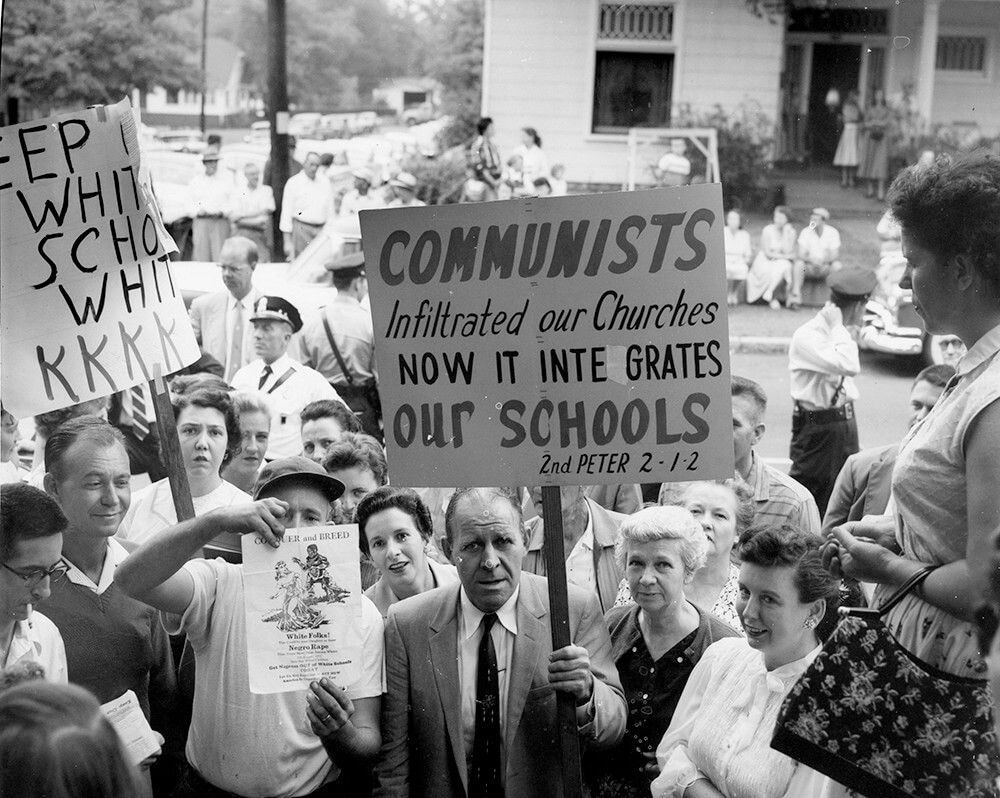
Do you see the poster the man on the bottom left is holding? It’s an anti-integrationist propaganda piece. I looked for it online, but was only able to find the top portion.
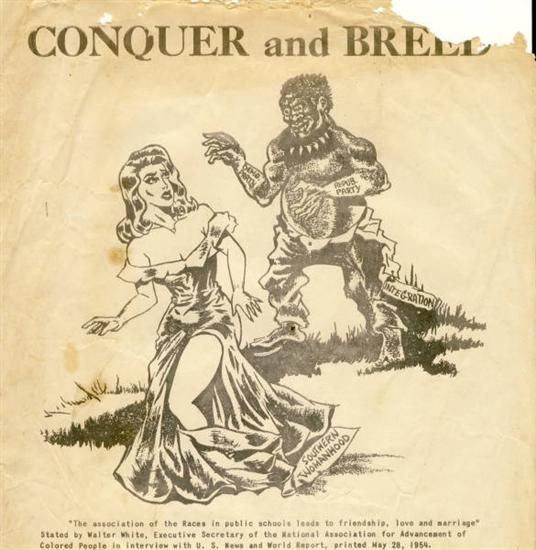
“Conquer and Breed,” the caption reads. A black figure, styled as a brute, bears the label “integration.” A white woman, posed as though fleeing, wears the label “southern womanhood.”
To be sure, one could argue white men were using the image of womanhood—an image carefully created and curated to keep women from moving beyond the narrow domestic box men wanted them in—as a tool to oppress black people. And this is absolutely true. But I don’t exactly see the white women of the South objecting to this use.

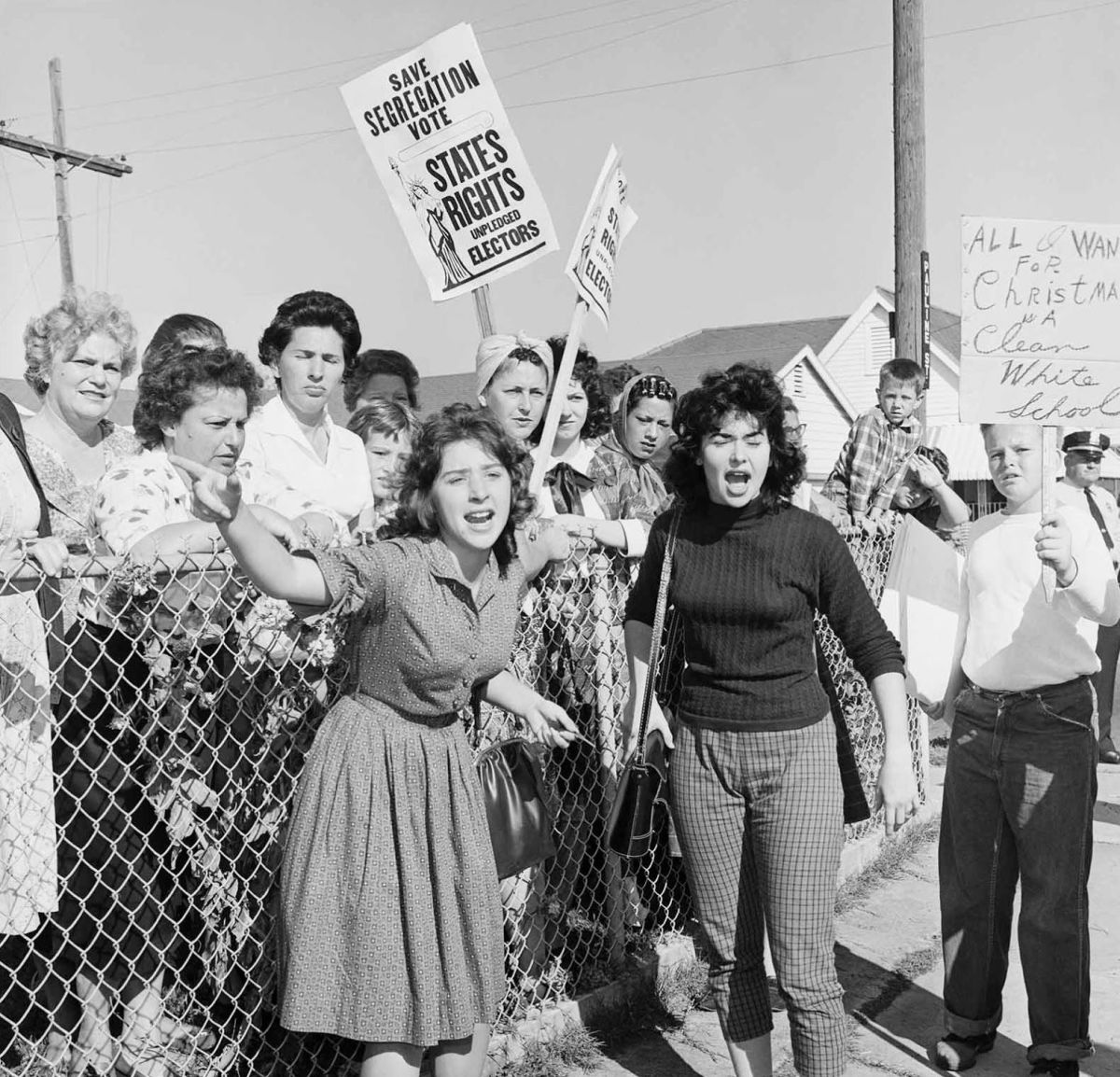
And of course, it wasn’t just the South. It showed up in places like Boston, where white women came out en masse against school bussing designed to end school segregation.

And, once again, it’s not over. 53% of white women voted for Donald Trump. Not so, black women. Black women voted overwhelmingly for Hillary Clinton. Black women still can’t trust white women to have their backs. White women have never had their backs.
This past March, black novelist Kim McLarin wrote an article titled Can black women and white women be true friends? for the Washington Post. In it, she wrote as follows:
Generally speaking, it’s not that I dislike white women. Generally speaking, it’s that I do not trust them. Generally speaking, most black women don’t.
…
This is what black women know: When push comes to shove, white women choose race over gender: Every. Single. Time.
This is so real it hurts.
And you know what else I’ve seen myself, locally? White women are fragile. The smallest point of criticism and they get upset. How dare you say that of them! And yes, I say this as a white woman! But I’ve learned that when criticism makes me uncomfortable, it’s best to close my mouth and sit with it, because there’s probably something there.
I’ll end with this incredibly important story, from McLarin’s article:
Every fall, I teach a survey class in African American literature, an undertaking I consider one of the chief honors of my life. One of my favorite books to teach in this class is Harriet Jacobs’s seminal slave narrative, “Incidents in the Life of a Slave Girl.”
Authenticated as the first book-length slave narrative written by a woman, “Incidents” is a powerful and compelling examination of slavery’s impact on black women and the black family.
“Slavery is terrible for men, but it is far more terrible for women,” she writes in the narrative’s most famous line. The students nod. They’re with Jacobs as she details the physical, psychological and sexual terrorism of slavery. They’re with her as she asserts the resilience and importance of black kinship. They’re definitely with her as she critiques the hypocritical Christianity of the South.
But when Jacobs gets around to criticizing white women — both Southern white women who turn a blind eye to, or actively enable, their husbands’ rape and debasement of enslaved women and their Northern counterparts who, enraptured by the romantic myth of the wealthy Southern gentleman, do the same — some students begin to balk. Without fail, at least one young white woman will raise her hand, eyes determined, chin quivering: “Yes, but all women were property back then.” Or: “Gender discrimination has always been a bigger problem than racism.” Or: “Well, white women didn’t have it much better than slaves.” Which is simply untrue.
I find these moments revealing, the student’s face both intense and needy as she mounts her defense of white women past.
If this student, who is young but neither thoughtless nor ill-informed, insists on believing that white women in 1850 were as oppressed as enslaved people, if she cannot and will not acknowledge the power differentials that existed within a system of legal, racialized slavery, how can she grapple honestly with the power imbalances of today?
And if she won’t, how can she and her black classmate possibly be friends?
Let me return, in closing, to the movie Harriet, with its sole white female character, Eliza Brodess—enslaver, abuser—who reminds us that white women were never the co-conspirators in this story. Instead, they were the co-villains.
As much as we white women would like to pretend that we’re not like that, or that this is just something to be found in dusty historical tomes, we can’t pretend the past—or the present—away. And we shouldn’t try. Instead, our call should be to do better.
I have a Patreon! Please support my writing!
Previous Post

December 9, 2019
Alan Keyes Promotes Space Alien Bleach Drinking
Next Post

December 11, 2019 Race and Class in Women's Suffrage Cartoons
Browse Our Archives
Select a Category Atheism Evangelicalism/Fundamentalism Family Feminism Homeschool Meta Parenting Patriarchy Politics Purity Quiverfull Social Justice Uncategorized Worthwhile reads
Select a Month February 2021 January 2021 December 2020 November 2020 October 2020 September 2020 August 2020 July 2020 June 2020 May 2020 April 2020 March 2020 February 2020 January 2020 December 2019 November 2019 October 2019 September 2019 August 2019 July 2019 June 2019 May 2019 April 2019 March 2019 February 2019 January 2019 December 2018 November 2018 October 2018 September 2018 August 2018 July 2018 June 2018 May 2018 April 2018 March 2018 February 2018 January 2018 December 2017 November 2017 October 2017 September 2017 August 2017 July 2017 June 2017 May 2017 April 2017 March 2017 February 2017 January 2017 December 2016 November 2016 October 2016 September 2016 August 2016 July 2016 June 2016 May 2016 April 2016 March 2016 February 2016 January 2016 December 2015 November 2015 October 2015 September 2015 August 2015 July 2015 June 2015 May 2015 April 2015 March 2015 February 2015 January 2015 December 2014 November 2014 October 2014 September 2014 August 2014 July 2014 June 2014 May 2014 April 2014 March 2014 February 2014 January 2014 December 2013 November 2013 October 2013 September 2013 August 2013 July 2013 June 2013 May 2013 April 2013 March 2013 February 2013 January 2013 December 2012 November 2012 October 2012 September 2012 August 2012 July 2012 June 2012 May 2012 April 2012 March 2012 February 2012 January 2012 December 2011 November 2011 October 2011 September 2011 August 2011 July 2011 June 2011
Follow Us!
TAKE THE
Religious Wisdom Quiz
True or False: Hebrews teaches that Jesus is the mediator of a new covenant.
Select your answer to see how you score.
TRUE FALSE
Related posts from Love, Joy, Feminism

"Liberal" and "Conservative" Have Actual Meanings

It's not about the economy, it's about being...


TRENDING AT PATHEOS Nonreligious

Dethroning Jesus and Enthroning Yourself
Jesus Never Asked to Be Worshipped. He Asked to Be Understood. Christianity...

Why Most Christians are Really Paulians and Jobians
I Don't Care, But It Matters Let's get this out of the...

Essential Tips to Successfully Navigate the Selling Process
Selling a house can feel overwhelming, but it doesn’t have to be....

To Make Remote Work Effective, Think About Others
The COVID-19 pandemic forced many companies to rapidly transition to remote work....

Flexibility Is Key to Solving Problems of Tomorrow
The world of work is undergoing a dramatic transformation. The COVID-19 pandemic...
view all Nonreligious blogs
Ad-Free & Subscriber Log-In Subscription Support
- About Us
- 2026 Calendar
- Videos
- Podcasts
- Library of World Religions
- Faith In Media Tracker
- Advertise With Us
- Write for Us
- Privacy Policy
- Terms of Service
- Do Not Sell My Data
- Contact Us
- Radiant Digital
- Manage Newsletter Subscriptions
- Unsubscribe From Notifications
- Sitemap
Copyright 2008-2026, Patheos. All rights reserved.
Subscription Support Ad-Free & Subscriber Log-In
Follow Patheos