
BuddhistCatholicContemplativeEvangelicalGeneral ChristianHinduJewishLatter-day SaintMuslimNew VisionsProgressive Christian
Beliefs
- Buddhist
- Catholic
- Contemplative
- Evangelical
- General Christian
- Hindu
- Jewish
- Latter-day Saint
- More Voices
- Muslim
- New Visions
- Pagan
- Progressive Christian
Topics
- Religion News
- Food and Religion
- Sports and Religion
- Religious Art
- Religious Music and Entertainment
- Religious Events
- History and Religion
- Style and Religion
- Politics and Religion
- Women in Religion
- Recreation Outdoors and Religion
- Business Finance and Religion
- Careers Workplace and Religion
- Education and Religion
- Family Parenting and Religion
- Health Fitness and Religion
- Home and Religion
- Relationships and Religion
- Technology and Religion
- Travel and Religion
Columnists
- Buddhist Columnists
- Business Finance and Religion Columnists
- Careers Workplace and Religion Columnists
- Catholic Columnists
- Contemplative Columnists
- Education and Religion Columnists
- Evangelists Columnists
- Family Parenting and Religion Columnists
- General Christian Columnists
- Health Fitness and Religion Columnists
- Hindu Columnists
- History and Religion Columnists
- Home and Religion Columnists
- Jewish Columnists
- More Voices Columnists
- Latter Day Columnists
- Muslim Columnists
- New Visions Columnists
- Nonreligious Columnists
- Pagan Columnists
- Politics and Religion Columnists
- Progressive Columnists
- Recreation Outdoors and Religion Columnists
- Relationships and Religion Columnists
- Religion News Columnists
- Religious Art Columnists
- Religious Events Columnists
- Religious Music and Entertainment Columnists
- Sports and Religion Columnists
- Style and Religion Columnists
- Technology and Religion Columnists
- Travel and Religion Columnists
- Women in Religion Columnists
Resource Library
- 2026 Calendar
- Library of World Religions
- The 100 Most Holy Places on Earth
- Patheos Answers
- Podcasts
- Videos
- Faith Leaders Database
- Anglican Episcopalian
- Bahai
- Baptist
- Buddhism
- Christianity
- Confucianism
- Eastern Orthodoxy
- Hinduism
- Holiness and Pentecostal
- ISKCON
- Islam
- Judaism
- Lutheran
- Methodist
- The Church of Jesus Christ of Latter-day Saints
- New Age
- Paganism
- Presbytarian and Reformed
- Protestantism
- Religion Behind the Scenes
- Roman Catholic
- Scientology
- Shia Islam
- Sikhism
- Sufism
- Sunni Islam
- Taoism
- Zen
- See all religions
Research Tools
 Ad-Free & Subscriber Log-In Subscription Support
Ad-Free & Subscriber Log-In Subscription Support
Follow Patheos 

- Trending:
- Forgiveness
- |
- Marriage
- |
- Consciousness
- |
- Death Penalty
- |
- Election
- |
- Halloween
 Love, Joy, Feminism
-
More
- Home
- Nonreligious
- Race and Class in Women’s Suffrage Cartoons
Race and Class in Women’s Suffrage Cartoons
Last updated on: December 11, 2019 at 9:34 am by Libby Anne
Race and Class in Women’s Suffrage Cartoons 2019-12-11T09:34:14-04:00 Libby Anne
Patheos Explore the world's faith through different perspectives on religion and spirituality! Patheos has the views of the prevalent religions and spiritualities of the world.
After yesterday’s post I went looking for women’s suffrage cartoons, and came upon this one, from the UK:

The point being, this well-dressed, upper class woman can clearly be trusted to make a more informed, responsible choice at the ballot box than this sloppily dressed, patched, Cockney accented man, so why can he vote while she can’t? That’s … yeah I’ll just say it. That’s classist. And more than a little cringe inducing.
There’s a version of this that was published in the U.S., too:
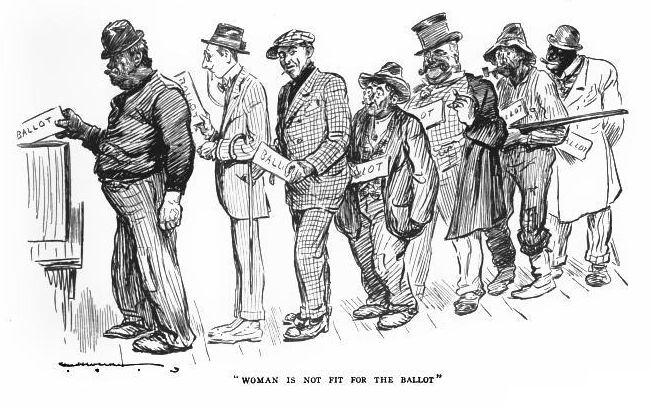

It’s not just the Irish man and the black man who are being derided as unworthy of the ballot box—there’s also the rich banker and the knock-kneed woodsman. And I imagine the other men there are meant to be stereotypes too. Still, the idea that white women needed to have the vote to counteract uneducated votes by Irish men and black men, among others, was a pro-suffrage argument.
These messages were intentional and carefully tailored:
Both the NWP and NAWSA created and perpetuated a singular image of a woman suffragist. The ideal was white, young, educated, and middle-class. Most active suffragists were middle-class women who had received higher education at universities like Vassar. Suffragists so desperately wanted to distance themselves from the poor that they proposed a float for a 1913 parade that included hobos. “Tramps,” one article for the Chicago Tribune wrote, “to appear in Washington, D.C. as horrible example.” The float was intended to show that uneducated, unmotivated homeless people had more political authority than women with degrees and ambitions. The woman suffragists wanted to find “four or five of the toughest hobos” near the nation’s capital to sport a sign reading, “but we kin vote.” The float never made it into the parade, but the suffragists clearly resented their relative lack of political rights.
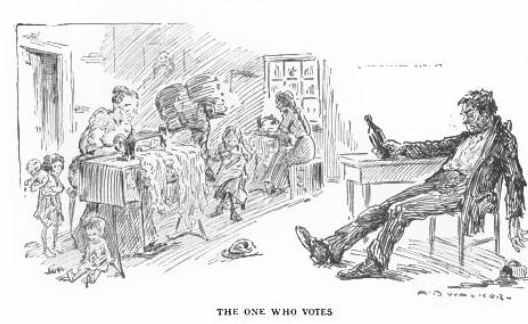
This one confused me for a bit, and I can’t say I’ve completely figured it out yet:

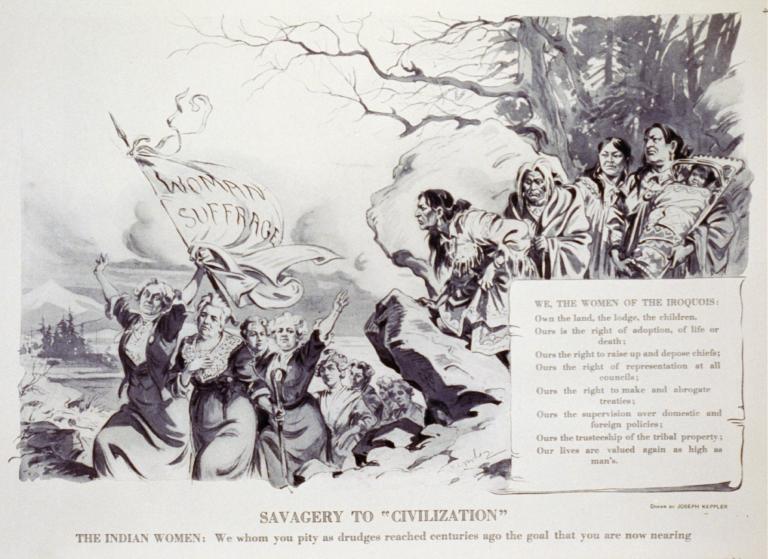
The text under the image reads “Savagery to ‘Civilization'” and “The Indian Women: We whom you pity as drudges reached centuries ago the goal that you are now nearing.”
The plaque to the right of the image reads:
WE, THE WOMEN OF THE IROQUOIS:
Own the land, the lodge, the children.
Ours is the right of adoption, of life or death;
Ours is the right to raise up and depose chiefs;
Ours is the right of representation at all councils;
Ours the right to make and abrogate treaties;
Ours the supervision over domestic and foreign policies;
Ours the trusteeship of the tribal property;
Our lives are valued again as high as man’s.
Is the argument that Native American women were the real civilized ones all along? Or is the argument that women’s suffrage would take society down into savagery? Or something else entirely?
In this picture, Native American Iroquois women overlook women marching under a “Woman Suffrage” banner. In the text box, it lists the rights of Iroquois women, noting they have the political agency that is desired by suffragists. The title “Savagery to ‘civilization,’” is meant to emphasize how Native Americans were viewed as “uncivilized,” but provided more rights and equality to its members.
Even if the intent is to nod positively toward women’s rights among the Iroquois, this use of Native Americans in a promotional like this at a time when Native American children were being stolen from their parents and imprisoned in boarding schools where they were forced to give up their culture feels … off. The image was published in 1914, which means it came shortly after the end of the “Indian Wars” in the American West, which were replete with horrific massacres of Native Americans.
It strikes me as very wrong to use someone’s culture as an argument without also taking a strong stance against the annihilation of that people and their culture.
I’ll finish on less of a dark note:

Is it just me, or is there some serious male fragility on display here?
I have a Patreon! Please support my writing!
Previous Post

December 10, 2019
We Need to Talk about White Women and Race
Next Post

December 12, 2019 "The Church" v. "The Churches" in Early Christianity
Browse Our Archives
Select a Category Atheism Evangelicalism/Fundamentalism Family Feminism Homeschool Meta Parenting Patriarchy Politics Purity Quiverfull Social Justice Uncategorized Worthwhile reads
Select a Month February 2021 January 2021 December 2020 November 2020 October 2020 September 2020 August 2020 July 2020 June 2020 May 2020 April 2020 March 2020 February 2020 January 2020 December 2019 November 2019 October 2019 September 2019 August 2019 July 2019 June 2019 May 2019 April 2019 March 2019 February 2019 January 2019 December 2018 November 2018 October 2018 September 2018 August 2018 July 2018 June 2018 May 2018 April 2018 March 2018 February 2018 January 2018 December 2017 November 2017 October 2017 September 2017 August 2017 July 2017 June 2017 May 2017 April 2017 March 2017 February 2017 January 2017 December 2016 November 2016 October 2016 September 2016 August 2016 July 2016 June 2016 May 2016 April 2016 March 2016 February 2016 January 2016 December 2015 November 2015 October 2015 September 2015 August 2015 July 2015 June 2015 May 2015 April 2015 March 2015 February 2015 January 2015 December 2014 November 2014 October 2014 September 2014 August 2014 July 2014 June 2014 May 2014 April 2014 March 2014 February 2014 January 2014 December 2013 November 2013 October 2013 September 2013 August 2013 July 2013 June 2013 May 2013 April 2013 March 2013 February 2013 January 2013 December 2012 November 2012 October 2012 September 2012 August 2012 July 2012 June 2012 May 2012 April 2012 March 2012 February 2012 January 2012 December 2011 November 2011 October 2011 September 2011 August 2011 July 2011 June 2011
Follow Us!
TAKE THE
Religious Wisdom Quiz
Like a sheep led to slaughter, silent before shearers, this servant was pierced for our transgressions. What chapter foretells this suffering?
Select your answer to see how you score.
Isaiah 7 Isaiah 9 Isaiah 61 Isaiah 53
Related posts from Love, Joy, Feminism


Lesbian Duplex 310: An Open Thread

The Vision: NASA Is On the Case

Lesbian Duplex 309: An Open Thread
TRENDING AT PATHEOS Nonreligious

Dethroning Jesus and Enthroning Yourself
Jesus Never Asked to Be Worshipped. He Asked to Be Understood. Christianity...

Why Most Christians are Really Paulians and Jobians
I Don't Care, But It Matters Let's get this out of the...

Essential Tips to Successfully Navigate the Selling Process
Selling a house can feel overwhelming, but it doesn’t have to be....

To Make Remote Work Effective, Think About Others
The COVID-19 pandemic forced many companies to rapidly transition to remote work....

Flexibility Is Key to Solving Problems of Tomorrow
The world of work is undergoing a dramatic transformation. The COVID-19 pandemic...
view all Nonreligious blogs
Ad-Free & Subscriber Log-In Subscription Support
- About Us
- 2026 Calendar
- Videos
- Podcasts
- Library of World Religions
- Faith In Media Tracker
- Advertise With Us
- Write for Us
- Privacy Policy
- Terms of Service
- Do Not Sell My Data
- Contact Us
- Radiant Digital
- Manage Newsletter Subscriptions
- Unsubscribe From Notifications
- Sitemap
Copyright 2008-2026, Patheos. All rights reserved.
Subscription Support Ad-Free & Subscriber Log-In
Follow Patheos