
BuddhistCatholicContemplativeEvangelicalGeneral ChristianHinduJewishLatter-day SaintMuslimNew VisionsProgressive Christian
Beliefs
- Buddhist
- Catholic
- Contemplative
- Evangelical
- General Christian
- Hindu
- Jewish
- Latter-day Saint
- More Voices
- Muslim
- New Visions
- Pagan
- Progressive Christian
Topics
- Religion News
- Food and Religion
- Sports and Religion
- Religious Art
- Religious Music and Entertainment
- Religious Events
- History and Religion
- Style and Religion
- Politics and Religion
- Women in Religion
- Recreation Outdoors and Religion
- Business Finance and Religion
- Careers Workplace and Religion
- Education and Religion
- Family Parenting and Religion
- Health Fitness and Religion
- Home and Religion
- Relationships and Religion
- Technology and Religion
- Travel and Religion
Columnists
- Buddhist Columnists
- Business Finance and Religion Columnists
- Careers Workplace and Religion Columnists
- Catholic Columnists
- Contemplative Columnists
- Education and Religion Columnists
- Evangelists Columnists
- Family Parenting and Religion Columnists
- General Christian Columnists
- Health Fitness and Religion Columnists
- Hindu Columnists
- History and Religion Columnists
- Home and Religion Columnists
- Jewish Columnists
- More Voices Columnists
- Latter Day Columnists
- Muslim Columnists
- New Visions Columnists
- Nonreligious Columnists
- Pagan Columnists
- Politics and Religion Columnists
- Progressive Columnists
- Recreation Outdoors and Religion Columnists
- Relationships and Religion Columnists
- Religion News Columnists
- Religious Art Columnists
- Religious Events Columnists
- Religious Music and Entertainment Columnists
- Sports and Religion Columnists
- Style and Religion Columnists
- Technology and Religion Columnists
- Travel and Religion Columnists
- Women in Religion Columnists
Resource Library
- 2026 Calendar
- Library of World Religions
- The 100 Most Holy Places on Earth
- Patheos Answers
- Podcasts
- Videos
- Faith Leaders Database
- Anglican Episcopalian
- Bahai
- Baptist
- Buddhism
- Christianity
- Confucianism
- Eastern Orthodoxy
- Hinduism
- Holiness and Pentecostal
- ISKCON
- Islam
- Judaism
- Lutheran
- Methodist
- The Church of Jesus Christ of Latter-day Saints
- New Age
- Paganism
- Presbytarian and Reformed
- Protestantism
- Religion Behind the Scenes
- Roman Catholic
- Scientology
- Shia Islam
- Sikhism
- Sufism
- Sunni Islam
- Taoism
- Zen
- See all religions
Research Tools
 Ad-Free & Subscriber Log-In Subscription Support
Ad-Free & Subscriber Log-In Subscription Support
Follow Patheos 

- Trending:
- Forgiveness
- |
- Marriage
- |
- Consciousness
- |
- Death Penalty
- |
- Election
- |
- Halloween
 Love, Joy, Feminism
-
More
- Home
- Nonreligious
- A Catholic Priest Confronted a Woman over Showing Her Shoulders
A Catholic Priest Confronted a Woman over Showing Her Shoulders
Last updated on: June 12, 2019 at 5:00 am by Libby Anne
A Catholic Priest Confronted a Woman over Showing Her Shoulders 2019-06-11T08:56:01-04:00 Libby Anne
Patheos Explore the world's faith through different perspectives on religion and spirituality! Patheos has the views of the prevalent religions and spiritualities of the world.
Purity culture. Purity culture everywhere.
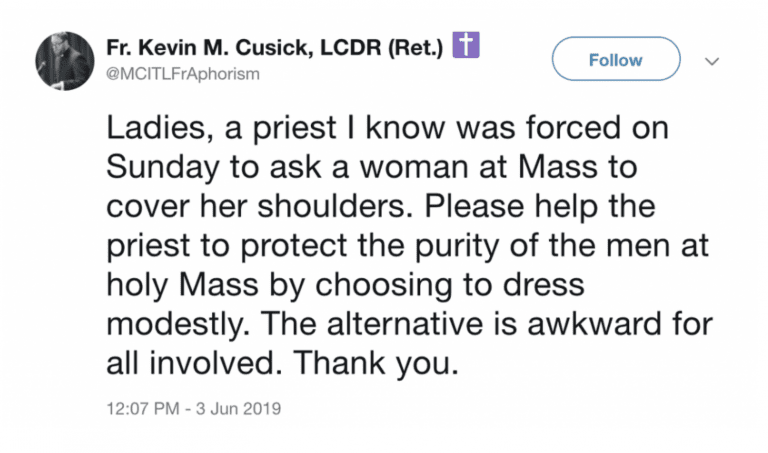
“Ladies, a priest I know was forced on Sunday to ask a woman at Mass to cover her shoulders,” the tweet by Fr. Kevin M. Cusick reads. “Please help the priest to protect the purity of the men at holy Mass by choosing to dress modestly. The alternative is awkward for all involved. Thank you.”
Let’s take it from the top, shall we?
We’ll start with perhaps the most important words in this tweet: was forced. Cusick’s priest friend was forced to ask a woman at Mass to cover her shoulders. But who did the forcing, exactly? Who made Cusick’s priest friend tell this woman to cover her shoulders? The answer is no one. No one made him. Cusick’s priest friend was not in any sense forced to shame this woman. He chose to do that.
Okay, next observation: in Cusick’s telling, his priest friend asked the woman to cover her shoulders. That’s not what “ask” actually means, though. And by that I mean that I very much doubt that this woman could have declined. Being “asked” to cover up is akin to being “asked” to leave. Or “asked” to resign.
Next, note that, in Cusick’s story, the woman was asked to cover her shoulders. Look, I’m not okay with shaming someone over short skirts or cleavage either, but shoulders? Seriously? What next, ankles? This really is absurd. Does this priest also take men aside when they wear form-fitting clothing that shows off well-defined pecs, or particularly excellent biceps? Somehow I doubt it.
Let’s talk, for a moment, about process and methods.
In Cusick’s tweet, his priest friend dealt with his feelings about this woman’s attire by going up to her and telling her to cover up. There is no way for a priest to do this without shaming her. The priest could have approached it in other ways. He could have created a dress code that’s written out, and posted it on the church doors the next Sunday. He could have approached an older woman in the church who mentors the woman and asked her to bring the issue up with her. He could have mentioned it generally in a sermon.
It’s not that I’m particularly okay with sermons against immodest dress or with older women taking younger women aside and coaching them on how not to distract men. I’m not. But the more I thought about Cusick’s tweet the more I felt the direct singling out, by a male religious leader, felt toxic and shame-inducing.
Cusick’s priest friend didn’t consider whether this woman will be comfortable in this church going forward. From his perspective, perhaps, he thinks that if a woman isn’t willing to accept spiritual correction, that’s on her. But that’s a little harsh, don’t you think? Especially when there were other ways to go about it? This priest is a man. In what world is a priest approaching a woman about her clothing choices appropriate?
I’m not actually onboard with sermons against immodest dress, or with older women in the church taking younger women aside and telling them not to wear this or that (which can itself be extremely shame-inducing), because I’m not okay with the idea that women need to cover up to protect men. On some level, this goes back to the idea that thinking sexual thoughts is sin, and I don’t think that idea is the least bit healthy.
We’re humans. We’re wired to find certain things attractive, or—god forbid—sexy. To teach men that thoughts that are wired into their brains and don’t hurt anyone are sin is extremely harmful. To put women in charge of making sure men don’t have thoughts that are wired into them is worse. Better to teach men—and women!—how to handle their natural urges, thoughts, and feelings in a healthy way.
Next let’s turn to dress codes.
As I wrote this post, I continually found myself feeling that if Cusick’s priest friend cares this deeply about what women attending his church wear, he should create a post a formal dress code. The ad hoc nature of this individual enforcement of a (presumably) unstated dress code is bad for everyone involved. But then I asked myself, would I actually be okay with that? When is a dress code okay—and when isn’t it?
Different sorts of dress are appropriate in different situations. You wouldn’t wear a crop top and short shorts to a board meeting—unless it is a very informal board, an d you knew that in advance. No one wants to be dressed inappropriately for an event or situation. But this sort of dress code isn’t about sex or maintaining men’s purity. It’s about being situation-appropriate.
If someone walks into a formal church service dressed in a halter top and a miniskirt, they’ll very likely feel out of place, and they’ll probably wear something different next time. I went to a funeral recently. I texted a few people to check what people were going to wear. How formal would it be? I didn’t want to feel out of place. My husband started a new job. Once again, he wanted to know about dress code—if everyone was wearing suits and ties, he would too. Most people want to dress appropriately for events or venues they attend.
There are hip churches where everyone dresses down; there are more traditional churches where people in attendance wear “church clothes.” If you’re leading a church, it could make sense to let people know, on your website or in welcome information, what the general feel of your worship services are. Casual attire? Sunday best? (I recently went to an elementary school graduation that asked attendees to wear their “Sunday best.”)
I draw a line, however, between dress codes designed to help people wear situation-appropriate clothing and those designed to keep women from districting the men. There’s a difference between saying “wear your Sunday best, at this church we like to dress up for God,” on the one hand, and saying “cover your shoulders, wear skirts that fall below your knees, and don’t show cleavage,” on the other.
Our local high school recently went through a complete rewrite of its school dress code. Why? Because the code wasn’t geared toward ensuring that students wore situation-appropriate clothing, but toward preventing female students from wearing a wide range of attire considered “distracting” to male students. The new dress code was re-centered on being situation-appropriate, rather than potential “distraction” to male students.
On contrast, a Catholic high school in San Diego just banned skirts, requiring female students to wear pants, because administrators were unable to effectively require girls to maintain “an overall modest skirt length.”
If the purpose of a dress code is to make sure people are situation-appropriate, that’s fine. But if its purpose is to prevent girls from being “distracting” to boys, that’s another thing entirely.
Cusick’s priest friend needs to get over it. He needs to understand that what women wear isn’t about him. And if he’s so hung up on sex (and his ability to have it) that even bare shoulders turn him on, he may want to ask some questions about his Church’s theology, and its role in furthering (or creating) his sexual hangups. Because really, this isn’t about what his parishioners wear. It’s about him, and his inability to be professional.
I have a Patreon! Please support my writing!
Previous Post

June 11, 2019
No, women aren't prizes to be won, but they are people
Next Post

June 13, 2019 Are the End Times Changing?
Browse Our Archives
Select a Category Atheism Evangelicalism/Fundamentalism Family Feminism Homeschool Meta Parenting Patriarchy Politics Purity Quiverfull Social Justice Uncategorized Worthwhile reads
Select a Month February 2021 January 2021 December 2020 November 2020 October 2020 September 2020 August 2020 July 2020 June 2020 May 2020 April 2020 March 2020 February 2020 January 2020 December 2019 November 2019 October 2019 September 2019 August 2019 July 2019 June 2019 May 2019 April 2019 March 2019 February 2019 January 2019 December 2018 November 2018 October 2018 September 2018 August 2018 July 2018 June 2018 May 2018 April 2018 March 2018 February 2018 January 2018 December 2017 November 2017 October 2017 September 2017 August 2017 July 2017 June 2017 May 2017 April 2017 March 2017 February 2017 January 2017 December 2016 November 2016 October 2016 September 2016 August 2016 July 2016 June 2016 May 2016 April 2016 March 2016 February 2016 January 2016 December 2015 November 2015 October 2015 September 2015 August 2015 July 2015 June 2015 May 2015 April 2015 March 2015 February 2015 January 2015 December 2014 November 2014 October 2014 September 2014 August 2014 July 2014 June 2014 May 2014 April 2014 March 2014 February 2014 January 2014 December 2013 November 2013 October 2013 September 2013 August 2013 July 2013 June 2013 May 2013 April 2013 March 2013 February 2013 January 2013 December 2012 November 2012 October 2012 September 2012 August 2012 July 2012 June 2012 May 2012 April 2012 March 2012 February 2012 January 2012 December 2011 November 2011 October 2011 September 2011 August 2011 July 2011 June 2011
Follow Us!
TAKE THE
Religious Wisdom Quiz
I went uninvited before the king, risking death, saying 'If I perish, I perish.' Who am I?
Select your answer to see how you score.
Vashti Esther Ruth Deborah
Related posts from Love, Joy, Feminism

What Do We Mean by Purity Culture?

Josh Harris Is No Longer a Christian, but...

The Bachelorette and the Bible Thumper
TRENDING AT PATHEOS Nonreligious

Dethroning Jesus and Enthroning Yourself
Jesus Never Asked to Be Worshipped. He Asked to Be Understood. Christianity...

Why Most Christians are Really Paulians and Jobians
I Don't Care, But It Matters Let's get this out of the...

Essential Tips to Successfully Navigate the Selling Process
Selling a house can feel overwhelming, but it doesn’t have to be....

To Make Remote Work Effective, Think About Others
The COVID-19 pandemic forced many companies to rapidly transition to remote work....

Flexibility Is Key to Solving Problems of Tomorrow
The world of work is undergoing a dramatic transformation. The COVID-19 pandemic...
view all Nonreligious blogs
Ad-Free & Subscriber Log-In Subscription Support
- About Us
- 2026 Calendar
- Videos
- Podcasts
- Library of World Religions
- Faith In Media Tracker
- Advertise With Us
- Write for Us
- Privacy Policy
- Terms of Service
- Do Not Sell My Data
- Contact Us
- Radiant Digital
- Manage Newsletter Subscriptions
- Unsubscribe From Notifications
- Sitemap
Copyright 2008-2026, Patheos. All rights reserved.
Subscription Support Ad-Free & Subscriber Log-In
Follow Patheos