
BuddhistCatholicContemplativeEvangelicalGeneral ChristianHinduJewishLatter-day SaintMuslimNew VisionsProgressive Christian
Beliefs
- Buddhist
- Catholic
- Contemplative
- Evangelical
- General Christian
- Hindu
- Jewish
- Latter-day Saint
- More Voices
- Muslim
- New Visions
- Pagan
- Progressive Christian
Topics
- Religion News
- Food and Religion
- Sports and Religion
- Religious Art
- Religious Music and Entertainment
- Religious Events
- History and Religion
- Style and Religion
- Politics and Religion
- Women in Religion
- Recreation Outdoors and Religion
- Business Finance and Religion
- Careers Workplace and Religion
- Education and Religion
- Family Parenting and Religion
- Health Fitness and Religion
- Home and Religion
- Relationships and Religion
- Technology and Religion
- Travel and Religion
Columnists
- Buddhist Columnists
- Business Finance and Religion Columnists
- Careers Workplace and Religion Columnists
- Catholic Columnists
- Contemplative Columnists
- Education and Religion Columnists
- Evangelists Columnists
- Family Parenting and Religion Columnists
- General Christian Columnists
- Health Fitness and Religion Columnists
- Hindu Columnists
- History and Religion Columnists
- Home and Religion Columnists
- Jewish Columnists
- More Voices Columnists
- Latter Day Columnists
- Muslim Columnists
- New Visions Columnists
- Nonreligious Columnists
- Pagan Columnists
- Politics and Religion Columnists
- Progressive Columnists
- Recreation Outdoors and Religion Columnists
- Relationships and Religion Columnists
- Religion News Columnists
- Religious Art Columnists
- Religious Events Columnists
- Religious Music and Entertainment Columnists
- Sports and Religion Columnists
- Style and Religion Columnists
- Technology and Religion Columnists
- Travel and Religion Columnists
- Women in Religion Columnists
Resource Library
- 2026 Calendar
- Library of World Religions
- The 100 Most Holy Places on Earth
- Patheos Answers
- Podcasts
- Videos
- Faith Leaders Database
- Anglican Episcopalian
- Bahai
- Baptist
- Buddhism
- Christianity
- Confucianism
- Eastern Orthodoxy
- Hinduism
- Holiness and Pentecostal
- ISKCON
- Islam
- Judaism
- Lutheran
- Methodist
- The Church of Jesus Christ of Latter-day Saints
- New Age
- Paganism
- Presbytarian and Reformed
- Protestantism
- Religion Behind the Scenes
- Roman Catholic
- Scientology
- Shia Islam
- Sikhism
- Sufism
- Sunni Islam
- Taoism
- Zen
- See all religions
Research Tools
 Ad-Free & Subscriber Log-In Subscription Support
Follow Patheos 

- Trending:
- Advent
- |
- Forgiveness
- |
- Thanksgiving
- |
- Election
- |
- Seasonal Holidays
- |
- Marriage
 Love, Joy, Feminism
-
More
- Home
- Nonreligious
- Answers in Genesis Adds an (Impossible) Ice Age to the Bible
Answers in Genesis Adds an (Impossible) Ice Age to the Bible
Last updated on: April 18, 2019 at 5:00 am by Libby Anne
Answers in Genesis Adds an (Impossible) Ice Age to the Bible 2019-04-16T15:34:24-04:00 Libby Anne
Patheos Explore the world's faith through different perspectives on religion and spirituality! Patheos has the views of the prevalent religions and spiritualities of the world.
I grew up on Answers in Genesis’ materials. I attended a conference keynoted by Ken Ham, and visited the Creation Museum as soon as it opened. But today, as someone who now accepts the science behind evolution, I can’t get over how bizarre and impossible Answers in Genesis’ claims about the earth’s past are.
Answers in Genesis recently published an article titled La Brea Tar Pits.
Did you know that in downtown Los Angeles paleontologists are still digging up fossils from one of the world’s most famous ice age sites?
…
When did the “tar” pits form? The geologic evidence indicates the pits didn’t form until long after the global flood, so the creatures must have lived after the flood too.
Wait, what? Exactly what geologic evidence indicates the La Brea Tar Pits formed after a global flood?
How do we know that? Several events had to take place in sequence. About 1,000 feet (300 m) beneath the park lies what is known as the Salt Lake Oil Field. … Marine algae buried in mudstone deeper down first had to produce the oil. Then the oil had to migrate up to be stored in the sandy beds. …
Next, the moving earth also caused a fault to form … Afterward, sometime during the rapid post-flood ice age (Pleistocene), glacial water then deposited about 200 feet (61 m) of alluvium (silt and clay) over this entire area, sealing all the layers below.
… Earthquakes … eventually opened fractures in the alluvium, enabling crude oil to leak up to the surface, where it collected in pools. … This sticky death-trap arose quite recently, after a long series of geologic events late in the rapid post-flood ice age (after the ice age alluvium was deposited!).
Young earth creationists typically argue that oil fields were formed during the flood. The tar pits formed over the oil fields, after oil leaked up through many layers of silt and clay. Ergo, the creatures trapped in the tar pits lived after the flood, at the end of the post-flood ice age (during which the silt and clay were deposited).
Wait—did they say “rapid” post-flood ice age?
Just how long was the last ice age? I went to look this up, and it seems we’re still in the last ice age. It seems ice age is characterized by ice at the poles, and during an ice age (the current one started 2.5 million years ago) the earth varies between “glacial” periods (growing ice sheets) and “interglacial” periods (retreating ice sheets). The last glacial period occurred from 115,000 to 11,700 years ago. We are currently in an interglacial period.
The animals trapped in the La Brea Tar Pits have been dated to the last glacial period—what Answers in Genesis calls the post-flood Ice Age. Reading this led me to Answers in Genesis’ primary article on this Ice Age.
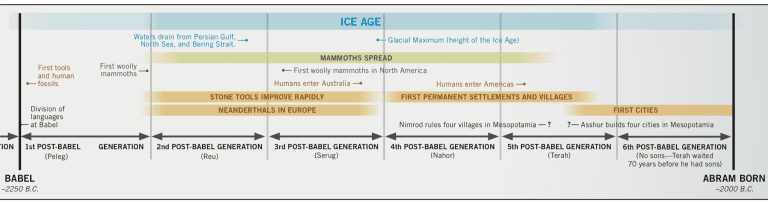
In reconciling the Ice Age, Answers in Genesis faces a serious problem. There are forests in Antarctica, under all of that ice. The Ice Age, then, can’t start immediately after Noah’s Flood. There has to be time for forests to grow.
But never fear! They have a timeline.

(click here to see the full-sized timeline)
Answers in Genesis argues—based on the Bible—that there were 100 years between the flood and the Tower of Babel, and that it was during these years that Antarctica grew forests. Or rather, it was during the first third of these years—the first human generation—that Antarctica’s forests grew. by the second third, they had already become ice. I don’t know about you, but I am extremely skeptical.
Forests don’t grow from scratch in a single human generation. Not mature forests, at least. I am willing to bet that there are trees in the forests buried under the Antarctic ice that are more than 30 years old. It sounds like I would be right. Also? Antarctica was tundra after it was forest, and before it was covered with ice. Where does that period of Antarctica’s geological history fit this timeline?
(click here to see the full-sized timeline)
Answers in Genesis has the ice age beginning with Babel—in fact, they argue that God might have created the Ice Age on purpose to ensure that people would disperse from Babel, as God had ordered. The Ice Age, according to this timeline, lasted for 250 years, or six human generations.
How much snow would have had to fall for this to have happened? Answers in Genesis includes a handy map that shows that during the Ice Age sea levels were lower, and that the sea beds surrounding the coasts became dry land. You could walk from Ireland to England. Is it even possible for that much water to evaporate and fall as snow, compacting into glaciers, in around a hundred years?
Are you familiar with the Little Ice Age? The period from roughly 1300 to 1850 was characterized by colder winters and cooler summers. And guess what? The glaciers did grow! This period lasted for 500 years, though—not 250—and it never threatened the kind of glaciation present in North America during the height of the last glacial period.
And it’s actually worse than that. The graphic above places the glacial maximum of Answers in Genesis “rapid” Ice Age at roughly 125 years in. After this, the ice still has to melt. So you have to get all of that ice—ice sheets that completely cover most of Europe and North America—in 125 years.
Also, about woolly mammoths. According to Answers in Genesis, there were no woolly mammoths on the Ark. Instead, there was just a single elephant pair. Woolly mammoths evolved after Babel from descendants of that single elephant pair, in one human generation. The scientists at Answers in Genesis are stronger believers in evolution than even I am! (Oh, I’m sorry, microevolution.*)
What’s that? You noticed that their graphic has Neanderthals existing for literally two generations? That’s not how genes work? No, no it is not! And remember—Answers in Genesis has the individuals that became the Neanderthals a generation later present at Babel, speaking the same language as everyone else and interbreeding with them. You’re damn straight that’s not how genes work.
Finally, we need to talk about Egypt.
It is hard to imagine such extreme changes in weather, landscapes, and vegetation during the rapid Ice Age and the years that followed. Some lush places in the north were stricken by drought, while monsoons filled the Sahara Desert with lakes and grasslands, attracting rhinoceroses, crocodiles, and human settlers. For a time at the end of the Ice Age, the drenched Nile Valley was not even habitable (at least, no human artifacts or villages have been found from this time). The great cities of Memphis and Luxor did not arise until many years later.
Answers in Genesis has the Ice Age ending in 2000 BC. At this time, they say, The Nile River Valley was uninhabitable and Memphis and Luxor were yet to be inhabited. This is absurd. Memphis was founded in 3100 BC. I already knew Egypt was a problem for young earth creationists—it was founded hundreds of years before the 2,350 BC date they give for Noah’s Flood—but Answers in Genesis’ dating of the Ice Age pushes the founding of Egypt back still further.
And it’s not just Egypt that’s a problem here.
I mean good gracious. Even Ur is a problem. Ur was already settled by around 5000 BC, which, by the way, is also before young earth creationists’ date for the creation of the world. So there’s that. By 3800 BC—1800 years before young earth creationists have the Ice Age ending—Ur was an established city.
Answers in Genesis exploration of when the Ice Age ended gives us some pointers as to how the organization deals with facts that don’t exactly support their conclusions:
The Bible also sheds light on the Ice Age’s end, though in an indirect way. If we can determine the dates of the first cities built after Babel, including Ur, and then show their relationship with dates for the last human and animal remains from the Ice Age, we can establish approximately when the Ice Age ended.
Just so we’re clear, “determine the dates of the first cities built after Babel” is code for check the Bible, not do archaeology. So you can see that I’m not making that up, here’s what comes next:
The Bible mentions that some very important cities were established by Abraham’s day and continued to thrive throughout Old Testament times.
Yep, totally not making this up.
Since Abraham grew up in Ur, we know that it must have been founded before his birth.
True, that is usually how that works.
And then there’s this:
While the “radiocarbon ages” are wrong because they exceed the Bible’s timeline [this is not how science works], the relative ages are useful. If something dates at 40,000 radiocarbon years and something else at 20,000 or 5,000, we know the first find is older than the second, and so on.
Radiocarbon dating shows that every fossil from the Ice Age predates anything from the earliest known human settlements.
If I’ve kept hold of the thread so far, the argument they’re making is that radiocarbon dating confirms that cities were founded only after the Ice Age (which, yes), and the Bible mentions cities in association with Abraham (okay), ergo, the Ice Age ended before Abraham came onto the scene.
There’s also this odd mention:
In no case do these settlements, including Ur, date as early as the end of the Ice Age. At the time of Ur’s settlement it was a port city on the Persian Gulf, but this gulf did not even exist during the Ice Age.
This combination of Bible and science is giving me whiplash.
Ur can’t actually have been continuously occupied from 38ooo BC on because the Bible says there was a global flood in 2350, and it can’t have been founded immediately after this Flood because science says there was an Ice Age; science says this Ice Age must have occurred after the Flood (because the Ice Age deposits are found on top of the pools of subterranean oil, which of course were created during the Flood); and, finally, science says cities were not founded until after the Ice Age.
Because the Bible says Abraham grew up in Ur—and science says cities were founded only after the Ice Age, and not during it—the Ice Age must have been over by the time Abraham was born.
You see what I’m saying? Answers in Genesis is slopping science onto their religion—but only when they decide to do so—and rejecting science when they conclude it doesn’t fit. The result isn’t something you’d find by looking only at science or only at religion, however. Seriously—comb the Bible, and you won’t find any mention of an Ice Age. It’s not there. Likewise, comb the geological and archeological evidence and you won’t find any evidence of a worldwide flood in 2350 BC.
When Answers in Genesis does glom science to their religious timeline, they frequently do so in ways that make no sense—you can’t fit a global Ice Age the size and scope of the last glacial period into 250 years. To make their timeline work, remember, you have to fit not only the growth of the ice sheets into that period *but also their disappearance—*remember, their argument is that Ur could not have been settled until the ice had melted, filling the Persian Gulf.
Also? You can’t get a wholly new species of elephant like the woolly mammoth in fifty years. And you can’t get an entirely new species of homo sapiens in two generations. You can’t get a full grown, mature forest (and a full grown tundra on top of it) in thirty years. It does not work like this.
And to think, I once thought this made so much sense.
* Answers in Genesis differentiates between “macroevolution” and “microevolution,” made up terms that allow them to argue that organisms change over time—because that’s pretty much indisputable—but that that does not count as Big-E Evolution. This is how Answers in Genesis can argue that Neanderthals evolved as a separate species in one human generation, but that it would have been impossible for early humans to have evolved from ape-like creatures over millions of years. Cool, huh?
I have a Patreon! Please support my writing!
Previous Post

April 17, 2019
Christian Devotional: Depression is a Fifth Column, So Be Happy
Next Post

April 19, 2019 Love Comes Softly: Magic Cake and Pig Slopping
Browse Our Archives
Select a Category Atheism Evangelicalism/Fundamentalism Family Feminism Homeschool Meta Parenting Patriarchy Politics Purity Quiverfull Social Justice Uncategorized Worthwhile reads
Select a Month February 2021 January 2021 December 2020 November 2020 October 2020 September 2020 August 2020 July 2020 June 2020 May 2020 April 2020 March 2020 February 2020 January 2020 December 2019 November 2019 October 2019 September 2019 August 2019 July 2019 June 2019 May 2019 April 2019 March 2019 February 2019 January 2019 December 2018 November 2018 October 2018 September 2018 August 2018 July 2018 June 2018 May 2018 April 2018 March 2018 February 2018 January 2018 December 2017 November 2017 October 2017 September 2017 August 2017 July 2017 June 2017 May 2017 April 2017 March 2017 February 2017 January 2017 December 2016 November 2016 October 2016 September 2016 August 2016 July 2016 June 2016 May 2016 April 2016 March 2016 February 2016 January 2016 December 2015 November 2015 October 2015 September 2015 August 2015 July 2015 June 2015 May 2015 April 2015 March 2015 February 2015 January 2015 December 2014 November 2014 October 2014 September 2014 August 2014 July 2014 June 2014 May 2014 April 2014 March 2014 February 2014 January 2014 December 2013 November 2013 October 2013 September 2013 August 2013 July 2013 June 2013 May 2013 April 2013 March 2013 February 2013 January 2013 December 2012 November 2012 October 2012 September 2012 August 2012 July 2012 June 2012 May 2012 April 2012 March 2012 February 2012 January 2012 December 2011 November 2011 October 2011 September 2011 August 2011 July 2011 June 2011
Follow Us!
TAKE THE
Religious Wisdom Quiz
What did Jesus say would happen if you build your house on the rock?
Select your answer to see how you score.
It would be fancy It would stand through storms It would sink It would get destroyed
Related posts from Love, Joy, Feminism
Maybe Let's Not Read More Puritans

"So Your Problem with Christianity is the Jesus...

No, the "Second Shift" Isn't Feminism's Fault
TRENDING AT PATHEOS Nonreligious

Dethroning Jesus and Enthroning Yourself
Jesus Never Asked to Be Worshipped. He Asked to Be Understood. Christianity...

Why Most Christians are Really Paulians and Jobians
I Don't Care, But It Matters Let's get this out of the...

Essential Tips to Successfully Navigate the Selling Process
Selling a house can feel overwhelming, but it doesn’t have to be....

To Make Remote Work Effective, Think About Others
The COVID-19 pandemic forced many companies to rapidly transition to remote work....

Flexibility Is Key to Solving Problems of Tomorrow
The world of work is undergoing a dramatic transformation. The COVID-19 pandemic...
view all Nonreligious blogs
Ad-Free & Subscriber Log-In Subscription Support
- About Us
- 2026 Calendar
- Videos
- Podcasts
- Library of World Religions
- Faith In Media Tracker
- Advertise With Us
- Write for Us
- Privacy Policy
- Terms of Service
- Do Not Sell My Data
- Contact Us
- Radiant Digital
- Manage Newsletter Subscriptions
- Unsubscribe From Notifications
- Sitemap
Copyright 2008-2026, Patheos, part of the Radiant Digital network of media brands. All rights reserved.
Subscription Support Ad-Free & Subscriber Log-In
Follow Patheos