
BuddhistCatholicContemplativeEvangelicalGeneral ChristianHinduJewishLatter-day SaintMuslimNew VisionsProgressive Christian
Beliefs
- Buddhist
- Catholic
- Contemplative
- Evangelical
- General Christian
- Hindu
- Jewish
- Latter-day Saint
- More Voices
- Muslim
- New Visions
- Pagan
- Progressive Christian
Topics
- Religion News
- Food and Religion
- Sports and Religion
- Religious Art
- Religious Music and Entertainment
- Religious Events
- History and Religion
- Style and Religion
- Politics and Religion
- Women in Religion
- Recreation Outdoors and Religion
- Business Finance and Religion
- Careers Workplace and Religion
- Education and Religion
- Family Parenting and Religion
- Health Fitness and Religion
- Home and Religion
- Relationships and Religion
- Technology and Religion
- Travel and Religion
Columnists
- Buddhist Columnists
- Business Finance and Religion Columnists
- Careers Workplace and Religion Columnists
- Catholic Columnists
- Contemplative Columnists
- Education and Religion Columnists
- Evangelists Columnists
- Family Parenting and Religion Columnists
- General Christian Columnists
- Health Fitness and Religion Columnists
- Hindu Columnists
- History and Religion Columnists
- Home and Religion Columnists
- Jewish Columnists
- More Voices Columnists
- Latter Day Columnists
- Muslim Columnists
- New Visions Columnists
- Nonreligious Columnists
- Pagan Columnists
- Politics and Religion Columnists
- Progressive Columnists
- Recreation Outdoors and Religion Columnists
- Relationships and Religion Columnists
- Religion News Columnists
- Religious Art Columnists
- Religious Events Columnists
- Religious Music and Entertainment Columnists
- Sports and Religion Columnists
- Style and Religion Columnists
- Technology and Religion Columnists
- Travel and Religion Columnists
- Women in Religion Columnists
Resource Library
- 2026 Calendar
- Library of World Religions
- The 100 Most Holy Places on Earth
- Patheos Answers
- Podcasts
- Videos
- Faith Leaders Database
- Anglican Episcopalian
- Bahai
- Baptist
- Buddhism
- Christianity
- Confucianism
- Eastern Orthodoxy
- Hinduism
- Holiness and Pentecostal
- ISKCON
- Islam
- Judaism
- Lutheran
- Methodist
- The Church of Jesus Christ of Latter-day Saints
- New Age
- Paganism
- Presbytarian and Reformed
- Protestantism
- Religion Behind the Scenes
- Roman Catholic
- Scientology
- Shia Islam
- Sikhism
- Sufism
- Sunni Islam
- Taoism
- Zen
- See all religions
Research Tools
 Ad-Free & Subscriber Log-In Subscription Support
Ad-Free & Subscriber Log-In Subscription Support
Follow Patheos 

- Trending:
- Forgiveness
- |
- Marriage
- |
- Consciousness
- |
- Death Penalty
- |
- Election
- |
- Halloween
 Love, Joy, Feminism
-
More
- Home
- Nonreligious
- The Right’s New Lie: The Left Gave Us Toxic Masculinity
The Right’s New Lie: The Left Gave Us Toxic Masculinity
Last updated on: February 19, 2019 at 10:10 am by Libby Anne
The Right’s New Lie: The Left Gave Us Toxic Masculinity 2019-02-19T10:10:06-04:00 Libby Anne
Patheos Explore the world's faith through different perspectives on religion and spirituality! Patheos has the views of the prevalent religions and spiritualities of the world.
A recent headline on another Patheos blog caught my eye: How the Left Gave Us Toxic Masculinity. The author, Gene Veith, explains as follows:
Complaints about “toxic masculinity” often come across as complaints about “masculinity.” The Gillette ad on the subject shows leering men committing sexual harassment, bullies tormenting those smaller than themselves, and otherwise being obnoxious. But such behavior was always scorned by men of honor.
This opening made me wonder about the affiliations and background of the author. According to his blog’s about page, Veith is a former professor at Patrick Henry College who now teaches at a seminary in Indiana.
I have questions. Namely, questions about Doug Phillips and Bill Gothard and all of the other evangelical pastors and Christian homeschool leaders and ministries who have landed in scandal for sexually abusing women and girls. These are all men who were (or are) in Veith’s circles. Would Veith argue that these men were not men of “honor”? If so, how is one to tell the difference? These men put on all the appearance of being good, godly men—until the truth came out.
I bring all of this up because of where Veith goes next:
But there is such a thing as men behaving badly. And this often happens when young boys grow up with no father or father figure to show them how to be a man. A substantial amount of research has shown that boys who grow up without a father often develop “hypermasculine” traits–that is, extreme physical and sexual aggression. They get in fights and sometimes commit violent crimes. They tend to be misogynistic towards women while also being promiscuous. Girls raised without a father often become “hyperfeminine,” becoming sexually promiscuous and usually getting pregnant at a young age, generally from one of those hypermasculine men who never stay around to be fathers to their children, much less husbands.
That is Veith’s argument—that men commit violence against women because they never had a father or a father figure to show them how to be a man. Look, I’m sorry, but Doug Phillips had a father. His father had very high profile in conservative politics, actually. He hit all Veith’s benchmarks. Bill Gothard had a father too. So did countless other men in Veith’s circles who have abused and mistreated the women around them.
Yet Veith never even addresses the abuse and toxicity in his own circles. He acts like it doesn’t exist. Instead, we get statements like this:
Traditionally, marriage civilized men by channeling their sexual desires into a loving relationship and parenthood. And it channeled their aggressiveness into protecting their family and working hard to provide for them. The fathers, in turn, taught their sons how to treat women and how to discipline themselves so they could grow up into effective adults.
Say what now?
Doug Phillips was married. So were most of the men in Veith’s circles who have been outed in recent years for sexual abuse and violence against women—do I really have to say this again? Marriage didn’t stop Phillips from grooming and sexually abusing his children’s nanny. Has Veith never heard of spousal abuse, or marital rape? Does Veith truly think marriage prevents men from committing violence against women? I have news for him: It doesn’t.
Before I offer a more in-depth response, let me give you one last paragraph from Veith:
Who was responsible for mocking these “1950s” families and for encouraging young people to rebel against it? Today marriage has all but disappeared in the poor working class of all races and single mothers are raising their children with no father in sight. But middle class and wealthy families too are torn by divorce and family dysfunction. And the Sixties, with the sexual revolution and the counter culture, threw out all restraints on principle. A consequence of all of this is both the despair among young people (listen to their music) and “toxic masculinity.”
Veith’s central argument is that violence against women is a product of two related factors: declining marriage rates and boys being raised without fathers. He dates both of these things as originating in the 1960s.
There was, it would seem, no violence against women before the 1960s. This is, of course, balderdash—especially when you consider that “toxic masculinity” does not refer only to sexual assault or spousal battery. It also refers to sexual harassment in the workplace; dismissal of women’s opinions; the belief that men cannot show pain or vulnerability; the idea that men must show intellectual, sexual, and physical dominance; the equating of the emotional with the feminine and the rejection of the feminine in men. These are all areas where we have improved since the 1960s.
In many cases, our awareness of a social problem emerges only when there is finally public will to challenge it. Before this, social problems are normalized. They are seen as simply a part of life, and are talked about in whispers. This was once the case with violence against women. It was the case, too, with police brutality against black people—this problem did not emerge with the birth of the Black Lives Matter movement. So, too, child abuse did not begin when public awareness led to the development of social systems to fight it. Rape on college campus did not start a decade ago, when a concerted movement arose to fight it. Our awareness of toxic masculinity did not signal its emergence.
Of course, violence against less women was less unknown in the past than Veith’s claims might suggest. In the U.S. over a century ago, people were already well aware that domestic battery was a problem. Social reformers of the time tied violence against women (and children) not to fatherlessness, or a failure to marry, but to alcohol use.
This image is from 1847:
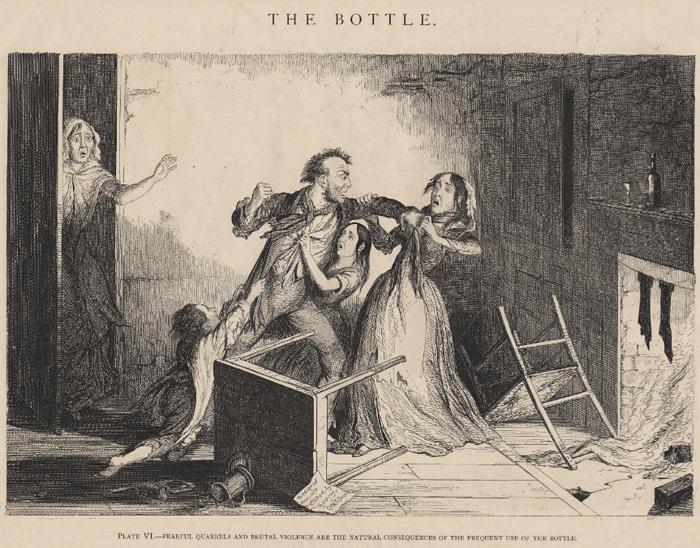
It would seem that toxic masculinity is not an invention that stemmed out of the 1960s—especially considering that it includes dismissal of women’s opinions and the idea that men should not show emotion or vulnerability.
I would be remiss if I did not examine the citation Veith included when he made his claim that “research has shown” boys that grow up without a father are prone to “extreme physical and sexual aggression” and “tend to be misogynistic towards women while also being promiscuous.” What evidence was used to make this claim? I opened the linked article and read it. This is not a data-heavy research article. It’s a conceptual article that begins by citing research conducted by others before moving on to conjecture and thought experiment.
The article’s author, Belinda Brown, begins by citing negative outcomes for boys from single-parent homes. She next argues that men have more tenuous connection to the family than women, due to their inability to become pregnant or lactate. She then argues that more attention needs to be paid to consciously creating a role for men in the family. Brown describes a number of pre-industrial practices for raising boys: aggressively separating boys from the feminine; conducting all-male rituals; and creating rituals that imitate the female reproductive process.
Brown argues that without the sorts of male coming of age rituals and all-male environments of the pre-industrial period, boys who grow up with single mothers are left to define the masculine by rejecting the feminine.
As father absent boys are the ones most likely to engage in the negative behaviour associated with ‘toxic masculinity’, this suggests that it is not masculinity which causes the bad behaviour but its absence. Where boys are more feminine and perceive themselves to be so they are more likely to behave badly. This suggests that the surest route away from toxic masculinity would be to encourage boys to develop their masculinity and enable them to find ways of being men. However, this is exactly what the current obsession with toxic masculinity prevents. Those who ‘call out’ toxic masculinity are inadvertently the creators of it.
Yet even as she makes these claims, Brown never cites any any studies linking fatherlessness to increases in sexual aggression or disrespect toward women. In her section on the problems associated with fatherlessness, Brown only cites studies on educational attainment, labor market outcomes, mortality, and delinquency. Veith, remember, cited Brown’s study as research showing that growing up without a father makes a boy sexually aggressive and misogynistic. Brown never cites research saying anything of the sort.
This shouldn’t be surprising. Toxic masculinity existed in spades when marriage was the norm and aberration from it was stigmatized; in a similar manner, toxic masculinity today is not limited to those raised in single family homes.
Let’s take a step back and look at the bigger picture: In his article, Veith acknowledges that toxic masculinity is a thing, and that it is a problem. He wants to make marriage and the eschewing of divorce the solution, of course, and he does not appear to understand what toxic masculinity actually is. Still, the concept of toxic masculinity has made inroads wide enough that Veith feels the need to respond. And that is worth noting.
[For those who may be curious: Brown was a professor in the University College London’s Centre for Transport Studies, where she wrote about the impact of city layout on children’s physical mobility, as well as children’s walking patterns and ways to decrease car use. After retiring due to family issues, she began writing articles with titles like The Internal Contradictions of Feminism for conservative publications. Finally, while the article Veith cites was written after Brown left the University College London, her university affiliation is still listed on the paper.]
I have a Patreon! Please support my writing!
Previous Post

February 18, 2019
Whiteness as Default in a Majority Minority Nation
Next Post

February 20, 2019 The Harvest Bible Chapel Scandal in a Nutshell (And Why You Should Care)
Browse Our Archives
Select a Category Atheism Evangelicalism/Fundamentalism Family Feminism Homeschool Meta Parenting Patriarchy Politics Purity Quiverfull Social Justice Uncategorized Worthwhile reads
Select a Month February 2021 January 2021 December 2020 November 2020 October 2020 September 2020 August 2020 July 2020 June 2020 May 2020 April 2020 March 2020 February 2020 January 2020 December 2019 November 2019 October 2019 September 2019 August 2019 July 2019 June 2019 May 2019 April 2019 March 2019 February 2019 January 2019 December 2018 November 2018 October 2018 September 2018 August 2018 July 2018 June 2018 May 2018 April 2018 March 2018 February 2018 January 2018 December 2017 November 2017 October 2017 September 2017 August 2017 July 2017 June 2017 May 2017 April 2017 March 2017 February 2017 January 2017 December 2016 November 2016 October 2016 September 2016 August 2016 July 2016 June 2016 May 2016 April 2016 March 2016 February 2016 January 2016 December 2015 November 2015 October 2015 September 2015 August 2015 July 2015 June 2015 May 2015 April 2015 March 2015 February 2015 January 2015 December 2014 November 2014 October 2014 September 2014 August 2014 July 2014 June 2014 May 2014 April 2014 March 2014 February 2014 January 2014 December 2013 November 2013 October 2013 September 2013 August 2013 July 2013 June 2013 May 2013 April 2013 March 2013 February 2013 January 2013 December 2012 November 2012 October 2012 September 2012 August 2012 July 2012 June 2012 May 2012 April 2012 March 2012 February 2012 January 2012 December 2011 November 2011 October 2011 September 2011 August 2011 July 2011 June 2011
Follow Us!
TAKE THE
Religious Wisdom Quiz
Who said, "Do you not know that your bodies are temples of the Holy Spirit"?
Select your answer to see how you score.
Peter Jesus James Paul
Related posts from Love, Joy, Feminism

It's not about the economy, it's about being...


Homeschooled Congressman Urged Conservatives to "Lightly Threaten" Their...

"So Your Problem with Christianity is the Jesus...
TRENDING AT PATHEOS Nonreligious

Dethroning Jesus and Enthroning Yourself
Jesus Never Asked to Be Worshipped. He Asked to Be Understood. Christianity...

Why Most Christians are Really Paulians and Jobians
I Don't Care, But It Matters Let's get this out of the...

Essential Tips to Successfully Navigate the Selling Process
Selling a house can feel overwhelming, but it doesn’t have to be....

To Make Remote Work Effective, Think About Others
The COVID-19 pandemic forced many companies to rapidly transition to remote work....

Flexibility Is Key to Solving Problems of Tomorrow
The world of work is undergoing a dramatic transformation. The COVID-19 pandemic...
view all Nonreligious blogs
Ad-Free & Subscriber Log-In Subscription Support
- About Us
- 2026 Calendar
- Videos
- Podcasts
- Library of World Religions
- Faith In Media Tracker
- Advertise With Us
- Write for Us
- Privacy Policy
- Terms of Service
- Do Not Sell My Data
- Contact Us
- Radiant Digital
- Manage Newsletter Subscriptions
- Unsubscribe From Notifications
- Sitemap
Copyright 2008-2026, Patheos. All rights reserved.
Subscription Support Ad-Free & Subscriber Log-In
Follow Patheos