
BuddhistCatholicContemplativeEvangelicalGeneral ChristianHinduJewishLatter-day SaintMuslimNew VisionsProgressive Christian
Beliefs
- Buddhist
- Catholic
- Contemplative
- Evangelical
- General Christian
- Hindu
- Jewish
- Latter-day Saint
- More Voices
- Muslim
- New Visions
- Pagan
- Progressive Christian
Topics
- Religion News
- Food and Religion
- Sports and Religion
- Religious Art
- Religious Music and Entertainment
- Religious Events
- History and Religion
- Style and Religion
- Politics and Religion
- Women in Religion
- Recreation Outdoors and Religion
- Business Finance and Religion
- Careers Workplace and Religion
- Education and Religion
- Family Parenting and Religion
- Health Fitness and Religion
- Home and Religion
- Relationships and Religion
- Technology and Religion
- Travel and Religion
Columnists
- Buddhist Columnists
- Business Finance and Religion Columnists
- Careers Workplace and Religion Columnists
- Catholic Columnists
- Contemplative Columnists
- Education and Religion Columnists
- Evangelists Columnists
- Family Parenting and Religion Columnists
- General Christian Columnists
- Health Fitness and Religion Columnists
- Hindu Columnists
- History and Religion Columnists
- Home and Religion Columnists
- Jewish Columnists
- More Voices Columnists
- Latter Day Columnists
- Muslim Columnists
- New Visions Columnists
- Nonreligious Columnists
- Pagan Columnists
- Politics and Religion Columnists
- Progressive Columnists
- Recreation Outdoors and Religion Columnists
- Relationships and Religion Columnists
- Religion News Columnists
- Religious Art Columnists
- Religious Events Columnists
- Religious Music and Entertainment Columnists
- Sports and Religion Columnists
- Style and Religion Columnists
- Technology and Religion Columnists
- Travel and Religion Columnists
- Women in Religion Columnists
Resource Library
- 2026 Calendar
- Library of World Religions
- The 100 Most Holy Places on Earth
- Patheos Answers
- Podcasts
- Videos
- Faith Leaders Database
- Anglican Episcopalian
- Bahai
- Baptist
- Buddhism
- Christianity
- Confucianism
- Eastern Orthodoxy
- Hinduism
- Holiness and Pentecostal
- ISKCON
- Islam
- Judaism
- Lutheran
- Methodist
- The Church of Jesus Christ of Latter-day Saints
- New Age
- Paganism
- Presbytarian and Reformed
- Protestantism
- Religion Behind the Scenes
- Roman Catholic
- Scientology
- Shia Islam
- Sikhism
- Sufism
- Sunni Islam
- Taoism
- Zen
- See all religions
Research Tools
 Ad-Free & Subscriber Log-In Subscription Support
Ad-Free & Subscriber Log-In Subscription Support
Follow Patheos 

- Trending:
- Forgiveness
- |
- Marriage
- |
- Consciousness
- |
- Death Penalty
- |
- Election
- |
- Halloween
 Love, Joy, Feminism
-
More
- Home
- Nonreligious
- A Catholic Priest’s Bizarre Eulogy for Atheism
A Catholic Priest’s Bizarre Eulogy for Atheism
Last updated on: January 10, 2019 at 5:20 am by Libby Anne
A Catholic Priest’s Bizarre Eulogy for Atheism 2019-01-08T15:32:23-04:00 Libby Anne
Patheos Explore the world's faith through different perspectives on religion and spirituality! Patheos has the views of the prevalent religions and spiritualities of the world.
I recently came upon an old article from Patheos’ Catholic channel titled The Facts: Atheism Is Dying Out. It was published in 2015, but for some reason or other was being shared anew on social media. And it’s maddening. All of it. It’s also wrong.
The post is written by a Catholic priest named Dwight Longenecker, and begins as follows:
We often hear from atheists how religion is dying out as mankind comes to see the clear light of reason.
Atheist “intellectuals” speak disparagingly about religion and predict that mankind is on the cusp of a new age in which religion will simply disappear as science, technology and reason are in the ascendant.
The facts indicate exactly the opposite. It is religion which continues to grow around the world while the statistics indicate that agnosticism and atheism are dying out.
Yes, there are some extremely smug and condescending atheists out there, and yes, they do talk about an ideal world where religions declines and more people become atheist, trusting in “science, technology and reason.” (I am not terribly enthusiastic about their portrayals, because these same individuals are frequently sexist and/or racist, which rather makes me wonder whether it is “reason” or something else entirely—say, compassion—that we should be working toward.)
This is not the time to get off track, however. Longenecker writes that “statistics indicate that agnosticism and atheism are dying out.” What statistics is he talking about? He’s talking about a Pew report, which he linked to.
The Pew report found as follows:
Sixteen per cent of the population was unaffiliated to a religion in 2010 and Pew predicted by 2050, this would fall to 13 per cent, mainly because individuals in this group are older and have less children.
The countries with the most unaffiliated populations were China, Japan and the United States, and Pew noted that in 35 years’ time, the increase in unaffiliated individuals would be predominantly in the West.
I took a look at the linked research paper, and the issue here is population change.
China has the largest proportion of unaffiliated individuals in the world, given its state atheism. China also has a population that is projected to decline, especially relative to countries like India, which have high population growth and high religious affiliation. Similarly, most other areas with high numbers of unaffiliated persons—Japan, Europe, the United States—are also projected to see their populations decline, whether in absolute terms or relative to that of other countries.
Interestingly, however, while the rate of unaffiliated individuals is projected to decline, the absolute number will increase:
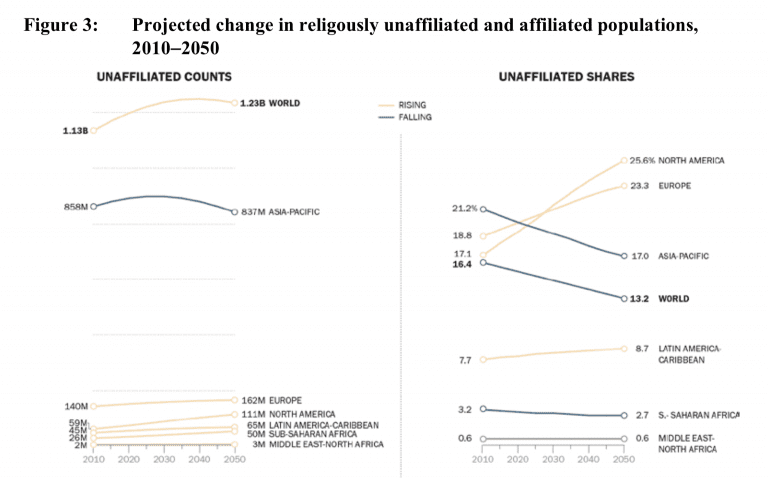
This image is a bit difficult to read; I apologize for that.
Between 2010 and 2015, the number of religiously unaffiliated individuals is projected to increase from 1.13 billion to 1.238 billion. So much for Longenecker’s claims that “agnosticism and atheism are dying out.” According to the projections, roughly a quarter of individuals in North America and Europe will be religiously unaffiliated by 2050, an increase from around 18% in 2010. The overall percentage of religiously unaffiliated individuals is projected to decrease from 16.4% to 13.2%, however, because the percentage of religiously affiliated individuals in the Asia-Pacific region is expected to decline from 21.2% to 17.0%.
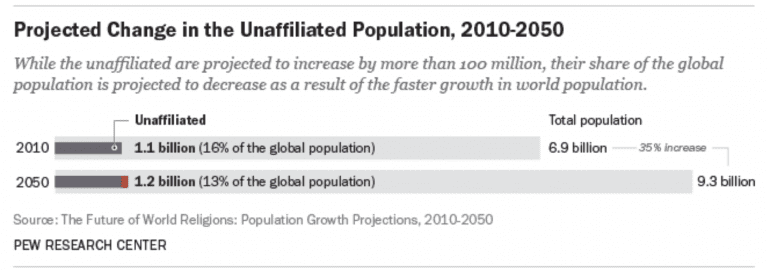
Again, hard to read—but you get the idea. The number of religiously unaffiliated people will increase; the percentage that is unaffiliated will decline, because the overall population will grow at a higher rate than the religiously affiliated population.
Longenecker aside, the actual finding here is that Europe and North America will see a growth in religious unaffiliated individuals (but not significant overall population growth) while Asia will see a gradual decrease, due in part (it appears) to a projected declining overall population. (Grouping Chinese atheists together with atheists in the U.S. and Europe, when China has state atheism and persecution of unlicensed religions, feels odd to me, but this is apparently how this data works).
Longenecker acknowledges that Islam is expected to overtake Christianity as the dominant world religion by 2100, but while he was more than happy to gloat about a decline in the percentage of religiously unaffiliated individuals as compared to other religious groups, he’s not as pessimistic about projections that suggest declines in his own religion’s global dominance.
Why? Well, there’s this:
These projections are based only on demographic trends. We should remember that most predictions like this end up being wildly inaccurate because they cannot predict a whole range of other variables.
Nice of him to tell us this only when discussing the rise of Islam and comparative decline of global Christianity, and not earlier.
Here are some unpredictable variables which could affect these predictions:
Let’s have a look at each item Longenecker offers.
—A revival of Christianity in the West. In the late eighteenth century atheism, rationalism and Freemasonry seemed to have taken over Europe. By the mid to late nineteenth century religious revival had swept through Europe and Christianity was surging forward. This revival was a result of fervent preaching, supernatural occurrences like Lourdes, new saints and evangelization.
Okay, this one seems fair enough.
—War or natural disaster – war, natural disaster or plagues can affect the religious demographic–both wiping out whole populations and turning people back to religion.
Um, what. Longenecker seems almost excited about this possibility.
—Mass conversions – history has shown (Mexico in the sixteenth century) that there can be an outpouring of the Holy Spirit and whole populations will suddenly convert to Christianity. While missionary efforts to Islamic countries are largely unsuccessful a supernatural conversion of Muslims to Christianity could change the landscape.
Hey what now? That wasn’t the outpouring of the Holy Spirit. That was colonialism and mass forced conversions. Is this really the model Longenecker wants followed, here? The invasion, colonialism, and forced conversion of Muslim countries? Actually—it occurs to me that Longenecker must actually think those conversions were the Holy Spirit. That’s … wow.
—Immigration and population controls. Western governments might start restricting Islamic immigration and deport Muslims. This would alter the religious scene and make the predictions go awry.
Would it really, though? Muslim individuals who seek to immigrate don’t somehow vanish if they’re turned away. Besides, Muslims who immigrate to Western countries tend to have fewer children. Isn’t it possible that turning Muslim immigrants away from the U.S. might actually result in a higher overall number of Muslim individuals in the world?
—Unexpected change in human reproduction. Many of the predictions are based on the assumption that artificial birth technologies will continue to advance throughout the world. Things could go either way: Muslims who are reproducing more than Christians might start to use artificial contraception and abortion or Christians might stop using them. Social trends might be reversed by economic conditions and people may start wanting large families or the unimaginable might happen: birth control pills might stop working and everyone will start having more babies.
Birth control pills might stop working … what. I don’t think Longenecker actually knows how they—or any other form of contraception—actually works. They’re not just going to—I mean, jeez.
Notice Longenecker’s focus on birth rates, though—it’s like he’s concerned about which religion is going to outbreed other religions. But then, that is exactly what he’s focused on, because most people ascribe to the religion of the family they’re born into. This is one of many reasons I find the idea of a benevolent God who requires belief in a specific religion—on threat of eternal damnation—so absurd. My first grader told me the other day that he can’t say what religion he is right now, because he “hasn’t chosen” which religion he wants to be yet. But that is damn unusual. Most people join a religion by reason of birth into it.
And if birth into the wrong religion gets you damnation unless you find out the mistake and switch—especially when switching is so very rare—well then. That seems messed up, to put it mildly.
Speaking of switching, the report Longenecker repeatedly referred to includes some fascinating information that he neglects to mention:
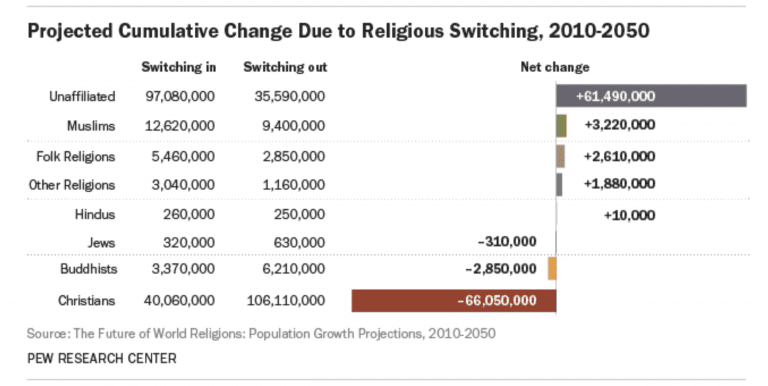
Between 2010 and 2015, Pew estimates that 61,490,000 million more people will switch to unaffiliated from another religious group than will switch from religiously affiliated to another group. During the same period, Pew estimates that 66,050,000 more people will switch from Christianity to another group than will switch to Christianity from another group. Yes, you read that right! Christianity is projected to lose more members than any other group—by a lot— while the religiously unaffiliated are expected to gain more members than any other group.
It’s interesting that Longenecker completely avoids mentioning this seemingly important information. According to Longenecker, despite gaining well over twice as many new adherents than Christianity—and losing a third as many members—“agnosticism and atheism are dying out.” Where is Longenecker’s concern for Christianity? Why is Christianity bleeding members like no other religion? Why doesn’t he even raise this question? It would seem to be relevant to his concerns!
Here’s another way to look at this: The religious groups on this list will see an increase in numbers due solely to population growth, and not due to people converting. At the same time, the religiously unaffiliated will see an increase in numbers due not to population growth but to people switching from various religious groups to the unaffiliated group. Pew suggests that 97 million people will switch to the unaffiliated group, far more than are expected to switch to any other religious group.
If I looked at my beliefs the way Longenecker does his, this is the point where I’d be declaring victory in the world of ideas, noting that my religious group (unaffiliated) will see more conversions than any other. But I’m not, so I’ll leave that argument aside.
Let’s look at how Longenecker concludes:
The bottom line is that religion is here to stay, and the predictions are that all religious groups will experience growth through the end of the century.
Atheists and agnostics are the only ones (along with Buddhists) who will see their numbers decline.
Um, what now. No, atheists and agnostics will not “see their numbers decline.” Their overall percentage of the population is projected to decline, sure, but the unaffiliated group is actually expected to gain members. So let’s be accurate here.
That Longenecker could look at a report that projects that the number of unaffiliated individuals will increase by over 100 million people and yet declare atheism to be “dying out” makes me see red. I do not consider myself a “New Atheist,” and I am not particularly concerned about whether the number of religiously unaffiliated people increases or declines, but this guy got even my hackles up. He started with his own preconceived conclusion and saw only what he wanted to see, and nothing else.
Little upsets me as much as misinterpreted statistics.
I have a Patreon! Please support my writing!
Previous Post

January 9, 2019
Telling the Cyntoia Brown Story Better
Next Post

January 11, 2019 Forbid Them Not: The Weird, Weird Supreme Court
Browse Our Archives
Select a Category Atheism Evangelicalism/Fundamentalism Family Feminism Homeschool Meta Parenting Patriarchy Politics Purity Quiverfull Social Justice Uncategorized Worthwhile reads
Select a Month February 2021 January 2021 December 2020 November 2020 October 2020 September 2020 August 2020 July 2020 June 2020 May 2020 April 2020 March 2020 February 2020 January 2020 December 2019 November 2019 October 2019 September 2019 August 2019 July 2019 June 2019 May 2019 April 2019 March 2019 February 2019 January 2019 December 2018 November 2018 October 2018 September 2018 August 2018 July 2018 June 2018 May 2018 April 2018 March 2018 February 2018 January 2018 December 2017 November 2017 October 2017 September 2017 August 2017 July 2017 June 2017 May 2017 April 2017 March 2017 February 2017 January 2017 December 2016 November 2016 October 2016 September 2016 August 2016 July 2016 June 2016 May 2016 April 2016 March 2016 February 2016 January 2016 December 2015 November 2015 October 2015 September 2015 August 2015 July 2015 June 2015 May 2015 April 2015 March 2015 February 2015 January 2015 December 2014 November 2014 October 2014 September 2014 August 2014 July 2014 June 2014 May 2014 April 2014 March 2014 February 2014 January 2014 December 2013 November 2013 October 2013 September 2013 August 2013 July 2013 June 2013 May 2013 April 2013 March 2013 February 2013 January 2013 December 2012 November 2012 October 2012 September 2012 August 2012 July 2012 June 2012 May 2012 April 2012 March 2012 February 2012 January 2012 December 2011 November 2011 October 2011 September 2011 August 2011 July 2011 June 2011
Follow Us!
TAKE THE
Religious Wisdom Quiz
Who built an ark for the animals?
Select your answer to see how you score.
Solomon David Noah Hezekiah
Related posts from Love, Joy, Feminism

Odd Priorities: A Nativity Scene 'Miraculously' Survived the...

Answers in Genesis: Be Careful, Wayward Adult Children...

How Should Churches Respond When People Leave?

"Teens Twice as Likely to Identify as Atheist...
TRENDING AT PATHEOS Nonreligious

Dethroning Jesus and Enthroning Yourself
Jesus Never Asked to Be Worshipped. He Asked to Be Understood. Christianity...

Why Most Christians are Really Paulians and Jobians
I Don't Care, But It Matters Let's get this out of the...

Essential Tips to Successfully Navigate the Selling Process
Selling a house can feel overwhelming, but it doesn’t have to be....

To Make Remote Work Effective, Think About Others
The COVID-19 pandemic forced many companies to rapidly transition to remote work....

Flexibility Is Key to Solving Problems of Tomorrow
The world of work is undergoing a dramatic transformation. The COVID-19 pandemic...
view all Nonreligious blogs
Ad-Free & Subscriber Log-In Subscription Support
- About Us
- 2026 Calendar
- Videos
- Podcasts
- Library of World Religions
- Faith In Media Tracker
- Advertise With Us
- Write for Us
- Privacy Policy
- Terms of Service
- Do Not Sell My Data
- Contact Us
- Radiant Digital
- Manage Newsletter Subscriptions
- Unsubscribe From Notifications
- Sitemap
Copyright 2008-2026, Patheos. All rights reserved.
Subscription Support Ad-Free & Subscriber Log-In
Follow Patheos