
BuddhistCatholicContemplativeEvangelicalGeneral ChristianHinduJewishLatter-day SaintMuslimNew VisionsProgressive Christian
Beliefs
- Buddhist
- Catholic
- Contemplative
- Evangelical
- General Christian
- Hindu
- Jewish
- Latter-day Saint
- More Voices
- Muslim
- New Visions
- Pagan
- Progressive Christian
Topics
- Religion News
- Food and Religion
- Sports and Religion
- Religious Art
- Religious Music and Entertainment
- Religious Events
- History and Religion
- Style and Religion
- Politics and Religion
- Women in Religion
- Recreation Outdoors and Religion
- Business Finance and Religion
- Careers Workplace and Religion
- Education and Religion
- Family Parenting and Religion
- Health Fitness and Religion
- Home and Religion
- Relationships and Religion
- Technology and Religion
- Travel and Religion
Columnists
- Buddhist Columnists
- Business Finance and Religion Columnists
- Careers Workplace and Religion Columnists
- Catholic Columnists
- Contemplative Columnists
- Education and Religion Columnists
- Evangelists Columnists
- Family Parenting and Religion Columnists
- General Christian Columnists
- Health Fitness and Religion Columnists
- Hindu Columnists
- History and Religion Columnists
- Home and Religion Columnists
- Jewish Columnists
- More Voices Columnists
- Latter Day Columnists
- Muslim Columnists
- New Visions Columnists
- Nonreligious Columnists
- Pagan Columnists
- Politics and Religion Columnists
- Progressive Columnists
- Recreation Outdoors and Religion Columnists
- Relationships and Religion Columnists
- Religion News Columnists
- Religious Art Columnists
- Religious Events Columnists
- Religious Music and Entertainment Columnists
- Sports and Religion Columnists
- Style and Religion Columnists
- Technology and Religion Columnists
- Travel and Religion Columnists
- Women in Religion Columnists
Resource Library
- 2026 Calendar
- Library of World Religions
- The 100 Most Holy Places on Earth
- Patheos Answers
- Podcasts
- Videos
- Faith Leaders Database
- Anglican Episcopalian
- Bahai
- Baptist
- Buddhism
- Christianity
- Confucianism
- Eastern Orthodoxy
- Hinduism
- Holiness and Pentecostal
- ISKCON
- Islam
- Judaism
- Lutheran
- Methodist
- The Church of Jesus Christ of Latter-day Saints
- New Age
- Paganism
- Presbytarian and Reformed
- Protestantism
- Religion Behind the Scenes
- Roman Catholic
- Scientology
- Shia Islam
- Sikhism
- Sufism
- Sunni Islam
- Taoism
- Zen
- See all religions
Research Tools
 Ad-Free & Subscriber Log-In Subscription Support
Ad-Free & Subscriber Log-In Subscription Support
Follow Patheos 

- Trending:
- Forgiveness
- |
- Marriage
- |
- Consciousness
- |
- Death Penalty
- |
- Election
- |
- Halloween
 Love, Joy, Feminism
-
More
- Home
- Nonreligious
- All the (Democratic) Women in the House
All the (Democratic) Women in the House
Last updated on: November 7, 2018 at 5:00 am by Libby Anne
All the (Democratic) Women in the House 2018-11-06T17:22:23-04:00 Libby Anne
Patheos Explore the world's faith through different perspectives on religion and spirituality! Patheos has the views of the prevalent religions and spiritualities of the world.
The Friendly Atheist recently shared a spreadsheet of secular candidates, most of them at the state level. I’m often skeptical of such lists, given the reality that secular individuals, like anyone else, can be misogynists and white supremacists. Indeed, “incel” terrorists tend to be nonreligious. Still, this list seems pretty solid—these are individuals with solid progressive credentials. And, I noticed almost immediately, a lot of them are women. 56 out of the 141 state legislature candidates listed, to be precise.
This started me wondering—just how many women are running for office? I’ve heard that rather than a “blue wave,” we should be talking about a “pink wave.” But what does that look like exactly? Vox reports on this “pink wave” as follows:
Women are running for office in record numbers this year. Most of those running are Democrats. While women comprise 43 percent of Democratic candidates in 2018 congressional general elections, they make up only 22 percent of Republican Senate candidates and only 13 percent of Republican House candidates. While Democratic women won House primaries at rates 20 percentage points higher than Democratic men, Republican women and men won House primaries at similar rates.
Vox explained this difference as follows:
Democratic elites are motivated to political action by candidate gender; Republican elites are not. Specifically, among Democrats, even mainstream party donors often support candidates due to gender-related concerns, while even Republican donors who donated to women’s PACs infrequently reference gender as a primary motivation.
In other words, Vox argues that Democrats donate and vote for women because they are women, thus giving Democratic women an advantage over Democratic men, but Republicans do not, treating each male and female candidates the same. I think there is a piece missing from Vox’s analysis, however. I don’t think Republicans actually treat male and female candidates the same.
The Vox article links to a relevant study that came out this summer, but does not fully analyze the study’s implications. Here is the study’s abstract:
The conventional wisdom in the literature on women candidates holds that “when women run, they win as often as men.” This has led to a strong focus in the literature on the barriers to entry for women candidates and significant evidence that these barriers hinder representation. Yet, a growing body of research suggests that some disadvantages persist for Republican women even after they choose to run for office. In this paper, I investigate the aggregate consequences of these disadvantages for general election outcomes. Using a regression discontinuity design, I show that Republican women who win close House primaries lose at higher rates in the general election than Republican men. This nomination effect holds throughout the 1990s despite a surge in Republican voting starting in 1994. I find no such effect for Democratic women and provide evidence that a gap in elite support explains part of the cross-party difference.
Vox addresses this study here:
…while 59 percent of Democratic Party donors indicated gender issues are a very important component of donation decisions, only 16 percent of Republican women’s PAC donors said the same. While 80 percent of Democratic donors to women’s PACs noted a gender-related organization among the groups that helped them decide on candidates to support, only 46 percent of Republican women’s PAC donors did.
This distinction helps explain why Republican women are disadvantaged in fundraising compared to similar Republican men, while Democratic women in some cases raise more than their male counterparts.
But if the Republican Party were actually treating men and women the same, why would Republican women face a fundraising disadvantage in comparison with Republican men? Vox indicates that Democratic donors trust the recommendations of women’s PACs while Republican donors do not—but whether or not donors listen to women’s PACs only explains why Republican women do not have a gender-based advantage, not why they appear to face a gender-based disadvantage.
It appears that while Democrats are predisposed to support female candidates, Republicans are predisposed to support male candidates. I’m over treating disproportionate support for male candidates as some sort of general neutral and disproportionate support for female candidates as something odd.
This isn’t about one party preferring female candidates and the other having no preference. It’s about one party preferring female candidates and the other preferring male candidates.
I’ll leave you with this fascinating chart:
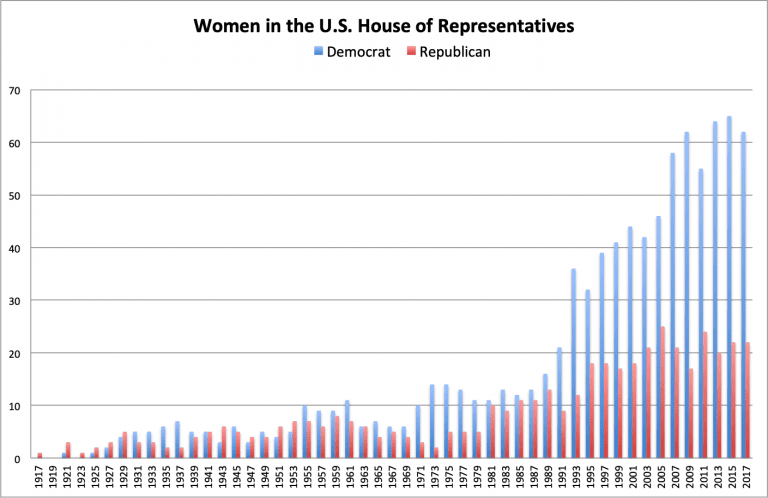
Fascinating, right? Republicans and Democrats elected relatively equal numbers of women candidates through the 1960s. In the 1970s, there was a sudden uptick in the number of Democratic women in the House while the number of Republican women actually declined slightly—until the 1980s, that is, when the number Republican women in the house jumped to meet the number of Democratic women.
Until the 1990s, that is. I grew up in the 1990s, and I’m becoming increasingly convinced that everything bad in this world has its origins in the 1990s. (I’m only partly kidding.) In the 1990s, the number of Democratic women in the house jumped by a lot while the number of Republican women grew slightly but stayed mostly stable. That pattern has continued to the present day.
It’s perhaps worth noting that the number of women in the House has yet to top 20%, even with the higher Democratic numbers seen above.
I have a Patreon! Please support my writing!
Previous Post

November 6, 2018
Vote, Ya'll

Browse Our Archives
Select a Category Atheism Evangelicalism/Fundamentalism Family Feminism Homeschool Meta Parenting Patriarchy Politics Purity Quiverfull Social Justice Uncategorized Worthwhile reads
Select a Month February 2021 January 2021 December 2020 November 2020 October 2020 September 2020 August 2020 July 2020 June 2020 May 2020 April 2020 March 2020 February 2020 January 2020 December 2019 November 2019 October 2019 September 2019 August 2019 July 2019 June 2019 May 2019 April 2019 March 2019 February 2019 January 2019 December 2018 November 2018 October 2018 September 2018 August 2018 July 2018 June 2018 May 2018 April 2018 March 2018 February 2018 January 2018 December 2017 November 2017 October 2017 September 2017 August 2017 July 2017 June 2017 May 2017 April 2017 March 2017 February 2017 January 2017 December 2016 November 2016 October 2016 September 2016 August 2016 July 2016 June 2016 May 2016 April 2016 March 2016 February 2016 January 2016 December 2015 November 2015 October 2015 September 2015 August 2015 July 2015 June 2015 May 2015 April 2015 March 2015 February 2015 January 2015 December 2014 November 2014 October 2014 September 2014 August 2014 July 2014 June 2014 May 2014 April 2014 March 2014 February 2014 January 2014 December 2013 November 2013 October 2013 September 2013 August 2013 July 2013 June 2013 May 2013 April 2013 March 2013 February 2013 January 2013 December 2012 November 2012 October 2012 September 2012 August 2012 July 2012 June 2012 May 2012 April 2012 March 2012 February 2012 January 2012 December 2011 November 2011 October 2011 September 2011 August 2011 July 2011 June 2011
Follow Us!
TAKE THE
Religious Wisdom Quiz
I was only seven years old when I became king and reigned for forty years in Jerusalem. Who am I?
Select your answer to see how you score.
Joash (or Jehoash) Josiah Manasseh Hezekiah
Related posts from Love, Joy, Feminism


Lesbian Duplex 310: An Open Thread

The Vision: NASA Is On the Case

Lesbian Duplex 309: An Open Thread
TRENDING AT PATHEOS Nonreligious

Dethroning Jesus and Enthroning Yourself
Jesus Never Asked to Be Worshipped. He Asked to Be Understood. Christianity...

Why Most Christians are Really Paulians and Jobians
I Don't Care, But It Matters Let's get this out of the...

Essential Tips to Successfully Navigate the Selling Process
Selling a house can feel overwhelming, but it doesn’t have to be....

To Make Remote Work Effective, Think About Others
The COVID-19 pandemic forced many companies to rapidly transition to remote work....

Flexibility Is Key to Solving Problems of Tomorrow
The world of work is undergoing a dramatic transformation. The COVID-19 pandemic...
view all Nonreligious blogs
Ad-Free & Subscriber Log-In Subscription Support
- About Us
- 2026 Calendar
- Videos
- Podcasts
- Library of World Religions
- Faith In Media Tracker
- Advertise With Us
- Write for Us
- Privacy Policy
- Terms of Service
- Do Not Sell My Data
- Contact Us
- Radiant Digital
- Manage Newsletter Subscriptions
- Unsubscribe From Notifications
- Sitemap
Copyright 2008-2026, Patheos. All rights reserved.
Subscription Support Ad-Free & Subscriber Log-In
Follow Patheos