
BuddhistCatholicContemplativeEvangelicalGeneral ChristianHinduJewishLatter-day SaintMuslimNew VisionsProgressive Christian
Beliefs
- Buddhist
- Catholic
- Contemplative
- Evangelical
- General Christian
- Hindu
- Jewish
- Latter-day Saint
- More Voices
- Muslim
- New Visions
- Pagan
- Progressive Christian
Topics
- Religion News
- Food and Religion
- Sports and Religion
- Religious Art
- Religious Music and Entertainment
- Religious Events
- History and Religion
- Style and Religion
- Politics and Religion
- Women in Religion
- Recreation Outdoors and Religion
- Business Finance and Religion
- Careers Workplace and Religion
- Education and Religion
- Family Parenting and Religion
- Health Fitness and Religion
- Home and Religion
- Relationships and Religion
- Technology and Religion
- Travel and Religion
Columnists
- Buddhist Columnists
- Business Finance and Religion Columnists
- Careers Workplace and Religion Columnists
- Catholic Columnists
- Contemplative Columnists
- Education and Religion Columnists
- Evangelists Columnists
- Family Parenting and Religion Columnists
- General Christian Columnists
- Health Fitness and Religion Columnists
- Hindu Columnists
- History and Religion Columnists
- Home and Religion Columnists
- Jewish Columnists
- More Voices Columnists
- Latter Day Columnists
- Muslim Columnists
- New Visions Columnists
- Nonreligious Columnists
- Pagan Columnists
- Politics and Religion Columnists
- Progressive Columnists
- Recreation Outdoors and Religion Columnists
- Relationships and Religion Columnists
- Religion News Columnists
- Religious Art Columnists
- Religious Events Columnists
- Religious Music and Entertainment Columnists
- Sports and Religion Columnists
- Style and Religion Columnists
- Technology and Religion Columnists
- Travel and Religion Columnists
- Women in Religion Columnists
Resource Library
- 2026 Calendar
- Library of World Religions
- The 100 Most Holy Places on Earth
- Patheos Answers
- Podcasts
- Videos
- Faith Leaders Database
- Anglican Episcopalian
- Bahai
- Baptist
- Buddhism
- Christianity
- Confucianism
- Eastern Orthodoxy
- Hinduism
- Holiness and Pentecostal
- ISKCON
- Islam
- Judaism
- Lutheran
- Methodist
- The Church of Jesus Christ of Latter-day Saints
- New Age
- Paganism
- Presbytarian and Reformed
- Protestantism
- Religion Behind the Scenes
- Roman Catholic
- Scientology
- Shia Islam
- Sikhism
- Sufism
- Sunni Islam
- Taoism
- Zen
- See all religions
Research Tools
 Ad-Free & Subscriber Log-In Subscription Support
Ad-Free & Subscriber Log-In Subscription Support
Follow Patheos 

- Trending:
- Forgiveness
- |
- Marriage
- |
- Consciousness
- |
- Death Penalty
- |
- Election
- |
- Halloween
 Love, Joy, Feminism
-
More
- Home
- Nonreligious
- Some Thoughts on Gender, Toxic Masculinity, and Role Models
Some Thoughts on Gender, Toxic Masculinity, and Role Models
Last updated on: March 28, 2018 at 9:39 am by Libby Anne
Some Thoughts on Gender, Toxic Masculinity, and Role Models 2018-03-28T09:39:57-04:00 Libby Anne
Patheos Explore the world's faith through different perspectives on religion and spirituality! Patheos has the views of the prevalent religions and spiritualities of the world.
I came upon this meme shared on Facebook by the page Geeks Gone Wild:
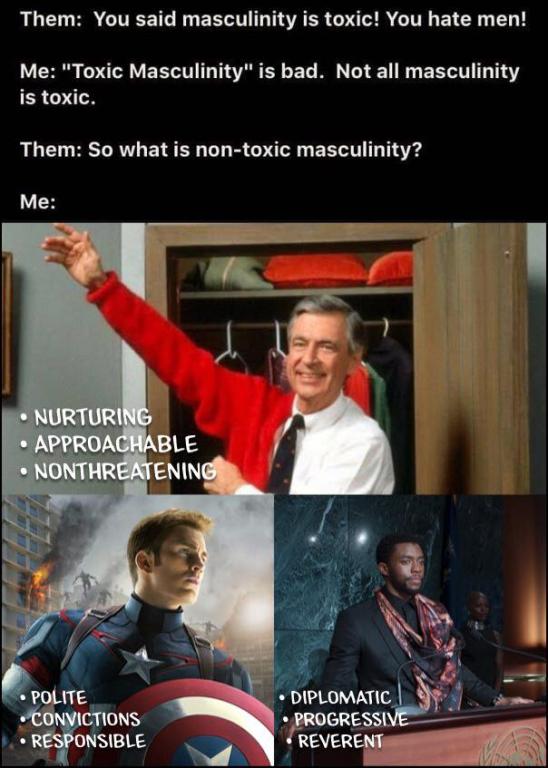
Description: At the top is a dialogue. “Them: You said masculinity is toxic! You hate men! Me: ‘Toxic Masculinity’ is bad. Not all masculinity is toxic. Them: So what is non-toxic masculinity? Me:” This dialogue is followed by pictures of three men: Mr. Rogers, Captain America, and T’Challa. By Mr. Rogers are the words ‘Nurturing, Approachable, Nonthreatening.’ By Captain America are the words ‘Polite, Convictions, Responsible.’ By T’Challa are the words ‘Diplomatic, Reverent, Progressive.'”
This meme brings up some of the themes from yesterday’s post on John Piper. Piper insisted that it must mean something to be masculine, something different from what it means to be feminine. There is a much larger conversation that has gone on, and is going on, surrounding what “masculine” and “feminine” mean and whether these terms or ideas have actual value (as opposed to emphasizing everyone’s “humanness”). But for many people, these ideas do have value.
Many feminists argue that in an ideal future, there would be no “masculine” or “feminine.” These distinctions and the differences they belie, after all, create stereotypes that frequently pigeonhole women (and men as well). They get in the way of seeing people as separate individuals with their own individual traits.
Transgender activists, however, point to the ongoing importance and meaning of the masculine and the feminine. When individuals transition from one gender to another, they make a statement that gender matters—that being perceived as masculine rather than feminine, or vice versa, is significant and has deep meaning.
Indeed, even non-binary individuals frequently identify to a certain extent with one gender or the other—the masculine or the feminine—using terms like “demiboy” or “demigirl.” How would transgender and nonbinary identities manifest in a society that did not have gender? I don’t think we can answer that, because such a world seems so very far away (and perhaps impossible).
For better or for worse, gender is the paradigm we have to work with. As a feminist, I approach this issue with two primary objectives: First, to ensure that “masculine” and “feminine” are understood broadly enough to give room for varieties of people; and Second, to ensure that the way we understand the “masculine” and the “feminine” is positive, helpful, and not toxic.
John Piper and other conservative evangelicals often have very specific constructs of the “masculine” and the “feminine” in mind. These constructs pigeonhole people. Women are to be nurturers, period. Men are to be providers, period. There’s no room for women who are assertive and not nurturing at all, or men who are nurturers and not particularly interested in the workplace.
I remember wishing, as a girl, that I was different than I was. I wasn’t graceful enough. I was too loud, too bossy, too talkative. I used to wonder how I would be able to submit to my future husband. Would I be able to be a sweet, nurturing, obedient wife? It was like being stuffed into a box I didn’t fit. And believe me, I did try to fit it. I wanted to fit it!
When we define gender and gender expression narrowly enough that children who do not fit in feel alienated and wonder if there is something wrong with them, there is a problem. When stereotypes about gender and gender expression shape individuals’ progression in the workplace regardless of individuals’ actual characteristics, there is a problem.
Where does the meme I began with come in? In addition to ensuring that narrow understandings of gender do not limit or alienate people, we also need to ensure that stereotypes about gender do not acculturate individuals into negative actions or values. This is where “toxic masculinity” comes in. Is masculinity about about guns and physical strength and bravado and the possession of beautiful women? For too many, it is.
For too many, it is “masculine” to settle disputes with violence. For too many, it is “masculine” to push women for sexual favors even after they say no. Challenging these ideas and discussing the role of “toxic masculinity” in domestic violence or mass shooting situations garners allegations of hating men. Using violence to solve problems and treating women as objects to be possessed, and on and on, is treated as somehow inherent to maleness.
Except that it isn’t.
This is why positive portrayals of strong individuals who are masculine (i.e. they are men) but also embody positive values and virtues is so important. Who do we want our little boys to emulate? What heroes do we want to set up as role models for them?
We need heroes of every gender who embody a variety of characteristics—nurturing and caring, assertiveness and daring, problem-solving and civic mindedness. We need T’Challa, and we need Katherine Johnson. We need Mr. Rogers and we need Wonder Woman.
We need to teach children that masculinity—and femininity—are not limiting. We need to teach them that they have the ability to define who they are—whether masculine, feminine, or nonbinary—and that they have a wide pallet to paint from.
I have a Patreon! Please support my writing!
Previous Post

March 27, 2018
Shorter John Piper: Women Can Be Possessions, or They Can Be Prey
Next Post

March 29, 2018 TTUAC: Normal Is Not Enough
Browse Our Archives
Select a Category Atheism Evangelicalism/Fundamentalism Family Feminism Homeschool Meta Parenting Patriarchy Politics Purity Quiverfull Social Justice Uncategorized Worthwhile reads
Select a Month February 2021 January 2021 December 2020 November 2020 October 2020 September 2020 August 2020 July 2020 June 2020 May 2020 April 2020 March 2020 February 2020 January 2020 December 2019 November 2019 October 2019 September 2019 August 2019 July 2019 June 2019 May 2019 April 2019 March 2019 February 2019 January 2019 December 2018 November 2018 October 2018 September 2018 August 2018 July 2018 June 2018 May 2018 April 2018 March 2018 February 2018 January 2018 December 2017 November 2017 October 2017 September 2017 August 2017 July 2017 June 2017 May 2017 April 2017 March 2017 February 2017 January 2017 December 2016 November 2016 October 2016 September 2016 August 2016 July 2016 June 2016 May 2016 April 2016 March 2016 February 2016 January 2016 December 2015 November 2015 October 2015 September 2015 August 2015 July 2015 June 2015 May 2015 April 2015 March 2015 February 2015 January 2015 December 2014 November 2014 October 2014 September 2014 August 2014 July 2014 June 2014 May 2014 April 2014 March 2014 February 2014 January 2014 December 2013 November 2013 October 2013 September 2013 August 2013 July 2013 June 2013 May 2013 April 2013 March 2013 February 2013 January 2013 December 2012 November 2012 October 2012 September 2012 August 2012 July 2012 June 2012 May 2012 April 2012 March 2012 February 2012 January 2012 December 2011 November 2011 October 2011 September 2011 August 2011 July 2011 June 2011
Follow Us!
TAKE THE
Religious Wisdom Quiz
Which king of Judah burned the scroll of Jeremiah's prophecy?
Select your answer to see how you score.
Jehoiakim Josiah Zedekiah Hezekiah
Related posts from Love, Joy, Feminism


"So Your Problem with Christianity is the Jesus...


TRENDING AT PATHEOS Nonreligious

Dethroning Jesus and Enthroning Yourself
Jesus Never Asked to Be Worshipped. He Asked to Be Understood. Christianity...

Why Most Christians are Really Paulians and Jobians
I Don't Care, But It Matters Let's get this out of the...

Essential Tips to Successfully Navigate the Selling Process
Selling a house can feel overwhelming, but it doesn’t have to be....

To Make Remote Work Effective, Think About Others
The COVID-19 pandemic forced many companies to rapidly transition to remote work....

Flexibility Is Key to Solving Problems of Tomorrow
The world of work is undergoing a dramatic transformation. The COVID-19 pandemic...
view all Nonreligious blogs
Ad-Free & Subscriber Log-In Subscription Support
- About Us
- 2026 Calendar
- Videos
- Podcasts
- Library of World Religions
- Faith In Media Tracker
- Advertise With Us
- Write for Us
- Privacy Policy
- Terms of Service
- Do Not Sell My Data
- Contact Us
- Radiant Digital
- Manage Newsletter Subscriptions
- Unsubscribe From Notifications
- Sitemap
Copyright 2008-2026, Patheos. All rights reserved.
Subscription Support Ad-Free & Subscriber Log-In
Follow Patheos