
BuddhistCatholicContemplativeEvangelicalGeneral ChristianHinduJewishLatter-day SaintMuslimNew VisionsProgressive Christian
Beliefs
- Buddhist
- Catholic
- Contemplative
- Evangelical
- General Christian
- Hindu
- Jewish
- Latter-day Saint
- More Voices
- Muslim
- New Visions
- Pagan
- Progressive Christian
Topics
- Religion News
- Food and Religion
- Sports and Religion
- Religious Art
- Religious Music and Entertainment
- Religious Events
- History and Religion
- Style and Religion
- Politics and Religion
- Women in Religion
- Recreation Outdoors and Religion
- Business Finance and Religion
- Careers Workplace and Religion
- Education and Religion
- Family Parenting and Religion
- Health Fitness and Religion
- Home and Religion
- Relationships and Religion
- Technology and Religion
- Travel and Religion
Columnists
- Buddhist Columnists
- Business Finance and Religion Columnists
- Careers Workplace and Religion Columnists
- Catholic Columnists
- Contemplative Columnists
- Education and Religion Columnists
- Evangelists Columnists
- Family Parenting and Religion Columnists
- General Christian Columnists
- Health Fitness and Religion Columnists
- Hindu Columnists
- History and Religion Columnists
- Home and Religion Columnists
- Jewish Columnists
- More Voices Columnists
- Latter Day Columnists
- Muslim Columnists
- New Visions Columnists
- Nonreligious Columnists
- Pagan Columnists
- Politics and Religion Columnists
- Progressive Columnists
- Recreation Outdoors and Religion Columnists
- Relationships and Religion Columnists
- Religion News Columnists
- Religious Art Columnists
- Religious Events Columnists
- Religious Music and Entertainment Columnists
- Sports and Religion Columnists
- Style and Religion Columnists
- Technology and Religion Columnists
- Travel and Religion Columnists
- Women in Religion Columnists
Resource Library
- 2026 Calendar
- Library of World Religions
- The 100 Most Holy Places on Earth
- Patheos Answers
- Podcasts
- Videos
- Faith Leaders Database
- Anglican Episcopalian
- Bahai
- Baptist
- Buddhism
- Christianity
- Confucianism
- Eastern Orthodoxy
- Hinduism
- Holiness and Pentecostal
- ISKCON
- Islam
- Judaism
- Lutheran
- Methodist
- The Church of Jesus Christ of Latter-day Saints
- New Age
- Paganism
- Presbytarian and Reformed
- Protestantism
- Religion Behind the Scenes
- Roman Catholic
- Scientology
- Shia Islam
- Sikhism
- Sufism
- Sunni Islam
- Taoism
- Zen
- See all religions
Research Tools
 Ad-Free & Subscriber Log-In Subscription Support
Ad-Free & Subscriber Log-In Subscription Support
Follow Patheos 

- Trending:
- Forgiveness
- |
- Marriage
- |
- Consciousness
- |
- Death Penalty
- |
- Election
- |
- Halloween
 Love, Joy, Feminism
-
More
- Home
- Nonreligious
- Neither of These Evangelical Responses to Depression is Particularly Helpful
Neither of These Evangelical Responses to Depression is Particularly Helpful
Last updated on: February 15, 2018 at 3:06 pm by Libby Anne
Neither of These Evangelical Responses to Depression is Particularly Helpful 2018-02-15T15:06:05-04:00 Libby Anne
Patheos Explore the world's faith through different perspectives on religion and spirituality! Patheos has the views of the prevalent religions and spiritualities of the world.
The way evangelicals approach mental health problems has often been ineffective and unhelpful. The evangelical approach to these issues, however, is not monolithic. (In fact, amazingly, Focus on the Family treats depression seriously and presents medication as an effective solution.) But two strains of thought present in many evangelical churches can keep individuals from seeking diagnosis or getting treatment. The first treats mental health problems as failures of faith—the fault of the individual.
Have a look at this tweet by influential evangelical theologian John Piper:
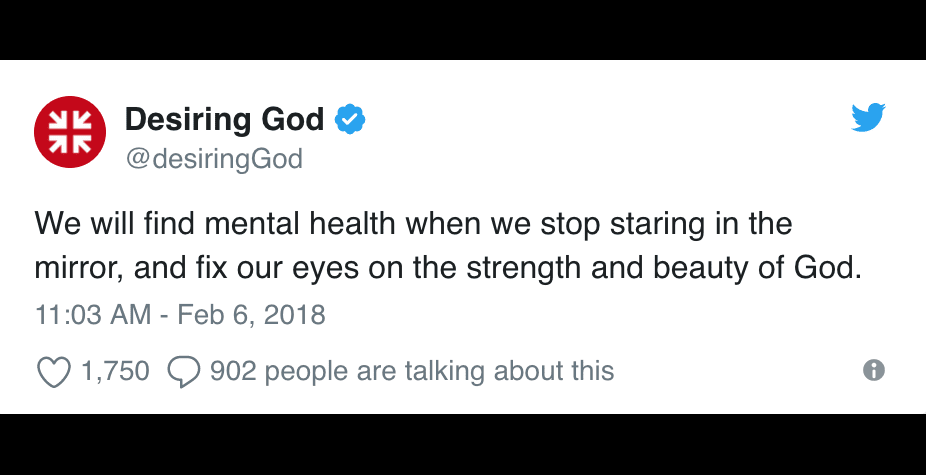
Text: “We will find mental health when we stop staring in the mirror, and fix our eyes on the strength and beauty of God.”
The other belief present in many evangelical churches holds that happiness is not something that we should seek in and of itself. This is the root of Piper’s mention of staring in the mirror—the idea that caring about our mental health (rather than focusing on God) is self-centered and selfish—but it is also different. Piper suggests that if we would stop focusing on the mirror and start focusing on God, our mental health problems will go away. But in a post this month in Christianity Today titled Blessed Are the Unsatisfied, evangelical author Amy Simpson suggests that maybe we may not be meant to be happy.
“We often assume that loneliness and dissatisfaction are symptoms of spiritual failure,” Simpson writes, echoing Piper’s tweet. “But what if they’re signs of healthy faith?” As she explains:
While most Christians freely embrace the idea that the world doesn’t satisfy, many believe the remedy is to find contentment in a relationship with Christ. As long as we are in relationship with Jesus, he will fill that “God-shaped hole” inside us, and once that hole is filled, we will no longer ache with desire or longing.
The trouble is, while knowing and following Jesus has its priceless rewards and eventually leads to fulfillment, it won’t fully deliver on this promise now. Sometimes obedience makes a person miserable. Sometimes it leads to suffering or even death. Yes, a relationship with God can bring comfort, peace, and even joy in hard circumstances. But it may not bring satisfaction or happiness—at least in complete and lasting form.
A believer’s faith, Simpson writes, may not be enough to satisfy them. Lack of satisfaction with life, she argues, may not be a spiritual problem at all. For those evangelicals who may may have been taught to blame themselves for their own depression or other mental health problems, this is a helpful message. But there’s a problem.
Have a look at this bit here:
In other words, maybe we don’t feel truly satisfied because we aren’t. Maybe God doesn’t want to take away our longings yet. When we grow deeper in faith and closer to Jesus, we’re likely to find ourselves less—not more—satisfied with life here and now.
Scripture gives us evidence of these truths.
Consider just a few of the Old Testament prophets. On the heels of his great victory over the prophets of Baal on Mount Carmel, Elijah ran for his life, became depressed and suicidal, and complained to God (inaccurately) that he was the only faithful prophet left alive.
And then there’s this:
What about Jesus himself? Was he satisfied by his life in this world? “He was despised and rejected by mankind, a man of suffering, and familiar with pain” (Isa. 53:3). He wept over Jerusalem, matter-of-factly told a potential follower that following him would be no picnic, and lost his temper over corruption in the temple. When he faced death by crucifixion, he spent the night in prayer and told his disciples, “My soul is overwhelmed with sorrow to the point of death.”
Of course, we cannot experience what Jesus experienced. We’ll never understand what it meant for him to don human form with its limitations, pains, and sorrows. But like Jesus, we should be uncomfortable here. We should be unsatisfied by what we experience in this life. We were made for another world, and God wants his people to long for it.
Do you see what’s missing here? There’s no suggestion that depression or suicidality should be treated. Instead, there’s an assumption that being unsatisfied with life and unfulfilled—and depressed or suicidal—is to be expected in this world. It’s just how it is, and it won’t change until we reach the next world—life after death. It should be unsurprising that that message would tend away from treatment and medication.
While I’m glad that there are some evangelicals who support the diagnosis and treatment of mental health issues—and there are—evangelical luminaries like John Piper and Christianity Today are still promoting ideas that present mental health issues as a personal failure or as something to simply suffer through. These two very different answers to the problem of being unhappy or depressed—“you’re just not focusing enough on God” and “you’re not supposed to be happy”—are equally unhelpful (and even dangerous).
I have a Patreon! Please support my writing!
Previous Post

February 14, 2018
Answers in Genesis Plays Fast and Loose with Mitochondrial DNA
Next Post

February 16, 2018 Voice in the Wind: Hadassah Is Given in Marriage (Sort Of)
Browse Our Archives
Select a Category Atheism Evangelicalism/Fundamentalism Family Feminism Homeschool Meta Parenting Patriarchy Politics Purity Quiverfull Social Justice Uncategorized Worthwhile reads
Select a Month February 2021 January 2021 December 2020 November 2020 October 2020 September 2020 August 2020 July 2020 June 2020 May 2020 April 2020 March 2020 February 2020 January 2020 December 2019 November 2019 October 2019 September 2019 August 2019 July 2019 June 2019 May 2019 April 2019 March 2019 February 2019 January 2019 December 2018 November 2018 October 2018 September 2018 August 2018 July 2018 June 2018 May 2018 April 2018 March 2018 February 2018 January 2018 December 2017 November 2017 October 2017 September 2017 August 2017 July 2017 June 2017 May 2017 April 2017 March 2017 February 2017 January 2017 December 2016 November 2016 October 2016 September 2016 August 2016 July 2016 June 2016 May 2016 April 2016 March 2016 February 2016 January 2016 December 2015 November 2015 October 2015 September 2015 August 2015 July 2015 June 2015 May 2015 April 2015 March 2015 February 2015 January 2015 December 2014 November 2014 October 2014 September 2014 August 2014 July 2014 June 2014 May 2014 April 2014 March 2014 February 2014 January 2014 December 2013 November 2013 October 2013 September 2013 August 2013 July 2013 June 2013 May 2013 April 2013 March 2013 February 2013 January 2013 December 2012 November 2012 October 2012 September 2012 August 2012 July 2012 June 2012 May 2012 April 2012 March 2012 February 2012 January 2012 December 2011 November 2011 October 2011 September 2011 August 2011 July 2011 June 2011
Follow Us!
TAKE THE
Religious Wisdom Quiz
There is a season for everything under heaven—a time to be born and a time to do what?
Select your answer to see how you score.
Sing Rest Die Live
Related posts from Love, Joy, Feminism

Maybe Let's Not Read More Puritans


"So Your Problem with Christianity is the Jesus...

No, the "Second Shift" Isn't Feminism's Fault
TRENDING AT PATHEOS Nonreligious

Dethroning Jesus and Enthroning Yourself
Jesus Never Asked to Be Worshipped. He Asked to Be Understood. Christianity...

Why Most Christians are Really Paulians and Jobians
I Don't Care, But It Matters Let's get this out of the...

Essential Tips to Successfully Navigate the Selling Process
Selling a house can feel overwhelming, but it doesn’t have to be....

To Make Remote Work Effective, Think About Others
The COVID-19 pandemic forced many companies to rapidly transition to remote work....

Flexibility Is Key to Solving Problems of Tomorrow
The world of work is undergoing a dramatic transformation. The COVID-19 pandemic...
view all Nonreligious blogs
Ad-Free & Subscriber Log-In Subscription Support
- About Us
- 2026 Calendar
- Videos
- Podcasts
- Library of World Religions
- Faith In Media Tracker
- Advertise With Us
- Write for Us
- Privacy Policy
- Terms of Service
- Do Not Sell My Data
- Contact Us
- Radiant Digital
- Manage Newsletter Subscriptions
- Unsubscribe From Notifications
- Sitemap
Copyright 2008-2026, Patheos. All rights reserved.
Subscription Support Ad-Free & Subscriber Log-In
Follow Patheos