
BuddhistCatholicContemplativeEvangelicalGeneral ChristianHinduJewishLatter-day SaintMuslimNew VisionsProgressive Christian
Beliefs
- Buddhist
- Catholic
- Contemplative
- Evangelical
- General Christian
- Hindu
- Jewish
- Latter-day Saint
- More Voices
- Muslim
- New Visions
- Pagan
- Progressive Christian
Topics
- Religion News
- Food and Religion
- Sports and Religion
- Religious Art
- Religious Music and Entertainment
- Religious Events
- History and Religion
- Style and Religion
- Politics and Religion
- Women in Religion
- Recreation Outdoors and Religion
- Business Finance and Religion
- Careers Workplace and Religion
- Education and Religion
- Family Parenting and Religion
- Health Fitness and Religion
- Home and Religion
- Relationships and Religion
- Technology and Religion
- Travel and Religion
Columnists
- Buddhist Columnists
- Business Finance and Religion Columnists
- Careers Workplace and Religion Columnists
- Catholic Columnists
- Contemplative Columnists
- Education and Religion Columnists
- Evangelists Columnists
- Family Parenting and Religion Columnists
- General Christian Columnists
- Health Fitness and Religion Columnists
- Hindu Columnists
- History and Religion Columnists
- Home and Religion Columnists
- Jewish Columnists
- More Voices Columnists
- Latter Day Columnists
- Muslim Columnists
- New Visions Columnists
- Nonreligious Columnists
- Pagan Columnists
- Politics and Religion Columnists
- Progressive Columnists
- Recreation Outdoors and Religion Columnists
- Relationships and Religion Columnists
- Religion News Columnists
- Religious Art Columnists
- Religious Events Columnists
- Religious Music and Entertainment Columnists
- Sports and Religion Columnists
- Style and Religion Columnists
- Technology and Religion Columnists
- Travel and Religion Columnists
- Women in Religion Columnists
Resource Library
- 2026 Calendar
- Library of World Religions
- The 100 Most Holy Places on Earth
- Patheos Answers
- Podcasts
- Videos
- Faith Leaders Database
- Anglican Episcopalian
- Bahai
- Baptist
- Buddhism
- Christianity
- Confucianism
- Eastern Orthodoxy
- Hinduism
- Holiness and Pentecostal
- ISKCON
- Islam
- Judaism
- Lutheran
- Methodist
- The Church of Jesus Christ of Latter-day Saints
- New Age
- Paganism
- Presbytarian and Reformed
- Protestantism
- Religion Behind the Scenes
- Roman Catholic
- Scientology
- Shia Islam
- Sikhism
- Sufism
- Sunni Islam
- Taoism
- Zen
- See all religions
Research Tools
 Ad-Free & Subscriber Log-In Subscription Support
Ad-Free & Subscriber Log-In Subscription Support
Follow Patheos 

- Trending:
- Forgiveness
- |
- Marriage
- |
- Consciousness
- |
- Death Penalty
- |
- Election
- |
- Halloween
 Love, Joy, Feminism
-
More
- Home
- Nonreligious
- Answers in Genesis Says Humans Did Not Come From Africa—And It Gets Weird
Answers in Genesis Says Humans Did Not Come From Africa—And It Gets Weird
Last updated on: June 26, 2017 at 5:00 am by Libby Anne
Answers in Genesis Says Humans Did Not Come From Africa—And It Gets Weird 2017-06-22T10:27:50-04:00 Libby Anne
Patheos Explore the world's faith through different perspectives on religion and spirituality! Patheos has the views of the prevalent religions and spiritualities of the world.
In researching a recent article on creationism, I came upon a particularly strange claim. One reason evolutionary scientists believe that humans originated in Africa is the greater diversity within mitochondrial DNA among peoples in Africa than among peoples elsewhere. Of course, creationists claim that humans originated in Turkey, at Ararat, where Noah’s Ark landed after the flood, and not in Africa. That means they have to explain the diversity in African mitochondrial DNA.
And so they have. Sort of. Frankly, I almost had to check the URL to make sure I was still on the Answers in Genesis website, because their solution was that out there. Here is an excerpt from an article by Answers in Genesis’ Nathanial T. Jeanson:
…African ethnic groups have about twice as many mtDNA differences among them as do non-African ethnic groups. If you assume that the rate of mtDNA mutations is constant with time, the fact of greater mtDNA diversity in Africans implies that Africans have been around longer than non-Africans.
However, implicit in this conclusion is a technical assumption about the mtDNA mutation rates. … Evolutionists implicitly assume that the generation times (time from birth of parent to birth of child) across all ethnic groups are the same.
However, marriage data from the United Nations suggests that this assumption is not valid (Table 5). On average, African females marry earlier in life than non-African females. About 32% of African women are married by ages 15–19 whereas only 12% of non-African women are married by the same age. … Since mtDNA is passed on maternally, these data imply that some African ethnic groups have twice as many mtDNA differences because twice as many generations have passed in their lineages as compared to non-African lineages.
…the YEC predictions correctly predicted the African mtDNA differences under the assumption of a higher generation time (e.g., assuming a generation time of 15 years…. The mtDNA differences among non-Africans … were predictable under the YEC model by assuming a generation time of 25 years…. Thus, the fact of higher mtDNA diversity in Africans does indeed appear to be due to their earlier age of marriage (and, presumably, of child-bearing), not to their supposed ancient evolutionary origin.
Yes, you read that right. The claim here is that Africans have more diverse mitochondrial DNA than non-Africans because they have seen twice as many generations as non-Africans. Yes, the claim really is that Africans have borne children at substantially lower ages than non-Africans for all time, a claim made based on modern marriage data from the United Nations.
Before we get into any of that, I want to note that Jeanson’s assumed generation time of 15 years for Africans is not reflected in modern data. This page suggests that average age of a mother at first birth in most African countries hovers around 19 to 21. Why Jeanson assumed a generation time of 15 years at all when, according to his own data, fewer than half (32%) of African women are married not by age 15-19 is a mystery. After all, 32% of women being married by age 15-19 suggests that only a small number would have married at 15, even if you assume an equal distribution.
Let’s have a look at this study to flesh this picture out:
Estimates … were obtained … for the most recent DHS surveys in 62 developing countries for which data files are available for public use (and with sample sizes of married women above 3000).
…
A full analysis of levels and trends in all 62 countries is beyond the scope of this methodological study, but a few findings can be noted. Estimates of M(t) [average age at first birth] vary widely among countries from a low of 19.1 in Niger (2006) to a high of 24.7 in the Maldives (2009). The unweighted averages of M(t) for countries in each of four regions are presented in Table 1. The low value for sub-Saharan Africa is unsurprising since this continent has not progressed as far through the fertility transition as the other regions. North Africa/West Asia and South Asia have the highest averages and Latin America has intermediate values.
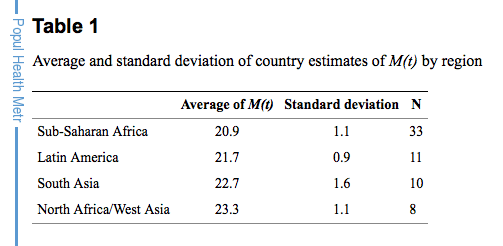
Table 1 compares the average age of first birth in 62 developing countries in Sub-Saharan Africa, Latin America, South Asia, and North Africa/West Asia, listing the average for each area. Sub-Saharan Africa has the lowest average age at first birth—20.9 years—while North Africa/West Asia has the highest—23.3 years—and Latin America and South Asia have averages in between—21.7 years and 22.7 years respectively. To say that this data does not back up Jeanson’s claim that generations occur twice as fast in Africa as elsewhere would be an understatement.
Jeanson has another problem as well. The authors of the above article note that developing countries in sub-Saharan Africa likely have the lowest average age at first birth because “this continent has not progressives as far through the fertility transition as the other regions.” In other words, there are modern reasons for Africa’s comparatively low current age at first birth vis a vis other countries. This is not some underlying constant.
The average of of first birth in the U.S. has in recent years increased to around 26. Note that I used the word increased. Average age at first birth is something that changes over time. The relatively high average age of first birth in many western countries today is due to specific circumstances associated with modernity (circumstances that will increasingly affect sub-Saharan Africa as well). Regardless of region, the average age at first birth varies depending on many factors—including the availability of resources—and changes over time.
One final note: The assumption that African populations have borne children earlier than other populations for all time strikes me as vaguely racist. Only a few months ago a middle aged white woman told me of her surprise at learning that the mother of a 34-year-old woman she had met was celebrating her 50th birthday; noting that this acquaintance was black, she mused that teenage pregnancy was “a part of their culture.” And yet, the average age at first birth among African American women (24.2 years) is only slightly lower than the overall average age at first birth (26.3).
Women of color have long been portrayed as especially sexual, promiscuous, or fertile; Jeanson’s suggestion that African women have borne children at such early ages that they have literally doubled the rate at which generations occur in that continent as compared to other areas (and that this has been the case for all time) occurs within the context of this casual cultural racism, and cannot help but be informed by it (even if unconsciously, if I’m being charitable).
If you need me, I’ll be over here facepalming.
Previous Post

June 25, 2017
Lesbian Duplex 126: An Open Thread
Next Post

June 27, 2017 Bill Cosby, the Church, and Supporting Victims
Browse Our Archives
Select a Category Atheism Evangelicalism/Fundamentalism Family Feminism Homeschool Meta Parenting Patriarchy Politics Purity Quiverfull Social Justice Uncategorized Worthwhile reads
Select a Month February 2021 January 2021 December 2020 November 2020 October 2020 September 2020 August 2020 July 2020 June 2020 May 2020 April 2020 March 2020 February 2020 January 2020 December 2019 November 2019 October 2019 September 2019 August 2019 July 2019 June 2019 May 2019 April 2019 March 2019 February 2019 January 2019 December 2018 November 2018 October 2018 September 2018 August 2018 July 2018 June 2018 May 2018 April 2018 March 2018 February 2018 January 2018 December 2017 November 2017 October 2017 September 2017 August 2017 July 2017 June 2017 May 2017 April 2017 March 2017 February 2017 January 2017 December 2016 November 2016 October 2016 September 2016 August 2016 July 2016 June 2016 May 2016 April 2016 March 2016 February 2016 January 2016 December 2015 November 2015 October 2015 September 2015 August 2015 July 2015 June 2015 May 2015 April 2015 March 2015 February 2015 January 2015 December 2014 November 2014 October 2014 September 2014 August 2014 July 2014 June 2014 May 2014 April 2014 March 2014 February 2014 January 2014 December 2013 November 2013 October 2013 September 2013 August 2013 July 2013 June 2013 May 2013 April 2013 March 2013 February 2013 January 2013 December 2012 November 2012 October 2012 September 2012 August 2012 July 2012 June 2012 May 2012 April 2012 March 2012 February 2012 January 2012 December 2011 November 2011 October 2011 September 2011 August 2011 July 2011 June 2011
Follow Us!
TAKE THE
Religious Wisdom Quiz
In Revelation, what are the names of the two cities that the two witnesses' bodies lie in?
Select your answer to see how you score.
Damascus and Tyre Rome and Athens Sodom and Egypt (figuratively called) Babylon and Jerusalem
Related posts from Love, Joy, Feminism

Maybe Let's Not Read More Puritans


"So Your Problem with Christianity is the Jesus...

No, the "Second Shift" Isn't Feminism's Fault
TRENDING AT PATHEOS Nonreligious

Dethroning Jesus and Enthroning Yourself
Jesus Never Asked to Be Worshipped. He Asked to Be Understood. Christianity...

Why Most Christians are Really Paulians and Jobians
I Don't Care, But It Matters Let's get this out of the...

Essential Tips to Successfully Navigate the Selling Process
Selling a house can feel overwhelming, but it doesn’t have to be....

To Make Remote Work Effective, Think About Others
The COVID-19 pandemic forced many companies to rapidly transition to remote work....

Flexibility Is Key to Solving Problems of Tomorrow
The world of work is undergoing a dramatic transformation. The COVID-19 pandemic...
view all Nonreligious blogs
Ad-Free & Subscriber Log-In Subscription Support
- About Us
- 2026 Calendar
- Videos
- Podcasts
- Library of World Religions
- Faith In Media Tracker
- Advertise With Us
- Write for Us
- Privacy Policy
- Terms of Service
- Do Not Sell My Data
- Contact Us
- Radiant Digital
- Manage Newsletter Subscriptions
- Unsubscribe From Notifications
- Sitemap
Copyright 2008-2026, Patheos. All rights reserved.
Subscription Support Ad-Free & Subscriber Log-In
Follow Patheos