
BuddhistCatholicContemplativeEvangelicalGeneral ChristianHinduJewishLatter-day SaintMuslimNew VisionsProgressive Christian
Beliefs
- Buddhist
- Catholic
- Contemplative
- Evangelical
- General Christian
- Hindu
- Jewish
- Latter-day Saint
- More Voices
- Muslim
- New Visions
- Pagan
- Progressive Christian
Topics
- Religion News
- Food and Religion
- Sports and Religion
- Religious Art
- Religious Music and Entertainment
- Religious Events
- History and Religion
- Style and Religion
- Politics and Religion
- Women in Religion
- Recreation Outdoors and Religion
- Business Finance and Religion
- Careers Workplace and Religion
- Education and Religion
- Family Parenting and Religion
- Health Fitness and Religion
- Home and Religion
- Relationships and Religion
- Technology and Religion
- Travel and Religion
Columnists
- Buddhist Columnists
- Business Finance and Religion Columnists
- Careers Workplace and Religion Columnists
- Catholic Columnists
- Contemplative Columnists
- Education and Religion Columnists
- Evangelists Columnists
- Family Parenting and Religion Columnists
- General Christian Columnists
- Health Fitness and Religion Columnists
- Hindu Columnists
- History and Religion Columnists
- Home and Religion Columnists
- Jewish Columnists
- More Voices Columnists
- Latter Day Columnists
- Muslim Columnists
- New Visions Columnists
- Nonreligious Columnists
- Pagan Columnists
- Politics and Religion Columnists
- Progressive Columnists
- Recreation Outdoors and Religion Columnists
- Relationships and Religion Columnists
- Religion News Columnists
- Religious Art Columnists
- Religious Events Columnists
- Religious Music and Entertainment Columnists
- Sports and Religion Columnists
- Style and Religion Columnists
- Technology and Religion Columnists
- Travel and Religion Columnists
- Women in Religion Columnists
Resource Library
- 2026 Calendar
- Library of World Religions
- The 100 Most Holy Places on Earth
- Patheos Answers
- Podcasts
- Videos
- Faith Leaders Database
- Anglican Episcopalian
- Bahai
- Baptist
- Buddhism
- Christianity
- Confucianism
- Eastern Orthodoxy
- Hinduism
- Holiness and Pentecostal
- ISKCON
- Islam
- Judaism
- Lutheran
- Methodist
- The Church of Jesus Christ of Latter-day Saints
- New Age
- Paganism
- Presbytarian and Reformed
- Protestantism
- Religion Behind the Scenes
- Roman Catholic
- Scientology
- Shia Islam
- Sikhism
- Sufism
- Sunni Islam
- Taoism
- Zen
- See all religions
Research Tools
 Ad-Free & Subscriber Log-In Subscription Support
Ad-Free & Subscriber Log-In Subscription Support
Follow Patheos 

- Trending:
- Forgiveness
- |
- Marriage
- |
- Consciousness
- |
- Death Penalty
- |
- Election
- |
- Halloween
 Love, Joy, Feminism
-
More
- Home
- Nonreligious
- Hispanic Christians and Evangelical Persecution Narratives
Hispanic Christians and Evangelical Persecution Narratives
Last updated on: May 15, 2017 at 12:13 pm by Libby Anne
Hispanic Christians and Evangelical Persecution Narratives 2017-05-15T12:13:02-04:00 Libby Anne
Patheos Explore the world's faith through different perspectives on religion and spirituality! Patheos has the views of the prevalent religions and spiritualities of the world.
“Half of Hispanic Christians Worry About Deportation Under Trump,” read the headline of a Christianity Today article earlier this year. While still conservative, the evangelical magazine Christianity Today has increasingly become a voice of reason within the evangelical community. In pointing this out, the author was noting something many evangelicals had probably not considered.
White evangelical Christians overwhelmingly voted for Trump, despite his insistence on connecting Hispanic immigrants with crime and his promise to deport undocumented immigrants. These same evangelicals are quick to focus on Christians abroad who suffer violence or persecution, and to sympathize with Christian communities in other nations or with fellow Christians they believe are being persecuted in the U.S. But what of Christian communities in their own country that may be torn apart by Trump’s policies?
Consider the white evangelical Christian response to ISIS. A year or two ago many of my evangelical friends on Facebook changed their profile picture to an image of old arabic lettering on black. Curious, I looked it up and found that it was an expression of solidarity for those Christians suffering under ISIS. I had known about ISIS for some time, and I knew that their victims were diverse—Christians, Yazidis, Muslims who didn’t share their particular beliefs.
In other words, ISIS didn’t target Christians specifically; the group tortured, enslaved, or killed anyone who did not share their specific approach to Islam. Given this reality, white evangelicals’ insistence on making ISIS about Christian persecution seemed narrow and self-absorbed.
What of the headline I began this article with? Half of Hispanic Christians Worry About Deportation Under Trump. The vast majority of the Hispanic population in the U.S. is Christian. True, many evangelicals do not view Hispanic Catholics as saved, but a growing number of Hispanics are Protestant. And while, yes, there is a far cry between deportation and terror at the hands of ISIS, both involve families and communities being torn apart. And I’m left wondering how evangelicals determine which groups—and which problems—they care about, and which they don’t.
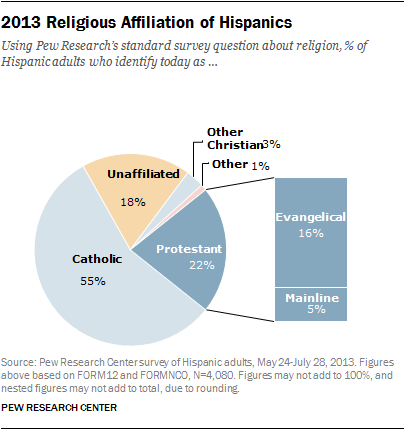
What sort of trouble counts as reason for concern, and what sort of trouble doesn’t? Many evangelicals support the removal of Obamacare provisions that protect the health of millions of Americans, most of them Christians. There are two reasons this looks different to evangelicals, however. First, evangelicalism stems from a tradition that has long valued and emphasized martyrdom. Christians dying due to persecution for their religion looks completely different from Christians dying from untreated diabetes or pancreatic cancer. Second, evangelicals believe they have a solution to death due to lack of healthcare—the sort of cost-sharing programs they elevate as a replacement for health insurance.
There’s also an issue regarding who counts as part of the in-group and who does not. Evangelicals don’t typically see mainline Christians, or Catholics, as part of their group. That changes when it comes to religious persecution abroad, however. Abroad, evangelicals draw attention to the persecution of Christian groups that they would consider heretic in other circumstances—groups whose theology and practice are far different from their own. Within the U.S., in contrast, mainline Christians are frequently viewed as an oppositional force—especially when those groups endorse progressive positions or ideas.
Do publications like Christianity Today have a chance at convincing evangelicals to see undocumented immigrants as part of their in-group? I suspect not, and here’s why: Those who support Trump’s hardline on immigration, including many evangelicals, typically center the problem as one of laws being broken. They frequently discuss all undocumented workers as criminals, because they committed the “crime” of entering the country without proper permission. From their perspective, having your community and your family torn apart is what you get for breaking the law, regardless of your religion.
Of course, the persecution of Christians abroad can be a matter of laws being broken as well—laws against blasphemy, for instance. Evangelicals rightly judge these laws unjust. Laws controlling the freedom of movement, in contrast, are judged to be just. I’m not so sure—but then, I’m also not an evangelical, or politically conservative. I wonder whether coming face to face with the reality of deportation—with separated families and holes torn in communities—would change evangelicals’ minds about the justness of such laws, or of their implementation. Maybe—but then again, maybe not.
Where we choose to exercise compassion—and where we do not—is a fascinating thing. Who and what we choose deserving of our compassion—and who and what we judge not deserving—is just as interesting.
Note: According to the New York Times, the majority of undocumented immigrants are from Mexico or elsewhere in Central and South America. However, two-thirds of all Hispanic Americans were born in the United States and more green card holders are from Mexico than from any other country. A comparison of these two infographics suggests that half of all immigrants to the U.S. from Mexico are properly documented. In this article I discuss undocumented Hispanic immigrants to the U.S., because that is where much of the rhetoric on immigration currently centers.
Previous Post

May 14, 2017
Lesbian Duplex 120: An Open Thread
Next Post

May 16, 2017 Confederate Monuments and "Historical Vandalism"
Browse Our Archives
Select a Category Atheism Evangelicalism/Fundamentalism Family Feminism Homeschool Meta Parenting Patriarchy Politics Purity Quiverfull Social Justice Uncategorized Worthwhile reads
Select a Month February 2021 January 2021 December 2020 November 2020 October 2020 September 2020 August 2020 July 2020 June 2020 May 2020 April 2020 March 2020 February 2020 January 2020 December 2019 November 2019 October 2019 September 2019 August 2019 July 2019 June 2019 May 2019 April 2019 March 2019 February 2019 January 2019 December 2018 November 2018 October 2018 September 2018 August 2018 July 2018 June 2018 May 2018 April 2018 March 2018 February 2018 January 2018 December 2017 November 2017 October 2017 September 2017 August 2017 July 2017 June 2017 May 2017 April 2017 March 2017 February 2017 January 2017 December 2016 November 2016 October 2016 September 2016 August 2016 July 2016 June 2016 May 2016 April 2016 March 2016 February 2016 January 2016 December 2015 November 2015 October 2015 September 2015 August 2015 July 2015 June 2015 May 2015 April 2015 March 2015 February 2015 January 2015 December 2014 November 2014 October 2014 September 2014 August 2014 July 2014 June 2014 May 2014 April 2014 March 2014 February 2014 January 2014 December 2013 November 2013 October 2013 September 2013 August 2013 July 2013 June 2013 May 2013 April 2013 March 2013 February 2013 January 2013 December 2012 November 2012 October 2012 September 2012 August 2012 July 2012 June 2012 May 2012 April 2012 March 2012 February 2012 January 2012 December 2011 November 2011 October 2011 September 2011 August 2011 July 2011 June 2011
Follow Us!
TAKE THE
Religious Wisdom Quiz
According to 2 Peter, what do scoffers in the last days follow?
Select your answer to see how you score.
False prophets Their own evil desires The traditions of men The wisdom of the world
Related posts from Love, Joy, Feminism

"Liberal" and "Conservative" Have Actual Meanings

It's not about the economy, it's about being...


Maybe Let's Not Read More Puritans
TRENDING AT PATHEOS Nonreligious

Dethroning Jesus and Enthroning Yourself
Jesus Never Asked to Be Worshipped. He Asked to Be Understood. Christianity...

Why Most Christians are Really Paulians and Jobians
I Don't Care, But It Matters Let's get this out of the...

Essential Tips to Successfully Navigate the Selling Process
Selling a house can feel overwhelming, but it doesn’t have to be....

To Make Remote Work Effective, Think About Others
The COVID-19 pandemic forced many companies to rapidly transition to remote work....

Flexibility Is Key to Solving Problems of Tomorrow
The world of work is undergoing a dramatic transformation. The COVID-19 pandemic...
view all Nonreligious blogs
Ad-Free & Subscriber Log-In Subscription Support
- About Us
- 2026 Calendar
- Videos
- Podcasts
- Library of World Religions
- Faith In Media Tracker
- Advertise With Us
- Write for Us
- Privacy Policy
- Terms of Service
- Do Not Sell My Data
- Contact Us
- Radiant Digital
- Manage Newsletter Subscriptions
- Unsubscribe From Notifications
- Sitemap
Copyright 2008-2026, Patheos. All rights reserved.
Subscription Support Ad-Free & Subscriber Log-In
Follow Patheos