
BuddhistCatholicContemplativeEvangelicalGeneral ChristianHinduJewishLatter-day SaintMuslimNew VisionsProgressive Christian
Beliefs
- Buddhist
- Catholic
- Contemplative
- Evangelical
- General Christian
- Hindu
- Jewish
- Latter-day Saint
- More Voices
- Muslim
- New Visions
- Pagan
- Progressive Christian
Topics
- Religion News
- Food and Religion
- Sports and Religion
- Religious Art
- Religious Music and Entertainment
- Religious Events
- History and Religion
- Style and Religion
- Politics and Religion
- Women in Religion
- Recreation Outdoors and Religion
- Business Finance and Religion
- Careers Workplace and Religion
- Education and Religion
- Family Parenting and Religion
- Health Fitness and Religion
- Home and Religion
- Relationships and Religion
- Technology and Religion
- Travel and Religion
Columnists
- Buddhist Columnists
- Business Finance and Religion Columnists
- Careers Workplace and Religion Columnists
- Catholic Columnists
- Contemplative Columnists
- Education and Religion Columnists
- Evangelists Columnists
- Family Parenting and Religion Columnists
- General Christian Columnists
- Health Fitness and Religion Columnists
- Hindu Columnists
- History and Religion Columnists
- Home and Religion Columnists
- Jewish Columnists
- More Voices Columnists
- Latter Day Columnists
- Muslim Columnists
- New Visions Columnists
- Nonreligious Columnists
- Pagan Columnists
- Politics and Religion Columnists
- Progressive Columnists
- Recreation Outdoors and Religion Columnists
- Relationships and Religion Columnists
- Religion News Columnists
- Religious Art Columnists
- Religious Events Columnists
- Religious Music and Entertainment Columnists
- Sports and Religion Columnists
- Style and Religion Columnists
- Technology and Religion Columnists
- Travel and Religion Columnists
- Women in Religion Columnists
Resource Library
- 2026 Calendar
- Library of World Religions
- The 100 Most Holy Places on Earth
- Patheos Answers
- Podcasts
- Videos
- Faith Leaders Database
- Anglican Episcopalian
- Bahai
- Baptist
- Buddhism
- Christianity
- Confucianism
- Eastern Orthodoxy
- Hinduism
- Holiness and Pentecostal
- ISKCON
- Islam
- Judaism
- Lutheran
- Methodist
- The Church of Jesus Christ of Latter-day Saints
- New Age
- Paganism
- Presbytarian and Reformed
- Protestantism
- Religion Behind the Scenes
- Roman Catholic
- Scientology
- Shia Islam
- Sikhism
- Sufism
- Sunni Islam
- Taoism
- Zen
- See all religions
Research Tools
 Ad-Free & Subscriber Log-In Subscription Support
Ad-Free & Subscriber Log-In Subscription Support
Follow Patheos 

- Trending:
- Forgiveness
- |
- Marriage
- |
- Consciousness
- |
- Death Penalty
- |
- Election
- |
- Halloween
 Love, Joy, Feminism
-
More
- Home
- Nonreligious
- San People Create Research Code
San People Create Research Code
Last updated on: April 13, 2017 at 8:23 am by Libby Anne
San People Create Research Code 2017-04-13T08:23:54-04:00 Libby Anne
Patheos Explore the world's faith through different perspectives on religion and spirituality! Patheos has the views of the prevalent religions and spiritualities of the world.
Check this out, from last month:
Scientists have studied the San people of Southern Africa for decades, intrigued by their age-old rituals and ancient genetic fingerprints. Now, after more than a century of being scrutinized by science, the San are demanding something back. Earlier this month the group unveiled a code of ethics for researchers wishing to study their culture, genes, or heritage.
You can read the full San Code of Research Ethics for yourself. But I was struck, as I read this story, by the detail that this is the very first time an indigenous African group has created a code of ethics for researchers.
The San are not the first indigenous population group to impose such codes on research. The Aboriginal Australians and Canada’s First Nations and Inuit have drawn up similar codes, which standardize consultation, the benefits due to participating communities, and data storage and access. But this is the first research code produced by an African group.
The San people have been the subject of research for many years, and this research has generally been imposed on them by western researchers, rather than conducted with their input and involvement. The San want to play a greater role in the development of research proposals, and in reviewing study findings.
In thinking about how western scientists conduct research on “other” groups and cultures, I’m reminded of the 1956 article, Body Ritual among the Nacerima.
While each family has at least one such shrine, the rituals associated with it are not family ceremonies but are private and secret. The rites are normally only discussed with children, and then only during the period when they are being initiated into these mysteries. I was able, however, to establish sufficient rapport with the natives to examine these shrines and to have the rituals described to me.
The focal point of the shrine is a box or chest which is built into the wall. In this chest are kept the many charms and magical potions without which no native believes he could live. These preparations are secured from a variety of specialized practitioners. The most powerful of these are the medicine men, whose assistance must be rewarded with substantial gifts. However, the medicine men do not provide the curative potions for their clients, but decide what the ingredients should be and then write them down in an ancient and secret language. This writing is understood only by the medicine men and by the herbalists who, for another gift, provide the required charm.
The charm is not disposed of after it has served its purpose, but is placed in the charmbox of the household shrine. As these magical materials are specific for certain ills, and the real or imagined maladies of the people are many, the charm-box is usually full to overflowing. The magical packets are so numerous that people forget what their purposes were and fear to use them again. While the natives are very vague on this point, we can only assume that the idea in retaining all the old magical materials is that their presence in the charm-box, before which the body rituals are conducted, will in some way protect the worshiper.
Beneath the charm-box is a small font. Each day every member of the family, in succession, enters the shrine room, bows his head before the charm-box, mingles different sorts of holy water in the font, and proceeds with a brief rite of ablution. The holy waters are secured from the Water Temple of the community, where the priests conduct elaborate ceremonies to make the liquid ritually pure.
The article was constructed as a piece of satire, meant to mimic the distance with which anthologists approach native groups by demonstrating how an anthropologist might write about American culture when using the same approach. The shrine described above is a medicine cabinet, and the font is the bathroom sink. The piece points to the limits in outsiders’ understandings of a culture, and to the eroticization western researchers often engage in when conducting research on non-western cultures.
The San Code of Research Ethics includes the right of the San people to review findings before publication, in part to provide feedback for accuracy, in case the researcher has misunderstood something.
I’m also reminded of this recent twitter exchange:

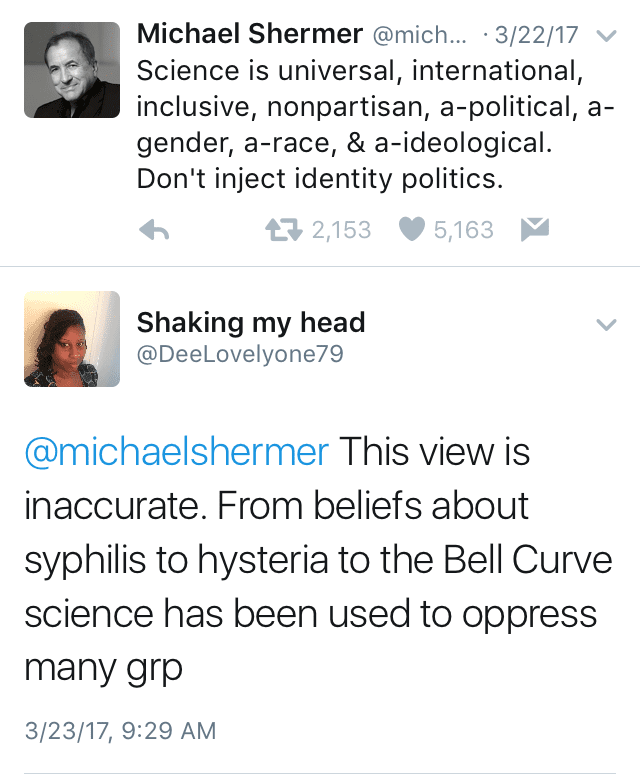

Text of tweet by Michael Shermer:
Science is universal, international, inclusive, nonpartisan, a-political, a-gender, a-race, & a-ideological. Don’t inject identity politics.
Text of response tweets:
So there was never a respected field called “race science”? Or “scientific eugenics”? Or the Tuskegee Syphilis Study?
This view is inaccurate. From beliefs about syphilis to hysteria to the Bell Curve science has been used to press many grp
Atrocities like the Tuskegee Syphilis Study & Nazi eugenics exemplify just what happens when your move identity politics from science.
Science, as conducted by researchers, is not automatically inclusive, accurate, or beneficial. Fortunately, scientistic bodies have learned from the past, and Institutional Review Boards help set standards for scientific research on human subjects. Statements by the San and other groups are a step forward in ensuring that research is fair, accurate, and not exploitative.
I have a Patreon! Please support my writing!
Previous Post

April 12, 2017
Halal Lunches and Fish on Fridays
Next Post

April 14, 2017 Voice in the Wind: Most Dysfunctional Siblings Ever
Browse Our Archives
Select a Category Atheism Evangelicalism/Fundamentalism Family Feminism Homeschool Meta Parenting Patriarchy Politics Purity Quiverfull Social Justice Uncategorized Worthwhile reads
Select a Month February 2021 January 2021 December 2020 November 2020 October 2020 September 2020 August 2020 July 2020 June 2020 May 2020 April 2020 March 2020 February 2020 January 2020 December 2019 November 2019 October 2019 September 2019 August 2019 July 2019 June 2019 May 2019 April 2019 March 2019 February 2019 January 2019 December 2018 November 2018 October 2018 September 2018 August 2018 July 2018 June 2018 May 2018 April 2018 March 2018 February 2018 January 2018 December 2017 November 2017 October 2017 September 2017 August 2017 July 2017 June 2017 May 2017 April 2017 March 2017 February 2017 January 2017 December 2016 November 2016 October 2016 September 2016 August 2016 July 2016 June 2016 May 2016 April 2016 March 2016 February 2016 January 2016 December 2015 November 2015 October 2015 September 2015 August 2015 July 2015 June 2015 May 2015 April 2015 March 2015 February 2015 January 2015 December 2014 November 2014 October 2014 September 2014 August 2014 July 2014 June 2014 May 2014 April 2014 March 2014 February 2014 January 2014 December 2013 November 2013 October 2013 September 2013 August 2013 July 2013 June 2013 May 2013 April 2013 March 2013 February 2013 January 2013 December 2012 November 2012 October 2012 September 2012 August 2012 July 2012 June 2012 May 2012 April 2012 March 2012 February 2012 January 2012 December 2011 November 2011 October 2011 September 2011 August 2011 July 2011 June 2011
Follow Us!
TAKE THE
Religious Wisdom Quiz
Who wrote many letters (epistles) in the New Testament?
Select your answer to see how you score.
Peter Paul John Jude
Related posts from Love, Joy, Feminism

Myon Burrell and the Criminal "Justice" System

When "Christian" Means "White People"

The Other Part of the Aurora "Stolen Van"...

When White Relatives Turn Fascist
TRENDING AT PATHEOS Nonreligious

Dethroning Jesus and Enthroning Yourself
Jesus Never Asked to Be Worshipped. He Asked to Be Understood. Christianity...

Why Most Christians are Really Paulians and Jobians
I Don't Care, But It Matters Let's get this out of the...

Essential Tips to Successfully Navigate the Selling Process
Selling a house can feel overwhelming, but it doesn’t have to be....

To Make Remote Work Effective, Think About Others
The COVID-19 pandemic forced many companies to rapidly transition to remote work....

Flexibility Is Key to Solving Problems of Tomorrow
The world of work is undergoing a dramatic transformation. The COVID-19 pandemic...
view all Nonreligious blogs
Ad-Free & Subscriber Log-In Subscription Support
- About Us
- 2026 Calendar
- Videos
- Podcasts
- Library of World Religions
- Faith In Media Tracker
- Advertise With Us
- Write for Us
- Privacy Policy
- Terms of Service
- Do Not Sell My Data
- Contact Us
- Radiant Digital
- Manage Newsletter Subscriptions
- Unsubscribe From Notifications
- Sitemap
Copyright 2008-2026, Patheos. All rights reserved.
Subscription Support Ad-Free & Subscriber Log-In
Follow Patheos