
BuddhistCatholicContemplativeEvangelicalGeneral ChristianHinduJewishLatter-day SaintMuslimNew VisionsProgressive Christian
Beliefs
- Buddhist
- Catholic
- Contemplative
- Evangelical
- General Christian
- Hindu
- Jewish
- Latter-day Saint
- More Voices
- Muslim
- New Visions
- Pagan
- Progressive Christian
Topics
- Religion News
- Food and Religion
- Sports and Religion
- Religious Art
- Religious Music and Entertainment
- Religious Events
- History and Religion
- Style and Religion
- Politics and Religion
- Women in Religion
- Recreation Outdoors and Religion
- Business Finance and Religion
- Careers Workplace and Religion
- Education and Religion
- Family Parenting and Religion
- Health Fitness and Religion
- Home and Religion
- Relationships and Religion
- Technology and Religion
- Travel and Religion
Columnists
- Buddhist Columnists
- Business Finance and Religion Columnists
- Careers Workplace and Religion Columnists
- Catholic Columnists
- Contemplative Columnists
- Education and Religion Columnists
- Evangelists Columnists
- Family Parenting and Religion Columnists
- General Christian Columnists
- Health Fitness and Religion Columnists
- Hindu Columnists
- History and Religion Columnists
- Home and Religion Columnists
- Jewish Columnists
- More Voices Columnists
- Latter Day Columnists
- Muslim Columnists
- New Visions Columnists
- Nonreligious Columnists
- Pagan Columnists
- Politics and Religion Columnists
- Progressive Columnists
- Recreation Outdoors and Religion Columnists
- Relationships and Religion Columnists
- Religion News Columnists
- Religious Art Columnists
- Religious Events Columnists
- Religious Music and Entertainment Columnists
- Sports and Religion Columnists
- Style and Religion Columnists
- Technology and Religion Columnists
- Travel and Religion Columnists
- Women in Religion Columnists
Resource Library
- 2026 Calendar
- Library of World Religions
- The 100 Most Holy Places on Earth
- Patheos Answers
- Podcasts
- Videos
- Faith Leaders Database
- Anglican Episcopalian
- Bahai
- Baptist
- Buddhism
- Christianity
- Confucianism
- Eastern Orthodoxy
- Hinduism
- Holiness and Pentecostal
- ISKCON
- Islam
- Judaism
- Lutheran
- Methodist
- The Church of Jesus Christ of Latter-day Saints
- New Age
- Paganism
- Presbytarian and Reformed
- Protestantism
- Religion Behind the Scenes
- Roman Catholic
- Scientology
- Shia Islam
- Sikhism
- Sufism
- Sunni Islam
- Taoism
- Zen
- See all religions
Research Tools
 Ad-Free & Subscriber Log-In Subscription Support
Ad-Free & Subscriber Log-In Subscription Support
Follow Patheos 

- Trending:
- Forgiveness
- |
- Marriage
- |
- Consciousness
- |
- Death Penalty
- |
- Election
- |
- Halloween
 Love, Joy, Feminism
-
More
- Home
- Nonreligious
- Why Aren’t Millennials Having Babies?
Why Aren’t Millennials Having Babies?
Last updated on: March 30, 2017 at 9:12 am by Libby Anne
Why Aren’t Millennials Having Babies? 2017-03-30T09:12:40-04:00 Libby Anne
Patheos Explore the world's faith through different perspectives on religion and spirituality! Patheos has the views of the prevalent religions and spiritualities of the world.
Sometimes it seems like the whole of American media has conspired to dump on Millennials. When I see my own generation responding to accusations of Millennial incompetence and general horribleness, the recession tends to take center stage, along with a changing economy. Consider the number of middle aged Trump supporters angry that the well-paying union jobs of the past are in decline. Millennials are affected by these same economic changes, and the recession—and they’re frequently saddled with college debt, debt they incurred because going to college was supposed to be the solution to weathering a changing job market.
To see some tangible ways the recession has affected Millennials, let’s look at a graph created by sociologist Philip N. Cohen outlining the birth rates of three different subsets of Millennials:
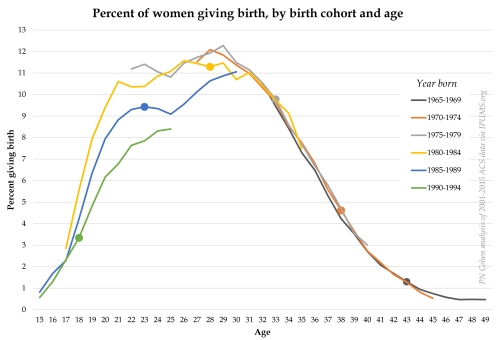
As Cohen explains:
The figure below shows the birth rates by age for women across six five-year birth cohorts. The dots on each line mark the age at which the midpoint of each cohort reached 2009. The oldest three groups are supposed to be “Generation X.” The three youngest groups shown in yellow, blue, and green — those born 1980-84, 1985-89, and 1990-94 — are all Millennials…
Cohen created his graph to illustrate the dramatic differences within Millennials’ experiences as a way to challenge the common divisions of age cohorts—what do the individuals in the yellow group really have in common with those in the green group, after all? But this graph is also important in illustrating the effects of the recession on those termed Millennials, as Cohen explains:
Most of the fertility effect on the recession was felt at young ages, as women postponed births. The oldest Millennial group was in their late twenties when the recession hit, and it appears their fertility was not dramatically affected. The 1985-89 group clearly took a big hit before rebounding. And the youngest group started their childbearing years under the burden of the economic crisis, and if that curve at 25 holds they will not recover.
I’m in that blue group. I was lucky enough to be fairly insulated from the recession, but others clearly were not, and the percentage of women in my five-year cohort having children took a literal dip as people postponed these decisions.
Most of my friends, especially on Facebook (where I stay in contact with many friends from college), are Millennials. Many of them are having children right about now, in their late 20s, and my Facebook feed sometimes seems completely full of babies. But others aren’t, frequently because their work situations are unstable (especially in the gig economy) or because their careers are so demanding that they don’t feel they can.
If older Americans are concerned about Millennials’ birthrates, I have some suggestions. I’ve watched the high cost of childcare and the inflexibility of even good jobs (especially those in the tech industry) delay decisions to have children—or decide them in the negative. I’ve known people who would like to have children but feel can’t, because they’re stringing together multiple low-paying part-time jobs and can hardly make ends meet even without childcare costs.
Oh and also? Health insurance. That plays a role in these decisions as well.
Government-funded childcare, universal health insurance, paid maternity leave, a higher minimum wage—all of these things would help ensure that Millennials who want to have children feel they are able to do so. And yet, those who complain most about Millennials’ low rate of childbearing tend to be those most against the above.
Another thing that would help is a good, hard look at both the instability of the gig economy and the inhuman expectations that accompany many careers. I have friends who don’t get home from work until at least 7:00 each night. I don’t know of any daycare centers that even stay open that long. Finding childcare can be especially difficult for those working multiple part-time jobs with schedules that change from day to day or week to week.
One common narrative explaining low Millennial birth rates is that of the selfish Millennial who chooses not to have children because they don’t want the inconvenience. There are certainly Millennials who have chosen not to have children—I know some myself, and selfish is the last thing I’d call them. But most Millennials I know who haven’t had children would like to have children—they just can’t figure out a way to swing it financially. And no, it’s not because they think children need to be enrolled in every activity or going to every camp or taking horseback riding or something. It typically has a lot more to do with things like unpaid maternity leave, childcare that is more expensive than college, and unstable (or shared) housing arrangements.
I’d like to see those who are concerned about low Millennial birthrates stop pointing blame and start learning about why Millennials aren’t having babies—and how they can help ensure that those who want to have children are able to do so.
Oh, and maybe stop complaining about single mothers.
Can you see the double bind here, for Millennials? If we have children we can’t support (or struggle to support) we’re irresponsible. But if we recognize that we can’t responsibly have children, and therefore do not have children, we’re selfish and a problem.
I have a Patreon! Please support my writing!
Previous Post

March 29, 2017
Massive Resistance Then and Now
Next Post

March 31, 2017 Voice in the Wind: Historically Inaccurate Gladiators
Browse Our Archives
Select a Category Atheism Evangelicalism/Fundamentalism Family Feminism Homeschool Meta Parenting Patriarchy Politics Purity Quiverfull Social Justice Uncategorized Worthwhile reads
Select a Month February 2021 January 2021 December 2020 November 2020 October 2020 September 2020 August 2020 July 2020 June 2020 May 2020 April 2020 March 2020 February 2020 January 2020 December 2019 November 2019 October 2019 September 2019 August 2019 July 2019 June 2019 May 2019 April 2019 March 2019 February 2019 January 2019 December 2018 November 2018 October 2018 September 2018 August 2018 July 2018 June 2018 May 2018 April 2018 March 2018 February 2018 January 2018 December 2017 November 2017 October 2017 September 2017 August 2017 July 2017 June 2017 May 2017 April 2017 March 2017 February 2017 January 2017 December 2016 November 2016 October 2016 September 2016 August 2016 July 2016 June 2016 May 2016 April 2016 March 2016 February 2016 January 2016 December 2015 November 2015 October 2015 September 2015 August 2015 July 2015 June 2015 May 2015 April 2015 March 2015 February 2015 January 2015 December 2014 November 2014 October 2014 September 2014 August 2014 July 2014 June 2014 May 2014 April 2014 March 2014 February 2014 January 2014 December 2013 November 2013 October 2013 September 2013 August 2013 July 2013 June 2013 May 2013 April 2013 March 2013 February 2013 January 2013 December 2012 November 2012 October 2012 September 2012 August 2012 July 2012 June 2012 May 2012 April 2012 March 2012 February 2012 January 2012 December 2011 November 2011 October 2011 September 2011 August 2011 July 2011 June 2011
Follow Us!
TAKE THE
Religious Wisdom Quiz
What does "Maranatha" mean?
Select your answer to see how you score.
Be joyful Praise Him It is finished Come, Lord
Related posts from Love, Joy, Feminism

"Liberal" and "Conservative" Have Actual Meanings

It's not about the economy, it's about being...


Impeachment Could Have Been a Gift to Republicans
TRENDING AT PATHEOS Nonreligious

Dethroning Jesus and Enthroning Yourself
Jesus Never Asked to Be Worshipped. He Asked to Be Understood. Christianity...

Why Most Christians are Really Paulians and Jobians
I Don't Care, But It Matters Let's get this out of the...

Essential Tips to Successfully Navigate the Selling Process
Selling a house can feel overwhelming, but it doesn’t have to be....

To Make Remote Work Effective, Think About Others
The COVID-19 pandemic forced many companies to rapidly transition to remote work....

Flexibility Is Key to Solving Problems of Tomorrow
The world of work is undergoing a dramatic transformation. The COVID-19 pandemic...
view all Nonreligious blogs
Ad-Free & Subscriber Log-In Subscription Support
- About Us
- 2026 Calendar
- Videos
- Podcasts
- Library of World Religions
- Faith In Media Tracker
- Advertise With Us
- Write for Us
- Privacy Policy
- Terms of Service
- Do Not Sell My Data
- Contact Us
- Radiant Digital
- Manage Newsletter Subscriptions
- Unsubscribe From Notifications
- Sitemap
Copyright 2008-2026, Patheos. All rights reserved.
Subscription Support Ad-Free & Subscriber Log-In
Follow Patheos