
BuddhistCatholicContemplativeEvangelicalGeneral ChristianHinduJewishLatter-day SaintMuslimNew VisionsProgressive Christian
Beliefs
- Buddhist
- Catholic
- Contemplative
- Evangelical
- General Christian
- Hindu
- Jewish
- Latter-day Saint
- More Voices
- Muslim
- New Visions
- Pagan
- Progressive Christian
Topics
- Religion News
- Food and Religion
- Sports and Religion
- Religious Art
- Religious Music and Entertainment
- Religious Events
- History and Religion
- Style and Religion
- Politics and Religion
- Women in Religion
- Recreation Outdoors and Religion
- Business Finance and Religion
- Careers Workplace and Religion
- Education and Religion
- Family Parenting and Religion
- Health Fitness and Religion
- Home and Religion
- Relationships and Religion
- Technology and Religion
- Travel and Religion
Columnists
- Buddhist Columnists
- Business Finance and Religion Columnists
- Careers Workplace and Religion Columnists
- Catholic Columnists
- Contemplative Columnists
- Education and Religion Columnists
- Evangelists Columnists
- Family Parenting and Religion Columnists
- General Christian Columnists
- Health Fitness and Religion Columnists
- Hindu Columnists
- History and Religion Columnists
- Home and Religion Columnists
- Jewish Columnists
- More Voices Columnists
- Latter Day Columnists
- Muslim Columnists
- New Visions Columnists
- Nonreligious Columnists
- Pagan Columnists
- Politics and Religion Columnists
- Progressive Columnists
- Recreation Outdoors and Religion Columnists
- Relationships and Religion Columnists
- Religion News Columnists
- Religious Art Columnists
- Religious Events Columnists
- Religious Music and Entertainment Columnists
- Sports and Religion Columnists
- Style and Religion Columnists
- Technology and Religion Columnists
- Travel and Religion Columnists
- Women in Religion Columnists
Resource Library
- 2026 Calendar
- Library of World Religions
- The 100 Most Holy Places on Earth
- Patheos Answers
- Podcasts
- Videos
- Faith Leaders Database
- Anglican Episcopalian
- Bahai
- Baptist
- Buddhism
- Christianity
- Confucianism
- Eastern Orthodoxy
- Hinduism
- Holiness and Pentecostal
- ISKCON
- Islam
- Judaism
- Lutheran
- Methodist
- The Church of Jesus Christ of Latter-day Saints
- New Age
- Paganism
- Presbytarian and Reformed
- Protestantism
- Religion Behind the Scenes
- Roman Catholic
- Scientology
- Shia Islam
- Sikhism
- Sufism
- Sunni Islam
- Taoism
- Zen
- See all religions
Research Tools
 Ad-Free & Subscriber Log-In Subscription Support
Ad-Free & Subscriber Log-In Subscription Support
Follow Patheos 

- Trending:
- Forgiveness
- |
- Marriage
- |
- Consciousness
- |
- Death Penalty
- |
- Election
- |
- Halloween
 Love, Joy, Feminism
-
More
- Home
- Nonreligious
- What Work of Christian Fiction Should I Review Next?
What Work of Christian Fiction Should I Review Next?
Last updated on: January 13, 2017 at 11:36 am by Libby Anne
What Work of Christian Fiction Should I Review Next? 2017-01-13T11:36:10-04:00 Libby Anne
Patheos Explore the world's faith through different perspectives on religion and spirituality! Patheos has the views of the prevalent religions and spiritualities of the world.
I’ve finished my review series of Michael Farris’ Anonymous Tip. I enjoyed reviewing a work of Christian fiction, though, and I’d like to do it again. With that in mind, I have obtained copies of three works of Christian fiction, and would like your input on choosing which one to review next. Bear in mind that I began reviewing Michael Farris’ Anonymous Tip in December 2014; it took us over two years to wade through the entire book, cover to cover. Whatever we choose, it’ll be around for a while!
Option #1:

The first book I’m considering reviewing (above) is also written by Michael Farris. Its title is “Forbid Them Not,” and it covers a fictional future in which the U. N. Convention on the Rights of the Child has been ratified, with dire consequences.
Washington, D.C.—January 27, 2005. After a landslide election that swept a Democratic majority into the United States Senate, today the Senate voted 69-31 to ratify the United Nations Convention on the Rights of the Child. Following a liberal shift of power in the government, two families find themselves on the brink of the unimaginable—removal of their children from their care. This new legislation limits parents’ ability to teach fundamental Christianity, spank their children, or make educational decisions, such as electing to homeschool. Laura Frasier, a public school teacher, finds herself in the middle of a philosophical maelstrom. As an ideological battle in the United States Supreme Court ensues, Cooper Stone must defend these families’ right to raise their children according to their own values.
This book would give us the opportunity to delve more deeply into Farris’ ideas about parental rights, and I’m interested in seeing whether Cooper Stone blurs ethical lines as effectively as Peter Barron. I’d also like to know whether the romance that surely plays out in this novel is as ethically concerning as that in Anonymous Tip. Still, some of my readers may be ready for a break from Farris’ novel-writing.
Option #2:

Next (above) I give you The Vision, by Debi Pearl. Yes—that Debi Pearl. In addition to her deeply problematic misogynist marriage manual, Created To Be His Help Meet, Debi is the author of a series placed in the end times.
Asher Joel moved across the country to eastern Tennessee to carry on his friend’s vision for reaching lost souls—and to gain respite from the terrorists who murdered his friend, Dan. But there he finds himself in the center of a maelstrom of mystery, terror, death, the looming threat of a catastrophic volcanic eruption—and the consuming fear of losing the woman he loves. Through it all, he and his friends work tirelessly and courageously to fulfill their vision. The Vision is a touching love story, a dramatic race against evil, and an emphatic reminder of the power of God that will take you on a ride so real you will find it difficult to separate fact from fiction.
Full disclosure: I have not read this book. But I just flipped through it and it looks like it could be a real page-turner. There’s a lot that happens. Based on my perusal, the Last Publishers is an evangelistic group focused on creating content in Arabic in an effort to convert the Muslims that are infiltrating the U.S. Oh and there’s stuff like abortion described in ways it does not happen, and pregnancy, herbs, and midwifery.
Option #3:
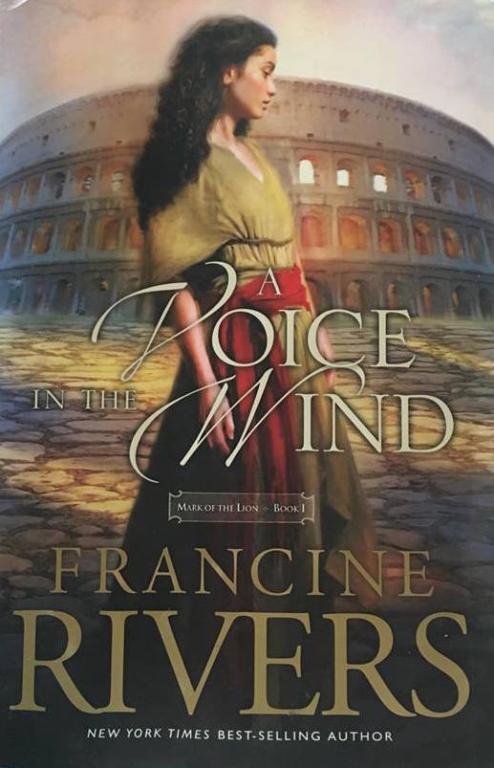
Finally (above) is option three: Francine Rivers’ novel, A Voice in the Wind. This is a book I read about three million times as a teenager. Some time ago, a commenter suggested it as an option for a future review, and I like the idea.
A Voice in the Wind transports readers back to Jerusalem during the first Jewish-Roman War, some seventy years after the death of Christ. Following the prides and passions of a group of Jews, Romans and Barbarians living at the time of the siege, the narrative is centered on an ill-fated romance between a steadfast slave girl, Hadassah, and Marcus, the brother of her owner and a handsome aristocrat. After surviving the massacre of her family and the destruction of Jerusalem by the Romans, Hadassah is captured and sold to a well-to-do merchant’s family. Brought to Rome, she is pressed into service as a personal slave to hedonistic Julia Valerian. Hadassah struggles to walk in the footsteps of Jesus and to treat her masters in a manner in keeping with His teachings, but she is forced to keep her religious identity a secret in order to survive. Confused and alone, she has only her faith to cling to as she tries to subtly bring God into the lives of her captors. Reckless, impulsive, and villainous, Julia tries to undermine Hadassah at every turn. But Julia’s brother, Marcus, is a different sort altogether. Is it possible for a love between Hadassah and Marcus to flourish considering not only their differing stations in life, but also the gap between Hadassah’s unrelenting faith and Marcus’ lack of belief in anything? Simultaneously, Atretes, a captured soldier from Germania, is forced to become a gladiator. This is the time of Rome’s decline and the decadence of a civilization on the verge of self-destruction serves as a powerful backdrop to the Barbarian’s struggle for survival in the arena.
There’s lots that goes on in this book, I promise. This book could provide an interesting lens into talking about how Christian fiction (and evangelicals more generally) handles the early church period. There would also be lots more about things like gender relations and the evangelical treatment of love and romance. It could be lighter than the other two in some ways—but not in others.
I’d like to invite my readers to leave comments indicating which they’d prefer. Feel free to rank the three options, even. I’ll go through and make a tally after a day or two. And then next Friday, we begin.
I have a Patreon! Please support my writing!
Previous Post

January 13, 2017
Anonymous Tip: The (Actual) End
Next Post

January 14, 2017 Saturday Link Love: Academia, Drug Users, and Health Insurance
Browse Our Archives
Select a Category Atheism Evangelicalism/Fundamentalism Family Feminism Homeschool Meta Parenting Patriarchy Politics Purity Quiverfull Social Justice Uncategorized Worthwhile reads
Select a Month February 2021 January 2021 December 2020 November 2020 October 2020 September 2020 August 2020 July 2020 June 2020 May 2020 April 2020 March 2020 February 2020 January 2020 December 2019 November 2019 October 2019 September 2019 August 2019 July 2019 June 2019 May 2019 April 2019 March 2019 February 2019 January 2019 December 2018 November 2018 October 2018 September 2018 August 2018 July 2018 June 2018 May 2018 April 2018 March 2018 February 2018 January 2018 December 2017 November 2017 October 2017 September 2017 August 2017 July 2017 June 2017 May 2017 April 2017 March 2017 February 2017 January 2017 December 2016 November 2016 October 2016 September 2016 August 2016 July 2016 June 2016 May 2016 April 2016 March 2016 February 2016 January 2016 December 2015 November 2015 October 2015 September 2015 August 2015 July 2015 June 2015 May 2015 April 2015 March 2015 February 2015 January 2015 December 2014 November 2014 October 2014 September 2014 August 2014 July 2014 June 2014 May 2014 April 2014 March 2014 February 2014 January 2014 December 2013 November 2013 October 2013 September 2013 August 2013 July 2013 June 2013 May 2013 April 2013 March 2013 February 2013 January 2013 December 2012 November 2012 October 2012 September 2012 August 2012 July 2012 June 2012 May 2012 April 2012 March 2012 February 2012 January 2012 December 2011 November 2011 October 2011 September 2011 August 2011 July 2011 June 2011
Follow Us!
TAKE THE
Religious Wisdom Quiz
What nation took Israel into captivity in 722 BC?
Select your answer to see how you score.
Egypt Babylon Persia Assyria
Related posts from Love, Joy, Feminism


Lesbian Duplex 310: An Open Thread

The Vision: NASA Is On the Case

Lesbian Duplex 309: An Open Thread
TRENDING AT PATHEOS Nonreligious

Dethroning Jesus and Enthroning Yourself
Jesus Never Asked to Be Worshipped. He Asked to Be Understood. Christianity...

Why Most Christians are Really Paulians and Jobians
I Don't Care, But It Matters Let's get this out of the...

Essential Tips to Successfully Navigate the Selling Process
Selling a house can feel overwhelming, but it doesn’t have to be....

To Make Remote Work Effective, Think About Others
The COVID-19 pandemic forced many companies to rapidly transition to remote work....

Flexibility Is Key to Solving Problems of Tomorrow
The world of work is undergoing a dramatic transformation. The COVID-19 pandemic...
view all Nonreligious blogs
Ad-Free & Subscriber Log-In Subscription Support
- About Us
- 2026 Calendar
- Videos
- Podcasts
- Library of World Religions
- Faith In Media Tracker
- Advertise With Us
- Write for Us
- Privacy Policy
- Terms of Service
- Do Not Sell My Data
- Contact Us
- Radiant Digital
- Manage Newsletter Subscriptions
- Unsubscribe From Notifications
- Sitemap
Copyright 2008-2026, Patheos. All rights reserved.
Subscription Support Ad-Free & Subscriber Log-In
Follow Patheos