
BuddhistCatholicContemplativeEvangelicalGeneral ChristianHinduJewishLatter-day SaintMuslimNew VisionsProgressive Christian
Beliefs
- Buddhist
- Catholic
- Contemplative
- Evangelical
- General Christian
- Hindu
- Jewish
- Latter-day Saint
- More Voices
- Muslim
- New Visions
- Pagan
- Progressive Christian
Topics
- Religion News
- Food and Religion
- Sports and Religion
- Religious Art
- Religious Music and Entertainment
- Religious Events
- History and Religion
- Style and Religion
- Politics and Religion
- Women in Religion
- Recreation Outdoors and Religion
- Business Finance and Religion
- Careers Workplace and Religion
- Education and Religion
- Family Parenting and Religion
- Health Fitness and Religion
- Home and Religion
- Relationships and Religion
- Technology and Religion
- Travel and Religion
Columnists
- Buddhist Columnists
- Business Finance and Religion Columnists
- Careers Workplace and Religion Columnists
- Catholic Columnists
- Contemplative Columnists
- Education and Religion Columnists
- Evangelists Columnists
- Family Parenting and Religion Columnists
- General Christian Columnists
- Health Fitness and Religion Columnists
- Hindu Columnists
- History and Religion Columnists
- Home and Religion Columnists
- Jewish Columnists
- More Voices Columnists
- Latter Day Columnists
- Muslim Columnists
- New Visions Columnists
- Nonreligious Columnists
- Pagan Columnists
- Politics and Religion Columnists
- Progressive Columnists
- Recreation Outdoors and Religion Columnists
- Relationships and Religion Columnists
- Religion News Columnists
- Religious Art Columnists
- Religious Events Columnists
- Religious Music and Entertainment Columnists
- Sports and Religion Columnists
- Style and Religion Columnists
- Technology and Religion Columnists
- Travel and Religion Columnists
- Women in Religion Columnists
Resource Library
- 2026 Calendar
- Library of World Religions
- The 100 Most Holy Places on Earth
- Patheos Answers
- Podcasts
- Videos
- Faith Leaders Database
- Anglican Episcopalian
- Bahai
- Baptist
- Buddhism
- Christianity
- Confucianism
- Eastern Orthodoxy
- Hinduism
- Holiness and Pentecostal
- ISKCON
- Islam
- Judaism
- Lutheran
- Methodist
- The Church of Jesus Christ of Latter-day Saints
- New Age
- Paganism
- Presbytarian and Reformed
- Protestantism
- Religion Behind the Scenes
- Roman Catholic
- Scientology
- Shia Islam
- Sikhism
- Sufism
- Sunni Islam
- Taoism
- Zen
- See all religions
Research Tools
 Ad-Free & Subscriber Log-In Subscription Support
Follow Patheos 

- Trending:
- Advent
- |
- Forgiveness
- |
- Thanksgiving
- |
- Election
- |
- Seasonal Holidays
- |
- Marriage
 Love, Joy, Feminism
-
More
- Home
- Nonreligious
- Why Hispanics Are “White” on Surveys (and Other Things)
Why Hispanics Are “White” on Surveys (and Other Things)
Last updated on: July 19, 2016 at 5:00 am by Libby Anne
Why Hispanics Are “White” on Surveys (and Other Things) 2016-07-18T11:41:55-04:00 Libby Anne
Patheos Explore the world's faith through different perspectives on religion and spirituality! Patheos has the views of the prevalent religions and spiritualities of the world.
In doing research for an earlier post on race and policing, I came upon a bizarre piece of conspiracy mongering a conservative website, the American Observer. The article in question was posted last November. Check it out:
The FBI’s own current (November 2015) list of most wanted murder suspects in the US . . . contains 71 suspects—of which only six are actually white, as can be seen from their mugshots. Some 51 of the remaining suspects are nonwhite Hispanics. Nonetheless, the FBI has classified all 51 of these people as “white.” (The remainder are correctly classified as “black.”)
. . .
The deliberate misclassification is done with the express purpose of boosting the number of crimes which the FBI ascribes to its “white” category. This is done because the federal statisticians are aware that if they correctly identified these Hispanics as nonwhite, then it would be impossible for even the controlled media to hide the overwhelming nonwhite crime plague.
That’s right, The New Observer argues that the FBI is classifying wanted Hispanic criminals as white in order to hide “the overwhelming nonwhite crime plague.” This claim is bizarre. Last week I took my children to a new doctor. In filling out all of the forms, I had to put down the children’s race. I marked “white” and then, in the very next question, I had to specify Hispanic or non-Hispanic. Do you know why? I didn’t until a few years ago, when I assisted with a class on immigration history. Legally and according to the U.S. government, Hispanics are classified as white. In other words, it’s not just in crime statistics, as the author of the above quoted American Observer article seems to think. The classification of Hispanics as white occurs across the board. Why is this, you ask? Because of the Treaty of Guadalupe Hidalgo, of course.
The year was 1848 and the Mexican government was signing a peace treaty with the U.S., bringing an end to the Mexican-American War. As part of the agreement, Mexico ceded its northernmost territories—land that is now now Arizona, New Mexico, California, Nevada, Utah, Colorado, and Wyoming—to the United States. But that land was already inhabited. What would happen to the Mexican citizens living on that land when it became part of the United States? Would they become American citizens? Or would they be treated more like Native Americans, constantly relocated and bereft of the rights afforded white Americans of European descent?
This took some wrangling. The Mexican government wanted to make sure that their citizens living in the ceded area would become full American citizens, but the government also wanted to ensure that those who preferred to live in Mexico as Mexican citizens could do so. So they struck a deal. Those Mexican citizens living in the territory changing hands would have one year to move into Mexico’s new borders, where they would retain their Mexican citizenship. If they chose to stay, they would be considered American citizens.
There was just one eensy teensy problem. By law, you had to be white to be a U.S. citizen. It was 1848 after all. The Naturalization Act of 1790 read as follows:
Be it enacted by the Senate and House of Representatives of the United States of America, in Congress assembled, That any Alien being a free white person, who shall have resided within the limits and under the jurisdiction of the United States for the term of two years, may be admitted to become a citizen thereof …
While more detail was added to the statute in 1795, the requirement that only free white persons could obtain citizenship remained. In order to honor both the Treaty of Guadalupe Hidalgo and its own naturalization law, the U.S. government had to classify the formerly Mexican citizens who resided in its new territory as white. And that—yes—is why Hispanics are listed under white on the census and other forms, and in the U.S. government’s official accounting of statistics, etc.
What Is Whiteness?
I’m not going to leave it there, though, because at this point you probably want to know more. How did our law change? When did we start including non-whites as citizens? As you might imagine, there was a bit of a problem after the Civil War. Were the freed slaves U.S. citizens? They certainly weren’t white! In 1868 the Fourteenth Amendment was passed to settle this question:
All persons born or naturalized in the United States and subject to the jurisdiction thereof, are citizens of the United States and of the State wherein they reside.
The Fourteenth Amendment created birthright citizenship, and allowed nonwhites born in the U.S. to be considered citizens, but what about nonwhite immigrants who wanted to become naturalized citizens? Here, the law did not change. Naturalization was still limited to free white persons. The 1870 Naturalization Act allowed for those of African descent to become naturalized U.S. citizens, but it otherwise limited naturalization to free white persons, purposefully excluding Asians, among others. The 1906 Naturalization Act did not change this requirement, maintaining a system that offered naturalization to free white persons and those of African descent.
What happened next, you ask? Have you heard of Takao Ozawa v. United States, a case decided by the Supreme Court in 1922? Probably not! You see, while naturalization was limited to free white persons and those of African descent, what white meant exactly was a bit fuzzy. Given this, Takao Ozawa, a Japanese man who had lived in the United States for two decades, sought naturalization under the argument that he was in fact white. Ozawa was a good candidate for a case of this sort. He had graduated from high school in the U.S., attended the University of California, and converted to Christianity. He spoke English exclusively in his home and with his children, whom he sent to Sunday School.

Takao Ozawa
The Supreme Court, in a unanimous ruling, found that “the words ‘white person’ were meant to indicate only a person of what is popularly known as the Caucasian race,” which excluded the Japanese. It’s worth noting that Ozawa sued for U.S. citizenship because the state of California had passed laws barring those ineligible for citizenship—such as himself—from owning land. I bet you never learned about that one in your high school history class.
At this point, then, the U.S. limited naturalization to those of African or Caucasian descent. But what did Caucasian mean, exactly? That’s a good question! Have you heard of United States v. Bhagat Singh Thind, decided by the Supreme Court in 1923? Probably not. Bhagat Singh Thind was an immigrant from India and a WWI veteran who had served in the U.S. army. When he heard about the Supreme Court’s decision white meant Caucasian, he decided to seek naturalization based on his ancestry and the the historical geographical origins of Caucasians.
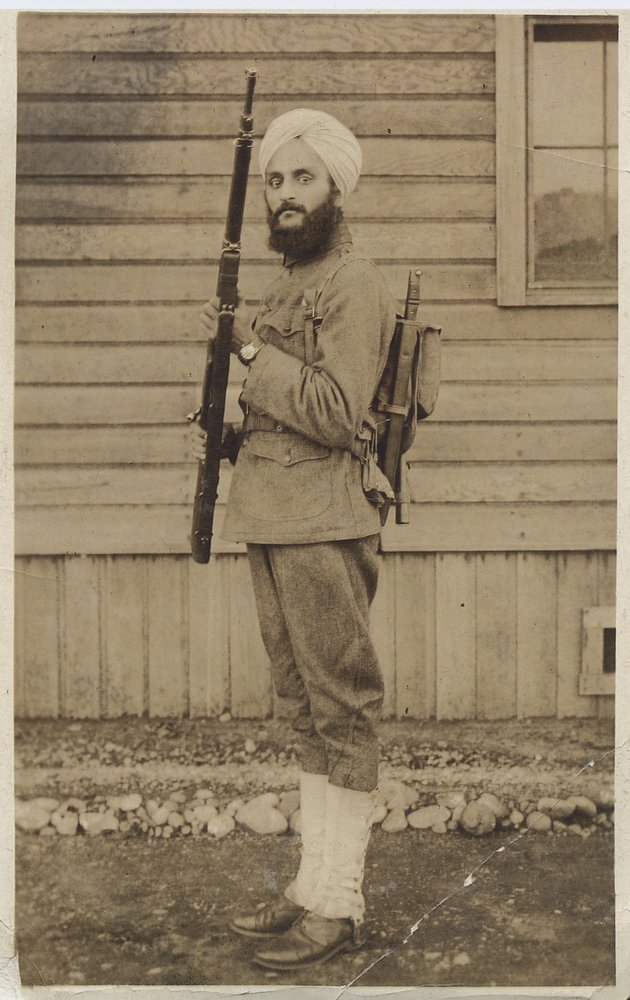
Bhagat Singh Thind, in his U.S. army uniform
The Supreme Court, once again unanimous, disagreed. They found that:
“What we now hold is that the words “free white persons” are words of common speech, to be interpreted in accordance with the understanding of the common man, synonymous with the word “Caucasian” only as that word is popularly understood.”
In other words, white meant Caucasian, and Caucasian meant whoever people think of as Caucasian. It was an artificially invented distinction designed to draw racial lines and deny citizenship to men like Takao Ozawa and Bhagat Singh Thind. In case you’re curious, Thind went on to earn his PhD and marry a white woman, with whom he had two children, Tara and David. He finally obtained U.S. citizenship in 1935, after Congress made all WWI veterans eligible for citizenship. But what of everyone else?
WWII made discriminating against nonwhite ethnic groups unfashionable. I know that sounds flippant, but it’s true—in the aftermath of WWII, people looked at what happened to the Jews and realized that it was fucked up to deny citizenship to entire groups of people based on their ethnic or racial backgrounds. A lot of things changed as a result of WWII—the United Nation was founded in 1945, and the Universal Declaration of Human Rights was drafted and signed three years later. It was in this context that Congress passed the Immigration and Nationality Act of 1952, ending the United States’ 172-year-old race-based naturalization requirements. “The right of a person to become a naturalized citizen of the United States shall not be denied or abridged because of race or sex,” the act read. Unfortunately, though, while it repealed the race-based naturalization requirements, the act maintained the country’s harsh and restrictive immigration quota system.
We haven’t talked about the quota system, have we?
Quotas, Quotas, Everywhere
Before 1924, our immigration policy was very open, unless you were Chinese, or, eventually, simply Asian. Those groups were excluded almost entirely, but no quotas were placed on immigrants from other areas of the world. This changed with the Immigration Act of 1924 (following the Immigration Restriction Act of 1921), which cut immigration severely. This act restricted annual immigration from any given country to 2% of the number of foreign-born individuals from that country who had been living in the U.S. in 1890. Why 1890? Because before 1890 most immigrants were from northern and western Europe while after 1890 most immigrants were from southern and eastern Europe, and southern and eastern European immigrants were viewed as inferior by many Americans. Using 1890 allowed them to severely restrict immigration from those areas while allowing a larger amount of immigration from the parts of Europe considered racially superior. (Check out this graph.)
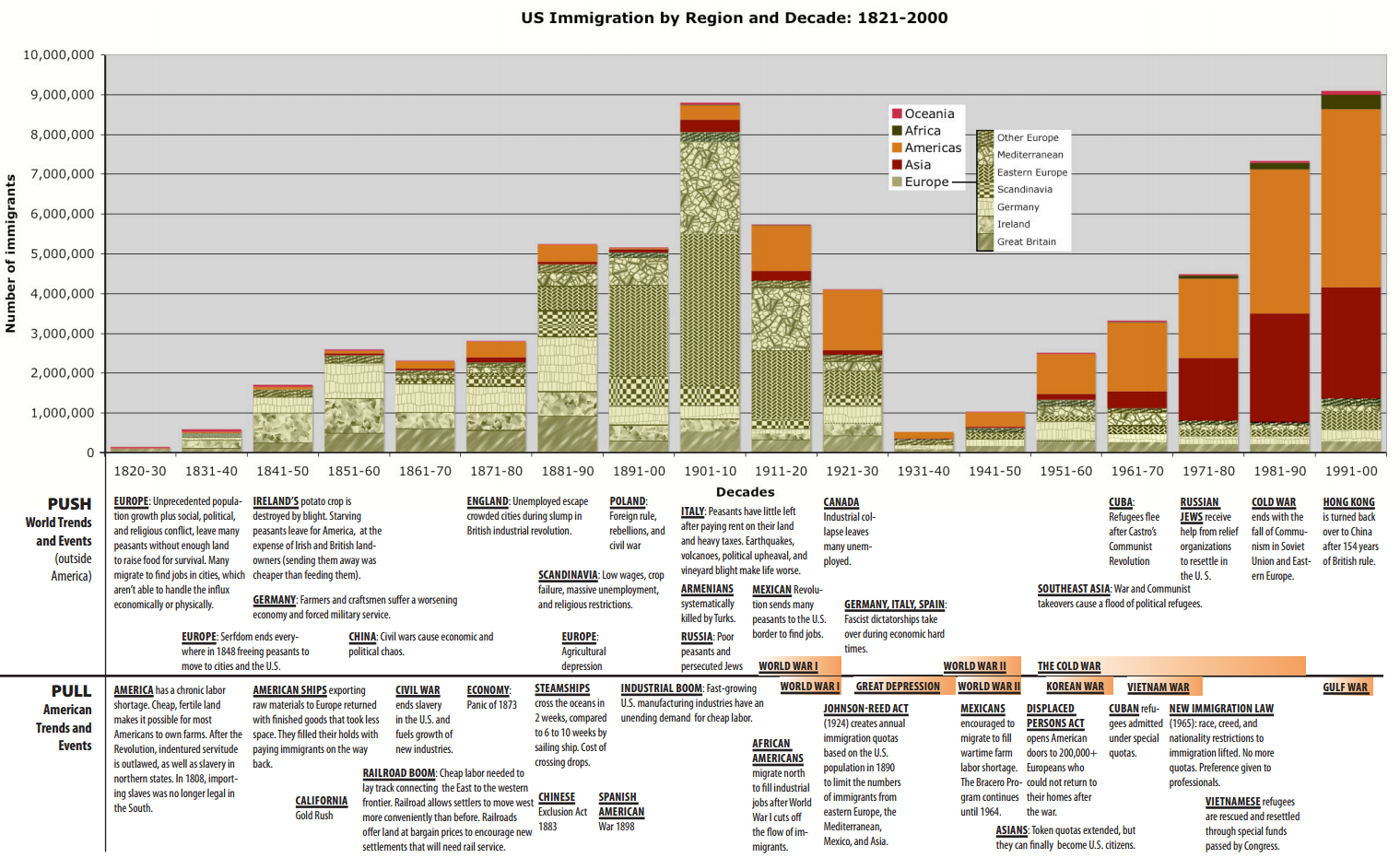
The U.S.’s new immigration restrictions need to be understood in the context of the rise of the Ku Klux Klan. People often associate the Klan primarily with racism and terror against black people, and this was indeed the primary focus of the first wave of the Klan, during Reconstruction. During the 1920s the second wave of the Klan, though, had many targets, including blacks, Catholics, and eastern European immigrants, among others. The Klan was not an isolated presence, either. In fact, their dominance in states like Indiana was well known.

There’s something else I bet you didn’t know. The United States obtained the Philippines from Spain in 1898 and fought a bloody war to subdue a local independence movement. Actually, that you probably did know. What you probably didn’t know is that during U.S. colonization Filipinos were considered U.S. nationals (though not U.S. citizens), and were thus free to travel to live and work in the United States, exempt from the harsh immigration quotas imposed on other countries. In fact, so many Filipinos traveled to the West Coast to work that a strong anti-Filipino nativist movement grew up. The result was that the U.S. passed a law initiating the Philipinnes’ independence process in 1934, and simultaneously limiting Filipino immigration to 50 per year. That’s right, 50 people. And yes, our motivation for granting the Philippines independence was motivated at least partially (and perhaps even primarily) by a desire to stem the flow of Filipino migrants.
Next came WWII. The United States’ immigration quotas may have played a role in Anne Frank’s father’s failure to obtain visas to bring his family to the U.S. Anti-semetism, which could lead to a refusal to issue visas even when quota spots remained, likely also contributed. The doors of U.S. immigration did not budge in the face of chaos abroad. After WWII, though, the plight of war refugees and the recent memory of what had happened when countries closed their doors to Jews fleeing Hitler made the United States’ restrictive immigration policies look bad. This did not, however, mean immediate wholesale reform. After much debate, Congress passed the Displaced Persons Act of 1948, allowing 400,000 displaced persons to to move to the U.S. The Immigration and Nationality Act of 1952, however, retained the country’s immigration antiquated quota system.
The children of the southern and eastern European immigrants who faced such opposition in the early 1900s fought in WWII, took advantage of the GI Bill to attend college, and moved into the cookie-cutter suburbs that sprang up after WWII. In a word, they became fully and unquestionably white. People stopped using terms like “Italian-American” and other hyphens. In this context, a quota system that discriminated against immigration from southern and eastern Europe made little sense, as President Kennedy once admitted in a speech given in Italy, pledging to bring about reform.
During the Cold War, the United States’ immigration quota system became a national embarrassment. It was quite clear that the system discriminated against immigrants from countries whose populations had been deemed racially inferior. International pressure also played a role in the civil rights movement—Jim Crow didn’t look great on the international scene, as it made the United States’ claims to being a bastion of freedom and democracy in the midst of the Cold War an obvious farce. Congress ultimately ended the quota system set up in 1924 with the Immigration and Nationality Act of 1965, which set up a new system based on uniting families and attracting immigrants with specific skills. This system forms the basis of the United States’ immigration policy today, and resulted in an increased diversity of immigrants.
Refugees, skilled workers, and relatives of existing immigrants have made up the bulk of documented immigration to the U.S. since 1965. Why are there eleven million undocumented immigrants in the U.S. today? The answer to that is fairly simple—our immigration system is set up to favor skilled laborers. In fact, the U.S. offers only 5,000 visas each year for unskilled workers coming on a permanent (i.e. not temporary or seasonal) employment basis. In other words, while our current system no longer discriminates based on race or national origin, it does make distinctions based on immigrants’ educational background and skill sets.
Conclusion
American immigration history is fascinating, as is the history of naturalization. I suspect most Americans have never heard of Takao Ozawa or Bhagat Singh Thind. I suspect most Americans know essentially nothing about the Treaty of Guadalupe Hidalgo, or about why Hispanics are considered white on surveys or in government statistics. I suspect most Americans don’t know that before 1952 you had to be white (or, since the civil war, African) to become a naturalized citizen, or that the Immigration Act of 1924 chose to use the year 1890 as an anchor for its quota system because that year best allowed them to limit immigration from eastern and southern Europe, whose populations were considered inferior.
But now you know, and that is at least something.
Previous Post

July 18, 2016
The White Invisibility of Racial Profiling
Next Post

July 20, 2016 My Life Until the Election: A Political Parable, with Dinosaurs
Browse Our Archives
Select a Category Atheism Evangelicalism/Fundamentalism Family Feminism Homeschool Meta Parenting Patriarchy Politics Purity Quiverfull Social Justice Uncategorized Worthwhile reads
Select a Month February 2021 January 2021 December 2020 November 2020 October 2020 September 2020 August 2020 July 2020 June 2020 May 2020 April 2020 March 2020 February 2020 January 2020 December 2019 November 2019 October 2019 September 2019 August 2019 July 2019 June 2019 May 2019 April 2019 March 2019 February 2019 January 2019 December 2018 November 2018 October 2018 September 2018 August 2018 July 2018 June 2018 May 2018 April 2018 March 2018 February 2018 January 2018 December 2017 November 2017 October 2017 September 2017 August 2017 July 2017 June 2017 May 2017 April 2017 March 2017 February 2017 January 2017 December 2016 November 2016 October 2016 September 2016 August 2016 July 2016 June 2016 May 2016 April 2016 March 2016 February 2016 January 2016 December 2015 November 2015 October 2015 September 2015 August 2015 July 2015 June 2015 May 2015 April 2015 March 2015 February 2015 January 2015 December 2014 November 2014 October 2014 September 2014 August 2014 July 2014 June 2014 May 2014 April 2014 March 2014 February 2014 January 2014 December 2013 November 2013 October 2013 September 2013 August 2013 July 2013 June 2013 May 2013 April 2013 March 2013 February 2013 January 2013 December 2012 November 2012 October 2012 September 2012 August 2012 July 2012 June 2012 May 2012 April 2012 March 2012 February 2012 January 2012 December 2011 November 2011 October 2011 September 2011 August 2011 July 2011 June 2011
Follow Us!
TAKE THE
Religious Wisdom Quiz
Which Christian group follows the Five Points of Calvinism?
Select your answer to see how you score.
Pentecostals Baptists Methodists Reformed
Related posts from Love, Joy, Feminism
"Liberal" and "Conservative" Have Actual Meanings

It's not about the economy, it's about being...
Impeachment Could Have Been a Gift to Republicans
TRENDING AT PATHEOS Nonreligious

Dethroning Jesus and Enthroning Yourself
Jesus Never Asked to Be Worshipped. He Asked to Be Understood. Christianity...

Why Most Christians are Really Paulians and Jobians
I Don't Care, But It Matters Let's get this out of the...

Essential Tips to Successfully Navigate the Selling Process
Selling a house can feel overwhelming, but it doesn’t have to be....

To Make Remote Work Effective, Think About Others
The COVID-19 pandemic forced many companies to rapidly transition to remote work....

Flexibility Is Key to Solving Problems of Tomorrow
The world of work is undergoing a dramatic transformation. The COVID-19 pandemic...
view all Nonreligious blogs
Ad-Free & Subscriber Log-In Subscription Support
- About Us
- 2026 Calendar
- Videos
- Podcasts
- Library of World Religions
- Faith In Media Tracker
- Advertise With Us
- Write for Us
- Privacy Policy
- Terms of Service
- Do Not Sell My Data
- Contact Us
- Radiant Digital
- Manage Newsletter Subscriptions
- Unsubscribe From Notifications
- Sitemap
Copyright 2008-2026, Patheos, part of the Radiant Digital network of media brands. All rights reserved.
Subscription Support Ad-Free & Subscriber Log-In
Follow Patheos