
BuddhistCatholicContemplativeEvangelicalGeneral ChristianHinduJewishLatter-day SaintMuslimNew VisionsProgressive Christian
Beliefs
- Buddhist
- Catholic
- Contemplative
- Evangelical
- General Christian
- Hindu
- Jewish
- Latter-day Saint
- More Voices
- Muslim
- New Visions
- Pagan
- Progressive Christian
Topics
- Religion News
- Food and Religion
- Sports and Religion
- Religious Art
- Religious Music and Entertainment
- Religious Events
- History and Religion
- Style and Religion
- Politics and Religion
- Women in Religion
- Recreation Outdoors and Religion
- Business Finance and Religion
- Careers Workplace and Religion
- Education and Religion
- Family Parenting and Religion
- Health Fitness and Religion
- Home and Religion
- Relationships and Religion
- Technology and Religion
- Travel and Religion
Columnists
- Buddhist Columnists
- Business Finance and Religion Columnists
- Careers Workplace and Religion Columnists
- Catholic Columnists
- Contemplative Columnists
- Education and Religion Columnists
- Evangelists Columnists
- Family Parenting and Religion Columnists
- General Christian Columnists
- Health Fitness and Religion Columnists
- Hindu Columnists
- History and Religion Columnists
- Home and Religion Columnists
- Jewish Columnists
- More Voices Columnists
- Latter Day Columnists
- Muslim Columnists
- New Visions Columnists
- Nonreligious Columnists
- Pagan Columnists
- Politics and Religion Columnists
- Progressive Columnists
- Recreation Outdoors and Religion Columnists
- Relationships and Religion Columnists
- Religion News Columnists
- Religious Art Columnists
- Religious Events Columnists
- Religious Music and Entertainment Columnists
- Sports and Religion Columnists
- Style and Religion Columnists
- Technology and Religion Columnists
- Travel and Religion Columnists
- Women in Religion Columnists
Resource Library
- 2026 Calendar
- Library of World Religions
- The 100 Most Holy Places on Earth
- Patheos Answers
- Podcasts
- Videos
- Faith Leaders Database
- Anglican Episcopalian
- Bahai
- Baptist
- Buddhism
- Christianity
- Confucianism
- Eastern Orthodoxy
- Hinduism
- Holiness and Pentecostal
- ISKCON
- Islam
- Judaism
- Lutheran
- Methodist
- The Church of Jesus Christ of Latter-day Saints
- New Age
- Paganism
- Presbytarian and Reformed
- Protestantism
- Religion Behind the Scenes
- Roman Catholic
- Scientology
- Shia Islam
- Sikhism
- Sufism
- Sunni Islam
- Taoism
- Zen
- See all religions
Research Tools
 Ad-Free & Subscriber Log-In Subscription Support
Ad-Free & Subscriber Log-In Subscription Support
Follow Patheos 

- Trending:
- Forgiveness
- |
- Marriage
- |
- Consciousness
- |
- Death Penalty
- |
- Election
- |
- Halloween
 Love, Joy, Feminism
-
More
- Home
- Nonreligious
- Who Is Outside the Circle?
Who Is Outside the Circle?
Last updated on: February 8, 2016 at 4:06 pm by Libby Anne
Who Is Outside the Circle? 2016-02-08T16:06:24-04:00 Libby Anne
Patheos Explore the world's faith through different perspectives on religion and spirituality! Patheos has the views of the prevalent religions and spiritualities of the world.
The Phoenix City Council has voted to replace the traditional prayer before their city council meetings with a moment of silence rather than allow a Satanist group a turn to give the prayer. As I was reading about this decision, I was struck by this image:
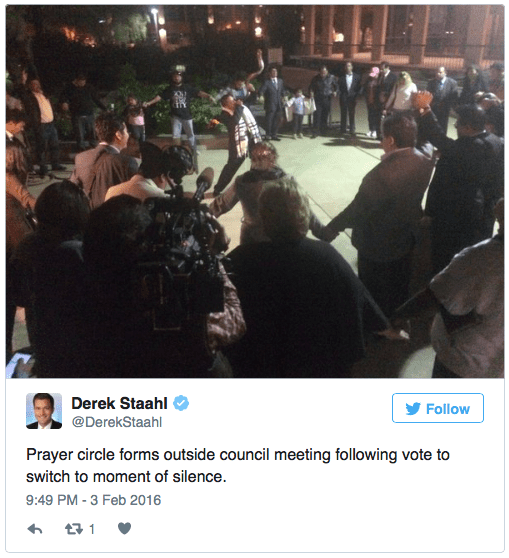
The text reads “Prayer circle forms outside council meeting following vote to switch to moment of silence” and the image shows a large circle of people, some in suits, holding hands. Do you know what I feel when I look at that picture?
I feel outside. I feel excluded.
What’s interesting is that the people forming that circle probably see prayer as unitive, and in a group of people who share the same beliefs, it can be. But the public prayers they are defending divide rather than uniting, because not everyone shares the same faith—or any faith at all. I am not religious. My husband is also not religious, and at this point, our children aren’t religious either. In many ways, we’re just like anyone else. Our children go to school, gymnastics, and martial arts. We go to the children’s museum, the park, the Y, and come home to have supper together, read books, and do some gaming together as a family. We go to a UU church, which is founded on common values rather than on common religious beliefs. But when I look at the circle in the image above, I become an outsider.
Don’t get me wrong, I have no problem with people gathering in like-minded religious groups and worshiping together. I have no problem with prayer circles in general, and I recognize that the people in that picture had a right to form that circle. But in that image, in that moment, those people were coming together in defense of Christian—yes, Christian—prayers at the beginning of their city council meetings. That wasn’t just some spontaneous outbreak of religious fervor. The strange thing is that they probably saw their act as unitive—the good people of the town coming together in the face of—of what, exactly? And that’s the problem.
It’s not just the nonreligious who are made to feel like outsiders in the face of the Christian majority working to cement its supremacy through public displays of Christianity such as opening prayers, it’s also those who aren’t Christian who are excluded. It’s also Jews, and Muslims, and Hindus, and Sikhs, and pagans. And this exclusion isn’t new. In the 1800s, amidst concerns about new immigrants, many common schools included daily reading from the Protestant Bible, which made the Catholic students feel like outsiders. In the 1950s, at the heart of the Cold War, schools in New York state opened with a prayer developed by Catholics, Protestants, and Jewish clergy—a prayer that made children who weren’t religious feel excluded.
Our public displays of what is often called “civil religion” should unite us, not divide us. We may be a majority-Christian nation, but we aren’t an only-Christian nation, and we are a nation ostensibly founded on religious freedom. When the founding founders declined to create an established religion, what they did was revolutionary. At the time, most countries had a state church. They chose a different route, because they knew that the young United States was already home to a religious diversity that would make an established church divisive, to say the least. While the United States doesn’t have a perfect record vis a vis a state establishment of religion—see the Bible reading and prayers mentioned above—it would behoove us to remember the underlying message—an establishment of religion in a country of diverse religious beliefs is divisive rather than unitive.
The people who formed that prayer circle in the image above had every right to do so, but it is only natural that their actions would leave people like me feeling like outsiders. When we look at controversies over public prayers at city councils or school board meetings, we need to ask who we leave standing on the outside looking in.
Stay in touch! Like Love, Joy, Feminism on Facebook:
Previous Post

February 5, 2016
Anonymous Tip: Chinese Worry Balls
Next Post

February 6, 2016 Saturday Link Love: Grease, Breast Milk, and Broken Hearts
Browse Our Archives
Select a Category Atheism Evangelicalism/Fundamentalism Family Feminism Homeschool Meta Parenting Patriarchy Politics Purity Quiverfull Social Justice Uncategorized Worthwhile reads
Select a Month February 2021 January 2021 December 2020 November 2020 October 2020 September 2020 August 2020 July 2020 June 2020 May 2020 April 2020 March 2020 February 2020 January 2020 December 2019 November 2019 October 2019 September 2019 August 2019 July 2019 June 2019 May 2019 April 2019 March 2019 February 2019 January 2019 December 2018 November 2018 October 2018 September 2018 August 2018 July 2018 June 2018 May 2018 April 2018 March 2018 February 2018 January 2018 December 2017 November 2017 October 2017 September 2017 August 2017 July 2017 June 2017 May 2017 April 2017 March 2017 February 2017 January 2017 December 2016 November 2016 October 2016 September 2016 August 2016 July 2016 June 2016 May 2016 April 2016 March 2016 February 2016 January 2016 December 2015 November 2015 October 2015 September 2015 August 2015 July 2015 June 2015 May 2015 April 2015 March 2015 February 2015 January 2015 December 2014 November 2014 October 2014 September 2014 August 2014 July 2014 June 2014 May 2014 April 2014 March 2014 February 2014 January 2014 December 2013 November 2013 October 2013 September 2013 August 2013 July 2013 June 2013 May 2013 April 2013 March 2013 February 2013 January 2013 December 2012 November 2012 October 2012 September 2012 August 2012 July 2012 June 2012 May 2012 April 2012 March 2012 February 2012 January 2012 December 2011 November 2011 October 2011 September 2011 August 2011 July 2011 June 2011
Follow Us!
TAKE THE
Religious Wisdom Quiz
What does God question Job about, showing His wisdom in creation?
Select your answer to see how you score.
Animals and nature Kingdoms Battles Religious rituals
Related posts from Love, Joy, Feminism

Maybe Let's Not Read More Puritans


"So Your Problem with Christianity is the Jesus...

No, the "Second Shift" Isn't Feminism's Fault
TRENDING AT PATHEOS Nonreligious

Dethroning Jesus and Enthroning Yourself
Jesus Never Asked to Be Worshipped. He Asked to Be Understood. Christianity...

Why Most Christians are Really Paulians and Jobians
I Don't Care, But It Matters Let's get this out of the...

Essential Tips to Successfully Navigate the Selling Process
Selling a house can feel overwhelming, but it doesn’t have to be....

To Make Remote Work Effective, Think About Others
The COVID-19 pandemic forced many companies to rapidly transition to remote work....

Flexibility Is Key to Solving Problems of Tomorrow
The world of work is undergoing a dramatic transformation. The COVID-19 pandemic...
view all Nonreligious blogs
Ad-Free & Subscriber Log-In Subscription Support
- About Us
- 2026 Calendar
- Videos
- Podcasts
- Library of World Religions
- Faith In Media Tracker
- Advertise With Us
- Write for Us
- Privacy Policy
- Terms of Service
- Do Not Sell My Data
- Contact Us
- Radiant Digital
- Manage Newsletter Subscriptions
- Unsubscribe From Notifications
- Sitemap
Copyright 2008-2026, Patheos. All rights reserved.
Subscription Support Ad-Free & Subscriber Log-In
Follow Patheos