
BuddhistCatholicContemplativeEvangelicalGeneral ChristianHinduJewishLatter-day SaintMuslimNew VisionsProgressive Christian
Beliefs
- Buddhist
- Catholic
- Contemplative
- Evangelical
- General Christian
- Hindu
- Jewish
- Latter-day Saint
- More Voices
- Muslim
- New Visions
- Pagan
- Progressive Christian
Topics
- Religion News
- Food and Religion
- Sports and Religion
- Religious Art
- Religious Music and Entertainment
- Religious Events
- History and Religion
- Style and Religion
- Politics and Religion
- Women in Religion
- Recreation Outdoors and Religion
- Business Finance and Religion
- Careers Workplace and Religion
- Education and Religion
- Family Parenting and Religion
- Health Fitness and Religion
- Home and Religion
- Relationships and Religion
- Technology and Religion
- Travel and Religion
Columnists
- Buddhist Columnists
- Business Finance and Religion Columnists
- Careers Workplace and Religion Columnists
- Catholic Columnists
- Contemplative Columnists
- Education and Religion Columnists
- Evangelists Columnists
- Family Parenting and Religion Columnists
- General Christian Columnists
- Health Fitness and Religion Columnists
- Hindu Columnists
- History and Religion Columnists
- Home and Religion Columnists
- Jewish Columnists
- More Voices Columnists
- Latter Day Columnists
- Muslim Columnists
- New Visions Columnists
- Nonreligious Columnists
- Pagan Columnists
- Politics and Religion Columnists
- Progressive Columnists
- Recreation Outdoors and Religion Columnists
- Relationships and Religion Columnists
- Religion News Columnists
- Religious Art Columnists
- Religious Events Columnists
- Religious Music and Entertainment Columnists
- Sports and Religion Columnists
- Style and Religion Columnists
- Technology and Religion Columnists
- Travel and Religion Columnists
- Women in Religion Columnists
Resource Library
- 2026 Calendar
- Library of World Religions
- The 100 Most Holy Places on Earth
- Patheos Answers
- Podcasts
- Videos
- Faith Leaders Database
- Anglican Episcopalian
- Bahai
- Baptist
- Buddhism
- Christianity
- Confucianism
- Eastern Orthodoxy
- Hinduism
- Holiness and Pentecostal
- ISKCON
- Islam
- Judaism
- Lutheran
- Methodist
- The Church of Jesus Christ of Latter-day Saints
- New Age
- Paganism
- Presbytarian and Reformed
- Protestantism
- Religion Behind the Scenes
- Roman Catholic
- Scientology
- Shia Islam
- Sikhism
- Sufism
- Sunni Islam
- Taoism
- Zen
- See all religions
Research Tools
 Ad-Free & Subscriber Log-In Subscription Support
Ad-Free & Subscriber Log-In Subscription Support
Follow Patheos 

- Trending:
- Forgiveness
- |
- Marriage
- |
- Consciousness
- |
- Death Penalty
- |
- Election
- |
- Halloween
 Love, Joy, Feminism
-
More
- Home
- Nonreligious
- Lying to Children Is Not a “Joke”
Lying to Children Is Not a “Joke”
Last updated on: January 26, 2016 at 9:33 pm by Libby Anne
Lying to Children Is Not a “Joke” 2016-01-26T21:33:45-04:00 Libby Anne
Patheos Explore the world's faith through different perspectives on religion and spirituality! Patheos has the views of the prevalent religions and spiritualities of the world.
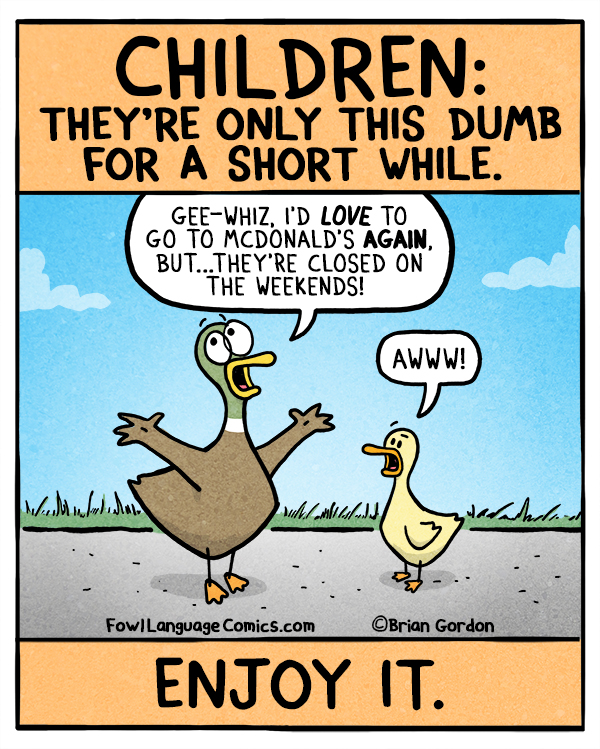
I recently saw the above cartoon shared on Facebook. Bizarrely, I saw it shared by progressives, and “liked” by progressives—and not just any progressives, progressive parents who embrace positive parenting. I was surprised and taken aback. Sharing cartoons that turn child abuse into a joke isn’t okay, and this isn’t okay either.
When did it become okay to joke about lying to children? Make no mistake, that is what this comic is talking about. What does it say about us, as a society, that we find a comic that makes light of and promotes lying to children funny? Do we really think that we as a society can joke about lying to children and then expect them to trust us? If we want a relationship of mutual trust and respect with our children, we need to prove ourselves worth of trust and respect.
And no, I’m some sort of non-parent who just doesn’t get it. I have two young children myself, and I understand the temptation to lie to them. Heck, I had the fight my urge to lie to my three-year-old earlier today! Our conversation went something like this:
“Can we go to the office and get candy?” Bobby asked.
“No honey, we’re not going to go to the apartment office right now.”
“Office closed?” Bobby wanted to know.
And that, right there, is where I could have said “yes.” He would have believed me, and that is where the conversation would have ended. I hesitated for a moment, knowing this. But I also knew that I want my son to trust me, and that he won’t trust me if I make a habit of lying to him for my own convenience.
“No, the office is open, but mommy’s working right now,” I told him.
“Oh,” he said. “Okay.”
And that was the end of the conversation, this time. Another day it might have gone on, with Bobby begging me to take him to the apartment office so that he could get a candy out of the bowl that sits on the apartment manager’s desk. I would have explained to him in more detail why I wasn’t going to take him to the office right then, or I might have realized that my reasons weren’t as sound as I thought—say, that “working” actually meant “Facebook,” and that a walk outside would be good for both of us. (I don’t see changing my mind as showing weakness, as some parents do.)
Of course, either of these outcomes would have required work on my part—more explaining, or a walk to the office–but they also would have offered payoff. Bobby would have gained more understanding of my need for time to work (and the fact that he can’t always have what he wants), or, if I’d changed my mind and taken him to the office, he would have learned that I listen to him and don’t refuse his requests arbitrarily or out of hand.
Lying to children too young to question what their parents say may seem convenient in the short term, but it’s nothing more than a shortcut around actual engagement and learning—and it’s a shortcut with some pretty severe potential negative consequences down the road. My daughter Sally is six now, and old enough to question what I tell her. She, too, likes going to the office and getting candy, and when she asks and I tell her its closed—because sometimes the office is closed—she is not always convinced (after all, I might be wrong) and likes to go and check.
When Sally checks for herself whether the apartment office is open, she does so in case I have it wrong, not because she thinks I might be lying. Office hours vary on the weekends, and weekday hours vary with the season, and as a result I haven’t always been correct. But Sally knows that if I have it wrong—if the office is actually open when I thought it was closed—it is a mistake, and not intentional deception.
Kids need to know that their parents (and the other adults around them) tell them the truth (at least, as far as they know it). How else are they supposed to trust them?
I am by no means perfect in this area, and am still learning myself. Some years back Jimmy Kimmel encouraged parents to hide their children’s Halloween candy and tell their kids they’d eaten it all, and then videotape the whole thing and send it to him. We tried this in our own home with Sally. Unlike the children in Jimmy Kimmel’s videos, Sally didn’t curl up and cry. She knew that it would be out of character for us to eat her Halloween candy, given our emphasis on respecting children’s personal possessions, so she refused to believe us, and, with some quick investigative fieldwork, exposed our lie. At the time, Sean and I found the entire thing hilarious, but now I find it regrettable. After all, it taught Sally that her parents were willing to lie to her face.
And frankly, in hindsight, the entire “joke” was just mean.
It’s true that children, and especially young children, are often very gullible, but that shouldn’t be an invitation to deceive them. Instead, it should be only more reason to be truthful and forthright with them. Children’s impressionability and ignorance of the world around them makes our responsibility to them, as adults, only greater.
There’s a lot more discussion, these days, about bullying in schools. I think we sometimes forget that adults, too, can also bully children, and, further, that parents can bully their own children. We would all be horrified if someone took a blind student’s books and held them just out of reach, taunting them. Why is it okay, in contrast, to take advantage of young children’s ignorance and gullibility?
I’ll give you a hint—it’s not. Let’s stop treating lying to children as a “joke.”
Next Post

October 9, 2015 Anonymous Tip: In Which Gordon Sees a Lawyer
Browse Our Archives
Select a Category Atheism Evangelicalism/Fundamentalism Family Feminism Homeschool Meta Parenting Patriarchy Politics Purity Quiverfull Social Justice Uncategorized Worthwhile reads
Select a Month February 2021 January 2021 December 2020 November 2020 October 2020 September 2020 August 2020 July 2020 June 2020 May 2020 April 2020 March 2020 February 2020 January 2020 December 2019 November 2019 October 2019 September 2019 August 2019 July 2019 June 2019 May 2019 April 2019 March 2019 February 2019 January 2019 December 2018 November 2018 October 2018 September 2018 August 2018 July 2018 June 2018 May 2018 April 2018 March 2018 February 2018 January 2018 December 2017 November 2017 October 2017 September 2017 August 2017 July 2017 June 2017 May 2017 April 2017 March 2017 February 2017 January 2017 December 2016 November 2016 October 2016 September 2016 August 2016 July 2016 June 2016 May 2016 April 2016 March 2016 February 2016 January 2016 December 2015 November 2015 October 2015 September 2015 August 2015 July 2015 June 2015 May 2015 April 2015 March 2015 February 2015 January 2015 December 2014 November 2014 October 2014 September 2014 August 2014 July 2014 June 2014 May 2014 April 2014 March 2014 February 2014 January 2014 December 2013 November 2013 October 2013 September 2013 August 2013 July 2013 June 2013 May 2013 April 2013 March 2013 February 2013 January 2013 December 2012 November 2012 October 2012 September 2012 August 2012 July 2012 June 2012 May 2012 April 2012 March 2012 February 2012 January 2012 December 2011 November 2011 October 2011 September 2011 August 2011 July 2011 June 2011
Follow Us!
TAKE THE
Religious Wisdom Quiz
Which prophet had a vision of God standing beside a destroyed altar?
Select your answer to see how you score.
Ezekiel Joel Micah Amos
Related posts from Love, Joy, Feminism

When You're So Paranoid Even Sunday School Teachers...

Did Debi Pearl Even Read the Letter Before...

We Want Our Kids to Listen---So Why Don't...
Raised My Children without Sin
TRENDING AT PATHEOS Nonreligious

Dethroning Jesus and Enthroning Yourself
Jesus Never Asked to Be Worshipped. He Asked to Be Understood. Christianity...

Why Most Christians are Really Paulians and Jobians
I Don't Care, But It Matters Let's get this out of the...

Essential Tips to Successfully Navigate the Selling Process
Selling a house can feel overwhelming, but it doesn’t have to be....

To Make Remote Work Effective, Think About Others
The COVID-19 pandemic forced many companies to rapidly transition to remote work....

Flexibility Is Key to Solving Problems of Tomorrow
The world of work is undergoing a dramatic transformation. The COVID-19 pandemic...
view all Nonreligious blogs
Ad-Free & Subscriber Log-In Subscription Support
- About Us
- 2026 Calendar
- Videos
- Podcasts
- Library of World Religions
- Faith In Media Tracker
- Advertise With Us
- Write for Us
- Privacy Policy
- Terms of Service
- Do Not Sell My Data
- Contact Us
- Radiant Digital
- Manage Newsletter Subscriptions
- Unsubscribe From Notifications
- Sitemap
Copyright 2008-2026, Patheos. All rights reserved.
Subscription Support Ad-Free & Subscriber Log-In
Follow Patheos