
BuddhistCatholicContemplativeEvangelicalGeneral ChristianHinduJewishLatter-day SaintMuslimNew VisionsProgressive Christian
Beliefs
- Buddhist
- Catholic
- Contemplative
- Evangelical
- General Christian
- Hindu
- Jewish
- Latter-day Saint
- More Voices
- Muslim
- New Visions
- Pagan
- Progressive Christian
Topics
- Religion News
- Food and Religion
- Sports and Religion
- Religious Art
- Religious Music and Entertainment
- Religious Events
- History and Religion
- Style and Religion
- Politics and Religion
- Women in Religion
- Recreation Outdoors and Religion
- Business Finance and Religion
- Careers Workplace and Religion
- Education and Religion
- Family Parenting and Religion
- Health Fitness and Religion
- Home and Religion
- Relationships and Religion
- Technology and Religion
- Travel and Religion
Columnists
- Buddhist Columnists
- Business Finance and Religion Columnists
- Careers Workplace and Religion Columnists
- Catholic Columnists
- Contemplative Columnists
- Education and Religion Columnists
- Evangelists Columnists
- Family Parenting and Religion Columnists
- General Christian Columnists
- Health Fitness and Religion Columnists
- Hindu Columnists
- History and Religion Columnists
- Home and Religion Columnists
- Jewish Columnists
- More Voices Columnists
- Latter Day Columnists
- Muslim Columnists
- New Visions Columnists
- Nonreligious Columnists
- Pagan Columnists
- Politics and Religion Columnists
- Progressive Columnists
- Recreation Outdoors and Religion Columnists
- Relationships and Religion Columnists
- Religion News Columnists
- Religious Art Columnists
- Religious Events Columnists
- Religious Music and Entertainment Columnists
- Sports and Religion Columnists
- Style and Religion Columnists
- Technology and Religion Columnists
- Travel and Religion Columnists
- Women in Religion Columnists
Resource Library
- 2026 Calendar
- Library of World Religions
- The 100 Most Holy Places on Earth
- Patheos Answers
- Podcasts
- Videos
- Faith Leaders Database
- Anglican Episcopalian
- Bahai
- Baptist
- Buddhism
- Christianity
- Confucianism
- Eastern Orthodoxy
- Hinduism
- Holiness and Pentecostal
- ISKCON
- Islam
- Judaism
- Lutheran
- Methodist
- The Church of Jesus Christ of Latter-day Saints
- New Age
- Paganism
- Presbytarian and Reformed
- Protestantism
- Religion Behind the Scenes
- Roman Catholic
- Scientology
- Shia Islam
- Sikhism
- Sufism
- Sunni Islam
- Taoism
- Zen
- See all religions
Research Tools
 Ad-Free & Subscriber Log-In Subscription Support
Ad-Free & Subscriber Log-In Subscription Support
Follow Patheos 

- Trending:
- Forgiveness
- |
- Marriage
- |
- Consciousness
- |
- Death Penalty
- |
- Election
- |
- Halloween
 Love, Joy, Feminism
-
More
- Home
- Nonreligious
- Admitting Privileges, Abortion, and the Trojan Horse of Protecting Women’s Health
Admitting Privileges, Abortion, and the Trojan Horse of Protecting Women’s Health
Last updated on: January 26, 2016 at 9:31 pm by Libby Anne
Admitting Privileges, Abortion, and the Trojan Horse of Protecting Women’s Health 2016-01-26T21:31:42-04:00 Libby Anne
Patheos Explore the world's faith through different perspectives on religion and spirituality! Patheos has the views of the prevalent religions and spiritualities of the world.
While spending time on google, I came upon this headline from an anti-abortion website last year: Court Records Indicate Nearly 1,000 Abortion Patients Likely Hospitalized Annually in Texas. The article explained that during the year 2011, a full 940 women were hospitalized in Texas due to complications from abortions. These numbers came out during court proceedings over new abortion restrictions. Of course, the article made this number out to be apocalyptic.
“Information in this decision has forced us to crunch the numbers,” said Troy Newman, President of Operation Rescue. “Our calculations based on conservative estimates indicates that nearly 1,000 women might very well be hospitalized each year in Texas alone. That number is completely unacceptable.”
The article included this image offering a breakdown of these hospitalizations:
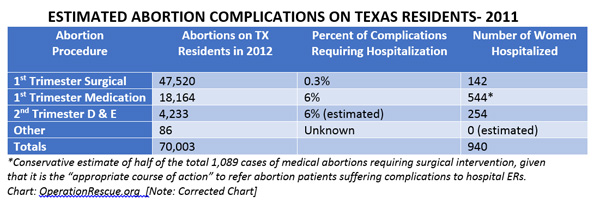
A total of 940 hospitalizations for 70,003 abortions adds up to only a 1.3% rate of hospitalization due to complications. Given how often abortion opponents emphasize the dangers of abortion, this number actually seems really low.
Some my find it surprising that 6% of those who have first trimester medication abortions have complications requiring hospitalization. However, this number is more complicated than it appears. While the 6% figure is used in that line, the number of women hospitalized listed is only 3%. As the note at the bottom explains, this is because the 6% statistic actually refers to the percentage of those who had to follow their medication abortion with a surgical abortion because the medication abortion did not complete, not to the percentage of women hospitalized. The number of women hospitalized is based on the assumption that half of those whose medication abortions do not complete will have their surgical abortion followup at a local hospital rather than at an abortion clinic.
Individuals who choose medication abortions are told up front that there is a small chance that the pills (which they take at home) will not be fully effective, and that in that case they will need to come in and follow the procedure up with a surgical abortion. The followup is routine, and is typically the result of the failure of the pills to complete the abortion, not life-threatening bleeding or other complications. In other words, while some percentages of these followup surgical abortions may occur in a hospital, they are simply a repeat abortion procedure and not blood transfusions or life support.
When we understand that the majority of the 6% figure for complications requiring hospitalization listed under first trimester medication abortions refers to those who have to follow their medication abortion with a routine surgical abortion, the risk listed for first trimester abortions declines quite a bit. Even with this understanding, however, medication abortions are still associated with more risk than surgical abortions. A proper response to this reality should be to (a) fund research to make the abortion pill safer and (b) promote the safer surgical abortions and make these surgical abortions more widely available, which are both things abortion opponents oppose.
It is well known that second trimester abortions have a greater risk of complications than first trimester abortions. Because of this, I don’t find the 6% rate of complications requiring hospitalization all that surprising. Because second trimester abortions are more risky, I support making first trimester abortions more readily available. A significant number of individuals who have second trimester abortions do so because they were unable to access an abortion during their first trimester, often due to accessibility or financial need. If we make first trimester abortions more accessible, we can substantially cut down on the number of second trimester abortions and thus cut down on the health risks involve—but this is exactly what abortion opponents are fighting to stop.
Even with the slightly higher rate of complications for medication abortions and the significantly higher rate of complications for second trimester abortion, the overall rate of hospitalization from complications due to abortion in Texas is only 1.3%. This number is far lower than the typical rate of hospitalization after an outpatient surgery center, yet Republicans are working to expand the number of outpatient surgery centers. If Republicans see outpatient surgery centers as a safe, cost-effective alternative to surgeries performed in hospitals, in spite of these centers’ substantially higher rate of hospitalization due to later complications, why all the fuss about abortion clinics, which follow essentially the same model and are in fact safer than outpatient surgery centers?
There’s something else that suggests that it’s not really about protecting women’s health as well. While roughly 1.3% of those who have abortions are hospitalized due to complications, nearly 100% of those who carry their pregnancies to term are hospitalized. In other words, if those 70,003 individuals had not had abortions, they would for all intents and purposes all have been hospitalized. Now yes, many would argue that childbirth is a natural process and should not be seen as a “complication.” Still, the rate of complications from pregnancy is not negligible, and in 2011 there were 30.7 maternal deaths per 100,000 live births. If abortion had the same mortality rate, we would have seen 21.5 deaths due to abortion in Texas in 2011, when instead there were zero.
Abortion is far safer than birth. Troy Newman of Operation Rescue calls 1000 hospitalizations due to abortion in Texas each year “completely unacceptable.” What does he think of the 116 women who died in childbirth in Texas in that same year? While researchers are still discussing the reasons for the U.S.’s unusually high maternal mortality rate, most agree that lack of access to healthcare is a significant part of the problem. And yet, Republicans have blocked both medicaid expansion and other proposals that would extend healthcare to pregnant individuals. If abortion opponents truly cared about women’s health, they ought to support policies that would make pregnancy and maternity care more affordable and more available—and they need to acknowledge that pregnancy and childbirth are far more risky than abortion, and act like they actually believe that.
Let’s finish by talking for a moment about the controversy over admitting privileges. A Texas law passed in 2013 required abortion doctors to have admitting privileges at a local hospital at any clinic where they provide abortions. On some level, this law sounds well meaning and reasonable. However, because of a decades-long campaign of terror against abortion doctors, many clinics are unable to find a local doctor willing to perform abortions. Further, the shortage of doctors willing to perform abortions and the stigma against abortion doctors means that doctors who do proally gvide abortions often end up only providing abortions. Many abortion doctors travel from clinic to clinic providing abortion services for individuals who wound not otherwise have access to an abortion provider. Requiring these doctors to have admitting privileges at numerous hospitals across the state is neither practical nor necessary, especially given the overwhelmingly safe nature of the procedure.
Abortion opponents would have you think that abortion doctors practicing at abortion clinics without having admitting privileges at a local hospital is profoundly medically dangerous, but this misunderstands the current situation. In my own town, our local Planned Parenthood offers abortions only one day a week. That day, an abortion doctor travels to my town from a nearby city. The Planned Parenthood clinic has an arrangement with a local doctor who would take over the care for any patient who has to be transferred to the hospital in case of an emergency. I am not sure whether this is common practice more generally, but hospital emergency rooms are required to accept and treat all patients regardless of whether the doctor who originally treated them has admitting privileges.
And if this isn’t enough to convince you, the American College of Obstetricians and Gynecologists (ACOG) and the American Medical Association (AMA) filed a joint amicus brief in support of Planned Parenthood’s challenge to the Texas admitting privileges law. Troy Newman of the anti-abortion group Operation Rescue has written that “[r]equiring local hospital privileges is a way to protect women and save lives until such time as the practice of abortion can be completely abolished,” making the true intent of such laws clear. The “lives” Newman writes of saving are the lives of the fetuses who will no longer be aborted, because the true intent of admitting privileges laws is to shut down abortion clinics, not to protect women’s health.
Note: I have used the term “women” as it refers to the terms used in the graph and have spoken of “women’s health” in the context of anti-abortion framing of this discussion. In all other cases I have sought to use gender neutral language to reflect the reality that anyone with functional ovaries and a uterus can become pregnant.
Previous Post

September 28, 2015
Let's Talk about Common Core Math
Next Post
October 1, 2015 I Grew Up in the Benedict Option. Here's Why It Didn't Work.
Browse Our Archives
Select a Category Atheism Evangelicalism/Fundamentalism Family Feminism Homeschool Meta Parenting Patriarchy Politics Purity Quiverfull Social Justice Uncategorized Worthwhile reads
Select a Month February 2021 January 2021 December 2020 November 2020 October 2020 September 2020 August 2020 July 2020 June 2020 May 2020 April 2020 March 2020 February 2020 January 2020 December 2019 November 2019 October 2019 September 2019 August 2019 July 2019 June 2019 May 2019 April 2019 March 2019 February 2019 January 2019 December 2018 November 2018 October 2018 September 2018 August 2018 July 2018 June 2018 May 2018 April 2018 March 2018 February 2018 January 2018 December 2017 November 2017 October 2017 September 2017 August 2017 July 2017 June 2017 May 2017 April 2017 March 2017 February 2017 January 2017 December 2016 November 2016 October 2016 September 2016 August 2016 July 2016 June 2016 May 2016 April 2016 March 2016 February 2016 January 2016 December 2015 November 2015 October 2015 September 2015 August 2015 July 2015 June 2015 May 2015 April 2015 March 2015 February 2015 January 2015 December 2014 November 2014 October 2014 September 2014 August 2014 July 2014 June 2014 May 2014 April 2014 March 2014 February 2014 January 2014 December 2013 November 2013 October 2013 September 2013 August 2013 July 2013 June 2013 May 2013 April 2013 March 2013 February 2013 January 2013 December 2012 November 2012 October 2012 September 2012 August 2012 July 2012 June 2012 May 2012 April 2012 March 2012 February 2012 January 2012 December 2011 November 2011 October 2011 September 2011 August 2011 July 2011 June 2011
Follow Us!
TAKE THE
Religious Wisdom Quiz
This chapter in Psalms declares the blessed man who meditates on God's law day and night is like a tree planted by streams. What is its number?
Select your answer to see how you score.
Psalm 119 Psalm 23 Psalm 1 Psalm 100
Related posts from Love, Joy, Feminism

"Liberal" and "Conservative" Have Actual Meanings

It's not about the economy, it's about being...


Maybe Let's Not Read More Puritans
TRENDING AT PATHEOS Nonreligious

Dethroning Jesus and Enthroning Yourself
Jesus Never Asked to Be Worshipped. He Asked to Be Understood. Christianity...

Why Most Christians are Really Paulians and Jobians
I Don't Care, But It Matters Let's get this out of the...

Essential Tips to Successfully Navigate the Selling Process
Selling a house can feel overwhelming, but it doesn’t have to be....

To Make Remote Work Effective, Think About Others
The COVID-19 pandemic forced many companies to rapidly transition to remote work....

Flexibility Is Key to Solving Problems of Tomorrow
The world of work is undergoing a dramatic transformation. The COVID-19 pandemic...
view all Nonreligious blogs
Ad-Free & Subscriber Log-In Subscription Support
- About Us
- 2026 Calendar
- Videos
- Podcasts
- Library of World Religions
- Faith In Media Tracker
- Advertise With Us
- Write for Us
- Privacy Policy
- Terms of Service
- Do Not Sell My Data
- Contact Us
- Radiant Digital
- Manage Newsletter Subscriptions
- Unsubscribe From Notifications
- Sitemap
Copyright 2008-2026, Patheos. All rights reserved.
Subscription Support Ad-Free & Subscriber Log-In
Follow Patheos