
BuddhistCatholicContemplativeEvangelicalGeneral ChristianHinduJewishLatter-day SaintMuslimNew VisionsProgressive Christian
Beliefs
- Buddhist
- Catholic
- Contemplative
- Evangelical
- General Christian
- Hindu
- Jewish
- Latter-day Saint
- More Voices
- Muslim
- New Visions
- Pagan
- Progressive Christian
Topics
- Religion News
- Food and Religion
- Sports and Religion
- Religious Art
- Religious Music and Entertainment
- Religious Events
- History and Religion
- Style and Religion
- Politics and Religion
- Women in Religion
- Recreation Outdoors and Religion
- Business Finance and Religion
- Careers Workplace and Religion
- Education and Religion
- Family Parenting and Religion
- Health Fitness and Religion
- Home and Religion
- Relationships and Religion
- Technology and Religion
- Travel and Religion
Columnists
- Buddhist Columnists
- Business Finance and Religion Columnists
- Careers Workplace and Religion Columnists
- Catholic Columnists
- Contemplative Columnists
- Education and Religion Columnists
- Evangelists Columnists
- Family Parenting and Religion Columnists
- General Christian Columnists
- Health Fitness and Religion Columnists
- Hindu Columnists
- History and Religion Columnists
- Home and Religion Columnists
- Jewish Columnists
- More Voices Columnists
- Latter Day Columnists
- Muslim Columnists
- New Visions Columnists
- Nonreligious Columnists
- Pagan Columnists
- Politics and Religion Columnists
- Progressive Columnists
- Recreation Outdoors and Religion Columnists
- Relationships and Religion Columnists
- Religion News Columnists
- Religious Art Columnists
- Religious Events Columnists
- Religious Music and Entertainment Columnists
- Sports and Religion Columnists
- Style and Religion Columnists
- Technology and Religion Columnists
- Travel and Religion Columnists
- Women in Religion Columnists
Resource Library
- 2026 Calendar
- Library of World Religions
- The 100 Most Holy Places on Earth
- Patheos Answers
- Podcasts
- Videos
- Faith Leaders Database
- Anglican Episcopalian
- Bahai
- Baptist
- Buddhism
- Christianity
- Confucianism
- Eastern Orthodoxy
- Hinduism
- Holiness and Pentecostal
- ISKCON
- Islam
- Judaism
- Lutheran
- Methodist
- The Church of Jesus Christ of Latter-day Saints
- New Age
- Paganism
- Presbytarian and Reformed
- Protestantism
- Religion Behind the Scenes
- Roman Catholic
- Scientology
- Shia Islam
- Sikhism
- Sufism
- Sunni Islam
- Taoism
- Zen
- See all religions
Research Tools
 Ad-Free & Subscriber Log-In Subscription Support
Ad-Free & Subscriber Log-In Subscription Support
Follow Patheos 

- Trending:
- Forgiveness
- |
- Marriage
- |
- Consciousness
- |
- Death Penalty
- |
- Election
- |
- Halloween
 Love, Joy, Feminism
-
More
- Home
- Nonreligious
- Are Creationists Withholding Information from Children?
Are Creationists Withholding Information from Children?
Last updated on: January 26, 2016 at 9:23 pm by Libby Anne
Are Creationists Withholding Information from Children? 2016-01-26T21:23:23-04:00 Libby Anne
Patheos Explore the world's faith through different perspectives on religion and spirituality! Patheos has the views of the prevalent religions and spiritualities of the world.
I recently came upon an article by Lou Doench responding to a response by Neil Carter to a comment made by Lawrence Krauss. If you’re confused, don’t worry! I was too! Basically, theoretical physicist Lawrence Krauss said that parents who teach their children creationism are committing child abuse.
“It’s like not allowing your children to have medicine, not allowing you children to be vaccinated, for example, is child abuse, because you are doing them harm.”
“In some sense, if you withhold information from your children because you would rather them not know what reality is really like, for fear that it is going to affect their beliefs, then you are doing them harm.”
Okay, but wait a minute. Virtually no evangelical or fundamentalist Christians today are calling for the removal of evolution from the classroom. Instead, they’re asking that creationism (or “intelligent design”) be taught alongside evolution. They’re also asking that textbooks cover various holes in the theory of evolution rather than concealing this information from children (I know, I know, but this is how they see it). In other words, from the creationist perspective, it’s the evolutionary scientists who write public school textbooks who are withholding information from children.
I was homeschooled using creationist science textbooks. My biology textbook had a section on evolution. While I have not reviewed every creationist textbook, I would imagine this is fairly standard. After all, how can a Christian textbook publisher equip students to refute evolution if they don’t know what it is? I’m not saying I completed my biology course with a thorough and accurate understanding of evolution. I didn’t. What I am saying is that I don’t believe either my parents or the textbook publisher saw themselves as withholding information in any way.
While not a direct response to Krauss point, here is a quote from an Answers in Genesis piece:
Dawkins’ only remaining character slur is “wicked”—a scandalous defamation that betrays the totalitarianism of militant atheism, which, for instance, demands that Darwinian evolution be taught in schools and universities without questioning the evidence or presenting alternative interpretations, and which labels parents who teach their children the biblical account of creation as “child-abusers.”
Here you see the idea that it is evolutionary scientists who are withholding information from children—to be exact, the holes in their theories and alternative interpretations of their evidence (again, this is the creationist understanding of what’s going on here, not mine).
To quote Stephen C. Meyer of the creationist Discovery Institute:
When two groups of experts disagree about a controversial subject that intersects the public school curriculum students should learn about both perspectives.
Again you see the emphasis on giving children more information, not less.
But there’s another problem with the argument that creationists want to “withhold information” from children because they “would rather them not know what reality is really like.” Namely, this statement presumes that creationists believe evolution is the correct position (the one in line with reality), and that itself is ludicrous. Look, I get that it can be hard to fully grasp that there are people who honestly think the world was created in six days six thousand years ago.The idea that the universe was spoken into existence only six thousand years ago is so absurd that it can be difficult to wrap one’s heads around the reality that there are people in the twenty-first century who really do believe this. But there are.
My father is a very intelligent and educated man. He was also an ardent young earth creationist. When I was a child and adolescent, my father spent much of his spare time reading, and there was often a creationist science book sitting on his nightstand. He loved to talk about creationism and evolution, and when he did he could explain his position, and back it up with evidence pulled from a variety of sources. Was he still wrong? Yes. But he was neither dishonest or unintelligent.
It’s true that the scientific literature he read was almost entirely from a creationist perspective. But let me ask you this, if you are a feminist, how often do you read books by Phyllis Schlafly or Beverly LaHaye? If you are a progressive, how often do you read books by Glenn Beck or Rush Limbaugh? It’s really quite natural to trust authors who support the position you have already chosen, and to read literature by those on the other side only with a sharp eye toward criticism. And the creationist literature my father read did present evolutionary arguments and quote from evolutionary sources—to refute them, of course, but it meant my father was at least aware of the positions taken by evolutionary scientists.
Let me give you a somewhat-lengthy example from an Answers in Genesis article:
The Coconino Sandstone is also noted for the large number of fossilized footprints, usually in sequences called trackways. These appear to have been made by four-footed vertebrates moving across the original sand surfaces (see Figure 4, left). These fossil footprint trackways were compared to the tracks made by reptiles on desert sand dunes,4 so it was then assumed that these fossilized footprints in the Coconino Sandstone must have been made in dry desert sands which were then covered up by wind-blown sand, subsequent cementation forming the sandstone and fossilizing the prints.
Yet another feature that evolutionary geologists have used to argue that the Coconino Sandstone represents the remains of a long period of dry desert conditions is the sand grains themselves. Geologists have studied the sand grains from modern desert dunes and under the microscope they often show pitted or frosted surfaces. Similar grain surface textures have also been observed in sandstone layers containing very thick cross beds such as the Coconino Sandstone, so again this comparison has strengthened the belief that the Coconino Sandstone was deposited as dunes in a desert.
At first glance this interpretation would appear to be an embarrassment to Bible-believing geologists who are unanimous in their belief that it must have been Noah’s Flood that deposited the flat lying beds of what were once sand, mud and lime, but are now exposed as the rock layers in the walls of the Canyon.
Above the Coconino Sandstone is the Toroweap Formation and below is the Hermit Formation, both of which geologists agree are made up of sediments that were either deposited by and/or in water. 5,6 How could there have been a period of dry desert conditions in the middle of the Flood year when ‘all the high hills under the whole heaven were covered’ (Genesis 7:19) by water?
. . .
The footprint trackways in the Coconino Sandstone have recently been re-examined in the light of experimental studies by Dr Leonard Brand of Loma Linda University in California.8 His research program involved careful surveying and detailed measurements of 82 fossilized vertebrate trackways discovered in the Coconino Sandstone along the Hermit Trail in Grand Canyon. He then observed and measured 236 experimental trackways made by living amphibians and reptiles in experimental chambers. These tracks were formed on sand beneath the water, on moist sand at the water’s edge, and on dry sand, the sand mostly sloping at an angle of 25 degrees, although some observations were made on slopes of 15deg; and 20° for comparison. Observations were also made of the underwater locomotion of five species of salamanders (amphibians) both in the laboratory and in their natural habitat, and measurements were again taken of their trackways.
A detailed statistical analysis of these data led to the conclusion, with a high degree of probability that the fossil tracks must have been made underwater. Whereas the experimental animals produce footprints under all test conditions, both up and down the 25° slopes of the laboratory ‘dunes’, all but one of the fossil trackways could only have been made by the animals in question climbing uphill. Toe imprints were generally distinct, whereas the prints of the soles were indistinct. These and other details were present in over 80% of the fossil, underwater and wet sand tracks, but less than 12% of the dry sand and damp sand tracks had any toe marks. Dry sand uphill tracks were usually just depressions, with no details. Wet sand tracks were quite different from the fossil tracks in certain features. Added to this, the observations of the locomotive behaviour of the living salamanders indicated that all spent the majority of their locomotion time walking on the bottom, underwater, rather than swimming.
Putting together all of his observations, Dr Brand thus came to the conclusion that the configurations and characteristics of the animals trackways made on the submerged sand surfaces most closely resembled the fossilized quadruped trackways of the Coconino Sandstone. Indeed, when the locomotion behaviour of the living amphibians is taken into account, the fossilized trackways can be interpreted as implying that the animals must have been entirely under water (not swimming at the surface) and moving upslope (against the current) in an attempt to get out of the water. This interpretation fits with the concept of a global Flood, which overwhelmed even four-footed reptiles and amphibians that normally spend most of their time in the water.
Not content with these initial studies, Dr Brand has continued (with the help of a colleague) to pursue this line of research. He recently published further results,9 which were so significant that a brief report of their work appeared in Science News10 and Geology Today. 11
His careful analysis of the fossilized trackways in the Coconino Sandstone, this time not only from the Hermit Trail in Grand Canyon but from other trails and locations, again revealed that all but one had to have been made by animals moving up cross bed slopes. Furthermore, these tracks often show that the animals were moving in one direction while their feet were pointing in a different direction. It would appear that the animals were walking in a current of water, not air. Other trackways start or stop abruptly, with no sign that the animals’ missing tracks were covered by some disturbance such as shifting sediments. It appears that these animals simply swam away from the sediment.
Because many of the tracks have characteristics that are ‘just about impossible’ to explain unless the animals were moving underwater, Dr Brand suggested that newt-like animals made the tracks while walking under water and being pushed by a current. To test his ideas, he and his colleague videotaped living newts walking through a laboratory tank with running water. All 238 trackways made by the newts had features similar to the fossilized trackways in the Coconino Sandstone, and their videotaped behaviour while making the trackways thus indicated how the animals that made the fossilized trackways might have been moving.
These additional studies confirmed the conclusions of his earlier researches. Thus, Dr Brand concluded that all his data suggest that the Coconino Sandstone fossil tracks should not be used as evidence for desert wind deposition of dry sand to form the Coconino Sandstone, but rather point to underwater deposition. These evidence from such careful experimental studies by a Flood geologist overturn the original interpretation by evolutionists of these Coconino Sandstone fossil footprints, and thus call into question their use by Young and others as an argument against the Flood.
If it were simply about withholding information, Answers in Genesis would conceal evidence of the Cocinino Sandstone fossil footprints entirely. But they don’t. Instead they present the evolutionary scientists’ interpretation of the footprints (that they were made in desert conditions), admit that this proves a problem for young earth creationists (because this rock layer was supposed to have been laid down during the global flood), and then explain that Dr. Leonard Brand Loma Linda University has examined the footprints and believes, for reasons he has laid out in articles in several scientific outlets, that they were laid down in watery conditions.
Now true, the article does not mention that some scientists have criticized Brand’s interpretation of the footprints, but on some level that’s unimportant—it is enough for Answers in Genesis to note that there is at least some reason to believe that the footprints were formed under water, whether or not every scientist agrees with this. Indeed, based on the above information, creationists would likely argue that any evolutionary textbook that does not mention some scientists believe the Cocinino Sandstone fossil footprints were formed in water is withholding information.
Answers in Genesis explains this phenomenon in images like this (here):
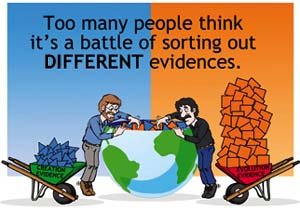

In this framework, creationists aren’t hiding anything. Rather, they’re working with the same evidence evolutionary scientists are working with. It is evolutions who are hiding something by not teaching students that there are alternative ways of interpreting the evidence (whereas creationist students know this). We saw this idea with the Cocinino Sandstone fossil footprints—both evolutionary and creationist scientists have the same evidence in front of them, and each sees it as supporting their own theory.
Indeed, creationists at Answers in Genesis have long argued that both sides (inasmuch as there are “two sides”) are looking at the same evidence, they are simply using a different lens. I grew up seeing images like this:
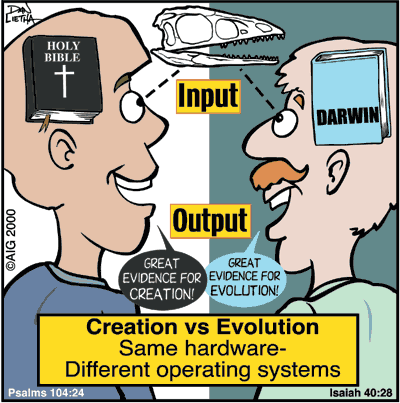

Note that the above image does not have the evolutionary scientist using a “scientific method” lens, but rather a “Darwin” lens. The argument is that at some point scientist decided that Darwin’s theory of evolution was true, and from that point on they’ve been working to fit the evidence to that theory, rather than looking at the evidence without preconceived ideas. And this is at the core of creationist thought—the idea that evolutionary scientists approach evidence with their conclusion already in mind, and that this, and not the evidence itself, is why evolution is so dominant in scientific fields.
Now obviously, I am not a creationist. I used to be. In some sense, the thing that changed my mind was the sheer preponderance of evidence that had to be explained away. Everywhere I looked, it felt like creationists were playing cleanup. The theory of evolution aligns neatly with every scientific field, and I came to feel that, on some level, creationists were simply running around saying “yes, but” over and over and over again. It began to feel like a contrary theory that might be fun to begin with, but in practice has to explain away too much to truly hold water. (Of course, the creationist might say the same thing about evolution, which may help explain why it took six months of research before I even considered changing my mind.)
Are there times when creationists are withholding evidence? Sure, and when that occurs (such as Answers in Genesis’ failure to mention that Dr. Brand’s interpretation has been criticized) we can put it out. But arguing across the board that creationists are withholding information when they would not only dispute that but also argue (convincingly, to many) that they are doing the opposite is not going to be effective. After all, creationists contend that school children should be presented with more information (i.e. information about creationism alongside information about evolution). We need to find more effective ways to communicate both our position and the problems with creationism.
Previous Post

August 3, 2015
Michael Farris Doesn't Read the Bible (Apparently)
Next Post
August 5, 2015 Maintaining a Relationship with Difficult Parents
Browse Our Archives
Select a Category Atheism Evangelicalism/Fundamentalism Family Feminism Homeschool Meta Parenting Patriarchy Politics Purity Quiverfull Social Justice Uncategorized Worthwhile reads
Select a Month February 2021 January 2021 December 2020 November 2020 October 2020 September 2020 August 2020 July 2020 June 2020 May 2020 April 2020 March 2020 February 2020 January 2020 December 2019 November 2019 October 2019 September 2019 August 2019 July 2019 June 2019 May 2019 April 2019 March 2019 February 2019 January 2019 December 2018 November 2018 October 2018 September 2018 August 2018 July 2018 June 2018 May 2018 April 2018 March 2018 February 2018 January 2018 December 2017 November 2017 October 2017 September 2017 August 2017 July 2017 June 2017 May 2017 April 2017 March 2017 February 2017 January 2017 December 2016 November 2016 October 2016 September 2016 August 2016 July 2016 June 2016 May 2016 April 2016 March 2016 February 2016 January 2016 December 2015 November 2015 October 2015 September 2015 August 2015 July 2015 June 2015 May 2015 April 2015 March 2015 February 2015 January 2015 December 2014 November 2014 October 2014 September 2014 August 2014 July 2014 June 2014 May 2014 April 2014 March 2014 February 2014 January 2014 December 2013 November 2013 October 2013 September 2013 August 2013 July 2013 June 2013 May 2013 April 2013 March 2013 February 2013 January 2013 December 2012 November 2012 October 2012 September 2012 August 2012 July 2012 June 2012 May 2012 April 2012 March 2012 February 2012 January 2012 December 2011 November 2011 October 2011 September 2011 August 2011 July 2011 June 2011
Follow Us!
TAKE THE
Religious Wisdom Quiz
What physical affliction did Job suffer?
Select your answer to see how you score.
Leprosy Broken bones Blindness Painful boils
Related posts from Love, Joy, Feminism

Maybe Let's Not Read More Puritans


"So Your Problem with Christianity is the Jesus...

No, the "Second Shift" Isn't Feminism's Fault
TRENDING AT PATHEOS Nonreligious

Dethroning Jesus and Enthroning Yourself
Jesus Never Asked to Be Worshipped. He Asked to Be Understood. Christianity...

Why Most Christians are Really Paulians and Jobians
I Don't Care, But It Matters Let's get this out of the...

Essential Tips to Successfully Navigate the Selling Process
Selling a house can feel overwhelming, but it doesn’t have to be....

To Make Remote Work Effective, Think About Others
The COVID-19 pandemic forced many companies to rapidly transition to remote work....

Flexibility Is Key to Solving Problems of Tomorrow
The world of work is undergoing a dramatic transformation. The COVID-19 pandemic...
view all Nonreligious blogs
Ad-Free & Subscriber Log-In Subscription Support
- About Us
- 2026 Calendar
- Videos
- Podcasts
- Library of World Religions
- Faith In Media Tracker
- Advertise With Us
- Write for Us
- Privacy Policy
- Terms of Service
- Do Not Sell My Data
- Contact Us
- Radiant Digital
- Manage Newsletter Subscriptions
- Unsubscribe From Notifications
- Sitemap
Copyright 2008-2026, Patheos. All rights reserved.
Subscription Support Ad-Free & Subscriber Log-In
Follow Patheos