
BuddhistCatholicContemplativeEvangelicalGeneral ChristianHinduJewishLatter-day SaintMuslimNew VisionsProgressive Christian
Beliefs
- Buddhist
- Catholic
- Contemplative
- Evangelical
- General Christian
- Hindu
- Jewish
- Latter-day Saint
- More Voices
- Muslim
- New Visions
- Pagan
- Progressive Christian
Topics
- Religion News
- Food and Religion
- Sports and Religion
- Religious Art
- Religious Music and Entertainment
- Religious Events
- History and Religion
- Style and Religion
- Politics and Religion
- Women in Religion
- Recreation Outdoors and Religion
- Business Finance and Religion
- Careers Workplace and Religion
- Education and Religion
- Family Parenting and Religion
- Health Fitness and Religion
- Home and Religion
- Relationships and Religion
- Technology and Religion
- Travel and Religion
Columnists
- Buddhist Columnists
- Business Finance and Religion Columnists
- Careers Workplace and Religion Columnists
- Catholic Columnists
- Contemplative Columnists
- Education and Religion Columnists
- Evangelists Columnists
- Family Parenting and Religion Columnists
- General Christian Columnists
- Health Fitness and Religion Columnists
- Hindu Columnists
- History and Religion Columnists
- Home and Religion Columnists
- Jewish Columnists
- More Voices Columnists
- Latter Day Columnists
- Muslim Columnists
- New Visions Columnists
- Nonreligious Columnists
- Pagan Columnists
- Politics and Religion Columnists
- Progressive Columnists
- Recreation Outdoors and Religion Columnists
- Relationships and Religion Columnists
- Religion News Columnists
- Religious Art Columnists
- Religious Events Columnists
- Religious Music and Entertainment Columnists
- Sports and Religion Columnists
- Style and Religion Columnists
- Technology and Religion Columnists
- Travel and Religion Columnists
- Women in Religion Columnists
Resource Library
- 2026 Calendar
- Library of World Religions
- The 100 Most Holy Places on Earth
- Patheos Answers
- Podcasts
- Videos
- Faith Leaders Database
- Anglican Episcopalian
- Bahai
- Baptist
- Buddhism
- Christianity
- Confucianism
- Eastern Orthodoxy
- Hinduism
- Holiness and Pentecostal
- ISKCON
- Islam
- Judaism
- Lutheran
- Methodist
- The Church of Jesus Christ of Latter-day Saints
- New Age
- Paganism
- Presbytarian and Reformed
- Protestantism
- Religion Behind the Scenes
- Roman Catholic
- Scientology
- Shia Islam
- Sikhism
- Sufism
- Sunni Islam
- Taoism
- Zen
- See all religions
Research Tools
 Ad-Free & Subscriber Log-In Subscription Support
Ad-Free & Subscriber Log-In Subscription Support
Follow Patheos 

- Trending:
- Forgiveness
- |
- Marriage
- |
- Consciousness
- |
- Death Penalty
- |
- Election
- |
- Halloween
 Love, Joy, Feminism
-
More
- Home
- Nonreligious
- Let’s Talk about Riots
Let’s Talk about Riots
Last updated on: May 5, 2015 at 10:18 am by Libby Anne
Let’s Talk about Riots 2015-05-05T10:18:39-04:00 Libby Anne
Patheos Explore the world's faith through different perspectives on religion and spirituality! Patheos has the views of the prevalent religions and spiritualities of the world.
The discussion of the Baltimore riots has split America, with conservatives lining up to condemn the riots and liberals lining up to defend them and each side calling the other racist. African Americans, too, are often split along the same lines.
For example, we see this from in the Atlantic:
Now, tonight, I turn on the news and I see politicians calling for young people in Baltimore to remain peaceful and “nonviolent.” These well-intended pleas strike me as the right answer to the wrong question. To understand the question, it’s worth remembering what, specifically, happened to Freddie Gray. An officer made eye contact with Gray. Gray, for unknown reasons, ran. The officer and his colleagues then detained Gray. They found him in possession of a switchblade. They arrested him while he yelled in pain. And then, within an hour, his spine was mostly severed. A week later, he was dead. What specifically was the crime here? What particular threat did Freddie Gray pose? Why is mere eye contact and then running worthy of detention at the hands of the state? Why is Freddie Gray dead?
. . .
When nonviolence is preached as an attempt to evade the repercussions of political brutality, it betrays itself. When nonviolence begins halfway through the war with the aggressor calling time out, it exposes itself as a ruse. When nonviolence is preached by the representatives of the state, while the state doles out heaps of violence to its citizens, it reveals itself to be a con. And none of this can mean that rioting or violence is “correct” or “wise,” any more than a forest fire can be “correct” or “wise.” Wisdom isn’t the point tonight. Disrespect is. In this case, disrespect for the hollow law and failed order that so regularly disrespects the community.
And this from conservative pro-Israel activist Chloe Valdary on the website Praeger University (which hosts five-minute videos on a variety of subjects from a distinctly conservative perspective, and is not in fact a university):
I should note that there are also progressive African American activists who have spoken against the riots on practical terms, arguing that they do more harm than good. And I do think that is where this conversation should take place—within the African American community. I don’t know what it is like to live with police brutality and the effects of racism, and I feel uncomfortable with weighing in about the proper response to these oppressions. So instead of talking about the Baltimore riots, I want to talk about other riots.
In the U.S. today “riots” is often seen as synonymous with “black urban violence.” And I think that’s the problem with Chloe’s argument in the above video—liberals don’t excuse black riots because they’re black, but rather because they see them as outpourings of justified anger from an underprivileged group that is underrepresented and often has few good options. We would feel the same way about riots carried out by white people in the same situation. In other words, it’s not actually about race. And I think to see that we need to look outside of this focus on black urban riots.
I also want to pause here for a moment to note that there are many, many different kinds of riots. Our country has an ugly history of “race riots” in which white mobs chased and beat black individuals, burned black homes, and killed literally hundreds of African Americans. These riots involved those with power using mob violence to control those without power. There are also sports riots, which involve angry or elated fans destroying property and burning things after sports games. And then, of course, there are riots carried out by under privileged groups pushing back against power.
First let’s look at the Stonewall riots. According to the Atlantic:
But what happened at the Stonewall Inn, really? New York papers tend to call it the Stonewall uprising, not the Stonewall riot, because it played out as six days of skirmishes between young gay, lesbian, and transgender individuals and the New York Police Department in the wake of a police raid of the Christopher Street bar in Manhattan’s West Village. The raid came amid a broader police crackdown on gay bars for operating without N. Y. State Liquor Authority licenses, which was something they did only because the SLA refused to grant bars that served gays licenses, forcing them to operate as illegal saloons. Into that void stepped opportunists and Mafia affiliates, who ran the unlicensed establishments and reputedly had deals with the police to stay in business. But on the night of June 27, 1969, a police raid on the Stonewall involving the arrests of 13 people inside the bar met unexpected resistance when a crowd gathered and one of those arrested, a woman, cried out to the assembled bystanders as she was shoved into a paddy wagon, “Why don’t you guys do something!”
The conflict over the next six days played out as a very gay variant of a classic New York street rebellion. It would see: fire hoses turned on people in the street, thrown barricades, gay cheerleaders chanting bawdy variants of New York City schoolgirl songs, Rockette-style kick lines in front of the police, the throwing of a firebomb into the bar, a police officer throwing his gun at the mob, cries of “occupy — take over, take over,” “Fag power,” “Liberate the bar!”, and “We’re the pink panthers!”, smashed windows, uprooted parking meters, thrown pennies, frightened policemen, angry policemen, arrested mafiosi, thrown cobblestones, thrown bottles, the singing of “We Shall Overcome” in high camp fashion, and a drag queen hitting a police officer on the head with her purse.
Stonewall is often (and I think rightly) credited as the origin of the modern gay rights movement. Why? Because people fought back. People with no power said “enough is enough” and found the power inside themselves to resist, and a movement was born. This idea that riots are never useful—that they never accomplish anything—is false. Riots can change history—and for the better.
Next a fictional riot—the one in District 11 during the Hunger Games.
For those of you who have avoided the whole Hunger Games franchise, the quick summary is this: The Capitol kept those in District 11 in dire poverty, forcing them to toil long hours in agriculture with foreign “Peacekeepers” as overseers. Each year two children from each district were selected to compete in the televised annual Hunger Games, in which the children fought to the death. When Rue, a young girl from District 11, died in the arena, Katniss, from District 12, mourned her—in direct violation of the spirit of the games. Those watching from District 11 broke into riots, destroying property and attacking the “Peacekeepers.”
Interestingly, the actress who played Rue retweeted a tweet making a direct comparison between the Baltimore riots and the riots in District 11.
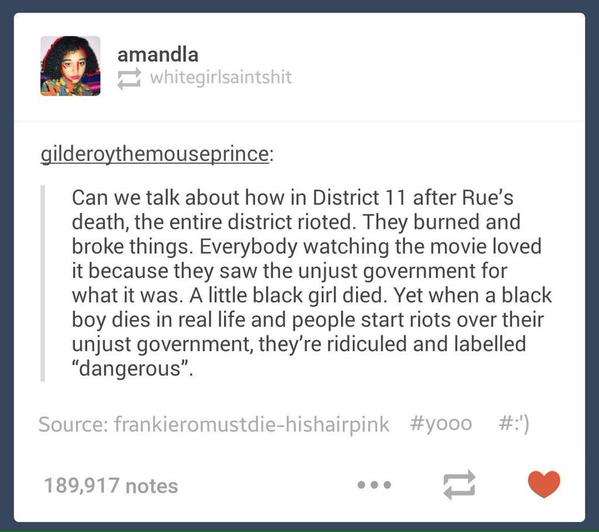
Those watching the movie likely saw the riots in District 11 as justified because they were carried out against the persons and property of an unjust and oppressive governing body. This does raise interesting questions about riots as an introductory act of a larger rebellion, or, in the case of Stonewall, as the opening of a movement. Are riots that spark these things different from other riots? Or perhaps we should ask, what makes them different? Why do they lead to the creation of a movement, or the development of a general uprising, while others don’t?
Now let’s talk about the string of riots that took place in the years immediately preceding the American Revolution. I’m sure you’ve heard the term “tar and feather,” but have you ever thought about what it really meant? During the years before the American Revolution, colonists destroyed the governor’s mansion and the homes of other important officials (this thing we call “looting” and “destruction of property”). And they did things like this:
https://www.youtube.com/watch?v=KdpKEs_dMHc
Here is where things get more dicey. When I watch the video above, I am appalled. To me, destruction of property feels different from violence against people, and a mob of people exercising violence against a lone man feels different from a tense standoff between two groups with similar numbers. But honestly, the Boston Tea Party itself makes me antsy. The colonists destroyed a huge amount of property, but it wasn’t the crown’s property they were destroying. Of course, the property was that of the East India Company, which was indirectly controlled by the crown and was undercutting local merchants—does that affect whether the actions were right or wrong?
I think we sometimes need to draw a line between “justified” and “understandable.” An action can be understandable, but still wrong. I think we also have to realize that things are complicated. I would love for morality to be black and white, but it’s not.
I want to touch on one last riot. In season 5 of Game of Thrones (spoiler alert!), Daenerys Targaryen faces increasing difficulty in ruling the city of Meereen. She has set the slaves of Meereen free from the masters—the city appears to have been divided completely into these two classes—but secretive guerrilla group formed by some among the masters, known as the Sons of Harpy, has begun killing her men.
When one of the Sons of Harpy is captured, Daenerys opts to put him on trial rather than executing him on the spot as is suggested by some among her advisors. But then Mossador, a freed slave, kills the captive in his cell, arguing that this is justified because of what the masters did to him and others like him. “The law is the law,” Daenerys says, and has Mossador tried for murder. When he is found guilty, she has him publicly executed. At this point the freed slaves turn on her, throwing rocks and attacking both her soldiers and the masters.
Were the freed slaves right to riot? Or were they wrong to do so, given that Daenerys is committed to preventing the masters from re-enslaving them? Was Mossador justified in killing a man who was a terrorist working to reinstate slavery, or was Daenerys right in wanting instead to put him on trial?
I thought I was going to come to the end of this piece with some conclusions, but I don’t feel like I have any. Riots are complicated. And honestly, so are uprisings, and rebellions, and so is war. By the end of the Hunger Games trilogy, Katniss, the protagonist, finds herself wondering if it was worth it, given the devastation created in the war her actions sparked, and the thousands upon thousands of lives lost. When is it better to live under some level of oppression, when the alternative is years of uncertain, horrific, and bloody conflict? When is destruction of property justified, and when is it not? When is a riot an act of pent-up anger, and when is it simply opportunistic? Why does a riot lead to change, and other times not? Is there a way to determine ahead of time whether the change a riot causes will be good, or bad?
In the end I really don’t have any answers, just musings.
Previous Post

May 4, 2015
Any Time I Hear Someone Say "Traditional Marriage"
Browse Our Archives
Select a Category Atheism Evangelicalism/Fundamentalism Family Feminism Homeschool Meta Parenting Patriarchy Politics Purity Quiverfull Social Justice Uncategorized Worthwhile reads
Select a Month February 2021 January 2021 December 2020 November 2020 October 2020 September 2020 August 2020 July 2020 June 2020 May 2020 April 2020 March 2020 February 2020 January 2020 December 2019 November 2019 October 2019 September 2019 August 2019 July 2019 June 2019 May 2019 April 2019 March 2019 February 2019 January 2019 December 2018 November 2018 October 2018 September 2018 August 2018 July 2018 June 2018 May 2018 April 2018 March 2018 February 2018 January 2018 December 2017 November 2017 October 2017 September 2017 August 2017 July 2017 June 2017 May 2017 April 2017 March 2017 February 2017 January 2017 December 2016 November 2016 October 2016 September 2016 August 2016 July 2016 June 2016 May 2016 April 2016 March 2016 February 2016 January 2016 December 2015 November 2015 October 2015 September 2015 August 2015 July 2015 June 2015 May 2015 April 2015 March 2015 February 2015 January 2015 December 2014 November 2014 October 2014 September 2014 August 2014 July 2014 June 2014 May 2014 April 2014 March 2014 February 2014 January 2014 December 2013 November 2013 October 2013 September 2013 August 2013 July 2013 June 2013 May 2013 April 2013 March 2013 February 2013 January 2013 December 2012 November 2012 October 2012 September 2012 August 2012 July 2012 June 2012 May 2012 April 2012 March 2012 February 2012 January 2012 December 2011 November 2011 October 2011 September 2011 August 2011 July 2011 June 2011
Follow Us!
TAKE THE
Religious Wisdom Quiz
What is the Pope's title as the head of the Catholic Church?
Select your answer to see how you score.
High Priest Supreme Pastor Father of the Church Bishop of Rome
Related posts from Love, Joy, Feminism

"Liberal" and "Conservative" Have Actual Meanings

It's not about the economy, it's about being...


Impeachment Could Have Been a Gift to Republicans
TRENDING AT PATHEOS Nonreligious

Dethroning Jesus and Enthroning Yourself
Jesus Never Asked to Be Worshipped. He Asked to Be Understood. Christianity...

Why Most Christians are Really Paulians and Jobians
I Don't Care, But It Matters Let's get this out of the...

Essential Tips to Successfully Navigate the Selling Process
Selling a house can feel overwhelming, but it doesn’t have to be....

To Make Remote Work Effective, Think About Others
The COVID-19 pandemic forced many companies to rapidly transition to remote work....

Flexibility Is Key to Solving Problems of Tomorrow
The world of work is undergoing a dramatic transformation. The COVID-19 pandemic...
view all Nonreligious blogs
Ad-Free & Subscriber Log-In Subscription Support
- About Us
- 2026 Calendar
- Videos
- Podcasts
- Library of World Religions
- Faith In Media Tracker
- Advertise With Us
- Write for Us
- Privacy Policy
- Terms of Service
- Do Not Sell My Data
- Contact Us
- Radiant Digital
- Manage Newsletter Subscriptions
- Unsubscribe From Notifications
- Sitemap
Copyright 2008-2026, Patheos. All rights reserved.
Subscription Support Ad-Free & Subscriber Log-In
Follow Patheos