
BuddhistCatholicContemplativeEvangelicalGeneral ChristianHinduJewishLatter-day SaintMuslimNew VisionsProgressive Christian
Beliefs
- Buddhist
- Catholic
- Contemplative
- Evangelical
- General Christian
- Hindu
- Jewish
- Latter-day Saint
- More Voices
- Muslim
- New Visions
- Pagan
- Progressive Christian
Topics
- Religion News
- Food and Religion
- Sports and Religion
- Religious Art
- Religious Music and Entertainment
- Religious Events
- History and Religion
- Style and Religion
- Politics and Religion
- Women in Religion
- Recreation Outdoors and Religion
- Business Finance and Religion
- Careers Workplace and Religion
- Education and Religion
- Family Parenting and Religion
- Health Fitness and Religion
- Home and Religion
- Relationships and Religion
- Technology and Religion
- Travel and Religion
Columnists
- Buddhist Columnists
- Business Finance and Religion Columnists
- Careers Workplace and Religion Columnists
- Catholic Columnists
- Contemplative Columnists
- Education and Religion Columnists
- Evangelists Columnists
- Family Parenting and Religion Columnists
- General Christian Columnists
- Health Fitness and Religion Columnists
- Hindu Columnists
- History and Religion Columnists
- Home and Religion Columnists
- Jewish Columnists
- More Voices Columnists
- Latter Day Columnists
- Muslim Columnists
- New Visions Columnists
- Nonreligious Columnists
- Pagan Columnists
- Politics and Religion Columnists
- Progressive Columnists
- Recreation Outdoors and Religion Columnists
- Relationships and Religion Columnists
- Religion News Columnists
- Religious Art Columnists
- Religious Events Columnists
- Religious Music and Entertainment Columnists
- Sports and Religion Columnists
- Style and Religion Columnists
- Technology and Religion Columnists
- Travel and Religion Columnists
- Women in Religion Columnists
Resource Library
- 2026 Calendar
- Library of World Religions
- The 100 Most Holy Places on Earth
- Patheos Answers
- Podcasts
- Videos
- Faith Leaders Database
- Anglican Episcopalian
- Bahai
- Baptist
- Buddhism
- Christianity
- Confucianism
- Eastern Orthodoxy
- Hinduism
- Holiness and Pentecostal
- ISKCON
- Islam
- Judaism
- Lutheran
- Methodist
- The Church of Jesus Christ of Latter-day Saints
- New Age
- Paganism
- Presbytarian and Reformed
- Protestantism
- Religion Behind the Scenes
- Roman Catholic
- Scientology
- Shia Islam
- Sikhism
- Sufism
- Sunni Islam
- Taoism
- Zen
- See all religions
Research Tools
 Ad-Free & Subscriber Log-In Subscription Support
Ad-Free & Subscriber Log-In Subscription Support
Follow Patheos 

- Trending:
- Forgiveness
- |
- Marriage
- |
- Consciousness
- |
- Death Penalty
- |
- Election
- |
- Halloween
 Love, Joy, Feminism
-
More
- Home
- Nonreligious
- Why Does Lily Work Two Jobs while Carl is Unemployed?
Why Does Lily Work Two Jobs while Carl is Unemployed?
Last updated on: February 28, 2015 at 8:17 am by Libby Anne
Why Does Lily Work Two Jobs while Carl is Unemployed? 2015-02-28T08:17:17-04:00 Libby Anne
Patheos Explore the world's faith through different perspectives on religion and spirituality! Patheos has the views of the prevalent religions and spiritualities of the world.
I recently read a 2014 article titled For white working-class women, it makes sense to stay single mothers. I found the article fascinating. The authors, both law professors, focus on the story of Lily, a working-class woman who became pregnant and subsequently broke up with her boyfriend, Carl. As they explain, Lily was employed while Carl was not, and Lily found Carl a drain on her finances—a liability she could not afford while raising a child. As she puts it:
“I can support myself. I always have. I can support myself and our kid. I just can’t support myself, the kid, and him.”
Unfortunately, the authors state that Carl’s economic options have shrunk while Lily’s have increased with barely a nod to the fact that Carl’s options are still greater than Lily’s. Because of this, I could see someone reading the piece and coming away with the mistaken impression that feminism has turned things upside down, that working-class women have surpassed men and working-class men are being shortchanged. Here is an example of this confusion in the article itself:
In our view what would make the most difference to this unfair marriage market are policies that would increase the number and quality of jobs available to working class men, retraining and unemployment benefits that fill in the gaps between jobs, and ongoing support for women’s autonomy. Since the ’80s, the gender gap in wages has increased at the top but shrunk in the middle.
The authors state that the wage gap has only shrunk, not disappeared, and yet they call for increasing the jobs available to working-class men specifically, rather than for increasing the jobs available to working class individuals of all genders. The implication of this call—or at least, the implication that many readers will take away from it—is that working class women now have more opportunities than working class men, but this is neither what the rest of the article suggests nor the reality.
The authors don’t mention Lily having any college education, so I think we can assume that she doesn’t. The article opens by mentioning that Lily works two jobs, but it doesn’t mention the nature of those jobs. Given Lily’s lack of college education and her need to work two jobs, I think we can assume that these are services jobs—in other words, that Lily is waiting tables at Applebees or stocking shelves at Walmart. This leaves me with a question. Why doesn’t unemployed Carl apply for a similar job?
Applebees and Walmart do not, to my knowledge, discriminate against male applicants. Indeed, male employees at Walmart have greater chances for advancement than female employees, given that they are disproportionately chosen for management positions. In other words, service sector jobs actually offer Carl more chance for advancement than they offer Lily. And yet Lily is working two of them while Carl is unemployed.
The authors explain Lily’s decision to break up with Carl as follows:
The economy has changed. A higher percentage of men today than 50 years ago have trouble finding steady employment, securing raises and promotions, or remaining sober and productive. Blue-collar men like Carl have lost ground while more highly educated men have gained. The unemployment rate for all men ages 20–24 is almost 13 percent, and those with only a high school education are more than twice as likely to be unemployed as those with a college degree. Moreover, many of the jobs that are available have become less reliable than they were for Carl’s dad. They don’t pay as well, last as long, or offer promotions or training. Carl has quit more than one job because he got fed up with his boss. More recently, he was laid off because construction work dried up during a particularly cold spell during the winter. After the layoff, he hung around with his friends, drinking and playing video games. Lily finally had enough when she found out that Carl had run up several hundred dollars in expenses on her credit card. Lily knows she will never be able to depend on him and, particularly now that she has a child, she doesn’t believe she can afford the risk.
For whatever reason, the authors feel the need to mention that the unemployment rate for men ages 20-24 was nearly 13% but not that the unemployment rate for women in that same age group was only two percentage points lower—nearly 11%—both far higher than the national average of 6.6%. So yes, women ages 20-24 have an easier time finding a job than men ages 20-24, but only very slightly. Further, this gap closes completely by age 25.
The authors mention that Carl has quit several jobs because he was “fed up” with his boss and that Carl had a construction job until he was laid off during the slow season. Could Lily have gotten Carl’s former construction job? I doubt she would have thought herself qualified to apply for it, but even if she had, she likely would not have been hired due to her gender. And yet, construction jobs generally pay significantly more than service sector jobs. In other words, Carl may have fewer economic opportunities than his father—I don’t deny that!—but he still has more economic opportunities than Lily.
Take a look at this graph based on 2009 data in Mississippi:
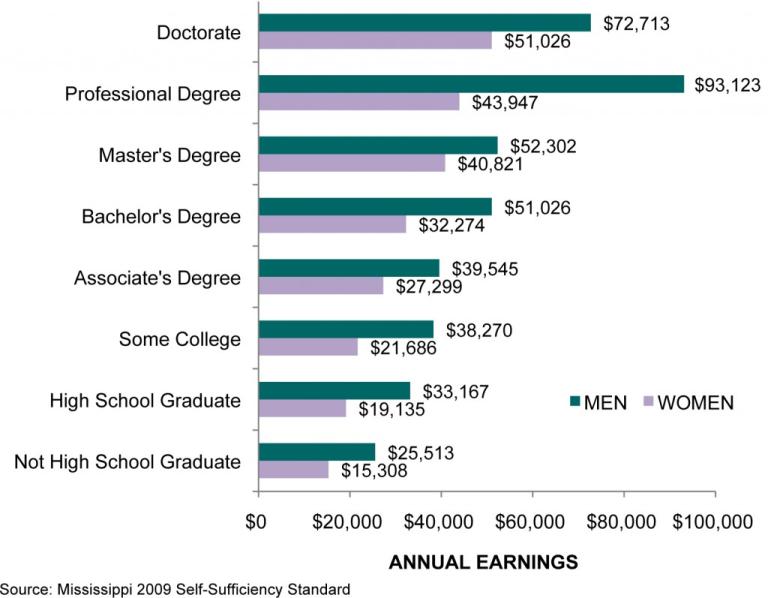
And this one, which uses national-level data:

(click on either image for the source)
In other words, while working-class men’s opportunities have decreased even as working-class women’s opportunities have increased, working-class men still have more opportunities than their female counterparts. Think of Carl and Lily. Lily appears to be holding down two service sector jobs with low wages and few chances for advancement. Carl, for his part, appears to be choosing not to apply for or keep similar jobs, preferring to work better jobs like construction when they are available. It is not that Lily has more economic opportunities than Carl, but rather that Lily is willing to work jobs that Carl appears to consider not worth his time.
As the stable, solid jobs previously available to working-class men become more rare, more working-class men are finding that the less stable, less well paying jobs traditionally held by working-class women are the only options available to them. While women like Lily are willing to work these jobs (and may not have expected more), some men, like Carl, may see these jobs as beneath them. In a very real sense, this is about a loss of privilege. Working-class men have traditionally had both more and better job opportunities than working-class women, and when these dry up and they find themselves faced with the same options as women they feel that they have been cheated out of what should be their right.
Should we care about the fact that job opportunities for working class men have declined? Absolutely. But we should also care about the fact that job opportunities for working-class women have always been slim. Neither Carl nor Lily should have to work two jobs to make ends meet, and yet it is Lily who is doing just that in an article that calls for expanding economic opportunities for men. There seems to be some irony going on here.
Previous Post

February 27, 2015
Anonymous Tip: Meet the Lawyer
Next Post
March 1, 2015 When We Expect More of Our Children than of Ourselves
Browse Our Archives
Select a Category Atheism Evangelicalism/Fundamentalism Family Feminism Homeschool Meta Parenting Patriarchy Politics Purity Quiverfull Social Justice Uncategorized Worthwhile reads
Select a Month February 2021 January 2021 December 2020 November 2020 October 2020 September 2020 August 2020 July 2020 June 2020 May 2020 April 2020 March 2020 February 2020 January 2020 December 2019 November 2019 October 2019 September 2019 August 2019 July 2019 June 2019 May 2019 April 2019 March 2019 February 2019 January 2019 December 2018 November 2018 October 2018 September 2018 August 2018 July 2018 June 2018 May 2018 April 2018 March 2018 February 2018 January 2018 December 2017 November 2017 October 2017 September 2017 August 2017 July 2017 June 2017 May 2017 April 2017 March 2017 February 2017 January 2017 December 2016 November 2016 October 2016 September 2016 August 2016 July 2016 June 2016 May 2016 April 2016 March 2016 February 2016 January 2016 December 2015 November 2015 October 2015 September 2015 August 2015 July 2015 June 2015 May 2015 April 2015 March 2015 February 2015 January 2015 December 2014 November 2014 October 2014 September 2014 August 2014 July 2014 June 2014 May 2014 April 2014 March 2014 February 2014 January 2014 December 2013 November 2013 October 2013 September 2013 August 2013 July 2013 June 2013 May 2013 April 2013 March 2013 February 2013 January 2013 December 2012 November 2012 October 2012 September 2012 August 2012 July 2012 June 2012 May 2012 April 2012 March 2012 February 2012 January 2012 December 2011 November 2011 October 2011 September 2011 August 2011 July 2011 June 2011
Follow Us!
TAKE THE
Religious Wisdom Quiz
Who was the first high priest of Israel?
Select your answer to see how you score.
Joshua Levi Moses Aaron
Related posts from Love, Joy, Feminism



No, the "Second Shift" Isn't Feminism's Fault

We need a lot more therapists in this...
TRENDING AT PATHEOS Nonreligious

Dethroning Jesus and Enthroning Yourself
Jesus Never Asked to Be Worshipped. He Asked to Be Understood. Christianity...

Why Most Christians are Really Paulians and Jobians
I Don't Care, But It Matters Let's get this out of the...

Essential Tips to Successfully Navigate the Selling Process
Selling a house can feel overwhelming, but it doesn’t have to be....

To Make Remote Work Effective, Think About Others
The COVID-19 pandemic forced many companies to rapidly transition to remote work....

Flexibility Is Key to Solving Problems of Tomorrow
The world of work is undergoing a dramatic transformation. The COVID-19 pandemic...
view all Nonreligious blogs
Ad-Free & Subscriber Log-In Subscription Support
- About Us
- 2026 Calendar
- Videos
- Podcasts
- Library of World Religions
- Faith In Media Tracker
- Advertise With Us
- Write for Us
- Privacy Policy
- Terms of Service
- Do Not Sell My Data
- Contact Us
- Radiant Digital
- Manage Newsletter Subscriptions
- Unsubscribe From Notifications
- Sitemap
Copyright 2008-2026, Patheos. All rights reserved.
Subscription Support Ad-Free & Subscriber Log-In
Follow Patheos