
BuddhistCatholicContemplativeEvangelicalGeneral ChristianHinduJewishLatter-day SaintMuslimNew VisionsProgressive Christian
Beliefs
- Buddhist
- Catholic
- Contemplative
- Evangelical
- General Christian
- Hindu
- Jewish
- Latter-day Saint
- More Voices
- Muslim
- New Visions
- Pagan
- Progressive Christian
Topics
- Religion News
- Food and Religion
- Sports and Religion
- Religious Art
- Religious Music and Entertainment
- Religious Events
- History and Religion
- Style and Religion
- Politics and Religion
- Women in Religion
- Recreation Outdoors and Religion
- Business Finance and Religion
- Careers Workplace and Religion
- Education and Religion
- Family Parenting and Religion
- Health Fitness and Religion
- Home and Religion
- Relationships and Religion
- Technology and Religion
- Travel and Religion
Columnists
- Buddhist Columnists
- Business Finance and Religion Columnists
- Careers Workplace and Religion Columnists
- Catholic Columnists
- Contemplative Columnists
- Education and Religion Columnists
- Evangelists Columnists
- Family Parenting and Religion Columnists
- General Christian Columnists
- Health Fitness and Religion Columnists
- Hindu Columnists
- History and Religion Columnists
- Home and Religion Columnists
- Jewish Columnists
- More Voices Columnists
- Latter Day Columnists
- Muslim Columnists
- New Visions Columnists
- Nonreligious Columnists
- Pagan Columnists
- Politics and Religion Columnists
- Progressive Columnists
- Recreation Outdoors and Religion Columnists
- Relationships and Religion Columnists
- Religion News Columnists
- Religious Art Columnists
- Religious Events Columnists
- Religious Music and Entertainment Columnists
- Sports and Religion Columnists
- Style and Religion Columnists
- Technology and Religion Columnists
- Travel and Religion Columnists
- Women in Religion Columnists
Resource Library
- 2026 Calendar
- Library of World Religions
- The 100 Most Holy Places on Earth
- Patheos Answers
- Podcasts
- Videos
- Faith Leaders Database
- Anglican Episcopalian
- Bahai
- Baptist
- Buddhism
- Christianity
- Confucianism
- Eastern Orthodoxy
- Hinduism
- Holiness and Pentecostal
- ISKCON
- Islam
- Judaism
- Lutheran
- Methodist
- The Church of Jesus Christ of Latter-day Saints
- New Age
- Paganism
- Presbytarian and Reformed
- Protestantism
- Religion Behind the Scenes
- Roman Catholic
- Scientology
- Shia Islam
- Sikhism
- Sufism
- Sunni Islam
- Taoism
- Zen
- See all religions
Research Tools
 Ad-Free & Subscriber Log-In Subscription Support
Ad-Free & Subscriber Log-In Subscription Support
Follow Patheos 

- Trending:
- Forgiveness
- |
- Marriage
- |
- Consciousness
- |
- Death Penalty
- |
- Election
- |
- Halloween
 Love, Joy, Feminism
-
More
- Home
- Nonreligious
- On Being a Prodigal
On Being a Prodigal
Last updated on: February 17, 2015 at 12:56 pm by Libby Anne
On Being a Prodigal 2015-02-17T12:56:29-04:00 Libby Anne
Patheos Explore the world's faith through different perspectives on religion and spirituality! Patheos has the views of the prevalent religions and spiritualities of the world.
Many of you have been following Alecia Faith Pennington’s situation. You can read my other posts on her story here, but in sum, Alecia Faith released a youtube video explaining that she does not have a birth certificate and cannot prove her identity, and stating that her parents had refused to help her. Alecia Faith’s mother, Lisa Pennington, a popular homeschooling blogger and speaker, responded by claiming that she and her husband have offered to help Alecia Faith. However, a perusal of Lisa’s blog rather confirms Alecia Faith’s story byrevealing her to be a controlling mother who kept even her adult children on a tight leash.
Today I want to talk about some comments on Lisa Pennington’s Facebook page, comments from homeschooling moms comforting Lisa in her “time of trouble” and praying that Alecia Faith’s heart will be “softened” and that she will turn to the embrace of her loving parents. I’ve seen this sort of thing before. Here’s a sampling:
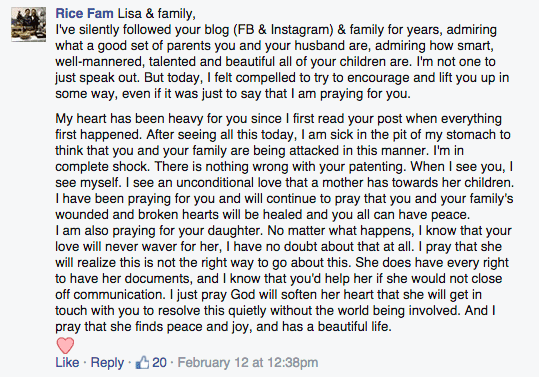
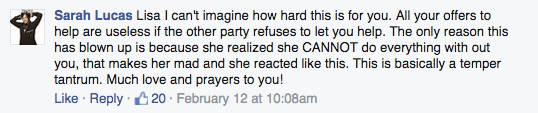
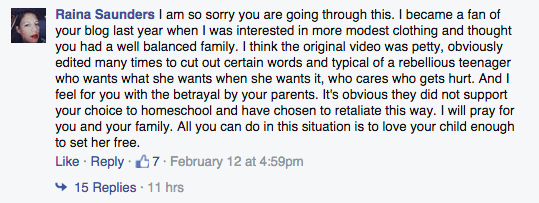
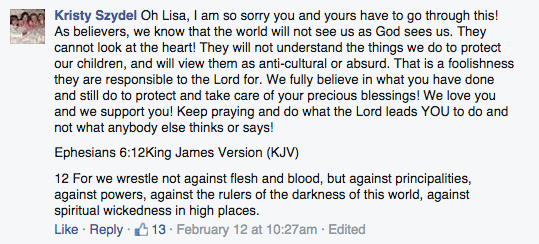
How familiar this all feels.
The idea of the prodigal is a strong trope in evangelical and fundamentalist culture. The problem is, first of all, that that any child who steps out of line is by default portrayed as a prodigal. And second, the problem is that because the story of the prodigal son ends with the son coming home in rags and begging forgiveness, that is the expectation here as well—that our actions are temporary and that in the end we’ll come back all apologetic.
I totally get that young adults sometimes make unwise decisions, and that sometimes they even make extremely bad decisions, such as becoming involved with meth or cocaine or getting in trouble with the law. I get that, and I can only imagine how difficult it would be, as a parent, to see your child head in that direction. But that’s not what we’re talking about here.
In evangelical and fundamentalist culture, any child who does not tow the party line risks being labeled rebellious and, ultimately, becoming a prodigal. And I should note that their prodigal status is rarely self-inflicted. Rather, adult children who choose different beliefs or make different lifestyle choices are treated as outsiders—as rebellious children, even. Emotional manipulation is applied in an attempt to bring them back to the fold. Is it any wonder many of these young adults choose distance as a result, sometimes cutting off contact entirely? It’s incredibly uncomfortable to be treated as an outsider and a problem by your own family, to say the least.
Then the parents’ church community and friends inevitably rally around them, offering comfort and support and offering to pray for God to change the prodigal’s heart. The focus is on how hard this must be for the parents, and the prodigals themselves are rarely actually asked for their side of what happened. Everything becomes about the parents, and how horribly difficult this situation is for them. No one considers that this situation might be difficult for the prodigal.
I was that child—that prodigal. I am that child—that prodigal.
When I chose some beliefs of my own, apart from my parents, I shifted from golden daughter to problem child. When I rejected my parents’ authority over me by refusing to break up with my boyfriend, things got worse. Need I note that I was twenty years old at the time? And my boyfriend? Why did they want me to break up with him? Was he a criminal, or an addict, or abusive toward me? Nope. His crime was not sharing all of my parents’ religious beliefs. He is now my supportive husband and life partner, dedicated father of my two children and hardworking co-provider for our family. Thinking you have the right to decide who your adult child can or can’t date rarely ends well—for you, that is.
My parents almost boycotted my wedding. They came, in the end, and sat in the back. My younger siblings were not allowed to participate in the ceremony as I had hoped. That’s not surprising, perhaps, because at that time whether I would be allowed to visit home and see my siblings in question. After the ceremony, my mom told me she and my dad had decided Sean and I would be allowed to visit. She said it like she was making a concession.
Leaving hurt. It was the hardest thing I’ve ever done. I was forced to choose between my family and my freedom, and given that choice I chose to run. It hurt to know that my parents were talking to my friends’ parents about me, twisting what had happened beyond recognition and portraying me as rebellious and wayward. It hurt to have to leave my siblings, my friends, my church community, everything. It was hard—very hard—to be suddenly alone in arranging things like housing or employment, with no parents or mentors to go to for advice. But my pain was invisible, swallowed up in the pain of my parents.
My parents are the ones who set out with a very specific end goal in mind when approaching childrearing—i.e., that the children turn out to share their beliefs and lifestyle choices. I didn’t chose that. They did. But children are wild cards, and don’t always conform to parental expectations—especially when those expectations are rigid or constrictive. In communities like mine—and Alecia Faith’s—children who don’t conform are too often cast aside, and a prodigal is born.

Next Post

February 18, 2015 Fifty Shades of Evangelical Justifications for Patriarchy
Browse Our Archives
Select a Category Atheism Evangelicalism/Fundamentalism Family Feminism Homeschool Meta Parenting Patriarchy Politics Purity Quiverfull Social Justice Uncategorized Worthwhile reads
Select a Month February 2021 January 2021 December 2020 November 2020 October 2020 September 2020 August 2020 July 2020 June 2020 May 2020 April 2020 March 2020 February 2020 January 2020 December 2019 November 2019 October 2019 September 2019 August 2019 July 2019 June 2019 May 2019 April 2019 March 2019 February 2019 January 2019 December 2018 November 2018 October 2018 September 2018 August 2018 July 2018 June 2018 May 2018 April 2018 March 2018 February 2018 January 2018 December 2017 November 2017 October 2017 September 2017 August 2017 July 2017 June 2017 May 2017 April 2017 March 2017 February 2017 January 2017 December 2016 November 2016 October 2016 September 2016 August 2016 July 2016 June 2016 May 2016 April 2016 March 2016 February 2016 January 2016 December 2015 November 2015 October 2015 September 2015 August 2015 July 2015 June 2015 May 2015 April 2015 March 2015 February 2015 January 2015 December 2014 November 2014 October 2014 September 2014 August 2014 July 2014 June 2014 May 2014 April 2014 March 2014 February 2014 January 2014 December 2013 November 2013 October 2013 September 2013 August 2013 July 2013 June 2013 May 2013 April 2013 March 2013 February 2013 January 2013 December 2012 November 2012 October 2012 September 2012 August 2012 July 2012 June 2012 May 2012 April 2012 March 2012 February 2012 January 2012 December 2011 November 2011 October 2011 September 2011 August 2011 July 2011 June 2011
Follow Us!
TAKE THE
Religious Wisdom Quiz
True or False: Daniel interpreted King Nebuchadnezzar's dream about a statue made of different metals.
Select your answer to see how you score.
TRUE FALSE
Related posts from Love, Joy, Feminism

Maybe Let's Not Read More Puritans


"So Your Problem with Christianity is the Jesus...

No, the "Second Shift" Isn't Feminism's Fault
TRENDING AT PATHEOS Nonreligious

Dethroning Jesus and Enthroning Yourself
Jesus Never Asked to Be Worshipped. He Asked to Be Understood. Christianity...

Why Most Christians are Really Paulians and Jobians
I Don't Care, But It Matters Let's get this out of the...

Essential Tips to Successfully Navigate the Selling Process
Selling a house can feel overwhelming, but it doesn’t have to be....

To Make Remote Work Effective, Think About Others
The COVID-19 pandemic forced many companies to rapidly transition to remote work....

Flexibility Is Key to Solving Problems of Tomorrow
The world of work is undergoing a dramatic transformation. The COVID-19 pandemic...
view all Nonreligious blogs
Ad-Free & Subscriber Log-In Subscription Support
- About Us
- 2026 Calendar
- Videos
- Podcasts
- Library of World Religions
- Faith In Media Tracker
- Advertise With Us
- Write for Us
- Privacy Policy
- Terms of Service
- Do Not Sell My Data
- Contact Us
- Radiant Digital
- Manage Newsletter Subscriptions
- Unsubscribe From Notifications
- Sitemap
Copyright 2008-2026, Patheos. All rights reserved.
Subscription Support Ad-Free & Subscriber Log-In
Follow Patheos